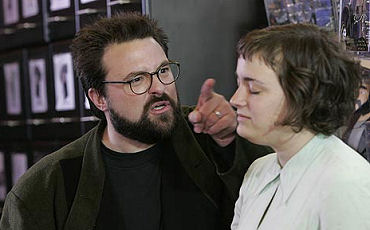
Smith teaches at mtvU

“There’s something cool about being around the vitality of youth. People who haven’t sold out yet, who still have that gleam in their eye that hasn’t been snuffed out by the studios.” — Kevin Smith talking to L.A. Times writer Dawn C. Chmielewski about a weekly mtvU show, “Sucks Less, With Kevin Smith.”

The basic idea is Smith teaching a UCLA School of Theatre, Film and Television class that produces mtvU. The TV channel is aimed at college students and serves some 750 schools. It mainly features short-form video by college students as well as music videos by up-and-coming artists.
There’s no “i” between the “h” and the “m” in Chmielewski’s Polish-sounding name. She should hook up and compare notes with USA Today‘s Susan Wloszczyna, who still takes the prize for having the least pronouncable, most unspellable name in the ranks of entertainment journalists. Chmielewski runs a close second, though. I’m sitting here trying to pronounce it right now.

Luhrman’s cattle drive

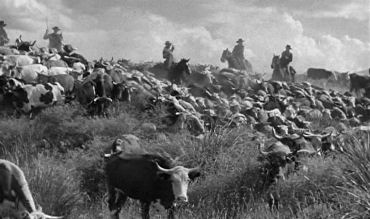
Somehow I never quite understood that Baz Luhrman‘s trouble-plagued, endlessly-prepping Australia, which will finally roll film in March with Nicole Kidman and Hugh Jackman in the leads, will basically be a down-under Red River. In telling his story of a risky Australian cattle drive occuring in mid to late 1941, Luhrman is looking at a very difficult and strenuous shooting schedule, partly because he intends to shoot au natural, or at least without the obvious augmentation of computer graphics.

Luhrman said several months ago that he intends to shoot Australia in the manner of Lawrence of Arabia, without any blatant CG crap. Quality-level filmmmakers are saying this all over — CG that looks like CG is horseshit. It’s funny, but reading a description of Luhrman’s project reminded me of Roadshow, a Martin Ritt project about a contemporary cattle drive that would have starred Jack Nicholson and Tim Hutton. (It fell apart in pre-pre-production about 25 years ago.)
Australia will be Luhrman’s “first time back in the director’s chair since 2001’s Moulin Rouge,” says an Empire report, “and willl focus on an English aristocratic land-owner (Kidman) who, in an attempt to avoid money-grabbing cattle barons, embarks on a harzardous cross-country trip with a rough and ready cattle driver (Jackman). The pair then encounter the Japanese bombing of Darwin, which occured a few days after the attack on Pearl Harbor.”

Meyers is busted

Nancy Meyers, the director-writer of The Holiday (Columbia, 12.8), has been totally busted for putting in that Cary Grant-came-from-Surrey line in her film, which I briefly questioned in an item a couple of days ago. I’d always read that Grant was born and raised in Bristol, England, and that he never once lived in Surrey. Since Meyers and a Columbia publicity rep both declined to return calls about this matter on Wednesday, I openly asked if anyone could provide clues to the Grant-Surrey conundrum. This morning a Cary Grant historian named Nancy Nelson, author of “Evenings with Cary Grant,” wrote in with the following:
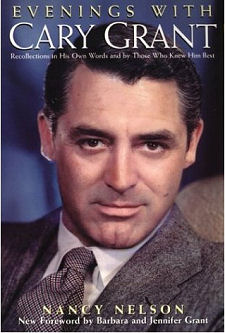
“You are absolutely right about Cary Grant and Bristol,” Nancy began. “I haven’t seen The Holiday, but from what you say, it’s a silly mistake. Grant’s origins are fairly well known. My book, ‘Evenings with Cary Grant‘, describes in detail his origins, including the interior of the house in which he lived. Starting at age 14, he traveled with a vaudeville outfit (The Pender Troupe) throughout the English provinces. I suppose it’s possible that they stayed in a house in Surrey, but I’m afraid there is absolutely no documentation. (I was the first writer to go through his private papers. I did not miss a thing, believe me.) Even so, a tour stop in Surrey does not warrant ‘Cary Grant came from Surrey.’
“Young Archie Leach traveled with the Pender Troupe to New York at the age of 16. When the Troupe returned to England, he stayed in the United States and made his own way. While he made many subsequent trips to England, he did not take up residence there.
“Responding to one of your emailers: Yes, Cary Grant’s accent is Bristol, cockney from the provinces, and what he called ‘American English,’ which he said he picked up at New York’s Polo grounds. (He was a lifelong baseball fan.) If you put it all together, that’s how you get the Cary Grant accent. Nobody sounds like him.
“Addressing the comment of one of your other responders, I’d like to say that when I give my talks about Cary Grant (‘The Cary Grant Few People Knew’), my SRO audiences are mixed, men and women. And the women represent three generations. Young women today know Cary Grant’s work and have seen his films, and they all want to know how they can meet a man just like him! Which reminds me of the Wall Street Journal reporter who once interviewed Cary when we were in San Francisco (I represented him for his one-man show ‘A Conversation with Cary Grant’), and this young reporter later wrote that Grant was the only male who could inspire lust in every red-blooded American girl …and her mother…and her grandmother.” And she did not say this about him when he was in the prime of his career. He was 80 and she was 24.
“Cary Grant died in Davenport, Iowa, just 20 years ago. November 29 (i.e., next Wednesday) is the anniversary of his death. His presence will always be with us through his films. My book is completely in his words and those of his friends and colleagues. Without conjecture or speculation and with full attribution, it is the most accurate book about him. It is often used as a reference.
“P. S. I will be speaking about Cary Grant at the National Arts Club in New York City on Tuesday, 12.19.06, and at The Metropolitan Museum of Art in New York City on Friday, 6.15.07.”

Marlon to Charlie

“I’m feeling like a very large turd on a very thin stick. I’m holed up in bed and taking everything from sled-dog urine to powdered East Indian vulva — maybe won’t work tomorrow if I feel the same. I really feel bad for not showing up at your birthday bash but I really feel shitty and best stay in bed. I don’t have much of a selection. I’m sure it will be a kick in the ass and I hate to miss it — Happiest of birthdays to you, Charlie.” — text of a handwritten letter written by Marlon Brando to Charlie Sheen, which is being auctoned by Leland’s. The bidding has started at a grand.

“Bobby” is dead

The big Thanksgiving Day box-office news…well, not exactly “big news” but it’s certainly unwelcome as far as the Weinstein Co. is concerned. Emilio Estevez‘s Bobby took in a mere $1,104,000 yesterday in 1667 situations, which translates into rough $662 per screen. Too bad, but the film sadly followed the fate of Sen. Robert F. Kennedy at the Ambassador Hotel on 6.4.88 — initial cheers and hoopla at Toronto and the AFI Film Festivals and friendly encounters with friendly press, and then it left the podium and made its way through a mixed crowd of average Joes…blam. The dream is over.

Phillipe Noiret, R.I.P,

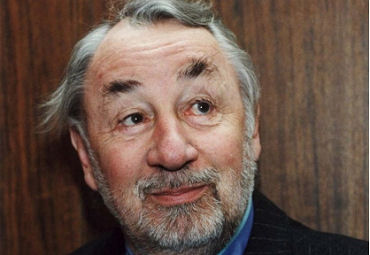
The great Phillipe Noiret, the portly, droopy- faced French character actor whose three greatest performances were in Giuseppe Tornatore‘s Cinema Paradiso and Bertrand Tavernier‘s Coup de Tourchon and Life and Nothing But, died a day or two ago. A sad thing to report, but we’re all getting there sooner or later — no exceptions. Weep not for Phillipe, who lived a very full and succulent life.

A man of cosmopolitan tastes who never failed to convey patience, kindliness and thoughtfulness, Noiret had recently turned 76 years old. The IMDB says he made 150 films, starting with his debut in a 1949 production of Gigi. His final film, Trois Amis, is apparently in post and set for release next year.
I admired Noiret all my life, but I never really swam in the pool. Houston-based critic and blogger Joe Leydon did for years, however, so please read his moving, very well-written tribute piece, which went up yesterday.

McWeeny, DVD “Vice”

AICN’s Drew McWeeny drove out to Universal a few days ago to see the not-yet-released DVD of Michael Mann‘s slightly longer “director’s cut” of Miami Vice, and while satisfied — pleased — he wasn’t exactly blown away. “I’m glad Universal is putting both the theatrical cut and the unrated alternate cut on disc, because I think they’re both worthwhile. I really liked the film when I saw it, and I think this new cut has some interesting alternative choices, but it doesn’t really change my feelings one way or another. All Mann has done is enhance certain relationships and tighten up a few sequences in subtle ways. It√ɬ¢√¢‚Äö¬¨√¢‚Äû¬¢s just different…equally as interesting [and] well worth your time.”

“Nativity” McCarthy

“Memories of dreary Sunday school classes come flooding back courtesy of The Nativity Story,” Variety‘s Todd McCarthy wrote a couple of days ago. “Earnestly Hallmark-worthy to a fault, this stodgy addition to the cinematic religious-revival gravy train offers only a bit of Year One location realism to distinguish it from films of its kind made in the ’50s and early ’60s, though at least then it might have had the advantage of a score by the likes of Miklos Rozsa, Franz Waxman or Alfred Newman. Admirers of [director] Catherine Hardwicke will be particularly surprised that the director of Thirteen and Lords of Dogtown could make something this conventional and unspontaneous.”

Elsewhere thanks

By saying yesterday that I hate eating big plates of food because of the way it makes me feel, I didn’t mean to sound unthankful for a lot of things. I’d like to express thanks to the various forces — parental guidance, genetics, fate — for things having worked out for Hollywood Elsewhere as well as they have over the last couple of years. Those of us who are healthy and not too fat or (God forbid) affllicted with terrible diseases can be thankful for these things also. I’m very thankful for all the gifted people in this town and elsewhere who are making excellent films, or at least trying like hell to do so. I’m thankful for something that happened a couple of nights ago, and the idea that serene music sometimes floats down into our laps from time to time. I’m not exactly thankful that I work 14 to 16 hours per day, but on the other hand I am because at least I’m strong and healthy enough to do that. I’m extremely thankful that my laptop is still doing well (it’s three years old and therefore on borrowed time), and that I will soon have enough ad revenue to go out and get a new 17″ widescreen. I’m very thankful that terrible forces haven”t swooped down like Valkyries and destroyed my life (which has happened to thousands in Iraq and Darfur and elsewhere) — I say that knowing that bad things can happen at any time. I’m grateful for a lot of things, but I still won’t eat anything today.

Goldstein on Oscar bloggers

Yesterday The Envelope columnist Patrick Goldstein wrote a toast about four Oscar bloggers — myself, Anne Thompson (Risky Biz blog), David Poland (The Hot Blog) and Tom O’Neil (Gold Derby). I’m thankful for the attention — thanks, Patrick — and especially for the following portion:

“Right now the writers who matter are the Oscar bloggers, who create the buzz studios need to keep their campaigns humming. In years past, the studios controlled the conversation, shaping campaigns with swanky ‘For your consider- ation’ ads. But the internet has changed everything. Just as Daily Kos and other liberal blogs exert a powerful gravitational pull over Democratic Party politics, the blogmeisters have become the key generators of buzz in Oscar campaign- ing.”
Thompson is the only one to receive Patrick’s full approval. He says O’Neil’s cover- age is breathless and campy, he calls Poland a know-it-all, and he zings me twice — for talking too much about clattering silverware screwing up taped interviews and (good God…not again) saying a few weeks ago that I was “very satisfied — I can even say comforted — that I was part of the team that…took down Munich.”
I swore, sighed and wrote Goldstein the following rebuttal: “By your own admission Hollywood Elsewhere has an impact of some kind. It gets into this and that topic, it gets read around town, etc I must have written…what?…six or seven anti-Munich screeds last year. I ran a photo of a ripped Munich billboard that may have done more to hurt that film’s Oscar chances than any piece of writing. And if there can be said to be a ‘team’ that helped to take down Munich — and c’mon, you know that columnists are part of the engine that drives any industry sentiment or current — why is it bad to say I was merely part of the effort?
“Not the leader, not one of the big cheeses, not Gen. Patton, not a major, not a captain, not a lieutenant…just another griping foot soldier trudging along in the ’05 mud and doing what I could to puncture the ego-collossus of Spielberg & the arrogant determinations of Time magazine. What’s so egoistic and boastful about that? If my father said, ‘I was a lieutenant fighting on Iwo Jima, and therefore I was part of the effort that defeated the Japanese on that island’…would that be seen as boastful and out-of-place?”

Payback vs. Point Blank

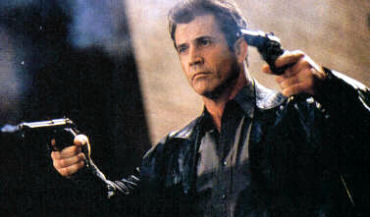
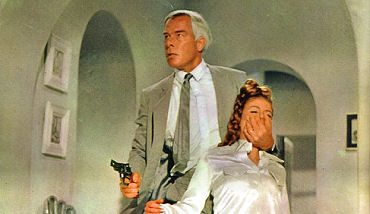
The harder, blunter version of Brian Helgeland‘s almost eight-year-old Payback is coming out on Paramount Home Video in March ’07, and it’ll also show at the Santa Barbara Film Festival in late January. A good guy gave me a VHS of it a few days ago; I watched some of it this morning. It’s smart and amusing in spurts, and I guess it’s an improvement of sorts…but its not much of one. I found it a little too dour. That’s one way of saying I still prefer John Boorman‘s Point Blank, the 1967 noir classic.

Both are based on Donald Westlake‘s “The Hunter.” Mel Gibson plays the hardball avenger in Helgeland’s version; Lee Marvin played the same guy in Point Blank . But the names…my God. Westlake’s character was called “Parker.” Marvin’s is called “Walker” — good metaphor, self-sufficient traveller, man on a journey — but Gibson’s is called “Porter.” That sounds subservient, timid…the name of an accountant.
I’ve recorded dialogue from a portion of the same scene in both films. The Point Blank version is between Lloyd Bochner‘s Carter and John Vernon‘s Mal Reese; the Payback version is between William Devane ‘s Carter and Gregg Henry‘s Val Resnick (same as Reese). Notice how much more lean and direct the Boor- man version sounds, and how tedious it feels when Henry half-jokes about not knowing Porter’s first name.

Wilson at the Beacon

It’s hard to put my finger on a simple, pared-down “why”, but this Ben Ratliff piece is one of the best-written impressions of the ongoing Pet Sounds tour — Brian Wilson and his crew stopped at NYC’s Beacon Theatre two nights ago — I’ve ever read, and I’ve read dozens over the past few years.