

The gap closed yesterday between Casino Royale and Happy Feet. The two are going to end up so neck-and-neck this evening — one studio’s estimate has Bond finishing the weekend with $41,122,000 and the Birds grabbing $41,254,000 — that their respective distributors, Sony/Columbia and Warner Bros., will probably be inflating the figures so as to position their film as the winner.
Right now, the Birds appear to be ahead of the Bond by $132,000…a nose-hair…but let’s see if the Bond spinners try to b.s. their way into a victory of some kind. Today’s (Sunday’s) figures will have to be very closely tallied down to the last dollar. Is it conceivable that the Birds will falter slightly and the Bond will pick up slightly also? Yeah, it could happen…but it’s not likely. This is definitely a squeaker, though. It’s Kennedy-Nixon in 1960.
The temptation for Sony and Warner Bros. to try and juggle each other on the reporting to the trades will be close to irresistable. Question is, how do you anticipate what the other guy is going to claim? It’s going to boil down to a question of who’s ballsier and who wants to lie more.
As expected, Happy Feet benefitted yesterday from a big family-trade surge, going from a Friday tally of $12,153,000 to a Saturday figure of $17,118,000. But Casino Royale also upticked — its Friday earnings of $14,904,000 increased by $800,000 the following day when it took in $15,779,000. Saturday business for sequels rarely increase — obviously a sign of unusual strength for the new 007.
Death of Movie Palace
A heartbreaking N.Y. Times story by Alex Mindlin about the closing of Movie Palace, a locally-owned Upper West Side Manhattan video store (105th and Broadway) that’s been run in a very neighborhood-friendly way by the same impassioned semi-ecentric, Gary Dennis, since 1984. The building has been sold and the new money-grubbing owner, a guy named Ralph Braha, more than doubled Dennis’ rent. And we all know the name of that tune.

“Like the movie theaters that preceded them, video stores are fast becoming relics, and their signs may soon join those unlighted movie marquees (with a vestigial letter or two) that dot various neighborhoods and remind passers-by of what once was,” Mindlin writes.
“But the decline of the video store is more than a story of small merchants undone by technological change. Like movie theaters, and unlike delis or drugstores, video shops in a city as film-saturated and film-savvy as New York emerged as centers of neighborhood life. Their selections mirror the people they serve, and their proprietors, like Mr. Dennis, can be beloved figures with a deep knowledge not only of local inhabitants’ film tastes, but also of other aspects of their lives.
“Salvatore Ierardo, the liquidation director for Video One Liquidators, a Florida company that sells off video stores’ inventories on site, sees the deaths of these shops firsthand. The stores are like “the guy that used to deliver ice,” he said, adding, “He worked hard and everything, but the refrigerator was working while he was sleeping.”
“Compared with some other video stores, Movie Place has not fared badly. For years, it resisted the forces that have been sweeping away many of the city’s other mom-and-pop video shops. Nationally, the number of privately owned video rental shops, as opposed to huge chains, fell to roughly 13,000 in 2005 from about 22,000 in 1996, according to Tom Adams, president of Adams Media Research, which tracks the entertainment industry.”
In short, almost half of the individually-owned video stores have gone bust in the last 10 years. The killers are the big video-store chains, Netflix, video-on-demand. Bit by bit, lease by lease, the neighborly human element in the DVD-renting experience is being squeezed and starved.
Genius Brand
“Best Picture of the Year” means different things to different folks. For some (most, I suspect) it means being the most fundamentally “entertaining” — the one that will most likely reach the largest middlebrow audience. (Which is why a lot of people are suddenly behind Dreamgirls.) For others, it’s the film that’s the most soul-soothing or life-capturing (Volver, Babel, Little Miss Sunshine, The Lives of Others ). Or that seems the most complete and fully realized according to its own particular rules (The Departed, The Queen, Pan’s Labyrinth, United 93).
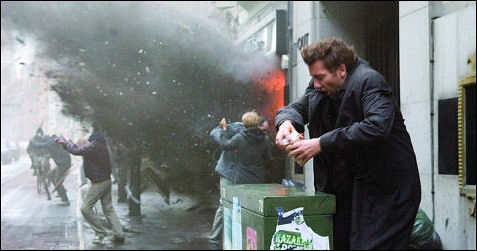
But for me, the highest synthesis of Best Picture satisfaction means delivering on one or two of the above plus one other — it has to be visually historic. It has to knock your socks off by way of sheer visual energy or innovation. So much so that what you’re seeing becomes absolutely “real” and everything else drops away. The popcorn is put under the seat, notions of bathroom breaks are out of the question, and you almost stop blinking for fear of missing something.
Alfonso Cuaron‘s Children of Men (Universal, 12.25) is that film, and is my choice so far for Best Picture of the Year.
This is a futuristic, dystopian end-of-the-world actioner and grim as hell, but what mainly comes through is how remarkably convincing it all looks and feels. Set in 2027 England, It’s one of the most exactingly detailed, full-on visions of a totally-fucked future — a world in which women have stopped having babies — that I’ve seen in any medium ever. Jim Clay and Geoffrey Kirkland‘s production design is so precisely composed that it easily trumps whatever down-head feelings the film may temporarily impart.
And yet Children of Men doesn’t push the moody atmospheric gloom-vibe of films like Dark City, The Handmaid’s Tale, 12 Monkeys or Blade Runner. Based on a 1993 novel by P.D. James, an elderly British woman who mainly writes murder mysteries, it’s a movie with underlying heart and hope — a vision of an Apocalyptic ruin that also delivers warmth and frailty and compassion, and a vision of life that actually includes a future.
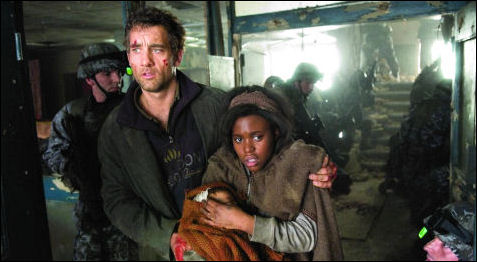
Understand this above all: Children of Men is the most excitingly photographed thing I’ve seen all year. It’s easily in the realm of Full Metal Jacket, Black Hawk Down and Saving Private Ryan, only more so. It’s basically one long take after another, but the standouts are three bravura sequences that each last four or five minutes (longer?) without a cut, and involve truly astonishing feats of sustained choreography and miraculous camera movement. This alone should trump any misgivings you may have about any other aspect (although there’s not much to beef about).
In short — it’s the photography, stupid. The dp is Emmanuel Lubezki and the camera operator was George Richmond. I don’t know who precisely did what but the hand-held lensing is the stuff of instant legend. If Stanley Kubrick were alive today he would absolutely drop to his knees.
Any film buff who doesn’t rush out and see this film at least twice (and drag along as many friends as possible both times) is a traitor to the cause. That’s all there is to it — see it or live in shame. There’s no third option.
Children of Men may not satisfy every sector of the audience (I talked to a white- haired guy after the big Thursday-night premiere who thought it was the worst thing he’s seen in years), or even a majority of the big-gun critics. Variety‘s Derek Elley, astonishingly, gave it a mezzo-mezzo review after catching it at the Venice Film Festival. And I’ve heard the usual beefs about Clive Owen not exuding enough warmth. And there is concern among Universal execs that Men may not make a whole lot of coin.
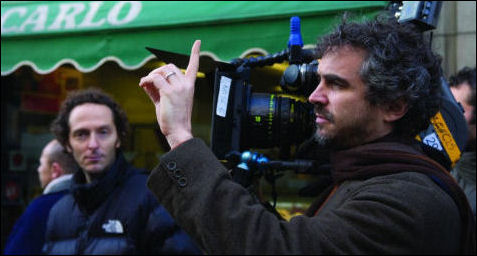
Children of Men director-co-writer Alfonso Cuaron (r.); the great Emmanuel “Chivo” Lubezki , the film’s dp, to the left
But ten, twenty or fifty years from now, long after the pure-fizz movies (the ones that sometimes make people giddy and chuckly when they’re first seen) have been forgotten, people who care about the eye-popping art and vitality of cinema at its finest will be watching Children of Men.
I guess that white-haired guy was brought down by Cuaron’s vision of a crumbling world — worldwide infertility, bands of terrorists, mass chaos, people in cages, roving criminals on every corner. Britain, however, is the last island of relative stability in this world of November 2027. All the other countries have collapsed into total ruin.
What rings so true about this polluted Orwellian atmosphere is that it’s not radically different from the England of today — it’s just a bit grimier and madder with more cops and bigger video-screen ads, and a lot more animals on the streets, and much dirtier exhaust coming out of everyone’s tail pipes. Soldiers and cops are roving all over the place, warnings are constantly broadcast and posted. Broken windows, rampant graffiti, kids throwing rocks and garbage at passing trains….all the signs.
The key plot point is that there have been no births in the world since 2009. It’s over — everyone has given up.
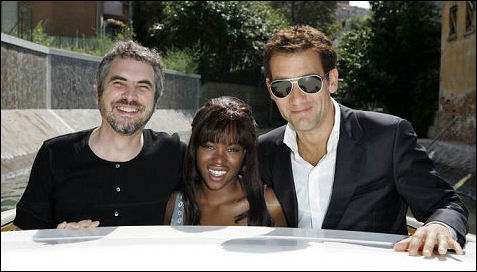
Cuaron, Ashitey, Owen during the Venice Film Festival
Owen’s arc is to go from being a bitter disllusioned milquetoast — a bureaucrat named Theo Faron who can only shuffle along and think of his own misery — to a fighting humanist-activist doing everything he can to protect an illegal refugee named Kee (Clare-Hope Ashitey), who, we soon learn, is miraculously pregnant. If it lives, the baby inside her will be the first child on the planet in 18 years. And it falls to Theo to smuggle Kee to a group called the Human Project, a group of scientists trying to find a cure for global infertility.
Michael Caine plays the only joyful character, a former political cartoonist-turned- pothead named Jasper who’s also Theo’s best friend. He’s in only two scenes but nonetheless lifts the film’s spirit significantly. Peter Mullan adds another energy jolt toward the end as a half-crazed cop friend of Caine’s.
The action starts with Theo being kidnapped by an immigrant-rights terrorist group run by Julian (Julianne Moore), a former lover of Theo’s who gave birth to their child only to see it die. She wants Theo to get hold of transit papers for Kee, which he does. But then things start to go crazy, and soon the film is pretty much one chase or high-peril situation after another.
That’s another reason people may pigeonhole this film as being less than it is — they’ll say it’s just another futuristic action flick.
I don’t think it matters at all if Cuaron and Timothy J. Sexton, who share script credit, have dealt with the various issues with sufficient or insufficient detail. It didn’t bother me that the infertility thing is never really explained — what mattered to me is that I absolutely believed it had taken hold.
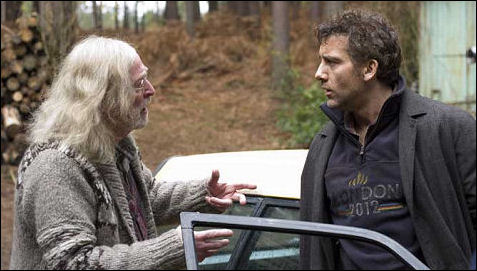
The photography is legendary not just for the excitement factor, but because it’s fascinating to try and figure out how this and that sequence was shot. My favorite is an attack on a car in the countryside — it’s a single take that reportedly required a special mini-crane that allowed the camera to shoot both inside and outside the car. The big battle sequence at the finale is mind-blowing. It’s basically the final battle sequence in Full Metal Jacket on steroids.
I had thought of Cuaron mainly as a soulful-whimsical dramatist after Y Tu Mama Tambien. His Harry Potter and the Prisoner of Azkaban (’04) was better than the others, but I did what I could to ignore it. His short in Paris J’etaime (“Parc Mon- ceau”) was pretty good. Children of Men, however, is a huge leap forward. Now he’s one of the big-boy visionaries in the class of Kubrick, Orson Welles, Spiel- berg, Gregg Toland, Chris Nolan, Ridley Scott, et. al.
Birds beating Bond
The Birds are beating Bond, by not by much. Happy Feet is expected to end up with about $42,595,000 (3804 theatres, $11,199 a print). Martin Campbell‘s Casino Royale will be close behind with a projected tally of $40,470,000 (3434 theatres, $11795 a print) — the Daniel Craig experiment has succeeded and they’re out of the woods.
The third-place Borat will be off about 47% with an expected Sunday-night tally of $15,052,000. Santa Clause 2 will be off 48%. As expected, Stranger Than Fiction is dying — off about 47% with an expected $7,082,000 by Sunday night. Flushed Away — $6,751,000, off 50%. The dumb-asses don’t want to see anything too arty so Babel‘s not babbling very well — in 1251 theatres it”s off 46% for a projected weekend taly of $2,977,000.
The Departed will be off 50% with a tally of $2,561,000 and a seventh-place finish. Fast Food Nation is dead — $417,000 in 321 theatres and $1300 a print…a wipeout. For Your Consideration will take in $379,000 in 22 theatres ($16,477 a print). Bobby opened in only 2 theatres and will take in about $36,450 — it’s tracking pretty well and should do decently when it opens wide next weekend.
Save you, destroy you
“If you bring forth what is within you, what you bring forth will save you. If you do not bring forth what is within you, what you do not bring forth will destroy you.” — quote attributed to Jesus Christ in the Gospel of Thomas, and used in the opening credits of Amy Berg‘s Deliver Us From Evil (Lionsgate).
“Traffic” wth meat
To salute the limited opening of Richard Linklater‘s Fast Food Nation (Fox Searchlight), here’s my original riff from the Cannes Film Festival. (Six months ago…jeez, time flies.) I know I was one of the first journos to use the description “Traffic with meat.” That’s still the best three-word description I can think of.
Hey Joe
I used to live on a second floor of a home in the Hollywood hills, on Franklin Avenue, and my landlord, believe it or not, was Mitch Mitchell, the frizzy-haired, British-born drummer for the Jimi Hendrix Experience. Darren Aronofsky‘s The Fountain has put me into a Hendrix receptivity realm for the last couple of days, and one result is that I’ve recently come across this “Hey Joe” track that’s almost all Mitch’s drums and Noel Redding‘s bass.
Fountain freebie

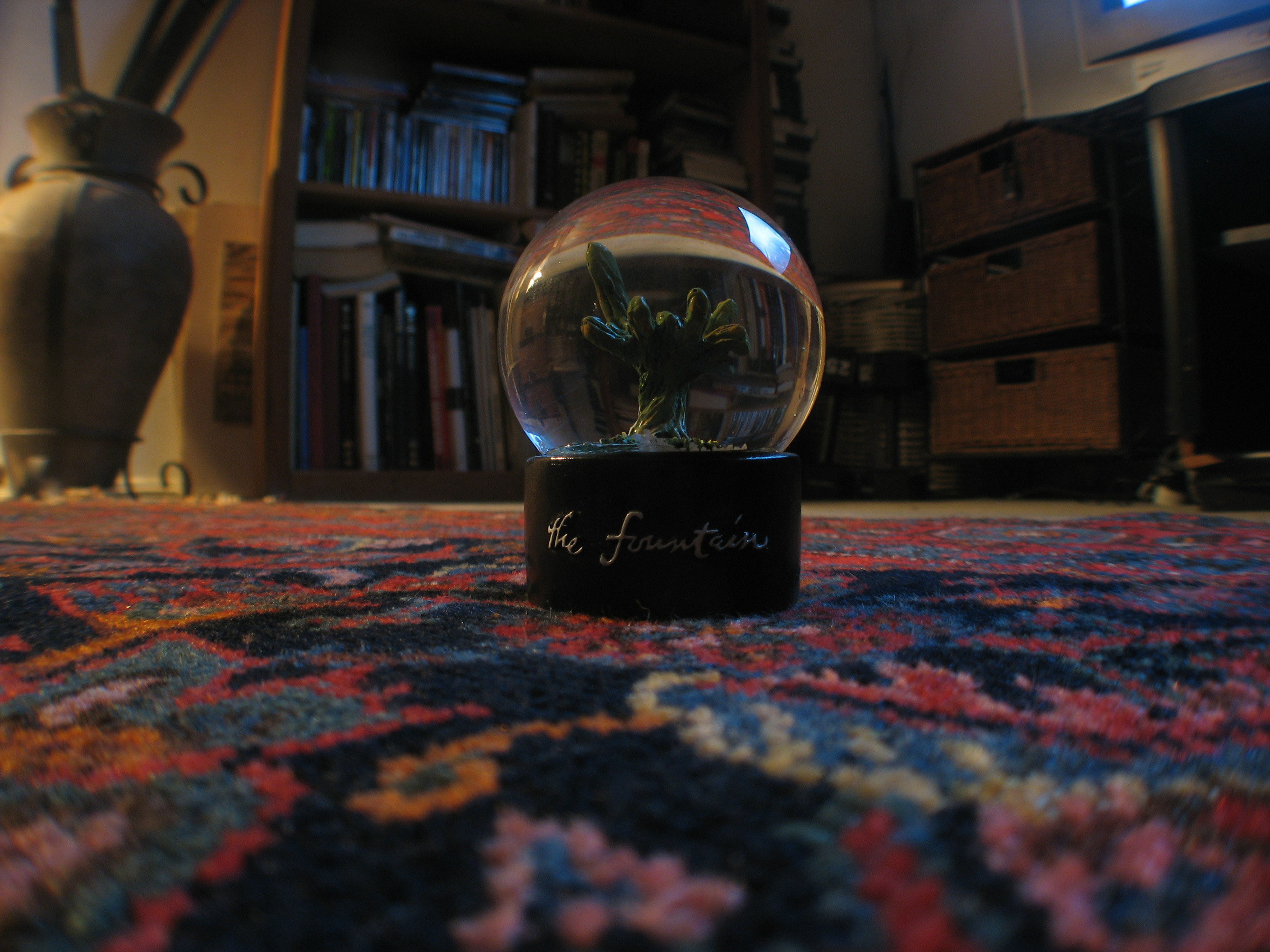
Fountain freebie paperweight…very nice. if Warner Bros. marketing knew what they had or how to sell it, they’d send out hookahs and hash pipes
Reactions to Bond
N.Y. Times reporter Sarah Lyall writing from London on how the British naysayers and negabobs who hated the idea of Daniel Craig as 007 aren’t negabobbiing any more. And the same paper’s Manohla Dargis had this to say in her review: “Successful franchises are always serious business, yet this is the first Bond film in a long while that feels as if it were made by people who realize they have to fight for audiences’ attention, not just bank on it. You see Mr. Craig sweating (and very nice sweat it is too); you sense the filmmakers doing the same.”
Director’s Unrated “Vice”
For those who had issues with Michael Mann‘s Miami Vice, or who so loved the fumes of it (like me) that it felt like perfectly calibrated adult escapism by way of a bad-ass drug-dealing movie, there’s an Unrated Director’s Cut coming on 12.5 that’s definitely a different deal than what played last summer in theatres.
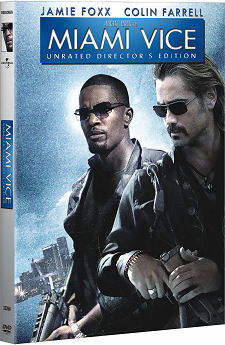
How exactly? I talked about it with a couple of Univeral Home Video publicists today and it’s a little hard to describe. What it boils down to is that 7 minutes of never-before-seen extra footage have been added, making the Director’s Cut 139 minutes long compared to the 132-minute theatrical cut. But a lot of stuff has also been re-edited and/or shortened or recalculated — about 19 minutes worth, the publicists said. So if you add it up it’s got about 28 and 1/2 minutes of fresh stuff…in a sense. Or if you want to be a hard-ass about it, 7 minutes worth with some editorial reshuffling thrown in.
Put it this way: Mann obviously knew that the theatrical version didn’t work all that well with Average Joes, or not well enough, so he gave it another shot and what came out is a different movie, to some extent. It starts with a boat chase instead of a nightclub scene, for one thing. I was hoping there’d be more footage of Gong Li naked, but the publicists disabused me of that dream. Thanks, Michael…thanks a lot.
College Guy on Apocalypto
There’s this very bright older guy who teaches a film course at a major university, and a somewhat younger man who works with him — call him College Guy — saw Mel Gibson‘s Apocaylpto recently, and he shared his views a couple of days ago. College Guy is bright and knowledgable so I figured it couldn’t hurt to add his view to the mix. The pic opens in three weeks. Gibson and his homies will have to show it to guys like me sooner or later.
“In many technical ways, Apocalypto is as ambitious as The Passion of the Christ. But in the gut-level storytelling ways that really matter, it comes up short all over the place. It’s a by-the-numbers chase film with minimal characterization and just enough Mayan flavoring to justify the film’s impressive atmosphere. The main problem with Apocalypto, I think, is that it doesn’t quite know what it’s about.
“The themes of apocalypse and social disintegration that one might expect from this film after seeing the trailers, for example, are little more than a footnote in the film’s overall structure. Yes, there’s a solar eclipse. Yes, there’s a little girl who, at the film’s one-hour mark, makes cryptic prognostications about the fate of the hero. Or humanity. Or something.
“95% of this film is about a man named Jaguar Paw running and fighting. But Apocalypto is an action film without a truly active hero. In fact, it isn’t until about 20 minutes into the film that you begin to realize Jaguar Paw is the hero of the film — a signal that these characters are more or less interchangable. One thing for sure: Jaguar Paw is a very good runner.
“From what I understand from his interviews and website for the film, Gibson has attempted to draw parallels between the brutality of the Mayans and the senseless violence surrounding the Iraq war. Mel’s discussions of
this film, however, are far more interesting, and far more nuanced than the film itself. I suspect that during the writing and production of Apocalypto, no one dared to challenge Mel’s belief that his film is indeed about more than a violent foot chase through the jungle.
“To be fair, the version of Apocalypto that I saw had a bare-bones temp musical score and unfinished visual effects (although I barely noticed deficiencies in the latter). But neither of these factors had any bearing on the narrative itself, which is fairly flat throughout, and will likely remain that way when the film opens in a few weeks.
“I find Edward James Olmos‘s observations confusing — there’s not much to grab on here that would generally make a film memorable: no larger message with which to pepper a press kit without straining, no hero that fuels the story in an active or truly defiant way, no antagonist that operates above and beyond the expected physical violence that Gibson injects into all of his films.
“I suspect this film will open as a curiosity and register as a big disappointment. Framing an action chase film in Mayan civilization is a compelling idea, but there’s not enough of an attempt to take advantage of the environment in which the film is set. Gibson and his team seem to want to frame this film as some kind of immersive, historical thinkpiece, but unfortunately there’s barely a whiff of that in the finished product.
“Plus there’s the expected fissure between action-movie buffs and, you know, people who actually read subtitles. This film will likely leave both camps more than a little blue-balled.”
Frigid 50
Film Threat’s annual listing of the Frigid 50: The Coldest People in Hollywood went up today…and it takes forever to load. It’s like trying to visit a graphic-heavy website in 1997 on dial-up. Plus I disagree with their putting Mel Gibson at the top of the list. He’s been dead meat for so long it looks like up to me. Apocalypto may or may not be as good as Edward James Olmos says it is, but it’s picking up some heat now. And the re-cut, supposedly tougher Payback will be out on DVD next year. (Paramount Home Video refused to send me a copy, but a guy from New York is sending me one.) Mel’s career may be so profoundly and tectonically dead that I may be missing the bigger picture, but i see at the very least a slight upswing. Maybe. Unless Apocaylpto is, like, really tedious.