Polanski Zenovich

“I’ve never set out to diminish the seriousness of what Roman Polanski did, but it comes down to crime and punishment. How much do you have to pay for the crime? What I’ve always set out to prove is, despite what Polanski did, which was awful, he was treated unfairly by the judge. That’s the bottom line.” — Filmmaker Marina Zenovich to Charles Lyons in today’s N.Y. Times about Polanski’s unlawful-sex-with-a-minor case, which she’s been making a documentary about for eons.


Polanski and attorneys leaving Santa Monica courthouse in ’77

Zenovich’s film, “untitled and unfinished” but presumably heading for a debut at next January’s Sundance Film Festival and some kind of commercial exposure in ’07, which marks the 30th anniversary of Polasnki’s unlawful sex with a minor case, takes a closer look at the manner and tactics of the presiding judge in Polasnki’s unlawful sex with a minor case — the late Laurence J. Rittenband.
Zenovich, a very smart, extremely tenacious pro whom I’ve known since the late ’90s, tells Lyons “it is impossible to reach conclusions about Mr. Polanski without drawing Judge Rittenband into the equation.”
I’ve been hearing this for years (most lately from Polanski biographer F.X. Feeney), but judging from Lyons’ carefully phrased article, Zenovich’s conclusion in this reportedly exacting and meticulous doc is that Rittenbrand handled the Polanski case rashly. One could go so far as to describe his judicial behavior in this matter as that of an intemperate, Judge Roy Bean-ish, shoot-from-the-hip asshole.
Zenovich “describes the judge as having lived the kind of vibrant personal life easier to associate with Polanski,” Lyons writes. “‘He was never married, and he loved being kind of a swinging bachelor, juggling a couple of girlfriends at once,’ Zenovich tells him. “What’s most interesting about him is that he tried to come across as so moralistic, but eventually I found out that this was a man who had a 20-year-old girlfriend when he was 54.”
“Even from the unfinished film, it is apparent that Zenovich — who made an earlier documentary, Who Is Bernard Tapie? without the participation of its subject, the French financier and politician — has become intent, like documentary filmmakers before her, on using the form to delve deeper than the written word or television usually allow,” Lyons writes.
Produced by Jeffrey Levy-Hinte and Lila Yacoub and exec produced by Steven Soderbergh, Zenovich’s film “will likely renew the debate over whether Polanski still has a price to pay if he returns to the United States.”

Pink converse sneakers

The sum effect of coverage of Marie-Antoinette in Vanity Fair, Vogue and the New Yorker along with the Kitson Boutique window treatments, wild posting and pink Converse sneakers “is penetrating the culture,” Columbia marketing president Valerie Van Galder has told Hollywood Reporter columnist Anne Thompson.

“In just the way that Sofia didn’t treat [the story of Marie Antoinette] as a straight biopic, we’re taking a unique approach,” Van Galder explains. “We’re having fun with the marketing. The movie has captured people’s imagination.”
Surely Van Galder doesn’t mean the movie itself — which I’ve over-campaigned against, I realize — has done the capturing. What she means, I think, is that the idea of Sofia Coppola putting pink converse sneakers into a shot of Marie Antoinette’s closet (or against some other backdrop) has caught on within the culture of female movie journalists, columnists and magazine editors along with, I suppose, some of their male gay counterparts. Kind of a “you go, girl” thing.
Hollywood Bytes columnist Elizabeth Snead has written that “the modern pink footwear creates a funny, girly, rebellious moment in a frothy film about a young girl who just wants to flirt, shop and party in 18th century France. And the sneaks also work with the film’s punky pink ads and the pink-themed court parties, pink champagne, pink wigs, and pink pastries.
“More importantly, the shoes are also a bright pink emblem of Sofia’s creative and independent spirit.”
Snead reports in the same column that “someone asked Coppola about the pink tennis shoes and she explained that it was her brother Roman, her second assistant director on the film, who put them in the shot. Dunst stayed comfortable wearing pink Converse tennis shoes under her royal gowns during filming. You never see them on [her] but there is a funny shot of the tennis shoes that remains in the film.”

All Squonked Out

All Squonked Out

Life is hard all over, day after day, but every time I visit a film festival I’m reminded how especially hard it seems for documentary filmmakers. How so many of them go into deep debt to get their films made, and how most find that it takes three or four or five years to finish. And if they don’t manage to win awards at film festivals it’s that much harder to land a DVD distribution deal because awards are regarded as selling points.


Filmmaker and script supervisor Peggy Sutton

There’s the personal satisfaction of making a film you’re happy wth, of course, plus the calling-card benefit that always helps when you’re starting your next film and looking to get the best people and/or cut the best deals. There’s the general heartwarm that comes from hearing positive reactions when your film plays before festival audiences (who tend to be generous) and all that, but for every Werner Herzog, Ken Burns or Michael Moore there are hundreds if not thousands of doc makers who reap almost no reward for their efforts, and who wouldn’t be able to stay in the game without superhuman tenacity.
Case in point: Peggy Sutton, a Manhattan-based script supervisor, and director of SQUONKumentary, a culture-clash doc about a group of Pittsburgh musicians who encounter some rough and tumble as they prepare their musical revue for a Broad- way venue. It’s an engaging, well-made piece — quirky, spirited — and I presume it’s been shown here and there since its completion sometime in late ’05. But I was nursing a feeling yesterday that Sutton might exemplify the thankless plight of the documentary filmmaker a bit more than others.
< ?php include ('/home/hollyw9/public_html/wired'); ?>
I spoke to Sutton last night about what she went through to get it made, but it was a bit noisy and everyone was drinking. I called with more questions this morning, twice, but she didn’t call back. (Probably thought I was trying to hit on her.) She’s probably shown SQUONKumentary at this and that festival, but all I know for sure besides the fact that it played here yesterday morning is what the IMDB says, which is that it showed it at the AFM (American Film Market) in September ’05.
The Bend Film Festival showing happened Friday at 11 a.m. at the Regal Old Mill, in the southern part of town. A more opportune venue would have been the Tower theatre on Wall Street, and a better time would have been in the late afternoon or evening. Obviously the festival wouldn’t be showing SQUONKumentary if they weren’t fans, but they seem to be slightly bigger fans of the some of the other films.

I shouldn’t be saying anything before tonight’s awards ceremony, but I can repeat that the jurors for the Bend Film Festival awards (myself among them) met yesterday and that SQUONKumentary, naturally, was one of the docs we talked overand weighed. I can’t say anything more except the obvious, which is that the competition at any well-regarded festival (and Bend definitely qualifies) is always tough.
And I was thinking as I spoke to Sutton last night…it’s hard to say it just so, especially under constrictions. But I came away from the jury deliberations with a keener appreciation for what filmmakers go through.
The performers — SQUONKers — in Sutton’s film are formally known as the Squonk Opera company, from Pittsburgh.
Sutton got to know them when she was hired to film two performances during Squonk Opera’s seven-week engagement on Broadway in 2000. They want clips to use for TV reviews and for distribution to European theatre producers.
“I was struck by them as people and as artists,” Sutton told a Pittsburgh Tribune writer in November 2005. “Theirs is not a conventional show. There’s no narrative. It doesn’t have a book or an overarching story. They think of themselves as a band first, with six members. There are visual elements and audience participation in their shows.”
Sutton’s performance footage became the core of her documentary film.
“I started editing in January 2005, which shows you how long the evolution was. I’ve been told the average time for a documentary is five years. You’re condensing lives into a three-act struggle.”
Sutton told me last night that it cost about $100,000 (I think); the IMDB says it cost about $150,000. “Are you in debt,” I asked her. “No,” she said. Obviously there’s a story there, but like I said…

SQUONKumentary shot in Manhattan, Brooklyn and Pittsburgh. The idea of beginning work on a project in 2000 and not finishing it for another four or five years sounds like a mind-blower to me. How does filmmaker “keep it up” all those years? I would think you’d get sick of the subject after a couple of years, or certainly by the third year. But four or five? Gimme a break.
Sutton’s income as a script supervisor has given her a relatively comfortable life. She’s worked on mostly indie-level films — Tape, Pollock, Election, Lawn Dogs, Songcatcher, Chasing Amy — as well as Stuart Little 2, Ash Wednesday and Men in Black 2.

O’Toole and Sharif

Peter O’Toole and Omar Sharif costarring again, for the third time! For eight or nine seconds I was entertaining the idea of actually paying to see One Night with the King, the Christian conservative right-wing Biblical costume movie, until….

“At the very beginning, Peter O’Toole shows up for a day’s work as the prophet Samuel, looking as if he wandered in from the set of Troy; later, his old friend from Lawrence of Arabia, Omar Sharif, ambles on as well as Memucan, whispering sage advice to the king. Unfortunately they’re separated by five centuries, and never share a scene. For a movie with the most righteous of intentions, that’s perhaps the most grievous moviemaking sins of all.” — from Stephen Witty‘s review in the Newark Star-Ledger.

Of course, no one likes to talk about the second movie O’Toole and Sharif costarred in. It’s a 1967 World War II film called Night of the Generals, and it has a fairly shitty reputation. The Egyptian-born Sharif had to wear loads of makeup to look like a German (he plays an intelligence officer, Major Grau, looking into murder charges that involve three high-ranking generals, one of who is played by O’Toole. The only DVD mastering of the film, directed by Anatole Litvak, is a Spanish import.

N.Y. Times, “Catch a Fire”

Philip Noyce‘s Catch a Fire (Focus Features, 10.27) is a smart, urgent political drama about how an uneducated average-Joe black guy, Patrick Chamusso (Derek Luke), was goaded — brutalized — into becoming an anti-apartheid terrorist in the early ’80s. But the idea the film came from a white guy, albeit an atypical one — Joe Slovo , the white chief of staff of the African National Congress√ɬ¢√¢‚Äö¬¨√¢‚Äû¬¢s military wing and later Nelson Mandela‘s housing minister.

It all started when Slovo, according to this 10.15 New York Times story by Kristin Hohenadel, told his daughter Shawn Slovo, a screenwriter, that she should write a script about Chamusso.
√ɬ¢√¢‚Äö¬¨√Ö‚ÄúTerrorism is the single biggest real fear in the contemporary world,√ɬ¢√¢‚Äö¬¨√Ǭù Robyn Slovo, another of Joe’s daughters and one of the flm’s producers, tells Hohenadel. √ɬ¢√¢‚Äö¬¨√Ö‚ÄúWhat√ɬ¢√¢‚Äö¬¨√¢‚Äû¬¢s interesting is there√ɬ¢√¢‚Äö¬¨√¢‚Äû¬¢s not enough time spent looking at why a man would do this. Not all terrorists are the same. But this is our attempt to make an audience identify with a terrorist, there√ɬ¢√¢‚Äö¬¨√¢‚Äû¬¢s no question about it.√ɬ¢√¢‚Äö¬¨√Ǭù
Chamusso “does not accept the terrorist label,” writes Hohenadel, adding that his fundamental claim is that he “was pushed to do it.”
For Noyce, Catch a Fire was “ultimately about transcendence,” she writes.
“South Africa’s recent history is a beacon to the rest of the world in terms of the peaceful resolution of bitter interracial conflict, keeping the infrastructure of the country intact, preserving the rights of citizens on all sides,” he says. “The movie really is about the South African miracle. The moral consequences of that struggle to all the participants, and then how in this society they’ve managed to move beyond that struggle. They live with it, they don’t deny it but they live together.”

Infamous Queen

Bad news, encouraging news: Doug McGrath‘s Infamous (Warner Independent), the second Truman Capote-writes-In Cold Blood movie, opened weakly yesterday in a limited 179-theatre break. $120,000 cume and $600 per print average yesterday — an expected $411,000 and a $2295 per-screen average by Sunday night. These numbers may not sound tragic, but in industry eyes this means it pretty much opened and closed. Stephen FrearsThe Queen (Miramax), on the other hand, expanded from 11 to 46 screens and will have about $937,000 by Sunday night, not counting last week’s take. It’s doing very well, and will probably continue to do so for a good while. Not to mention the bump that will happen with Mirren gets her Best Actress nomination.

Weekend numbers

Takashi Shimizu‘s The Grudge 2 (Columbia), showing in 3211 situations, will end up in first place Sunday night with roughly $27,261,000. But the big story is Martin Scorsese‘s The Departed (Warner Bros.), which will come in second roughly $19,369,000, dropping only 26%. That’s a very strong hold from last weekend, especially considering that last Sunday’s business was stronger than usual due to the Columbus Day holiday that came the next day (i.e., Monday, 10.9).
Man of the Year will be third with an expected Sunday-night cume of $12,399,000, Open Season will end up with $11,105 (decent hold). Texas Chainsaw Masscare: The Beginning, weakened by The Grudge 2, will have about $8,559,000. The Marine, which opened without critics screenings, will end up with $6,693,000, give or take. The Guardian, $5,738,000. Employee of the Month, $5,248,000. One Night with the King (a religious-right flick with “some sensuality,” starring Tiffany Dupont and costarring Peter O’Toole and Omar Sharif with “some sensuality,” about Esther — as iin “the book of…” — winning the heart of the king). Jackass Number Two will end up with $3,122,000 for the weekend.

Defending “Marie Antoinette”

“It may be tempting to greet Marie Antoinette with a Jacobin snarl or a self- righteous sneer, since it is after all the story of the silly teenager who embodied a corrupt, absolutist state in its terminal decadence,” A.O. Scott wrote yesterday. on the occasion of Sofia Coppola‘s film being shown at the N.Y. Film Festival. “But where’s the fun in such indignation? And, more seriously, where is the justice? To say that this movie is historically irresponsible or politically suspect is both to state the obvious and to miss the point.”

But it’s not that Coppola’s film, which has visual splendor and a fine tonal consistency all through, is historically irresponsible — it’s the fact that it exudes vapid self-portraiture at every turn. Once you get past the well-honed profession- alism that went into the making of the damn thing, the selective nature of Coppola’s screenplay — she obviously relates to the trapped-rich-girl experience and little else — renders something not so much “boring” as rigorously drained.
And yet here are Scott and L.A. Times critic Kenneth Turan (his piece also filed yesterday) defending Coppola’s integrity and basically saying that embracing a vapid approach is okay — deserving of respect — as long as you do it with disci- pline and style. There’s no question that Coppola had a vision when she made this film, and that it was very much her own. I’ve said that from the beginning, but God, what a diminishment of the vision thing.
There’s also no question that a significant factor behind Scott, Turan, Michel Ciment and a lot of other critics cutting Marie-Antoinette a break or going so far as to praise it is a certain sublimated kowtowing to the Coppola legend/tradition/ aura…a veiled showing of respect to a once very powerful king. Without this and other dad-related factors (including the rich-girl-trapped-in-a-royal-court sensibility in the first place), there would never have been a Marie-Antoinette. Is there anyone out there who believes Sofia would have won her 2003 Best Original Screenplay Oscar for Lost in Translation without the Coppola gimme factor plus Bill Murray‘s inspired improvisings?

“History Boys” & Griffiths

Had I not been all Bend-ed and distracted yesterday, I would have posted a sampling of reviews of Nicolas Hytner‘s The History Boys (Fox Searchlight,11.21) which opened yesterday in England. The consensus is not one of immense enthusiasm for the film, but derby-wise Richard Griffiths‘ performance as a rotund, intellectually spirited grammar school prof named Hector may — favoring winds allowing — have a shot at a Best Actor nomination.
The Envelope‘s Tom O’Neil yesterday reported that Fox Searchlight, encouraged by the rave reviews Griffiths has gotten from London film critics, has decided to push him in the Best Actor category instead of Supporting, which had been the previous thinking due to Boys‘ ensemble-y nature.
Leslie Felperin‘s Variety review last Wednesday was the first to lower the boom on the film itself — now there’s a chorus of critics saying more or less the same things. The Guardian‘s Peter Bradshaw called it “an odd, faintly directionless experience…a stagey and oddly contrived movie directed by Nick Hytner, with the kind of elaborate, highly worked dialogue that is exhilarating in the theatre, but rather unreal-sounding on the big screen.
“It is set, notionally, in the early 1980s, though Bennett’s mental picture of the scene is surely from decades further back than that. There are some ’80s pop songs on the soundtrack and modernized touches that appear to overshoot the period runway; we get talk of ‘media studies’ (for the Oxbridge term? in the early 80s?) and the boys invoke their ‘rights’ when a master casually whacks them over the head with some exercise books.”
Bradshaw is especially good with his riffs on Mr. Creosote:
“Really, though, we are in Mr. Chips country. And the Mr. Chips who has wisely and wittily guided a number of clever-clogs youngsters to academic success is a master called Hector, rumbustiously played by Richard Griffiths. Heaven knows, Mr. Griffiths was no starveling playing Uncle Monty in Withnail and I 20 years ago — but now he is a mighty presence indeed.
“[Griffiths] actually has a stunt double listed on the final credits, presumably for long-shots showing Hector in his crash helmet sedately riding a motor-scooter into the school grounds, and that is not exactly Mission: Impossible stuff. As far as he is permitted, Griffiths dominates the screen with talent and charm — and sheer equatorial girth.”

Bamigboye on BAFTAs

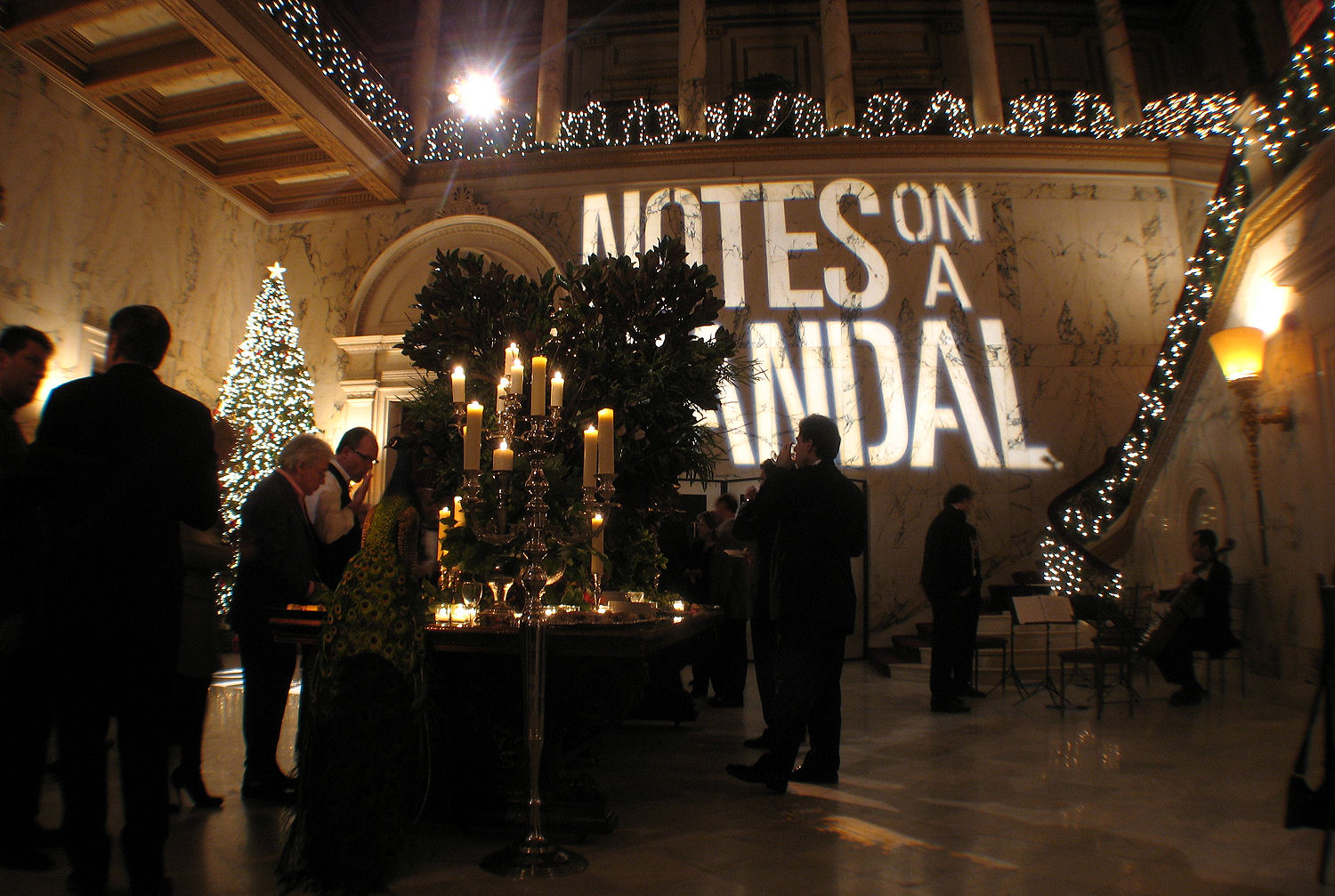
It’s been a strong year for British films and British performers. The proof, says Daily Mail columnist Baz Bamigboye, is that the 2007 BAFTA Awards, set for Sunday, 2.11, will have a larger-than-usual amount of actual competing Brits. To make his point he starts by safely predicting “the Battle of the Dames” — Notes on a Scandal‘s Judi Dench vs. The Queen‘s Helen Mirren going head-to-head for the best actress crown. (Baz has seen Notes and says Dench “nails it.”) Dench’s costars in this film, Cate Blanchett and Bill Nighy (as Blanchett’s husband) will also be up for best supporting BAFTAs, he says. Little Children ‘s Kate Winslet will also be in the running, he claims, for her role in Todd FieldsLittle Children. So will Toby Jones for his “cracking portrayal” of Truman Capote in Infamous…wait a minute, wait a minute, wait a minute. There’s no heat for Jones on this side of the pond — Bamigboye is saying he’s a likely BAFTA nominee because he’s British? he’s also predicting that the Venus team — costars Peter O’Toole (of course), Leslie Phillips (really?), Jodie Whittaker (doubtful) and a “peerless” Vanessa Redgrave (maybe) — may be nominated for their work in Roger Michell ‘s smalllish low-budgeter. Bamigboye is further predicting that Jude Law and Martin Freeman will get BAFTA noms for their work in Breaking And Entering.

Bend jurors

The column wasn’t very active today either, largely because the Bend Film Festival jury — myself and five other guys — sat down and mulled over which films will win the cash (including a $10,000 Best of Show” award) and non-cash prizes for a little more than four hours. We started around 11:15 this morning and finished at 3:20 pm. There were some differences of opinion but very little debating; everyone was more or less on the same page. The winners will be announced on Saturday night.


Bend Film Festival jurors during deliberative recess — (l. to r.) entertainment attorney Richard Roll, director Taggart Siegel (The Real Dirt on Farmer John), myself, critic/journalist/Movie City Indie editor Ray Pride, director-writer-actor Hank Rogerson (Shakespeare Behind Bars), filmmaker Rory Kelly (Sleep With Me, Some Girl); in a Wall Street storefront window, a board game for sale; the festival’s flagship venue is the Tower theatre, located on Wall Street in the center of downtown; ditto; haven