Shortbus shortcomings

“I’m not saying John Cameron Mitchell‘s Shortbus is up there with Citizen Kane or Drunken Master II,” says Richard Corliss in a Time essay called “Meet the F–kers.” “It’s mostly clever, sometimes meandering. And I have to say I didn’t get all that jazzed by the many gay exertions (or the straight ones).”
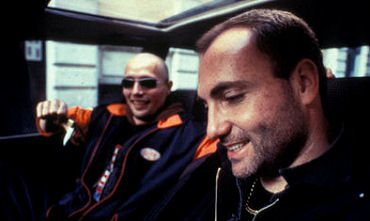
Really? I thought the sequence with Paul Dawson leaning upside down against a wall and blowing himself was right up there with the Odessa Steps sequence in Sergei Eisenstein‘s Battleship Potemkin.

“But I was, critically speaking, excited to see the coherent integration of explicit sex scenes into a naturalistic story film,” Corliss continues. “Mitchell said that in press interviews here, he was asked over and over, ‘Why sex?’ I wonder: What took so long? Most people laugh and cry; most people have sex, occasionally at the same time. Sex isn’t divorced from our own emotional biographies; it’s an inextricable part of it.
“So I applaud Mitchell. And I say to other intrepid filmmakers: Just do it.” — critic Richard Corliss in his 10.6.06 Time piece called “Meet The F–kers.”

I respect Shortbus also for blending tangible emotional fibre with downtown Manhattan sexuality and hormonal urgency, blah, blah, and I too wish there would be more sexuality and less overt violence in movies, etc. And I laughed at the singing menage a trois scene. But the truth is that I was bored — vaguely bored — during a lot of Shortbus, and moderately repelled by some of the sexual footage.
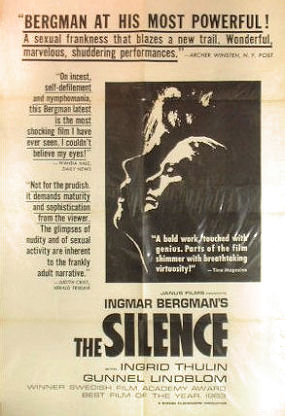
Repelled partly because of Mitchell’s dp, Frank G. DeMarco, using overly bright lighting on all that white blotchy skin, and partly because I miss the kind of sugggestive, carefully lit scenes of skin and out-front sexuality that were part of Hiroshima Mon Amour , the 1959 Alan Resnias film, and Ingmar Bergman‘s 1963 film The Silence.
I know, I know…get with Mitchell and DeMarco’s blotchy white skin program and get in step with the 2006 program. But I don’t want to live in a cinematic world of shrugs, yawns and popcorn and leg-stretching breaks in the lobby .

Another “Departed” view

“I saw The Departed last night,” an industry friend wrote this morning. “I recognize the awesomeness of the filmmaking, of course. But I agree with you that it really is about nothing at all. It’s a film without a soul. And the praise it’s gotten makes me wonder how much the aura of a director influences critics. Sometimes it helps and sometimes it hurts.
“Allegiance factors are a big factor with Clint Eastwood these days also. Million Dollar Baby was a lazily directed film. It was all in the screenplay. Casino was not well reviewed, but had it been directed by an unknown, it would have been hailed, perhaps even an Oscar winner.
“On the reverse there’s so much love for Martin Scorsese now. A lot of the fervor for The Departed is actually a celebration of a good-old-days feeling…the Marty they knew and loved many years ago back in the fold. Allegiance factors are a big factor with Eastwood these days also. Million Dollar Baby was a lazily directed film. It was all in the screenplay.”
Clarifying: I didn’t say it’s “about nothing at all” in my original review. I wrote that The Departed “doesn’t exactly throb with thematic weight. It may not be profound or symphonic, but it’s cause for real cheering. Is it as good as Goodfellas? Well, no…but who cares? It’s tight and trim and exciting at every turn. And at least it’s Scorsese back in the groove.”

Here comes Mel

Next Thursday and Friday morning (10.12 and 10.13) Mel Gibson will grovel before Diane Sawyer on ABC’s Good Morning, America about his anti-Semitic blurtings when he was arrested for that DUI last summer. The idea, of course, is to pave the way for Apocalypto (Touchstone, 12.8) by at least starting to try and mitigate some of the disdain that the Hollywood community feels for him.

Bening on Deirdre

“In Running With Scissors, which is based on Augusten Burroughs‘s best-selling memoir about his crazy, destructive upbringing, Annette Bening portrays Burroughs’s mother, a would-be poet who is addicted to pills that have been prescribed by her psychiatrist. Under the sway of narcotics and convinced that her greatness will be realized only if she is on her own, Deirdre allows the psychiatrist to legally adopt her only child, young Augusten.

“Despite the extreme loopiness of this woman, Bening manages to make her understandable and sympathetic — she is a fascinating mess, a strangely driven and complicated diva without any particular talent. ‘Deirdre’s aspirations are true for all of us,’ Bening explained. ‘Sometimes the aspiration is just as passionate as the result. The dream can overtake everything.'” — from Lynn Hirschberg‘s profile of Bening in Sunday’s N.Y. Times (10.8).

Dusty stage

It’s nearly time to start getting into Clint Eastwood‘s Flags of Our Fathers, but before it all starts here’s a musical hint about a thematic predecessor. No need to make a big deal out of it. Just something to consider and maybe chew on.

“Departed” theory

My theory-of-the-moment is that a good portion of the Departed dissers who’ve written in over the last 28 hours or so are basically responding to all the praise from professional critics. They’re posting, in other words, out of a longing to slap down the know-it-alls and set them straight. I believe that the actual hoi polloi verdict — i.e., one more fully reflective of how most ticket buyers are responding — is more enthused than what’s been coming in so far. Or am I…you know, wrong again?

Scott doing Penetration

Ridley Scott has told Comingsoon’s Edward Douglas that his next project will be a Middle Eastern drama based on a forthcoming book (due in March ’07) by journalist David Ignatius called “Penetration”, and that the script will be written by Departed scribe William Monahan. “It’s really about what’s happening now in the Middle East, our complete misunderstanding of what’s going on and how we’re not dealing with it,” Scott tells Douglas. “Inevitably, [it gets] into the heat in terms of a man who is actually a par journalist that gets sucked into working on a peripheral level in a special department where he gets into real trouble in the Middle East. But it’s so accurate.” In other words, something Syriana-ish served with Scott’s usual visual pizazz?

DeGeneres showing respect

“I want to be respectful,” Ellen DeGeneres recent told N.Y. Times writer Jacques Steinberg about her upcoming Oscar Awards hosting gig. “I know what the job is. It’s to honor movies and to honor people who worked hard. Those people take it seriously. I’m there to make them feel good and take their minds off it a little bit and make it a fun night.” I honestly don’t think anyone needs respectful or disrespectful — everyone just wants the Oscar show host to be really sharp and funny, like Billy Crystal was during his mid to late ’90s hosting heyday.

Jamie Stuart #3

I forgot to post the latest Jamie Stuart NY Film Festival video thing a couple of days ago. Pedro Almodovar, Penelope Cruz, Warren Beatty, Michael Apted, et. al. Does Suart wear those sneakers and that knit beanie everywhere he goes? Is that like a signature thing, the way Stanley Kubrick of the ’60s and ’70s would always wear a dark suit and a white shirt?

Clint at Four Seasons

The legendary Clint Eastwood answered questions this morning about Flags of Our Fathers (Dreamamount, 10.20). Tall and trim, a model of silver-fox urbanity, he strode in and sat at a table in front of 60 or 70 seated entertainment journalists inside a small “ballroom” inside the Four Seasons hotel, and talked straight and plain about his World War II drama for just over 47 minutes.

The guy looked only slightly (or do I mean vaguely?) bowed by his 76 years. Tanned face, tight features, perfectly cut grayish-white hair, and wearing a beautifully tailored gray suit and light blue shirt with a tie with some kind of conservative dazzle pattern.
Before listening to this recording of the q & a, you should recall a few things.
Flags is Eastwood’s sad and elegaic drama that’s partly about the Marines who fought and died during the battle of Iwo Jima in early ’45, but is mostly about three veterans of that battle who raised the American flag on a pole atop Mt. Surabachi during the fighting, resulting in a photo that was sent around the world and came to symbolize the valor and sacrifice of U.S. forces.
These three men — — John Bradley (Ryan Phillipe), Ira Hayes (Adam Beach) and Rene Gagnon (Jesse Bradford) — were sent home to take bows and raise funds and build morale on a big public relations tour arranged by the military. Flags partly deals with the conflicted and/or buried feelings that arose from this effort, and from the conflict between two worlds — the godawful battle-of-Iwo-Jima world where everything was ferocious and pure and absolute, and the confusing, lost-in-the- shuffle world of back home, where almost everything felt off and incomplete.

This isn’t a review or reaction of any kind — that won’t happen for another several days. But I can at least say that Flags is a mature and very soulful meditation piece with its head and heart in the right humanistic place, and that a couple of hot-shot critic friends are feeling a good amount of respect and admiration for it.
It was also obvious that the room this morning was full of respect for Eastwood and his storied career as a director, with the critical highpoints (prior to Flags of Our Fathers) being Bridges of Madison County and the Oscar-winning Unforgiven and Million Dollar Baby.
Now that you know the basics, listen away.