Boiled pot

Notice how the cheap metal pot sitting on my non-Martha Stewart stove in my kitchen is not perfectly round? How it’s all warped and oddly bent and has a darkly-stained bottom? That’s because every day I boil water for tea and then I go back to the computer to write something, and then I come out of my writing coma 15 or 20 minutes later and the water is all boiled out and the pot is just taking the heat.

So I pick it up with a pot holder and pour cold water on it and the kitchen fills with steam. I have done this, no exaggeration, about 40 or 50 times now, which is why this pot is totally baked and about to be tossed. I’ve already ruined two Bed, Bath and Beyond pouring pots this way…nice ones too. The kind that whistle when the water’s ready, I mean. And even when they were whistling I used to ignore them so I could finish the thing I was writing at the time. So it’s not cool and pretty stupid, really. And I’m just admitting this, M.Night Shyamalan-style.

Yari stiffing “Crash”-ers?

So Crash producer Bob Yari isn’t paying out all the money he should be paying to the profit participants on Crash — director-cowriter Paul Haggis, screenwriter Bobby Moresco, Sandra Bullock, Matt Dillon, Don Cheadle and five other actors in the cast — and the meager money he’s parted with has been slow in arriving. This despite Crash having cost only $7.5 million to shoot and the total world income standing at $180 million so far. Why? Hollywood bookkeeping, people skimming, human nature.
A seasoned publicist who’s been at this racket since the ’60s once told me that people you work with will almost always fuck you financially one way or the other — by shortchanging you, by delaying payments, by disputing what you’re owed. Every damn time, he said. It’s probably built into our genes, he said.
Yari tells N.Y. Times reporter Sharon Waxman that he’s “aware of the dissatisfaction, but that [he’s] completely up to date on payments. The profit participants “have been correctly paid,” he told her. “They will be paid more. This is the process. We’ve done everything aboveboard. If we wanted to not pay people and have them sue us, we wouldn’t pay them at all.”
I don’t know about that. I think that if Yari wanted to stiff the Crash participants without getting into a bunch of lawsuits he would (a) delay, and then (b) delay some more, and then (c) he’d finally send two or thee of them a modest check for $19,000, and then (d) he’d piss around some more, and (e) then say that Lion’s Gate and other people on hoarding profits, not him, and then (f) if a reporter called he’d get on the phone and say that everything is in perfect order.

James on Mann

“No other writer-producer-director makes males more excited at the prospect of a new film — especially a cop thriller — than Michael Mann. But it’s an anticipation that crosses gender and taste barriers, integrating art film buffs with the Friday night popcorn crowd. Fans look to this peerless creator of impeccably crafted films about existential male loners — films such as The Last of the Mohicans, Heat and The Insider — for a superior kind of big budget cinema, a hyperrealism that is simultaneously dumbfounding and realistic. He seems to be the sort of guy who can talk fast cars all day with the studio suits, as if he were a suit himself. Yet his artistry is a matter of absolute dedication, making him perhaps the most extreme cinema perfectionist since Stanley Kubrick.” — Nick James in last Sunday’s Guardian Observer.

Goldstein on Shyamalan

According to L.A. Times columnist Patrick Goldstein, what makes Michael Bamberger‘s “The Man Who Heard Voices” “especially damaging” is that Lady in the Water director-writer M. Night Shyamalan told Bamberger absolutely everything and let it all hang out. In so doing, says Goldstein, Night “violated Hollywood PR Law No. 1: Never let people see you as you really are. In an era when stars hide behind their handlers, who vet writers, limit their access and keep them miles away from any dirty laundry, Night let Bamberger see it all — straight, no chaser.”
This is an early July riff, I realize, and it’s time to move on, but Goldstein’s column just came out and I’m reacting
I said this before in my response to Janet Maslin‘s N.Y. Times review about Bamberger book, and here it is again. By giving Bamberger access to his insecure inner sanctum without restrictions, Shyamalan allowed for a portrait of “a vulnerable egoistic guy with problems — a guy with a deep belief in dreams and voices (as all creative types need to be) but with control-freak tendencies and a need for a certain kind of approval that requires being not just rich but fully understood by colleagues; a guy with demons and uncertainties like anyone else, but amplified by the power he’s accumulated as a big-time Hollywood director.”
What I find very revealing is that Maslin and Goldstein and a lot of others in the media are contemptuous of Night’s honesty. And they endorse and approve of people who carefully edit their public persona and spin everything up and down the flapgpole. They’re actually standing on the side of the 2006 Generic Deceivers. We all recognize that everyone has to play the game this way if they want to survive, but why am I one of the few people to at least show respect for Shyamalan’s willingness to let people see his trembling inner child? The guy may have problems, granted, but you can’t say he doesn’t have a kind of cast-iron courage.
And one other repeated point: take off the armor and we’re all scared and anxious and messed up in this or that way, including myself and Patrick Goldstein and Janet Maslin and Michael Mann. The difference is that Shyamalan has the courage to confess this and Bamberger has the focus and discipline to just lay it down as he heard and felt it, and all Maslin and Goldstein can write in response is tsk-tsk, “not very smart”, and a repeat of the John Lennon lyric, “Hey, you’ve got to hide your love away.” How very big of them.

Men Apart

Men Apart

We all know the five-year anniversary of the 9/11 attacks is happening soon, and that Hollywood has gotten into this already with Paul Greengrass’s United 93 (which I still feel is the best theatre-released film of the year so far), and that Oliver Stone’s World Trade Center is about to pop on August 9th, and that the TV networks are planning on airing some 9/11 stuff in September.
And I can understand people saying, “Look, leave me out of this…we all went through it and it was awful but I’ve moved on…enough.”
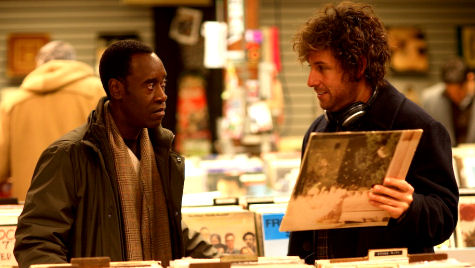

Don Cheadle, Adam Sandler in Mike Binder’s Reign O’er Me

But what if there was a 9/11 movie that was only nominally about 9/11? A movie about dealing with 9/11 grief by not dealing with it, by keeping it in a box? Which, let’s face it, is where an awful lot of people are still at these days. (Like the ones who refused to see United 93 last spring, for instance) And which opens a door in a broader sense to a whole way of living, or not living as it were.
This is what Mike Binder’s Reign O’er Me, which I saw a couple of weeks ago, is more or less about. Set in Manhattan, it’s about a dentist and a widower in his 30s named Charlie (Adam Sandler) who lives in a state of total shutdown that requires never feeling grief over his dead wife and daughters — killed on 9/11 because they were on one of the jets that slammed into the towers. Because the hard drive has been erased and he’s living somewhere else.
< ?php include ('/home/hollyw9/public_html/wired'); ?>
The story’s about how Charlie slips into a renewed friendship with a dental-school pal named Allan (Don Cheadle), a well-to-do husband and father who relates to Sandler because he’s also living in a place of crust and solitude, and how this friendship brings some comfort to both. And then, very gradually, a bit more.
I’m bringing this up because I know Reign O’er Me is honest and real and excep- tional. And because I’m hearing that Sony Pictures execs are also high on it and have tested it with Average Joes and gotten some great test scores, and are thinking about opening it on December 1st and going for what they can get.
I’m also talking about Reign because I feel it touches the communal 9/11 current in a sadder and more intimate way than World Trade Center…no offense to Oliver or Michael Shamberg or Stacey Sher or Paramount, because they’ve made a good film also. But Reign has a metaphor that spreads out and sinks in. Which is that everybody (or almost everybody) buries the stuff that hurts.
I’m also mentioning Reign O’er Me because Sandler is damned convincing as Charlie, and despite his having never gone into serious acting territory, his work is good enough here to warrant entry into the year-end derby. I’m serious.
Sandler has never tried to do much more than his patented Sandler shtick (Punch Drunk Love and maybe The Wedding Singer excepted). But his Reign performance is a trip off the reservation. And it all crescendos in a breakdown scene at the end of Act Two that nails it and makes the performance whole. Say what you will about Click and Little Nicky, but Sandler’s Charlie is going to earn serious respect.
I’m also talking about Reign O’er Me because it’s Binder’s best film ever — it’s at least two or three notches better than The Upside of Anger, which I thought was a solid 8.5 with a couple of nicely full-bodied performances by Joan Allen and Kevin Costner.
And because Cheadle is superb in the film also — I found him much more affecting in this than in Hotel Rwanda. And because the rest of the cast — Jada Pinkett Smith, Saffron Burrows, Liv Tyler, Robert Klein, Melinda Dillon, John de Lancie, Donald Sutherland, and Binder himself — give rooted, lived-in performances all down the line.


Jada Pinkett Smith, Don Cheadle

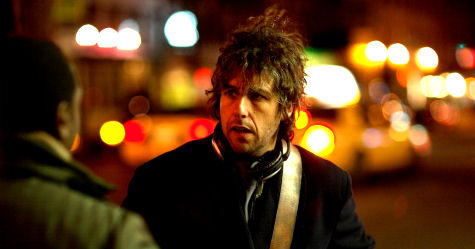
And because Russ T. Aslobrook’s widescreen photography, which was captured with a digital Genesis camera, is quite beautiful at times, the footage of nighttime Manhattan in particular.
And because the whole thing just works in a layer-by-layer way. Because it has a certain decency and quiet focus…a not-slow, not-hurried, building-into-something- true quality. And because it’s finally as much about Cheadle’s character and his marital issues as it is about Sandler’s emotional novacaine.
There are plans afoot to try to get it shown at certain festivals and hire the right publicity firm, etc. The usual moves for any quality-level drama with a December release date. Reign O’er Me (which is incorrectly called Empty City on the IMDB) may or may not get awards traction…who knows? Resistance among the Sandler haters may be so stiff that they won’t consider him for Best Actor…but I would be astounded if he doesn’t pick up support among the handicappers.
That’s about it. I just wanted to put this out there and let everyone know that some- thing pretty damn good has joined the fray…nothing more.

Kattrall Nissan

If anyone knows anyone who managed to digitally capture that Kim Cattrall Nissan ad that ran on New Zealand TV before it was banned for being too sexually out-there….the one in which she moaned suggestively while driving over a hump in the road (the ad reportedly shows a yellow road sign with that very word printed in black letters), and then, while talking to a Nissan salesman, says, “Why didn’t you tell me it was so big? I just wasn’t prepared for it! The all-new Nissan Tiida makes you feel really, really, really good inside. Absolutely fabulous! I mean the great body and the way you moved it.” Send it along and I’ll run the link or load it onto my server…whatever.

Edelstein on “Vice”

In Miami Vice, director Michael Mann and cinematographer Dion Beebe “make everything strange — the hard horizontal lines of office buildings, the maze of tributaries off Biscayne Bay. Shots of Crockett and Tubbs’s team are near hallucinatory in their mixture of amorphousness and brisk efficiency. The violence is fast, messy, discombobulating — much of the climactic shootout is Cops-style, from a limited video vantage, the soft pop-pop-pop of distant guns far eerier than the usual overamplified cannon roars.” — from David Edelstein ‘s rave review in New York magazine.

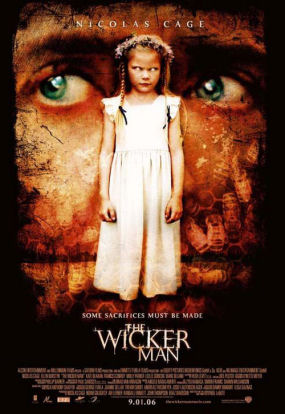
“Wicker Man” poster

Director-writer Neil Labute talked about The Wicker Man (Warner Bros., 9.1) at Comic Con last weekend, and also showed a scene from the opening of the film. Nic Cage is a motorcycle cop pulling over a young mother because her daughter has thrown a doll out in the road. The scene starts to get creepy, and then creeper still…and then shocking, and then demonic.

The Wicker Man trailer is even creepier. They’ve both left me with a feeling that it’s going to be a very unnerving, very scary film . Labute is one of the brightest directors around, but I wouldn’t call him warm and fuzzy. And you need a little touch of steel in your soul, I think, to push the right buttons and do the job on people. Labute acknowledged last weekend that the subject, deep down, has something to do with his feelings about women.

DVD Newsroom debut

DVD Newsroom needs to be denser with Drudge report-type links to all the hot DVD sites, but the idea is good — a one-stop shopping DVD site with a daily blog digest of studio news and releases. As co-editor Suki Jonze explains, “We watch the watchmen with irreverent beer goggles…no more checking tons of sites….we pull it all together with a nice bloggy bow on top. ” Okay, but I want to see a Hollywood Wiretap site for DVD’s. That would make me happier.

Nilsson again

The Los Angeles premiere — finally! — of John Scheinfeld‘s Who is Harry Nilsson (and Why Is Everybody Talking About Him)? will be a one-shot thing at the American Cinematheque’s Aero theatre on Wednesday, 8.23 at 7:30 pm. A truly touching saga of a relentlessly self-destructive genius, Nilsson is still apparently looking for a distribution arrangement of some kind. (A call to Scheinfeld wasn’t returned.)
Nilsson was one of rock music’s most gifted songwriters and melody-makers…ever. The glory of his life was a period of eight years — roughly from ’66 to ’74 — when he wrote or sang “Cuddly Toy,” “Without You,” “Everybody’s Talkin’ At Me” (the famous Midnight Cowboy tune), “Maybe,” “One,” “Daybreak”, “Coconut,” “Jump Into the Fire” and “You’re breaking my heart, you’re tearing it apart, so fuck you.” His first 25 years were formative (he was born in 1941) and the last 20 were about self destruction — booze, drugs and who knows how many tens of thousands of cigarettes. His parents both died in their 50s so maybe he believed it was in the cards, but Nilsson’s heart finally gave out in January 1994, just before the big L.A. earthquake.
Obviously those eight years were blessed, shining, God-imbued. The parts of his character that would eventually lead to his death were present and pulsing, but the creative instincts ruled and he was truly king of a kingdom then. The Beatles, Randy Newman and Brian Wilson worshipped Nilsson, and so did everyone else in the music industry along with the millions of fans. But as Eric Idle says of Nilsson, “He liked to party, and he got that….and in the end, it got him.” In the life story of almost any genius, the third act usually sucks.

Munoz vs. Shmuger

There’s a bit of a “what’s this about?” feeling behind Lorenza Munoz‘s L.A. Times examination of the daunting tasks facing Universal’s co-chairman Marc Shmuger, and particularly the industry view (which she seems to personally endorse) that marketing guys like Shmuger and Disney’s Oren Aviv running the show at two major studios is a bad trend. I mean, you can feel the agenda when she takes a swipe at Shmuger for “using cold business terms such as the ‘product line.'”
I’m not saying that marketing guys-running-the-big-studios is necessarily a wonderful trend either, but here’s what I think may have happened. Munoz and her editors mainly wanted to go after Aviv, in part because she and her editors were angered and alarmed when Dick Cook picked Aviv to suddenly replace Nina Jacobson last week (everyone was upset about this), and also because Aviv was disingenuous with N.Y. Times reporter Laura Holson the other day about the circumstances leading up to his being offered the job, and because he said “I want to make movies like The Pacifier,” but there’s nothing to really nail him for so she went after Shmuger instead. It’s just a theory, but at least it explains the “why?” behind her piece.
The topical opportunity. obviously, is Michael Mann’s Miami Vice, which opens on 7.28. There’s a graph in which Munoz all but forecasts Vice‘s failure, and you get the idea she’s not exactly dispassionate about the idea of Shmuger struggling and possibly failing to get this richly aromatic crime film off the ground. Calling it Uni’s “biggest gamble,” she notes that Vice “cost $140 million to make…but given the somewhat tepid tracking with audiences so far, the film could have difficulty turning a quick profit despite a $50 million marketing and publicity campaign.”