

Miami Vice was a financial slapdown for Universal — it hurt and it stung — and L.A. Times writer Lorenza Munoz examines the details. Michael Mann‘s undeniably entrancing crime pic cost at least $235 million to make and market, and pulled in a lousy $63 million theatrically in this country…not good. “The studio underestimated the inherent challenges of translating ‘Miami Vice’ to the big screen,” Universal chairman Marc Shmuger tells Munoz. “As a commercial proposition, it had a familiar title but not a really deeply appealing connection to the larger audience.”
And then there’s the beef about talent getting overcompensated. “The biggest winner in the case of Miami Vice could be Mann, who will make at least $6 million, plus a percentage of the box-office receipts, before Universal makes a dime, according to people familiar with his deal,” Munoz reports. Miami Vice is symptomatic of a malaise in the industry,” media analyst Harold Vogel contends. “The industry is undergoing a transition in terms of business models. For the first time in many years, they are encountering strong head winds against whatever they throw up against the screen.”
Garbage at bus stop

Strong evidence of Syracuse University students having waited for a bus an undetermined number of hours before shot was taken at campus bus stop. Snapped on Sunday, 9.3, 4:45 pm.

McCarthy on Telluride
Variety critic Todd McCarthy susses the just-wrapped Telluride Film Festival, and reports in the final graph on the skunk that got into the 70mm screening of Jacques Tati‘s Playtime: “At about the hour-and-45- minute mark, a great rustling commenced on the Galaxy Theater’s main floor, followed by outright panic and a stench that was unmistakable: A skunk had somehow made its way into the cinema and was scurrying around under the seats — another Telluride first that would be hard to reproduce anywhere else.” And by the way, here’s McCarthy’s Little Children review.
“Illusionist” Making Out
“Proving to be a late summer sleeper, The Illusionist summoned an estimated $8 million at 971 venues over the extended weekend, its first nationwide. Like Little Miss Sunshine, the $16 million period drama has maintained a high per theater average with each expansion, suggesting broad appeal and strong word-of-mouth, and, with a $12.1 million gross in 17 days, it has already exceeded the rosiest of expectations prior to opening. Producer Bob Yari will expand The Illusionist to around 1,400 theaters on Sept. 8.” — from Brandon Gray‘s “Box Office Mojo” report on 9.4.06.
speed-the-plow Thompson
A speed-the-plow version of Anne Thompson‘s Telluride impressions on her Risky Biz blog: (a) Little Children (New Line, director-writer Todd Field) — Telluride reaction was “decidedly mixed…some people don’t buy this movie”…a “deglamorized” Kate Winslet has solid shot at a best actress nomination; (b) The Namesake (Fox Searchlight, director: Mira Nair) — “Strong stuff”, “positive” Telluride reaction, pacing needs to be tightened; (c) Venus (Miramax, director: Roger Michell) — Telluride reaction: “The folks loved it but critics may be mixed: the movie is a smart, well-made, conventional crowd-pleaser. Oscar Watch: No question that Peter O’Toole will move the aging Academy.” (d) The Last King of Scotland (Fox Searchlight, director: Kevin Macdonald) — Good Telluride reaction, Best Actor buzz for star Forrest Whitaker; (e) The Lives of Others (Sony Pictures Classics, director-writer Florian Henckel-Donnersmarck) — Telluride reaction was “rapturous…if Germany submits the film for Oscar consideration, it should land a nomination”; (f) Catch a Fire (Focus Features, director: Phillip Noyce) — “Good” Telluride reaction, and star Derek Luke “could prevail in an unusually weak year for leading men, but the movie will need brilliant marketing from Focus Features and huge critical and audience support to survive the competitive Oscar season”; and (g) Infamous (Warner Independent, director: Douglas McGrath) — Telluride reaction was “positive”, but star Toby Jones “can’t go up against the memory of Philip Seymour Hoffman, last year’s Oscar winner, nor will Sandra Bullock erase Catherine Keener as Harper Lee. But Daniel Craig‘s powerful performance as Smith has a shot as supporting.” Wells comment: This will never, ever happen — Craig is a fine actor, but is seriously miscast here.
How Irwin died
One of the late Steve Irwin‘s contemporaries, cameraman and spearfisherman Ben Cropp, has spoken to a cameraman friend who was nearby when Irwin was killed yesterday by a sting ray tail and has seen the footage. Here’s Cropp’s description, as passed along to The Australian on Saturday night:
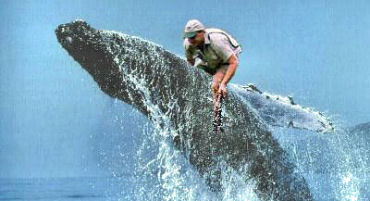
“Steve was up in the shallow water, probably 1.5 meters to 2 meters deep, following a bull ray which was about a meter across the body — probably weighing about 100 kilograms — and with quite a large spine. And the cameraman was filming in the water.”
Cropp said the stingray freaked when he felt cornered by Irwin and the cameraman. “Steve was alongside and there was the cameraman ahead, and [the animal] probably felt there was danger and it balked. It stopped and went into a defensive mode and swung its tail with the spike. Steve unfortunately was in a bad position and copped it.
“I have had that happen to me, and I can visualize it — when a ray goes defensive, you get out of the way. Steve was so close he could not get away, so if you can imagine it — being right beside the ray and it swinging its spine upwards from underneath Steve, and it hit him.”
“The Lives of Others”
“I’m on my way back to L.A. from Telluride, and without question the biggest find of the fest was The Lives Of Others, a German-made from first-time director Florian Henckel-Donnersmarck, who worked six years on the film and it now being courted by all the agencies,” a friend wrote early this evening.
“Sony Pictures Classics picked it up last May, and it’s set for a February ’07 release. This should be the German Oscar entry for Best Foreign Language Film, from which a nomination is all but assured, and perhaps even the Oscar itself.
“The story’s basically about the last days of Stasi, the diseased East German Secret Police, as things were falling apart in ’89. It’s about a Stasi agent (Ulrich Muhe) eavesdropping on a playwright (Sebastian Koch) and his actress wife (Martina Gedeck), and the stuff that comes to the surface when they begin to intreract.
“Philip Noyce‘s Catch a Fire also was getting good buzz on the street and many were calling Mira Nair‘s The Namesake her best ever (although I missed it).
“Kings Men” trailer
I watched the trailer for All The King’s Men for the eighth or ninth time last night, and I’m starting to seriously doubt my ability to watch the full-length feature version of this Steven Zallian film with anything close to a neutral and receptive attitude. Sean Penn‘s squealing, vocal-chord-shredding delivery of that stump speech (“Yo’ weel is mah strength!”) at the end is driving me up the wall. It’s chalk-on-a-blackboard time. “They want to take from yew…and ahh weeyull not let theyemmmm!”
Shrieking girls
I’m sitting in a Starbucks on Marshall Street in Syracuse, and it seems like a fair and reasonable thing to say that the louder a person (a woman in particular) giggles, laughs and shrieks in a crowded cafe, the less worthy they are as a human being and the less gifted their children will turn out to be, if and when they conceive. Loud whoops of laughter from groups of college-age chickie-babes are on the same level of offensiveness as a fat homeless man urinating on a crowded street in broad daylight. I’m listening to these women right now and I’m thinking, “You’re future is mapped out for you…you’ll never be invited to the White House…you’ll almost certainly suffer through a bad marriage…you’ll never run your own business…it’s highly doubtful that you read books, and if you do it’s only airport fiction,” etc.
“Children” wounded in Venice
The buzz on Alfonso Cuaron‘s Children of Men (Universal, 12.25), which had been teetering since Universal bailed on its original early fall opening in favor of a Xmas debut, has now downshfted due to a yes-and-no Venice Film Festival review Variety‘s Derek Elley, along with a similar view posted by Screen Daily‘s Steve Marshall.
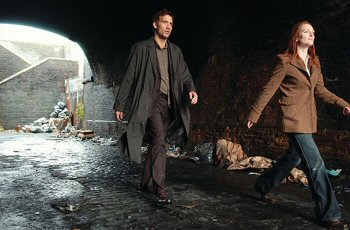
Children still sounds like an absolute must-see, but these reactions leave me with no choice but to scratch Children from Best Picture consideration, and to scratch Cuaron from the Best Director ranks. Sorry, Uni publicity pallies, but it’s a tough world out there and cigars cannot be handed out for “pretty good” with two exceptional standout selling points.
Elley gives Children of Men a passing grade, but says the only aspects of this futuristic melodrama that really and truly kick ass are Emmanuel Lubezki‘s hand-held cinematography and Michael Caine‘s supporting performance as an eccentric hippie-ish type. Otherwise, he says, it’s not bad, spotty, touch-and-go.
Elley praises the “gritty, docu-like sequences [in which] Cuaron and camera operator George Richmond orchestrate several lengthy single takes that have a front-line feel….these include an attack in a car (a single take that required a special rig for the camera to get inside and around the car) and the movie’s showpiece climax. Latter single take recalls Full Metal Jacket in its landscape and Black Hawk Down in its intensity.”
He also singles out Caine for bestowing “some heart and soul due to a wonderfully eccentric [turn] that’s awards-season-worthy. Caine’s beatific performance, in hippie spectacles and shoulder-length hair, is treasurable, and provides the two shafts of sunlight in the otherwise gray and wintry movie,” he says.
Otherwise, Elley calls Men “an often grippingly realized portrait of a not-so-futuristic Blighty, in which fascism and infertility have become uneasy bed partners” but ” a fine but flawed exercise in dystopia. Much more effective when it’s a down-and-dirty actioner than when the script tries to grapple with the multitude of personal and political issues raised, pic suffers from cold lead playing by Clive Owen.
“Set only 21 years in the future, in November 2027, pic — based on the 1993 novel by British writer P.D. James, better known for her murder mysteries — posits a world racked by infertility and social chaos, in which terrorism is the norm. The U.K., however, is a relative haven of peace — ‘The world has collapsed; only Britain soldiers on,’ trumpets Brit-TV propaganda — and as a consequence immigration is out of control.
“Cuaron clearly got to know Blighty when shooting Harry Potter and the Prisoner of Azkaban. He paints a grungy, Orwellian country of perpetual security announcements, prowling armed police, garbage in the streets and illegal immigrants in cages — in fact, not so different from the U.K. today, and far more believable in every respect than in the feeble V for Vendetta.”
Elley says that “Cuaron’s decision not to shoot in widescreen actually accentuates the movie’s gritty power” — which means what? That Cuaron went with a 1.33 to 1 aspect ratio like Gus Van Sant‘s Elephant and Last Days, or that he shot it in standard, no-big-deal 1.85 to 1? Is Elley hinting that the normally effective way to shoot a dark futuristic flick is to shoot it in widescreen scope (2.35 to 1)? This part of the review lost me.
Vachon Hates Angelika
Indie producer Christine Vachon (Far From Heaven, Boys Don’t Cry) has it in for Manhattan’s Angelika Film Center, according to a N.Y. Post excerpt from her upcoming memoir called “A Killer Life: How An Independent Producer Survives Deals and Disasters in Hollywood and Beyond” (Simon & Schuster, 9.19). “I hate the Angelika,” Vachon has reportedly writen about the Houston street plex. “I won’t see movies there. The seats are uncomfortable, the sound is crummy, you can hear the 4/5/6 train rumbling underneath you, and the film projectors are terrible. Don’t even get me started on how the Technicolor [in] Far From Heaven looked on their screens. I couldn’t watch.”
Crime against “Idiocracy”
“I must ask why you (and others, including David Poland) are ignoring the artistic crime being committed by Fox against Mike Judge‘s Idiocracy this weekend. By most accounts, this film’s satire sounds quite scathing. And the reviews seem to be generally positive (67% positive from Rotten Tomatoes), except for EW‘s truly idiotic online non-review, so I can’t buy the ‘it must be really awful’ studio line.
“That the film hasn’t been released anywhere on the east coast, and has been unceremoniously dumped in limited release in a few cities — dumped to the extent that frickin’ Moviefone actually refers to the films as ‘Untitled Mike Judge Project,’ and very few people have even seen a poster for the damn thing — is news of some sort, certainly, for entertainment journalists.
“I know you’re not in LA right now (where it’s playing), but I still think this deserves a mention. Also, it’s playing in Toronto (though not at the festival). Let’s hope some critics and journalists do their duties and see it this week or next.” — Bilge Ebiri
Okay, you’re right. I’ll see it when I get back to Toronto and then run something, before the festival starts.