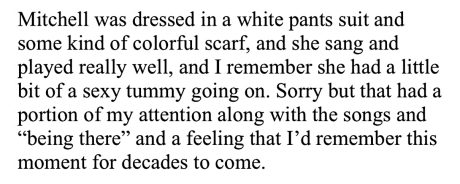
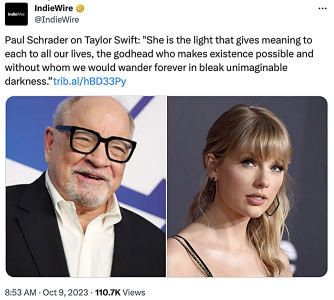
But this tweet is dead-on:

But this tweet is dead-on:

According to The Guardian‘s Charlotte Edwardes, and more specifically Oppenheimer star Cillian Murphy, director Chris Nolan doesn’t have a telephone, an email address or a computer: “He’s the most analogue individual you could possibly encounter,” Murphy says.
About Oppenheimer itself, Murphy calls it “an extraordinary piece of work…very provocative and powerful…it feels sometimes like a biopic, sometimes like a thriller, sometimes like a horror. It’s going to knock people out…what [Nolan] does with film, it fucks you up a little bit.”
A journalist friendo knows a sketchy someone who’s claiming it’s “a bit dull.” (The source, I’m told, is not to be trusted.) Another journalist knows someone who saw Oppenheimer a few weeks ago, and this fellow has described it as “slightly pretentious but with a knockout 30-minute finale.”
On 3.21.23 I posted a warning…actually a feeling of anxiety and trepidation about Nolan’s sound mixing of Oppenheimer. Please God (or please Chris) — allow me to understand the dialogue in this upcoming film. Please don’t drive me crazy with the fucking mix…please. There is no one in the cinematic universe who would be more overjoyed than myself if the dialogue turns out to be audience-friendly.
The Empire Strikes Back climax with a Nolan sound mix:
An excellent exploration of the Nolan sound aesthetic going back to The Dark Knight:
HE’s favorite Jack Nicholson films are, in this order, The Last Detail, Prizzi’s Honor, Chinatown, Carnal Knowledge, Heartburn, The Departed, Five Easy Pieces, Easy Rider, As Good As It Gets, The Shining, Terms of Endearment, The Passenger.
I wouldn’t complain if someone told me you may never again watch Tim Burton’s Batman (‘ 89). Ditto Milos Forman’s One Flew Over The Cuckoo’s Nest (‘76) — never a big fan of that film.

There is no joy in Mudville over the sluggish response to Adele Lim‘s raunchy Joy Ride, which was produced by Point Grey Pictures’ Seth Rogen and Evan Goldberg.
Deadline‘s Anthony D’Alessandro projected between $7 and $9M at 2,820 locations; now the weekend tally is looking closer to $6.5M. A $1,100,000 haul on Thursday, and $2,600,000 yesterday — $3,700,000 so far. Friday’s per-screen average was $922.
Although the film sent me into a black pit of depression and I only laughed once, I’m not personally delighted by this shortfall. Lim directs with urgency and vigor, and Cherry Cheva and Teresa Hsiao‘s well-structured script delivers heart as well as vulgarity. I’d decided by the finale that I didn’t completely hate it, and that ain’t hay.
But I knew the formerly titled Joy Fuck Club was a dead fish when I saw the B-minus CinemaScore rating plus that statement by David Poland that he’d returned for a second viewing with his wife and 13-year-old son. Yes — I’m referring to an adjunct of the Poland curse.


A Warner Archive Bluray of Howard Hawks‘ Land of the Pharoahs (’55) pops on 7.18. It features grainy WarnerColor and a 2.55:1 aspect ratio.
In a September ’78 issue of Film Comment Martin Scorsese stated that Pharoahs was one of his guilty pleasures. It’s certainly “big” and colorful — it was partly shot in Egypt — and boasts a lot of great-looking sets and costumes, and Hawks used something close to 10,000 extras.
But the only thing that’s truly great about Pharoahs is Dimitri Tiomkin‘s score.
The musical accompaniments by the Russian-born Tiomkin often had a soaring, grandiose, even bombastic quality, but his scores were so rousing they almost served as characters in and of themselves.
The greatest Tiomkin scores: Duel in the Sun, It’s a Wonderful Life, Red River, The Men, The Big Sky, High Noon (film historian Arthur R. Jarvis, Jr. once claimed that Tiomkin’s music “saved” that Oscar-winning Fred Zinneman film), The High and the Mighty, The Guns of Navarone, Strangers on a Train, I Confess, Dial M for Murder, The Thing from Another World, Giant, Rio Bravo, The Alamo.
A week and a half ago (6.26.23) I noted the 40th anniversary of the opening of Twilight Zone: The Movie, and mentioned an interest in wanting to find a copy of Stephen Farber and Marc Green‘s “Outrageous Conduct: Art, Ego, and the Twilight Zone Case” (1.1.88).
I asked my local library if they had a copy — they did not. But they offered to search for a copy at other libraries in southwestern Connecticut. Two days ago they told me they’d found one and that it had been sent down by courier. I’m now reading it. Smoothly written, excellent reporting. Thanks to the Wilton Library.

In yesterday’s comment thread for my Joy Ride review, a commenter named “The Machine is still on Moira” said “this review is up there with Wells’ review of To The Wonder.”
To The Wonder “is a wispy, ethereal thing composed of flaky intimations and whispers and Lubezki’s wondrous cinematography with maybe 20 or 25 lines of dialogue, if that. It’s basically The Tree of Life 2: Oklahoma Depression. It’s Malick sitting next to you and gently whispering in your ear, ‘You wanna leave? Go ahead. Go on, it’s okay, I don’t care…do what you want. But you can also stay.'”
“I’ve been dumping on this film since catching it at last September’s Toronto Film Festival, but I want to emphasize something important. The trick is to see this thing without expecting it to act like a movie. Because it works if you submit to it like you would an art gallery experience. It’s passive and reflective like the sea on a windless day, but in a Moby-Dick sort of way: “The sea where each man, as in a mirror, finds himself.”
“Malick gives you so little to grapple with (at least in terms of a fleshed-out narrative and that thing we’ve all encountered from time to time called ‘speech’ or ‘talking’ or whatever form of oral communication you prefer) that” — like staring at paintings or sculptures in a museum — “it’s pretty much your responsibility to make something out of To The Wonder‘s 112 minutes,” I wrote on 9.11.12.
“It’s all about you taking a journey of your own devising in the same way we all take short little trips with this or that object d’art, whereever we might happen to find one. The film is mesmerizing to look at but mostly it just lies there. Well, no, it doesn’t ‘lie there’ but it just kind of swirls around and flakes out on its own dime. Run with it or don’t (and 97% of the people out there aren’t going to even watch this thing, much less take the journey) but ‘it’s up to you,’ as the Moody Blues once sang.
“To The Wonder doesn’t precisely fart in your face. It leads you rather to wonder what the air might be like if you’ve just cut one in a shopping mall and there’s someone right behind you, downwind. That’s obviously a gross and infantile thing to think about, but To The Wonder frees you to go into such realms if you want. It’s your deal, man. Be an adult or a child or a 12 year-old or a buffalo. Or a mosquito buzzing around a buffalo. Naah, that’s dull. Be a buffalo and sniff the air as Rachel McAdams walks by! You can go anywhere, be anything. Which is liberating in a sense, but if you can’t or won’t take the trip you’ll just get up and leave or take a nap or throw something at the screen. Or get up and leave and head for the nearest mall.
“I went with it. I wasn’t bored. Well, at least not for the first hour. I knew what I’d be getting into and I basically roamed around in my head as I was led and lulled along by Emmanuel Lubezki‘s images and as I contemplated the narcotized blankness coming out of Ben Affleck‘s ‘Neil’ character, who is more or less based on Malick. Or would be based on Malick if Malick had the balls to make a film about himself, which he doesn’t. If Malick had faced himself and made a film about his own solitude and obstinacy and persistence…wow! That would have been something.
“But Malick is a hider, a coward, a wuss. He used to be the guy who was up to something mystical and probing and mysterious. Now he tosses lettuce leaves in the air and leaves you to put them all into a bowl as you chop the celery and the carrots and the tomatoes and decide upon the dressing.
“I don’t know how many times Olga Kurylenko (who plays Ben Affleck‘s French wife who winds up stranded and gasping for air in Bartlesville, Oklahoma) twirls around in this film, but she does it a lot.”
Any agent or talent manager will tell you that once an actor has broken into the Hollywood big leagues by starring or costarring in a critically hailed or commercially successful film, they need to score again within, say, the next five to ten years. They can’t just cruise along indefinitely in a moderate or mezzo-mezzo fashion — they need to equal what they accomplished with their first flurry of hits.
Ten years ago Margot Robbie was launched with a spritzy, attention-getting role as Leonardo DiCaprio‘s gold-digger wife in The Wolf of Wall Street, a critical knockout that earned over $400 million.
Robbie has done relatively well for herself since, save for her recent losing underwhelming streak of the last four years — Harley Quinn in Birds of Prey (’20) and The Suicide Squad (’21), a puzzling, dead-end lead performance in David O. Russell‘s perplexing and calamitous Amsterdam (’22) and especially her abrasive and misbegottten Nellie LaRoy in Damien Chazelle‘s Babylon (’22), a breathtaking critical and commercial flop.
Then again Robbie delivered an appealing cameo in Adam McKay‘s enjoyable, critically praised The Big Short (’15). Two years after that (’17) she not only starred in but produced I Tonya (’17), an indie-level mockumentary that was mostly critically approved (I hated it) and earned $53.9 million — not bad for a hand-to-mouth indie that cost $11 million to produce. Two years later she played Sharon Tate in Quentin Tarantino‘s Once Upon A Time in Hollywood (’19). The same year she played a fictitious character in Jay Roach‘s Bombshell, a Fox News / Roger Ailes expose. The following year she produced Emerald Fennell‘s Promising Young Woman (’20).
So she’s hung in there pretty well, but Barbie, it appears, will be Robbie’s first heavy-throttle, high-octane hit since The Wolf of Wall Street.
Whether or not it’ll score critically is another story.
A regional friend who gets around says he’s hearing “very mixed” reactions to Barbie. There are tea leaves to be read…tea leaves under a cloak of secrecy. A couple of pallies saw Barbie over the last couple of days and were asked to signed NDAs. If Barbie was some kind of great or exceptional, wouldn’t exciting buzz be circulating now, like the Mission Impossible 7 buzz was all over the place for the last several months? In the same sense downbeat reactions to Indy 5 were detectable for months on end. So if Barbie is a big winner, why would you have industry vets sign NDAs? I’ll tell you why. Because loose lips sink ships.

Posted by World of Reel‘s Jordan Ruimy about a week ago:

Everyone is welcomed, embraced and celebrated in Barbie-land. Unless, of course, you’re a white, middle-aged or older cis male like Will Ferrell’s Mattel CEO or, you know, someone like myself. In which case you’re a bit of a problematic life form.
Which is sorta kinda how it works in the real world these days, no?
Now as before, the smart play is to keep your head down and operate within the herd, so to speak. Don’t mouth off or make waves, don’t stand out, conform or be silent. And if you’re an older white cis male, be as invisible as possible. That or get the hell outta Dodge.

Better to get Barbie out of the way early, allowing myself time to tap out a brief, in-depth review before settling in for the main course at 7 pm.


I stared at Adele Lim‘s Joy Ride (aka Joy Fuck Club) like an Egyptian sphinx. I was honestly hoping to laugh but I didn’t. At all. I just fucking sat there…sorry. I seem to recall having the same reaction to the Hangover movies. I hate movies about people drinking shots. I really do.
Others in the audience laughed, however, so there’s that. High-pitched hyena laughter, I mean. And certain critics have called it funny. So blame me….it’s my fault that I didn’t so much as smirk or guffaw or even crack a smile.
Actually, that’s not true — I smirked at the sex scenes. Particularly an oral sex scene with two guys eating out Ashley Park‘s character at the same time, and I don’t mean one of them licking her anus while the other does the clitoris…I mean both of them chowing down side by side. That I laughed at.
And I did respect much of what I was watching. Joy Ride is not some sloppy-ass, improvisational bullshit anarchy comedy like…I don’t know, What’s New Pussycat or something. It’s a real movie with a sense of structure and three acts and an aspirational heart. It emotionally touches bottom during the last 20 or 25 minutes.
And I respected the decisive, highly sprung energy…the shallow but spritzy feel of it…the lively performances…Lim’s fast-paced, high-velocity direction…the screwballish, His Girl Friday-like script by Cherry Cheva (aka Chevapravatdumrong) and Teresa Hsiao. It’s really not bad.
It’s silly and shallow and formulaic but comedies like this are expected to dive into this kind of jaundiced fuckwad swimming pool.
I didn’t much care for Sabrina Wu‘s “Deadeye”, the obligatory trans-non-binary character with (not a pun) slightly dead eyes, but I pretty much loved the other three — Park’s “Audrey Sullivan”, a lawyer and an allegedly Chinese child of adoptive white parents who lives in White Hills, Washington (there has never been any town or village or real-estate district in the world called White Hills…a completely bullshit and thoroughly racist name of a cliched Anglo hamlet), Sherry Cola‘s “Lolo Chen”, and Stephanie Hsu‘s Kat.
And I really loved Daniel Dae Kim, who plays the husband of Audrey’s birth mother.
Much of Joy Ride feels inhabited by at least a semblance of recognizable human behavior. Not actual human behavior, mind, as it adheres to the rules of farce, but at least it tries to go there now and then. I respected that effort.
Don’t let the fact that I smirked at only one scene and sat stone-faced throughout the rest of it….don’t let that stop you from giving it a whirl.
The first two thirds to three-quarters of Joy Ride made me feel like my life is winding to a close and that perhaps I need to think about killing myself, but I gradually got past that. What matters, I think, is that it pays off during the final 20 or 25.