

A split decision from the trades on Michael Mann‘s Miami Vice. Variety‘s Brian Lowry doesn’t do cartwheels but he generally approves of the fact that “Mann’s handsome adaptation eschews the campy spoofs and thinly veiled disdain for the source material (think Starsky & Hutch and Charlie’s Angels) that have plagued TV-based movies; instead, Vice revels in the creative latitude that an R-rated feature provides without departing from the show’s rudimentary structure.” But the Hollywood Reporter‘s Michael Rechshaffen is calling it “a long and talky excursion that fails to engage the viewer from the outset” with Colin Farrell and Jamie Foxx appearing “to be engaged in a contest to determine who can appear more morose while expending the least amount of energy, especially in terms of their own flat exchanges.”
Tracking Problems
Variety‘s Gabriel Snyder has written a savvy story about how tracking from the three big companies (NRG, Marketcast, OTX) sometimes varies wildly, and how “midway through the summer, the studios have become keenly aware of cracks in their crystal ball.”
Tracking, or the survey data that’s supposed to give a strong clue what films people are interested in seeing, “has become the key source of studio expectations over B.O. prospects,” Snyder writes. “But the information, once closely guarded, has gone public at the exact moment that serious questions are being raised over its reliability.”
The biggest complainer in the piece, understandably, is Universal’s co-chairman Marc Schmuger, who was irate over an item I wrote from Cannes about The Break-Up that noted that 30% of people polled had a “definite interest” in seeing the film, and only 5% said it was their “first choice” to see that weekend, which seemed to mean that “the game is pretty much over,” I wrote. (Snyder says the author was “a blogger from Hollywood-Elsewhere.com.” I guess there’s no way to stop people from calling HE a blog, but I prefer the handle of “columnist.”)
I was just repeating what I’d been told and the figures weren’t inaccurate, but the verdict wasn’t a fully considered call on my source’s part or my own, and I’ve openly admitted this and tried to learn from this episode. (Schmuger says that NRG, MarketCast and OTX “were in complete disagreement on how The Break-Up was going to perform along every step of the way…when your information is in such disagreement, you’re in complete confusion…it was a classic case where tracking was significantly off from where the performance was…it was the most frustrated I’ve ever been in my many, many years at a studio.”)
I consider myself a bit wiser about tracking as a result. I learn something new every time I sift through it. Snyder’s article points out four flaws in the surveying techniques of the three companies, and these same flaws have been pointed out to me by a Universal publicist pal, and I wrote about them myself. So let’s hope that tracking improves down the road.
Box-office falloffs
M. Night Shyamalan‘s Lady in the Water did 4% less business on Saturday than it did on Friday. That’s due to word-of-mouth, of course. It might have dropped even more if it hadn’t been for the rain that hit the northeast (and especially the New York City area) on Saturday. Lady is going to end up with about $18,165,000…the weakest Shyamalan showing since he became “big.” Kevin Smith‘s Clerks 2 suffered a big Friday-to-Saturday drop also. It went from a 7.21 take of $3,967,000 to a haul of about $3,214,000 on 7.22. Sorry to be the bearer but that’s a 20% dropoff…bad. It may not even make $10 million by this evening. Ivan Reitman‘s My Super Ex-Girlfriend will finish seventh with $8.5 million…another tank.
SpiderMan winding down?
Spider-Man 3 (Columbia, 5.4.07) will be the last one? I somehow don’t see that as a huge problem. Does anyone?
Nudie Pataky
Elsa Pataky, a Spanish-born European actress who’s been doing fairly well in Spanish features and TV for the last eight or nine years, has a small role in Snakes on a Plane. Her character is called Maria, and she’s on the cover of Maxim this month. The New Line guys showed a couple of her Maxim photos at Comic-Con on Friday, and I’m trying to end this item without giving off the vibe I’m giving off. Forget it…lost cause.
Lebowski U-Tube
Isolate all the “fuck”‘s in The Big Lebowski and cut ’em all together. Not brilliant, but pretty funny.
The Fun’s Over
The Fun’s Over
[Before reading this article, click on this mp3 file — the song you’ll hear fits the mood of what’s being said.]
For yours truly, the helium began to leak out of the Snakes on a Plane balloon when it was announced last Tuesday that New Line had decided not to advance- screen it for critics. That was a big uh-oh for those who knew the code. Then came last Friday afternoon’s Snakes presentation at Comic-Con, and that was it. End of story, case closed, unplug the phones.
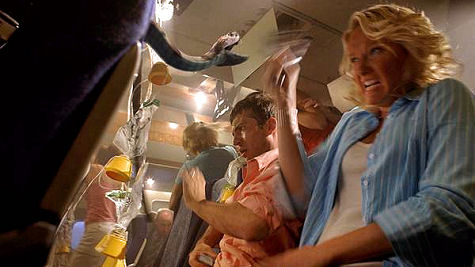
Dumb animatronic snake drawing response from actress hired to play terrified passenger in New Line’s Snakes on a Plane (8.18)
Judging by the eight or nine-minute reel I saw in Hall H, Snakes on a Plane is going to be a wackazoid cheeseball thriller for the pseudo-hippers. But not that much fun for people like me.
The reel seemed to promise a film that will be energetic and kick-assy and will almost certainly do the old New Line exploitation bootie-shake from start to finish. But it also had some fake-snake CG that seemed to be generated by FX software created in 1997. And of course the snakes are lethal killing machines that actually go “hssss!” like a pissed-off audience sitting in a movie theatre. And some of the big snakes, like Spielberg’s Jaws shark, rumble and growl like lions on the plains of Kenya. And some of the animatronic snake models don’t look right.
< ?php include ('/home/hollyw9/public_html/wired'); ?>
The reel promised a lot of screaming and sweating and some great snake-kill moments, but the cutting didn’t seem all that great. (It seemed to me that a bit with Samuel L. Jackson slipping into the pilot’s seat and trying to bring the plane out of a steep dive — a standard plane-thriller gambit — was handled pretty sloppily.)
And it had at least one instance of shamelessly bad dialogue when Jackson says to a senior stewardess when things get rough, “I need you to be strong for me.” A guy I talked to later on tried to dismiss this as part of the joke that I’m incapable of getting because of my own problems, not the movie’s. If I had a sense of humor I would relish the fact that Snakes on a Plane is a genre parody, he meant. So SoP is Airplane now? I think not. Some dialogue isn’t awful enough to be funny — it just goes thud.
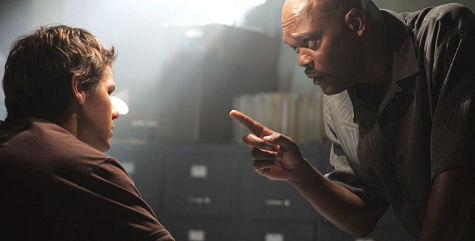
The great Samuel L. Jackson (r.) at FBI agent Neville Flynn.
But the hoo-hah demeanor projected by Snakes director David R. Ellis is what really did it. 45 seconds after he walked out on-stage and started talking about the film, alarm bells were racketing in my head. A former stunt man, actor and 2nd A.D., Ellis reminds me of a hundred below-the-line guys I’ve met in this town over the last 20-odd years…an amiable go-alonger with a good sense of humor and a lot of friends….a guy who walks around in shorts and sandals and who likes to chill in the backyard on weekends with burgers on the barbie and a can of beer in his hand.
Don’t get me wrong. Snakes will be “fun” if you go with the right downmarket attitude. It’s a safe bet it’ll clean up when it opens on 8.18 (the guessers are talking a first-weekend tally in the mid to high 20s), and I’ve been told it has at least three or four “nooo!” scenes that fans are going to howl at as they text-message their friends and spread the word. If this happens it’ll probably translate into decent repeat business.
But the X-factor, smart-guy audience that had been primed and ready to enjoy this comic horror-thriller since the Snakes internet movement began last March has been jettisoned. Jettisoned back when the film was made, I mean. The hepcats loved the title and had fun with it, but they never realized (or wanted to realize) what kind of film Snakes on a Plane actually was all along. And I include myself in that equation.
The impression I got from the short reel on Friday is that Snakes on a Plane is maybe one-tenth as hip as the Snakes riffs we’ve all enjoyed the last three or four months on www.snakesonablog.com….if that.
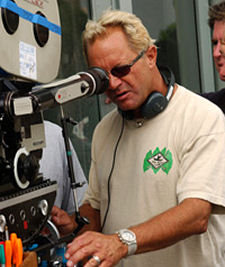
Snakes on a Plane director David R. Ellis
I said it a long time ago, but the best part of Snakes on a Plane happened online in March and April. The movie couldn’t possibly live up to all the hype, and now we’re all starting to get the idea that it indeed hasn’t. Reality has set in, o my brothers. Welcome to the world of 116 No. Robertson Blvd.
Jackson,who was fantastic last Friday on the Hall H stage, said at one point that he loved what had happened with the internet Snakes frenzy, and that he’s looking forward to a day when interactive fans will create plot points for a new film — that the fans will one day become the new auteurs. In fact the fans were the auteurs with the Snakes on a Plane phenomenon. They ran the show. The Snakes team and the New Line “creatives” have been playing catch-up and “hey, can we get in on this thing?” all along.
Who knows what the three Snakes screenwriters — John Heffernan, Sebastian Gutierrez, David Dalessandro — had in mind in the early stages, but I know the Snakes footage I saw on Friday and the what-the-hell, pocket-the-paycheck attitude I picked up from David R. Ellis are one and the same.
The New Line powers-that-be have basically said, retroactively, “Uhh, thanks for the internet word-of-mouth guys. We all had some fun with those clever videos and songs and posters you came up with…really loved it. But that was you, not us. Thanks for thinking it might be and for helping us make millions, and…well, try not to blame us for not being on your wavelength.”
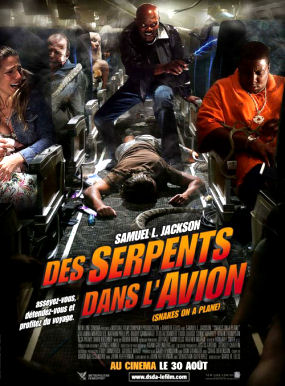
I guess I basically drove all the way down to San Diego last Thursday to have my concerns about Snakes on a Plane confirmed, and now they have been.
I’m sure New Line publicity would like me to be strong for them. Do the dance, hold the line and wait until the movie opens on Friday, 8.18. But they showed the footage at Comic-Con and brought Ellis up on the stage, and I think it’s fair to air my impressions of that.
It just hit me I may be helping the cause with this piece. Critics and media people who haven’t thought much about SoP may read it and go “stupid piece of shit” and write it off, and then they’ll pay to see it in theatres at those 10 pm shows on Thursday , 8.17 and — who knows? — maybe it’ll be a lot more entertaining than what the Comic-Con footage reel indicated and they’ll write good reviews and spread the word.
It’s always better to see a film with low expectations (or no expectations) than high ones. Any distribution exec will tell you this, including the ones at New Line.
L.A. seediness

On the west side of La Cienega Blvd. just north of Beverly Blvd. is a serious Hollywood-style lingerie shop , and across the street is a strip club. I’ve never been inside either of these places and I’ve lived less than four blocks away for the last 15 years. And I haven’t bought a drink at the nearby Coronet Pub in two or three years. But there’s something almost luscious in the late 1950’s seediness represented by these three business establishments. The spirit of Elmore Leonard swirls in and out of their beams and doorframes and floor varnishings. They’re not exactly the L.A. equivalent of the River Oaks theatre, but they’re not far from that.



River Oaks threatened
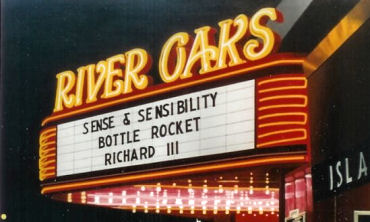
The Landmark River Oaks theatre in Houston is a beautiful old movie theatre, and it has one of the prettiest marquees I’ve ever seen. (I was just in Houston last April and took some pictures of it.) And now Weingarten Realty Investors, a Houston-based company that owns and manages about 300 retail properties in the southern U.S., is apparently looking to tear it down. A pox upon these heartless scumbags if they manage to do this. Old movie theatres harken back to a bygone America. They’re shrines to what used to be. Fortifiers of community soul. Part of what still makes this country beautiful and worth cherishing. And some people are incapable of understanding that.
Jake as Lance
Jake Gyllenhaal to play Lance Armstrong in a Sony-produced biopic, per Nikki Finke ‘s column. Another sports biopic…French locations…go, Lance…terrific. I feel nothing — nothing — about this.
Jack Warden R.I.P.
Jack Warden, who died on 7.19 at age 85, was one of the greatest character actors of the 20th Century, and you don’t have to look any farther than his incredibly skillful and heartfelt performance as Max Corkle in Warren Beatty and Buck Henry‘s Heaven Can Wait (1978) to verify that fact.
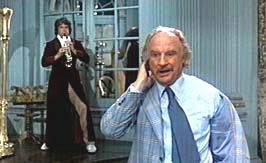
Just chapter-flip to the scene when Corkle comes to visit billionaire Leo Farnsworth (Beatty), who’s actually died and been inhabited-reanimated by the spirit of Corkle’s old football-player pal Joe Pendleton. Corkle is confused when Farnsworth starts talking to him like they’re good buddies, but the best bit happens when Farnsworth tries to explain the rules of life, death, probabilty and outcome. Significantly, the camera stops cutting away to Beatty and stays entirely on Warden for nearly a full minute as Corkle’s discomfort increases with each new mind-blowing assertion by his host.
Warden’s first standout performance was in Sidney Lumet‘s Twelve Angry Men (1957) as the marmalade-salesman juror who can’t wait to end deliberations so he could make it to a Yankee game. His other four knockout roles were as Lester the moustachioed businessman in Hal Ashby‘s Shampoo (’74), Washington Post editor Harry M. Rosenfeld in Alan Pakula‘s All The President’s Men (’76), twin used-car salesmen Roy and Luke Fuchs in Bob Zemeckis ‘s Used Cars (’80), and Paul Newman‘s co-counsel Micky Morrisey in Lumet‘s The Verdict (’82).
Come to think of it, Warden’s Shampoo performance may be the equal of his work in Heaven Can Wait . The scene near the finale when Lester reviews the shambles of his life while sitting in the modest home of hairdresser George Roundy (Beatty) is a near-great one. As I recall, it ends with Warden saying, “God, I need a drink.”
Moriarty on Night
This passage from Drew McWeeny‘s Lady in the Water AICN review got me: M. Night Shyamalan “seems to have cast himself as the Writing Messiah, a man whose words are so powerful that they will alter the very fabric of our reality. The character idea alone would be a little nauseating, but for Night to step in and play his biggest role in any film except his largely-unseen first film…and to have it be this particular role… this is what I mean when I say he invites the comments on his ego now. This would be like George Lucas insisting on playing The Emperor or Alfred Hitchcock playing Norman Bates. It’s so lunkheaded you can’t look away. God help me, I√ɬ¢√¢‚Äö¬¨√¢‚Äû¬¢m not exaggerating.” Read the whole review. It’s a mean one, but it has a thorough and perceptive examination of Night’s egoistic artist psychology.