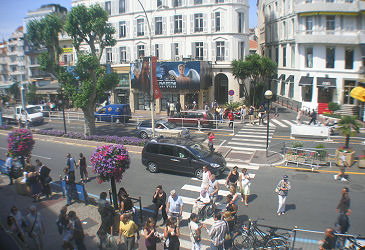

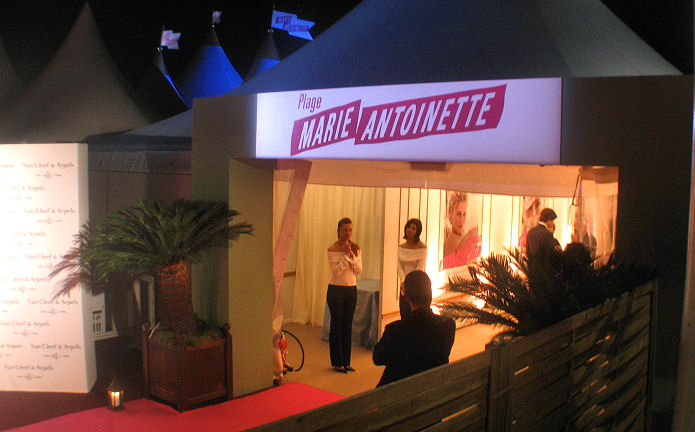
And: (a) Lying duo Molly Hassell and M. Blash aboard the Big Eagle cocktail party for their film — Tuesday, 5.23, 5:55 pm; (b) Shortbus guys Paul Dawson and PJ DeBoy (or is it the other way around?…sorry) at Tuesday’s Lying party; given my sentiments about the film, I didn’t feel quite right about attending Wednesday night’s Marie-Antoinette party…something of a spot decision; (c) Just before a tour bus nearly ran me down — Wednesday, 5.24.06, 7:55 am; (d) Hotel Splendid.




“I understand why some might not like Marie-Antoinette, but the idea of people actually booing it is the most hilariously hypocritical thing I’ve heard at Cannes this year. At least half the competition films that I’ve seen, many of them French, have been dull, turgid and labored. Obviously
Marie-Antoinette doesn’t invite emotional responses as strongly as Lost In Translation did, but Coppola seems to be being criticized for what she hasn’t made, as opposed to recognizing what she has. I think it’s a mistake, if not grossly unfair, of you to somehow paint the film as a failure just because of the overblown reactions of a few pompous Euro crits. The only reaction I heard at my screening was a couple of middle-aged women, one of whom remarked to the other ‘Tres, tres bon’, reflecting my response as well.” — Distribution pal who always asks for anonymity. Wells response: It’s fair to report the boos. They were loud and prolonged, and they expressed my own feelings as well as many, many other press people I spoke to afterwards. As I said yesterday, the theme, craft and tonal consistency in Marie-Antoinette qualify it as a well-made film, but the bland thoughtlessness that lies at the center of it — the complete shucking of the elements that give her story resonance — is rancid. And boooo! to that.
“I don’t know if you’d heard reports of this, but prior to last night’s preview screening for X-Men 3 there was a trailer for Snakes on a Plane and the audience went BALLISTIC! You could tell they were hip to it cause the cheering started as soon as the single word “Snakes” went up, and just thundered all throughout the fairly short teaser, which featured a few fleeting glimpses of snakes, passengers in jeopardy, and Sammy J. I think the idea that SOAP fever is dying down is bollocks. This thing is just getting warmed up.” — Max Evry, Washington, D.C.
I have this idea that Sharon Waxman‘s N.Y. Times story about 20th Century Fox execs pulling the plug on Used Guys, the Jim Carrey-Ben Stiller-Jay Roach comedy, isn’t just well reported. It’s also, I suspect, a sign of the times, a turn in the road…a shot heard round the Hollywood world. The $112 million budget meant that Used Guys would “be one of the most expensive original comedies ever made,” Waxman writes. “And in an industry with crushing marketing costs and top-shelf stars taking a huge chunk of every ticket sale, the studio decided the math didn’t add up.” Bottom-line indicator: Carrey, Stiller, Roach (the director) and other top-dollar players are going to have to start adapting to a world in which they’ll have to settle for being very well paid for their talent and name value, instead of being paid fantabulously-orgasmically. Get used to it, hombres.
Enjoyed a nourishing talk Tuesday night at the Babel party with Pan’s Labyrinth director Guillermo del Toro. I’m seeing GDT’s film tomorrow (Thursday afternoon), chatting formally with him on Friday afternoon. Guillermo said he’s honored that a film such as his (i.e., fantasy, wild imagination, special effects ) is playing at Cannes, but he also believes the festival prize winners have pretty much been decided at this point. (Volver, Babel, et. al.) Naturally he’s rooting for Babel, being a close Innaritu friend and ally from way back.
An Inconvenient Truth opens in Los Angeles and New York today. (I think.) Eli Pariser’s www.moveon.org says “how it does on opening weekend will determine how the movie is received in the press and even how many other cities get to see it.” He’s right, and if you want to help pledge to see the film and urge your friends, etc.
Maybe it’s my fault due to an overly complex paragraph, but that Hollywood Wiretap story that quotes my Marie-Antoinette review got it slightly wrong. I didn’t say that “the scene that seemed to most rile the crowd was one ‘in which French agitators shout angry epithets outside the bedroom of the reviled French queen.'” I made an analogy between French malcontents shouting epithets at Kirsten Dunst’s character in the film and the angry booers at this morning’s screening “as Sofia Coppola’s film ended.”
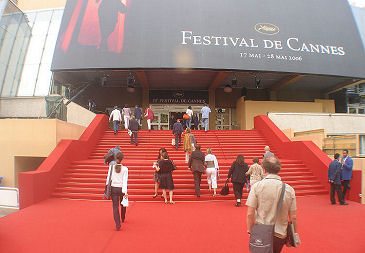
Steps of the Palais prior to Tuesday morning’s Babel screening — 5.23.06, 8:05 am.
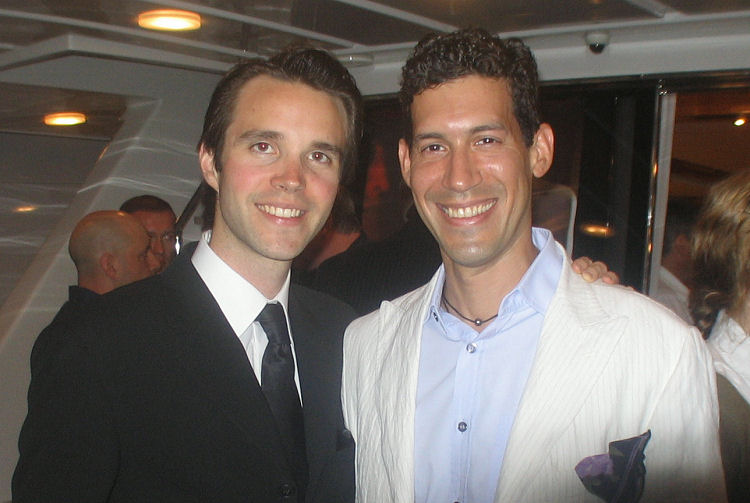
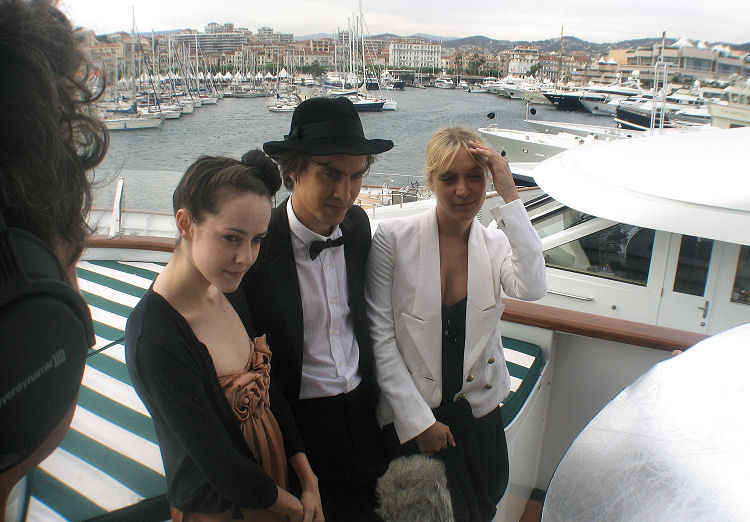
And some others: (a) American traffic cops will ride mountain bikes, but I doubt if they’d ever putter around on cute scooters like these — Tuesday, 5.23, 3:25 pm; (b) Emerging Arists Film Festival honchos Max Ryerson and Thomas Ethan Harris, whose launch party happened a week ago last Tuesday (5.16) in Monte Carlo; (c) The Lying trio on a Big Eagle yacht late Tuesday afternoon: Jena Malone, writer/director M. Blash, Chloe Sevigny — Tuesday, 5.23.06, 5:40 pm; (d) I admit it — I’m vaguely embarassed to be running this photo.


Sony Pictures Classics has partnered up on Persepolis, an in-production animated feature based on Marjane Satrapi ‘s comic-book autobiography (which was written in two parts). SPC announced their distribution deal with the producers at a Tuesday lunch at the Carlton Beach restaurant.
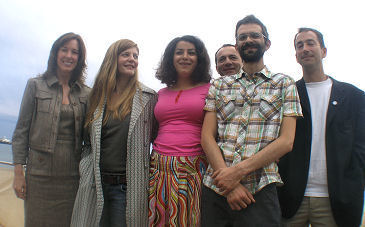
Kathy Kennedy (far left in this group photo and the one above) is the project’s executive producer. Marc-Antoine Robert and Xavier Rigault of 2.4.7 are the hands-on producers. The plan is for the film to be completed by the spring of ’07 and not just be submitted to next year’s Cannes Film Festival but given its debut there. That’s SPC Tom Bernard on the far right; SPC’s Michael Barker is two bodies in from Bernard.
Blood of a Lady
In a reflection of a scene in Marie-Antoinette (Columbia, 10.13) in which French agitators shout angry epithets outside the bedroom of the reviled French queen, loud boos were heard inside the Grand Lumiere theatre this morning as Sofia Coppola‘s film ended. Boos have greeted Cannes screenings before, but not even Richard Kelly‘s heavily trashed Southland Tales got this kind of reception.
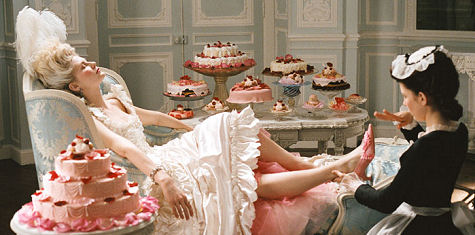
Kirsten Dunst in Sofia Coppola’s Marie-Antoinette, which showed this morning at the Cannes Film Festival
I don’t know how to avoid calling this an absolute p.r. disaster for the film, which has the ironical distinction of being almost completely devoid of interest (unless handsome photography, authentic sets, knockout 18th Century garb and a first-rate Rip Torn performance are enough for you) and yet rather well made.
This will certainly rank as a stain upon Coppola’s reputation, as she has arguably made the shallowest and dullest historical biopic of all time.
It seems fair to ask if this movie is on some level a subconscious attempt at self-portraiture. Coppola knows (or should know) about being part of a privleged family and being surrounded by enablers and enjoying the benefits of living in a protective membrane…and here she’s made a movie about a polite, agreeably- mannered bimbo living more or less the same kind of life and never getting a clue about anything outside of her own realm.
Lady Antonia Fraser‘s biography, which Coppola’s film is based upon, argued that there was more to the Austrian princess who became the Queen of France than her reviled reptuation has indicated all these centuries, and that she’s been misunderstood and her mettle undervalued. And yet Coppola’s film says next to nothing about Marie Antoinette’s intestinal fortitude.
This is a profoundly boring film and a politically inert and careless one to boot — quite deliberately, it seems.

Director Sofia Coppola and Dunst on set of Marie-Antoinette
Coppola doesn’t even relate the story of Antoinette’s final four years, which is the period in which, after years of profligate indulgence at the expense of the French treasury, the queen was said to have shown real dignity and character as she faced the kiss of steel. The fact that Antoinette was caught up in the French revolution and finally had her head sliced off in 1793 is — hello? — the reason she’s (in)famous, the reason Fraser wrote the book, and the reason people might conceivably want to see Marie-Antoinette …and yet Coppola blows it off.
I didn’t conduct a straw poll, but this morning’s boos probably had a bit to do with this.
And yet, from a perspective or whether or not Coppola has fulfilled her take on the the life of one of the most loathed women in history (i.e., the ultimate example of royalist arrogance), she’s actually done a good job.
The emptiness aside, Marie-Antoinette is a very well-made piece in terms of overall composition, pacing, consistency of tone, acting, production design, etc. There’s an obvious discipline at work here, even if it’s in the service of always keeping everything shallow and insulated, shallow and insulated, shallow and insulated.
The use of ’80s music (Bow Wow Wow, New Order, etc.) is actually one of the better things about it, because at least you have something to groove on when the tracks are playing.
The not-well-made aspects — and these are crucial — are the lack of spiritual resonance, rooting interest and dramatic tension.
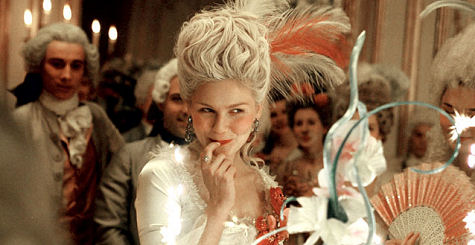
I am paying Coppola respect by saying it appears to have been her vision to make an exquisitely-composed dead movie about a group of priveleged, narcotized, all-but-dead people (i.e., King Louis XVI, Marie Antoinette and all the Counts, Countesses and social-political hangers-on at the Versailles Palace in the 1770s, ’80s and early ’90s) who couldn’t have cared less about life outside their gilded cocoon.
She might even have a subtle social-scolding scheme up her sleeve. “This is how life was for the Versailles royals back then,” her film seems to be saying. “And you know what? These people were just as shallow, spoiled and self-absorbed as many of you are. Consider this and the notion that history repeats itself.”
But the showing of empty lives of leisure without elements of action or dramatic choice has its limits.
There was all kinds of intrigue going on in Antoinette’s life back then (as this Wikipedia history of Antoinette’s life makes clear). Any director with any interest in the twists and turns of her political drama from the time of the storming of the Bastille in 1789 until her death by guillotine in 1793 could have made a very gripping film. And yet almost everything of consequence that happened during this period has been ignored.
There isn’t even a brief mention of “the Affair of the Necklace”, which did more to sully Antoinette’s reputation with the French anti-royalists than anything else. (Charles Shyer devoted almost an entire film to this very episode in 2001, called The Affair of the Necklace.)
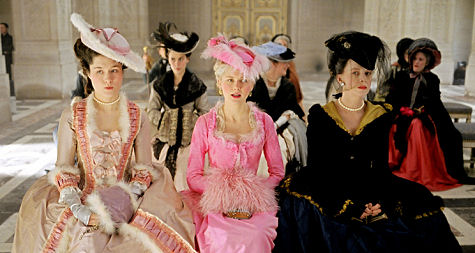
Unknown actress, Dunst, Judy Davis in Marie-Antoinette
As far as it goes, Kirsten Dunst’s performance as Antoinette feels like it came from some emotional investment and plays, on a certain level, as a half-sympathetic portrait. Jason Schwartzman’s King Louis XVI is a total one-noter, but Coppola hasn’t given him anything to do or say that doesn’t exude the personality of a precocious man-child.
Torn, however, is amusing and spunky as King Louis XV. Snappy perfs are also delivered by Judy Davis, Asia Argento, Steve Coogan (whose characters surround Antoinette at Versailles) and Marianne Faithful (as Antoinette’s mother).
In a way I almost admire the gutsiness of Coppola’s decision to make this into a wafer-thin movie. You might hate Marie-Antoinette , as I did, but at least Coppola developed a thematic approach and then shot it that way and stuck to her guns. She deserves a kind of credit for this.
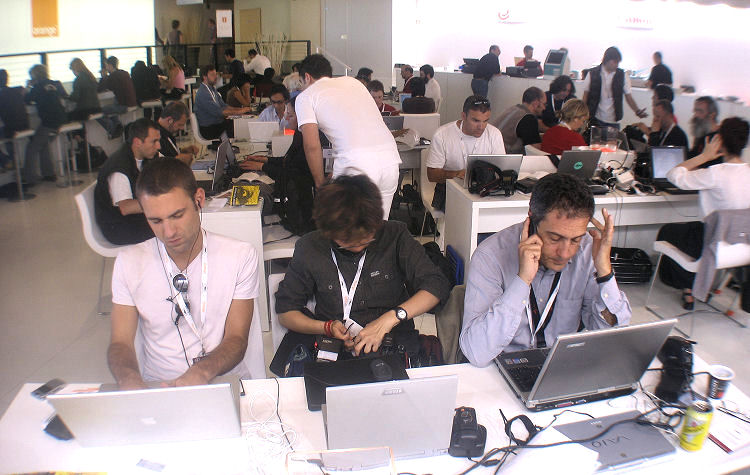
Cinematical’s James Rocchi just walked by inside the Orange Wi-Fi Cafe and shared a killer line in his review, which he just sent in:
“Marie Antoinette is famous for having said of her subjects, ‘Let them eat cake.’ Sofia Coppola’s view seems to be, ‘Let them eat icing.'”
The N.Y. Post‘s “Page Six” column has quoted that downbeat- tracking item I wrote last Saturday about The Breakup, along with a Universal spokesperson saying that “Wells doesn’t understand tracking” [and that] “for a romantic comedy, the numbers are very encouraging.” I quoted NRG figures that put “definite interest” levels at 30, and “first choice” at 5, and concluded, perhaps a bit rashly, that the game is “pretty much over.” The numbers were accurate and I conveyed an interpretation that seemed right to me, but I’m allowing for an error of emphasis on my part because I’ve since been told by others that this conclusion was simplistic and lacked perspective. The numbers I ran only tell part of the story, as they were only a reading of the pulse of the potential audience two and a half weeks away from the opening. The first choice and definite interest figures were misleading, I’ve been told, because biggies like The DaVinci Code and X-Men 3 were ruling at the time the survey was taken, and that scores for The Break-Up and The Omen will markedly improve with tomorrow’s (i.e., Thursday, 5.25) numbers. I’ve since been told, in fact, the The Breakup may pull in a more-than-substantial opening weekend sum. I’m not saying what I said earlier will prove to be incorrect — the Vince Vaughn-Jennifer Aniston comedy was not looking like a strong contender when I ran that item. Aniston’s name-marquee value doesn’t appear to mean much to audiences so far, and NRG respondents have reported a fairly pronounced disinterest in seeing Vaughn inhabit a romantic-boyfriend part. And there’s also that re-shot ending, which advance-screening witnesses have said is a cop-out. But sometimes the wind shifts and sometimes audiences are slow on the pickup, so let’s see what happens.
Babel is Booming
Alejando Gonzalez Innaritu’s Babel, which press-screened this morning, is, I believe, a lock to win the Palmes D’Or. Everyone seems to be feeling this, spreading it around. If it doesn’t win, fine — it’ll still be an incredibly vivid and brilliant film — but I’ll be greatly surprised.
Babel (Paramount Vantage, 10.6) is an incredibly shrewd work in the sense that it’s shaped in a way that keeps you fully absorbed, and yet gradually awakened to the fact that there’s a greater whole coming together than what is indicated by gathering sum of story and scenes.
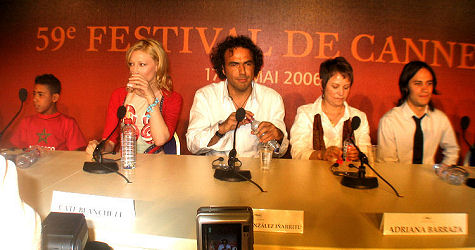
(l. to r.) Cate Blanchett, Alejandro Gonzalez Innaritu, Gael Garcia Bernal at this morning’s Babel press conference — 5.23.06, 11:33 am.
In the most rudimentary sense it’s a film about how one bullet out of a rifle causes damage and hurt to many people in various tangential roundabout ways. But it’s more deeply about how we’re all affected by everything and everyone…how no one is an island, we’re all in this together and everything we say or do echoes all over the place.
It’s about interconnectedness, aloneness, and human frailty, and is especially about parents and children. It radiates compassion and precision and refined artistry with every last frame, shot, edit and line of dialogue.
< ?php include ('/home/hollyw9/public_html/wired'); ?>
That last line sounds like breathless film-critic crap, so let’s go over the basics again…
Guillermo Ariagga’s script tells four stories that take place in three countries — Tunisia, Mexico and Japan — and several disparate characters (four played by Brad Pitt, Cate Blanchett, Gael Garcia Bernal and a young unknown Japanese actress, Rinko Yakusho).
The Tunisian section has two stories — that of a married American tourist couple (Pitt, Blanchett) and their encounter with a bullet, and a story about how that bullet is haphazardly fired from a long distance away by a pair of youths playing with a newly-purchased rifle, and about the consequences of this.
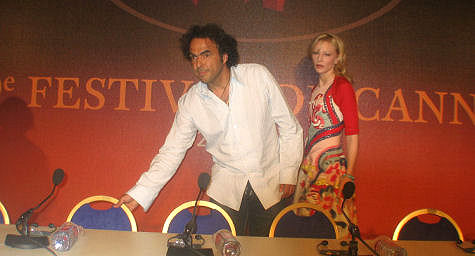
Innaritu, Blanchett as they entered the Salles de Presse inside the Palais this morning (5.23.060) at 11:25 am.
The Mexican section is about this couple’s nanny (Adriana Barraza) and her taking Pitt and Blanchett’s kids (Elle Fanning, Nathan Gamble) across the border into Mexico for a wedding, which leads to bad things all around, particularly for her nephew (Gael Garcia Bernal).
The Japanese portion is about the relationship between a wealthy businessman (Koji Yakusho) and his deaf daughter (Rinko Kikuchi), and the daughter’s encounters with various men, among them a visiting police detective.
They and many other are linked in the same way that the characters in Inarritu’s Amores Perros and 21 Grams are linked — by a single violent act.
This one of those “small” portraits of humanity writ large…and like I mentioned in my Inarritu interview a week and a half ago, it becomes larger and richer and more poignant the more you think about it.
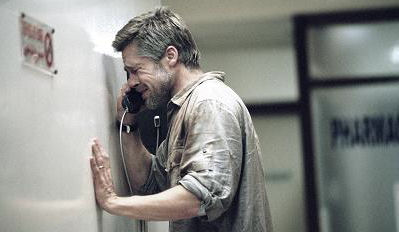
Some journalists in the post-screening press conference were asking Innaritu, “So…what’s it all about, really?” That plus the hearty applause and whoo-whoos from the press at the end of the screening tells me it’s one of those film that resonates in a way that’s fuller and deeper than any concisely worded “meaning” or “explanation.”
Innaritu answered by saying the film “has no lesson — I don’t do films to give lessons. It is a film about human beings…not Moroccans, not Mexicans, not Japanese, not Americans. It’s not about what separates us, but what binds us.”
The teeming energy before the packed press conference began, and the respectful applause given to each player when they were announced at the press conference got underway…you can just feel that this film has connected in a big way.
“The connections between the characters [in Babel] are not about coincidence,” Innaritu went on. “What makes us happy varies with each culture, with each person, but what makes us sad and miserable is something that everyone knows and shares.
“I can say the film is about incommunication, misunderstanding and loneliness,” Inarritu said in an interview we did on 5.5, or about eighteen days ago.
“But for me, the bottom line DNA of this film is about how fragile and vulnerable we are. How do you say, this is a chain, this is a little piece of the chain? A link? For me when a link is broken then the chain is broken. And that, for me, is what this film is about.
“Babel was an idea I had when I first arrived in the United States,” he recalled. “This film would have been impossible without me being a director in exile, I would say. Because what comes from this is that you have a consciousness…a very strange perspective of your country and of yourself.
“I’m speaking of a complex relationship between a citizen of a Third World country” — Inarritu was born, raised and launched his career in Mexico — “and this country, and the traveling that I have done in the last six years, the way you understand things. So I guess that was what [led] to the necessity of making this film.
“So I started working on this thing with Carlos Cuaron [the brother of Alfonso Cuaron and screenwriter of Y Tu Mama Tambien]. In the beginning. He would be the writer. But we began it as an argument and never took it beyond that, so we decided that he would do another project that we were developing.
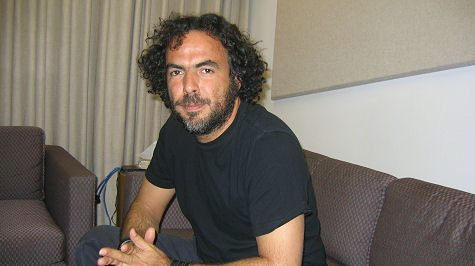
Babel director Alejandro Gonzalez Innaritu during interview at CBS Radford — Wednesday, 5.3.06, 1:10 pm.
“At this point I invited Guillermo to participate in this story, and we obviously…as part of that process, we decided to share a lot of things.”
“I think Babel is different from Amores perros and 21 Grams because the range of this film is completely different, style-wise, than the other ones. Because every story has a particular narrative and personality, and I feel that this is a more cinematic piece.
“I tried to combine the realistic aesthetic that normally I have been working in, but qualitating from an imaginary world where the music and the sound is a guiding force. There are a lot of sound elements in Babel. I was really taking the audio seriously. Using it to try and be inside a character.
“I stripped down so many things in the script by myself, and I was constantly adjusting and adapting and rewriting a lot of things based upon the culture and the situation I was in. It was a very difficult and informative process.
“I feel it is a very different film from the other ones in tone and style. It’s more cinematic. I can only put only one line in the script, but in the shooting I can make a ten-minute piece out of a whole interior consciousness [trip] by one of the characters.
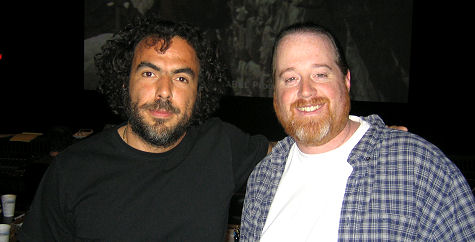
Inarritu, Babel editor Stephen Mirrione — Wednesday, 5.3.06, 1:17 pm
“I had to make a lot of decisions. In a good way. I added some things, and I also took out some things. I was shaping a lot and learning a lot and learning the limitations of the actors. So in the end I took out like 30% of the script down, in the editing. So there have been a lot of changes.
“We shot in Morocco, and then pre-production in Mexico, and then we shot in Mexico, and then over to Japan for pre-production and then we shot there. It was the same as doing four separate films, which was intellectually and emotionally very difficult. To shoot something in Morocco and at the same time think about the likelihood that a scene would cut directly into a scene I know I will shoot in Japan seven or eight months later. It was an exercise.
“And it was such a struggle, about going or not going to Cannes,” he added. “But we finally decided that Cannes is a good platform for this kind of film. It’s a four-language film, a very personal film, a very complicated film, and this festival exists for that…for this kind of film.