“Dynamite” For The Nervous System

Remember the good old JFK days when it took a little while to attack the Soviet Union with nuclear weapons? If a rogue order to bomb the Russkis had been given by an unstable SAC base commander in the early ’60s, say, nuclear bombs would then be delivered by Air Force guys flying big-ass B-52s, and with “one geographical factor in common — they are all two hours from their targets inside Russia.”

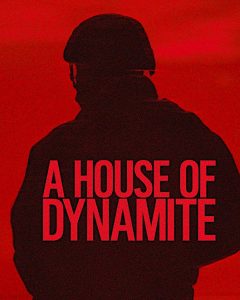
President Merkin Muffley has two hours to try and stop this bonkers attack and thereby prevent the Doomsday Machine from going off? Man, that’s a really luxurious time frame to work with, certainly compared to the lousy 25 minutes that top-level strategists and officials (White House, government, military) have in Kathryn Bigelow‘s A House of Dynamite (Netflix, 10.10).

A bum 25 minutes to, like, do something about a North Korean or Chinese or possibly even a Russian nuclear missile heading toward the great city of Chicago? C’mon! Some people need 25 minutes just to take a dump and then wash their hands, brush their teeth and spray the bathroom with Febreze.

First of all, isn’t 25 minutes a bit much, as in not enough breathing room? Wouldn’t it be dramatically preferable if the missile’s travel time took 40 minutes instead? More time to think, consider options, fire back at Pyongyang, freak out, call loved ones, generate an immediate warning to Chicago-area smartphones, etc.

A 6.22.18 Business Insider report estimated that a nuke travelling from Pyongyang to Chicago might take 39 minutes and 30 seconds. Has that Armageddon clock really been cut by 50% over the last seven years?

The fact that Dynamite lasts 112 minutes may suggest to some that the essential suspense kicks in for only 25 or so, once, or roughly one-fifth of the running time….wrong.

Bigelow and screenwriter Noah Oppenheim‘s strategy is to wade into three versions of the same 20-minute countdown — different locales, different key characters, all wearing the usual clenched, super-grim expressions.

Now that I’m re-running the film in my head, I’m not precisely recalling how those three 25-minute sections add up to 112. I’d really like to watch it again with a stopwatch.

If Bigelow went with three 40-minute sequences, more situational stuff could happen. Little things, big things, eccentric whatevers. 20 minutes is just too crammed, man. Especially for the people of Chicago.

Unless I missed something (and it’s quite possible that I did), none of the Dynamite decision-makers give serious thought to the idea of instant-messaging the entire Chicago populace (not to mention the people of Illinois, Wisconsin and Indiana) and saying something like “hey, guys…not much time for anything, but you need to immediately find some local school with old-fashioned classrooms so you can can all put your heads under the desks…seriously, you have 25 minutes to confess your sins or fuck your boyfriend or girlfriend one last time or go to church and pray to the one and only God or order your favorite spicy hot dog or Subway ssalami andwich or tell your kids that you adore them or, you know, pop an Oxy or inject yourself with Vietnamese heroin.”

One of the basic Dynamite messages, by the way, is that this country’s “iron dome” defense system doesn’t work all that well, especially when the task is “htting a bullet with a bullet.”

Fair question #1: “Yeah, okay, it’s a tough nut to crack but if you can’t lick this technological challenge, then what good are you, Jimmy Dick?”

Fair question #2: If you were Oppenheim and creating A House of Dynamite on your Macbook Pro, would your instinct be to show Chicago being melted to death and/or blown into little shards with a super-gigantic mushroom cloud reaching so many miles high that even Cary Grant‘s Roger Thornill could see it from that Prairie Stop Highway 41 cornfield, which was….what, in southern Illinois or western Indiana?

Or would you figure “naaah, it’s more effective to hold back and prompt the audience to imagine the carnage instead?”

Cheers and congrats to all the Dynamite players, first and foremost Rebecca Ferguson (generally the coolest and most composed), followed by Idris Elba (irked and perplexed U.S. President), Gabriel Basso (second most disciplined), Jared Harris (unstable James Forrestal-like Defense Secretary), Tracy Letts (the General Buck Turgidson of this scenario, only older and without the laughs and no pistol-hot girlfriend), Anthony Ramos (hardcore team leader who vomits when push comes to shove), Moses Ingram, Jonah Hauer-King, Greta Lee (North Korean expert) and the great Jason Clarke

A House of Dynamite is not my idea of a game-changer in any kind of stylistic visual sense. It’s basically just a highly effective throttle-ride, very nicely shot by regular Bigelow dp Barry Ackroyd, and razor-cut like a motherfucker by Kirk Baxter.

What’s the default term? “A super-tense, nail-bitten thriller that Joe and Jane Popcorn will have a high old time with”…something like that But it won’t deliver the same charge on a 65-inch HD screen. It was great seeing it on the huge screen at the Sala Darsena. Everyone should be so lucky or priveleged.

Heartbreaking Hind Rajab Episode Gets Docudrama Treatment

The Voice of Hind Rajab is an emotionally devastating, 89-minute docudrama about the January 2024 slaughter of a family of Palestinian innocents (and the five-year-old Hind Rajab in particular) in northern Gaza, from impassioned director-writer Kaouther Ben Hania.

It screened this morning at 8:30 am, and was met with sustained applause during the closing credits.

I found the film deeply upsetting, but it has to be stated that the focus is solely on the anguish and terror of this poor little girl, and is therefore manipulative by creating a narrative that says “bloodthirsty Israel troops were the bad guys who brought pure evil into this girl’s life”.

But at the same time the film ignores the indisputable fact that Hind Rajab would probably be living today if Hamas had not viciously attacked and murdered 1195 Israelis on 10.7.23, and if Israel hadn’t decided to turn the Gaza Strip into a lifeless moonscape in response.

Rajab was killed by IDF forces during the Israeli invasion of the Gaza Strip, roughly 20 months ago. They also killed six of her family members, plus two paramedics who had attempted her rescue.

Wiki excerpt: “Rajab and her family were fleeing Gaza City when their vehicle was shelled, killing her uncle, aunt and three cousins, with Rajab and another cousin surviving and contacting the Palestine Red Crescent Society (PRCS) to ask for help while noting that they were being attacked by an Israeli tank. The cousin was eventually killed.

“Rajab was left stranded in the vehicle for hours on the phone, as paramedics from PRCS attempted to rescue her. Both Rajab and the paramedics were later also found killed.

“Israel claimed it had no troops present and denied carrying out the attack.

“This was refuted, however, by Washington Post and Sky News investigations, which relied on satellite imagery and visual evidence, concluding that a number of Israeli tanks were indeed present and one had likely fired 335 rounds on the car that Rajab and her family had been in, with tank operators being able to see that the car had civilians including children in it.

“The Forensic Architecture investigation also concluded that an Israeli tank had also likely attacked the ambulance that came for Rajab.”

HE reaction, tapped out a half-hour after the screening ended: “This is an emotionally manipulative drillbit film about the awful ravages of war.

“No God’s-eye view, no bitter irony, no Paths of Glory-like compassion for combatants on either side, and certainly no conveying the basic reasons for the slaughter.

“It’s mainly about the constant milking of our emotions by focusing on a terrified five-year-old girl struggling to survive inside a car with her dead (i.e., ‘sleeping’) family as she speaks to a small group of Palestinian crisis workers trying to arrange for Red Cross workers to rescue her.

“Hind Rajab’s life is at extreme risk, of course, because of (a) Hamas’s suicidal fanaticism and (b) Benjamin Netanyahu’s determination to wipe them all out, down to the last combatant.

“The film is extremely sad and affecting (the audience applauded passionately), but be honest — it shamelessly milks, milks and milks until the cows come home.

“Innocent civilians, after all, have been in the collateral line of fire and savagely murdered throughout history. When has this never not been tragic or horrifying?

“How many terrified little girls died because of the aggressive battle strategies of Julius Caesar, Alexander the Great, Genghis Khan, Napoleon Bonaparte, George Washington, William Tecumseh Sherman, Adolf Hitler, George S. Patton, Omar Bradley and William Westmoreland?

“And how many little German girls died, by the way, from bombs dropped by Lieutenant Colonel James Stewart, who was the flight leader for a massive thousand-plane attack upon Berlin, and who also helped bomb the shit out of Frankfurt, Brunswick, Bremen and Nuremberg?”

News bulletin: War is cruel, merciless and morally repugnant.

Top-Tier, Efficiently Made, Vaguely Underwhelming

There have been no genuine grand slams at the 82nd Venice Film Festival. Not to hear it from press folk, at least.

I recognize that so far the strongest emotional press-screening reaction has been in response to Kaouther ben Hania‘s The Voice of Hind Rajab, which indicates it’s a favorite to win The Golden Lion. And yet its refusal to consider the horrendous Gaza conflict within some kind of realistic social-political context and its insistence upon a strict and narrow emotional focus strongly argues that it’s dishonest and manipulative on a certain level.

I also recognize that Park Chan-wook‘s No Other Choice, which I chose not to see because PCW’s films have always infuriated or at least annoyed me, is probably Hind Rajab‘s closest Golden Lion competitor.

If I was on Alexander Payne‘s jury I would push for Laszlo NemesOrphan (which at least brandishes a certain artistic integrity, despite concluding with one of the coldest and ugliest resolutions I’ve ever considered in a movie theatre), Olivier AssayasThe Wizard of the Kremlin, Francois Ozon‘s The Stranger, or perhape even Noah Baumbach‘s Jay Kelly, if only because it has the best closing line of all the competition flicks.

The across-the=board presumption is that Mona Fastvold‘s The Testament of Ann Lee, a bazonkers musical about 18th Century Shaker fanatics that will smother your soul and cause Average Joe audience members to weep with frustration, will wind up with some kind of Venice Film Festival award. Giving it the coveted Golden Lion would be going overboard, so the most likely end result will probably be a Best Actress Volpi Cup for Amanda Seyfried.

The best out-of-competition films, hands down, have been Luca Guadagnino‘s After The Hunt, Laura Poitras and Mark ObenhausCover-Up and Iain Forsyth and Jane Pollard‘s Broken English.

Ozon’s “Stranger” Gives Good Despair

Late this morning I caught Francois Ozon‘s The Stranger, a clean, precise and matter-of-fact adaptation of the classic 1942 Albert Camus novella, which I’ve been read about for years and therefore have had a passing familiarity with but have never actually, like, uhm, read.

Nor have I ever seen Luchino Visconti’s 1967 adaptation, which costarred Marcello Mastroianni and Anna Karina. But the Camus novella has long been regarded as a masterpiece of chilly existentialism, and processing the randomness of life and fate in existential terms has always appealed to my suburban malcontent mindset so I’ve been “on the team” for decades, in a sense.

Set in late 1930s or ’40s French Algeria (definitely pre-Battle of Algiers), Ozon’s The Stranger, which adheres closely to the Camus narrative, is about an aloof, taciturn but mild-mannered fellow named Meursault (Benjamin Voisin) who isn’t given to rapturous celebration of anything. As in, like, nothing.

Except for the joy of sex, that is, with a young single woman named Marie (Rebecca Marder), a typist whom he knew from a workplace and whom he quickly seduces after attending his mother’s funeral, where he alienated fellow mourners by not showing even slight traces of emotion.

A polite, disciplined sort who’s into an exceedingly dry form of anhedonia, Mersault’s fate is sealed in a beach altercation in which he’s vaguely provoked by a native Algerian ruffian over some local incident of cruelty. He almost dispassionately puts five bullets into the guy, and soon after goes on trial for murder while steadfastly refusing to deny guilt or offer some kind of rationale for the shooting, much less plead for mercy.

Mersault’s basic attitude is “life sucks any way you slice it plus I’m just cruising along atop my laid-back-because-nothing-matters mental surfboard, and we’re all going to die sooner or later so who gives a shit?” and so on.

Mersault is a Nowhere Man but doesn’t mind this in the least. He feels no delight or worship in his veins because he’s just an office functionary without a love life or any devotional artistic passion or the blessings of a beautiful granddaughter or a dog or a cat or anything. He doesn’t even have social media to get lost in and sedated by.

So the Ozon film hit me fresh, and left me…well, generally swept along, never bored and consumed in contemplation.

Camus’s dry, chilly narrative is pretty much straight from the text, Voisson’s performance is appropriately curt and contained, Manuel Dacosse‘s black-and-white cinematography is luscious and razor-sharp, Marder is touching and tantalizing, the supporting cast (which includes Holy Motors costar Denis Lavant), and the 120-minute length just flies right by.

As I was approaching the main festival headquarters I was suddenly ten feet from the ginger-haired Voison, who was posing for a quick photo. I wanted to snap a photo also but I wasn’t fast enough. If I’d dropped a Lemon 714 a half-hour earlier I would have waved and said “yo, bruh!…just saw the film, and I’m on the team!…a fan, I mean.”

“House” On Fire

Only 60 minutes before the press screening of Julian Schnabel In The Hand of Dante so I must be brief:

The house in Kathryn Bigelow and Noah Oppenheim‘s A House of Dynamite (Netflix, 10.10 theatrically) is the world itself…the entire interconnected realm…everyone…all the countries, all the leaders…and no one, it turns out, is fully up to dealing with impending Armageddon…not technologically, not emotionally or psychologically…so the movie is a firehouse alarm…a serious warning…a reality check from holy-shitville.

We’re all living on the edge of terrible destruction, Bigelow and Oppenheim are basically saying. How close or imminent is it? Very close, closer than we think, and our ability to protect Chicago or Washington or New York City, not to mention retaliate against the suspected aggressor[s], who might be our friends in the DPRK, is not what anyone would call formidable.

Bigelow’s film is therefore not a 21st Century version of Sidney Lumet‘s Fail Safe (although it’s certainly Fail Safe-adjacent) or Stanley Kubrick‘s Dr. Strangelove without the laughs…because unlike these mid ‘60s thrillers, it doesn’t…well, I guess I shouldn’t spoil.

But it’s basically “you think there’s some kind of response to an incoming missile that might save us? Or at least allow for semblance of a future? Think again.”

Surprisingly Not Half Bad

A few hours ago a friend texted that Benny Safdie‘s The Smashing Machine (A24, 10.3) “felt a bit flat.”

HE RESPONSE: “Yeah, maybe a bit but it mainly felt real and honest and committed to avoiding the usual sports-saga tropes…a probing, hand-held verite thing that adheres to an atmosphere that feels like lived-in reality.”

I was generally pleased with Johnson, whom I’ve found annoying for years, for having actually dug into a role and delivered in intimate, actorish terms…startling! I only know that I believed his Mark Kerr. Pain and Gain aside, Johnson has played the same, strapping, canned-dialogue icon in all his previous films, which have mostly been formulaic shit. He dropped the pose this time.

And Johnson’s argument scenes with Emily Blunt‘s Dawn Staples, whom Kerr was married to for roughly 15 years, touch bottom. Staples is portrayed as half a traditional heart-of-gold girlfriend, and half a pain-in-the-ass egotist who “cares” but is primarily focused on her own life designs — the very definition of a non-Zen partner.

Cheers also for Ryan Bader, who plays Kerr’s best friend Mark Coleman with relaxed assurance and conviction.

Holy-Roller Madness….Indecipherable, Shitty-Looking, Audacious To A Fault

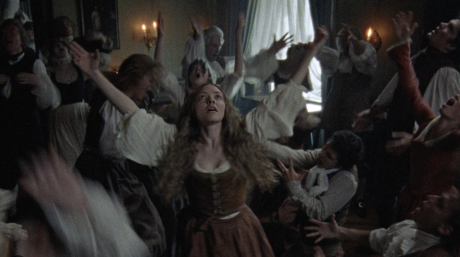
Mona Fastvold‘s The Testament of Ann Lee is certainly striking and, for what it’s worth, a wackazoid original — a regimented, pageant-like, nutbag historical musical about Ann Lee, the eccentric Shakers founder who was into ecstatic God-praising and celibacy and fervent denial of sexuality.

Lee was a devoted, shrewish-looking miserabalist who left northwest England, along with a couple of dozen followers, to re-settle in upstate New York (who’s ever even heard of Niskayuna?) and dedicate themselves to unmatched religious fanaticism.

How do you make a film about radical secularists who were into hymn-singing and general shrieking and, one presumes, pissing off the normies? Credit Fastvold, at least, for giving in to the crazy…for surrendering to Lee’s ecstatic mystical whateverisms, and really going for it willy-nilly.

While shooting near Budapest at the cost of a mere $10 million, Fastvold and her cast (Amanda Seyfried, Thomasin McKenzie, Lewis Pullman, Stacy Martin, Tim Blake Nelson, Christopher Abbott, Matthew Beard) and crew went mad with the Shaker spirit, and you have to respect that.

Congrats to composer Daniel Blumberg and choreographer Celia Rowlson-Hall. The madness clearly engulfed them also, and they’ve created otherworldly asylum vibes.

The movie pulsates with extreme this and that — extreme behavior, extreme denial of life, extreme visual murkiness despite being shot in 70mm, the embrace of puritanical madness. All of the terrible spiritual suppressive stuff that has given old-time Christian religion such a bad name for centuries is abundant.

Plus I couldn’t understand a single word of it, and for whatever reason there were no English subtitles, which every Venice Film Festival entry has brandished so far.

I knew early on that The Testament of Ann Lee would almost certainly give me pain because Fastvold cowrote it with husband Brady Corbet, whose direction of The Brutalist made people like myself writhe in agony last year, and whom I regard as a kind of louche anti-Christ of modern cinema. I knew, in short, that the Corbet influence would be bad news, and boy, was it ever!

HE to industry friendo after last night’s press screening: “Fastvold’s Shaker film is mute nostril agony. A journo pally concurs — ‘Awful’. I noticed five to six walkouts, heard a couple of boos when it ended.”

Friendo to HE: “It sounds like this year’s Women Talking.”

HE to friendo: “It’s much, MUCH worse than Women Talking. Somebody has called it The Brutalist: Folie a Deux.”

The real Ann Lee, who lived until age 48, was rather ugly, and Seyfried (who turns 40 in December) is, of course, beautiful, so the film’s realism is lacking in this regard.

And as long as hotness is on the table, 35-year-old Stacy Martin, who plays Jane Wardley, a British born co-founder of the Shakers, is way too attractive to play a woman who’s into a no-sex, God-and-only-God lifestyle…one look at Martin and you’re thinking “what is she doing with this bunch?”

Fastvold: “I thought Ann Lee deserved something grandiose and wonderful. How many stories have we seen about male icons on a grand scale, again and again and again? Can we not see one story about a woman like this?”

Seyfried on her Shaker singing: “A lot of it was animal sounds as opposed to melodic sounds.”

“About Half Of My Movies Are Good, Half Are Not”

Woody Allen is a heavenly get for Bill Maher and Club Random. Obviously.

Woody Allen on the “capsule meaning” ofThe Purple Rose of Cairo (starting at 25:30):

“We are all, in my opinion, forced to choose between reality and fantasy. And it’s very pleasurable to choose fantasy. But that way, in the end, lies madness. So you have to choose reality, and reality always kills you. It always hurts you. but you have no choice. You can’t choose fantasy because you’ll go nuts [if you do]. So you have to choose real, and real is always heartbreaking because life is heartbreaking.”

2nd best observation, Maher quoting Allen (33:20): “The line that I loved was, uh, I think about about one of your early dates, and you said ‘I was so exhausted when I got home…so exhausted from being charming. I felt like I’d run a marathon’.

Allen: “But I would not want to give the impression that I was some kind of ladies man who scored all the time. Most of the time I struck out. I succeeded only a few times.”

Allen is too refined and discreet to use HE’s baseball analogy, but what he’s basically saying is that he probably batted around .400. (Okay, maybe .350.) The engulfing tragedy of 2025 and the generally disparaging view of intellectually limited or non-adventurous men among feminist-minded, #MeToo-influenced women is that so many average guys — the ones who aren’t flush, I mean, and are living marginally or modestly with a vaguely shitty car and perhaps an atrocious dress sense — a majority don’t even get lucky one time out of 100, if that.

Scott Galloway calls them “a generation of young men filled with rage and shame.”

A cheap, callous, antagonistic post from the Variety scumbags. Just a casual joke on Woody’s part, and they’re suggesting that he’s somehow on the team: