Here They Come….Wedding Crashers!

Here They Come…

That Vince Vaughn profile in the current Newsweek doesn’t lie. His performance as a motor-mouthed, totally scheming hound in Wedding Crashers — a very sharp, at times inspired comic romp — is so hilarious at times that it feels off the earth.
I was saying to myself during last night’s press screening, “This is astounding…the great dialogue just keeps blasting away and Vaughn isn’t missing a beat.”
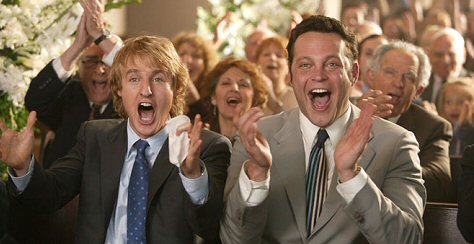

Immaculate deception: Owen Wilson and Vince Vaugh in David Dobkin’s Wedding Crashers

It’s not just Vaughn, of course, but Vaughn and Owen Wilson — also playing a schemer but at the same time the half-soulful counterpoint to Vaughn’s totally sociopathic manipulator — and the banter between them. These guys are a better comic team than Wilson and Ben Stiller. The back-and-forth is fantastic…it’s Martin and Lewis-level.
Vaughn’s comic timing and manic energy make this far and away his best performance since Swingers, and yet he’s so much better here than he was in that 1996 film. It’s Vaughn finding his groove the way Cary Grant kicked into gear when he made The Awful Truth and Bringing Up Baby.
< ?php include ('/home/hollyw9/public_html/wired'); ?>
Vaughn never falters except at the end when the movie makes him go all sappy and sincere. But mostly (and let’s just admit here and now that Crashers doesn’t quite make it all the way around the track) he’s perfect. We’re talking major current here.
Wedding Crashers (New Line, 7.8) stumbles at the close of the second act and doesn’t get its groove back until the very end (it flops around like a goldfish for about 20 minutes), but most of it works. Just because a section of the final act doesn’t play like it should doesn’t mean the first 80% isn’t glorious.
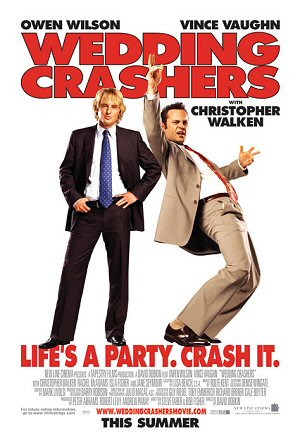
Nobody sings anything in The Wedding Crashers, but the gags and especially the His Girl Friday-on-steroids banter between Vaughn and Wilson is so hilarious and whip-smart that it feels like great music. We’re talking kick-ass dialogue of an exceptionally high order…flip, smarty-pants stuff that doesn’t quit and keeps building and getting funnier.
Plus a reasonably decent stab at romantic sincerity here and there and a very winning, career-making performance by Rachel McAdams.
It’s Vaughn and Wilson (giving the warmest, most fully developed and winning performance of his career…as much of a career-bump thing as his breakout performance in Shanghai Noon was) hitting comic highs that haven’t been felt in a mainstream studio comedy in ages.
It’s the whole concoction — the chemistry between Vaughn and costar Owen Wilson, the wit and attitude in Steve Faber and Bob Fisher’s script (jazzed by Vaughn and Wilson’s on-set improvs), and echoes of not just Meet the Parents but Mike Nichols’ The Graduate.
The Wedding Crashers isn’t as successful as it could be with the sincere emotional stuff, but it does a half-decent job of working with the Graduate scheme of the Three D’s (desire, deception, discovery).
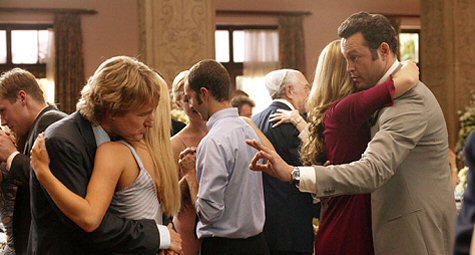
The Graduate is about Benjamin Braddock’s desire for the sultry Mrs. Robinson, the deception he has to throw around to pursue his weeks-long affair with her, and the discovery of true love when he meets and falls for Elaine, her classy and soulful daughter. The last act is about Benjamin’s trying to stop Elaine from marrying a sexist arrogant asshole named Carl.
The Wedding Crashers brings a slightly different order to the formula — discovery preceded by desire preceded by deception.
It’s about a likable deceiver (Wilson’s John Beckwith) — a guy who spends all his time crashing weddings with his pal Jeremy (Vaughn) so he can score with emotionally receptive bridesmaids by lying his ass off about everything…whatever works so he can get in their pants.
Emotions thicken when he falls for a very classy and soulful girl (McAdam’s Claire Cleary), a daughter of a powerful man (like Elaine’s attorney dad was). The discovery comes when he realizes he’s in love and absolutely has to prevent her from marrying an arrogant asshole named Sack (Bradley Cooper, who bears a resemblance to Brian Avery, the actor who played “Carl” 38 or 39 years ago).
I don’t want to make too much of the Graduate analogies, but they do exist and The Wedding Crashers is at least trying to fuse sincere emotionality with rollicking humor. Call me an easy lay, but the fact that it’s not too bad during the heartfelt portion (the last 20 minutes or so) strikes me as acceptable.
The bottom line is that most of this film sails above the clouds. I realize the R rating is going to restrict business among kids in the hinterlands, and it may be too hip for the room in the red-state areas and especially among those who thought Meet the Fockers was the schizzle.
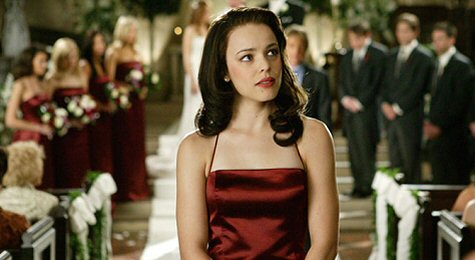

Rachel McAdams, giving the most winning and emotionally grounded performance in a romantic comedy in a long time.

The Wedding Crashers is so much sharper and scalpel-ish than Fockers, they’re not even in the same ballpark. I think it’s funnier and a lot hipper than Meet the Parents even.
There’s only one seriously “off” element, and this is elaborated upon in a transcript of a back and forth I had last night with a guy (see below).
This is a great, great guy comedy…it accepts and celebrates the fact that 95% of the time the only way to get rolling with a woman is to give a sincerely tender, bullshit-stuffed performance. And the first two-thirds (or three-quarters or whatever) take you on a ride with a couple of serious pros who know all the ropes and the angles and still get thrown for a loop and are made to suffer for their sins.
And it’s 80% pure pleasure.

Debate

A guy named “Erasmus” wrote last night to say he’d recently seen Wedding Crashers at a screening held by Creative magazine, and that he thinks it may be getting mixed word-of-mouth because of the ending.
“Not true,” I answered him. “This movie really sails for the first two thirds. I was howling. I was in fucking heaven. It loses its way when the guys get busted, yes, but it gets it back at the very end. And those first three-quarters are incandescent.”
And here’s how it went from there….
Erasmus: To be fair the first two acts which would roughly be the first one hour and ten minutes work reasonably well.
Wells: Not “reasonably well”….inspired. When this movie is in the groove it is in the damn groove and three or four times funnier than Meet the Parents when it is. I’m not exaggerating my feelings. It is awesomely funny at times.
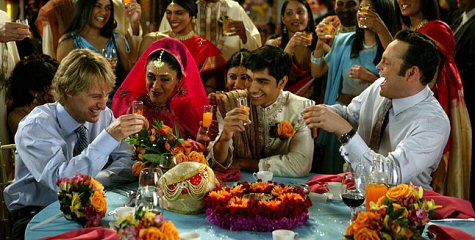
Erasmus: In a Hollywood genre-go-lucky way.
Wells: I really think you’re missing it. I think it’s brilliant, wonderful, ecstasy-time during those first two acts.
Erasmus: But the third act falls apart and everyone knows it’s how the audience feels as they walk out of the movie that matters.
Wells: The third act is bit of a fumble, yes. The movie loses the heat when the guys are busted and sent packing. But the end of it works pretty well. It’s not inspired but it’s pretty good. It touches the bottom of the pool.
Erasmus: And then there’s that big-name supporting cameo that totally kills the movie.
Wells: [Name]’s appearance is not a good thing for this film…you’re right. He’s not funny. He’s actually a drag. He’s actually tedious. He’s a monkey wrench…a chemistry killer.
Erasmus: In fact, some people will say, why is this guy is every comedy all the time? They did not need him.
Wells: Correct.
Erasmus: Any other actor but this guy would have been fine.
Wells: Agreed.
Erasmus: And so in a summer filled with many movies with serious third-act problems — War of the Worlds, Bewitched, Mr. and Mrs. Smith — another has been added to the list.
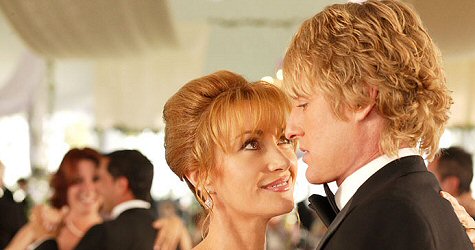

Jane Seymour, Owen Wilson

Wells: You’re not wholly wrong, but the third-act problems are not fatal. They just wound it somewhat.
Erasmus: This movie will still be a hit, despite the stock characters.
Wells: Isla Fisher’s character — the little redhead Vaughn hooks up with — brings a certain freshness to the piece. Rachel McAdam’s character is on the stocky side, fine, but she’s such a good actress she makes her character feel more believable than she’s actually written. Walken is a bit more supple and less obsessive in his father-of-the-bride role than De Niro was.
Erasmus: And a Jane Seymour development that is
started and then dropped right this.
Wells: Why did they do that? Drop her, I mean.
Erasmus: The first two-thirds work. But they had a chance for Meet the Parents-like numbers of $160 million but will get, at the maximum, $80 million.
Wells: I don’t think so. This thing sails so well during the first two thirds, it will be as big as Parents….I think.

Clone Wars

To cover their bases, critics planning to review Michael Bay’s The Island (DreamWorks, 7.22) should probably take a gander at a 1979 low-budget sci-fi flick called Clonus, which came out on DVD last March.
I won’t be seeing The Island until this weekend (it’s sneaking Saturday night) and I haven’t seen Clonus (a.k.a., Parts: The Clonus Horror), but I know they’re both paranoid thrillers about people being cloned by some super-secret government agency.
It’s being widely alleged by a lot of geeks out there (as well as the “movie connections” references for both films on the IMDB) that The Island is a remake of Clonus.


Scarlett Johansson, Ewan McGregor in The Island

Here’s a link to one of the many websites making this claim.
The general view seems to be that the makers of the 26 year-old Clonus — director Robert S. Fiveson, screenwriters Bob Sullivan and Ron Smith — should have received credit or compensation or something.
If the remake allegations have merit (I say “if”), the Island producers and the DreamWorks attorneys probably compared the 1979 film to their about-to-be-filmed screenplay and calculated there was no way the Clonus team could come after them legally.
Clonus, which has apparently been shown on the Sci-Fi Channel and Mystery Science Theater 3000, is about a character named Richard, a resident of some kind of remote micro-managed outpost. Like all the inhabitants of this carefully controlled environment, Richard hopes to be chosen to be sent to a country where everything is ultra-cool and civilized, or something like that.
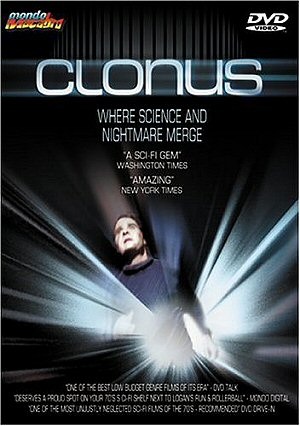
He eventually discovers that everything about his existence is bogus. He and all of his friends are actually clones whose basic purpose is to provide spare parts for their organic human counterparts. Knowing it’s only a matter of time before this happens, Richard and a fellow clone named Lena attempt an escape to an outside world, blah blah.
The IMDB’s synopsis for The Island reads as follows: “A man (McGregor) goes on the run after he discovers that he is actually a ‘harvested being’ and is being kept along with others in a utopian facility.”
For what it’s worth, if you do a Google search for ‘Clonus’ and ‘The Island’ you’ll get thousands of hits commenting on the similarities.
There’s a difference of opinion about whether Clonus is a moderately worthy little sci-fier or a grade-Z enterprise that sucks eggs. Reader opinions will be considered and possibly posted.

Considering

At the beginning of my so-called journalistic career some 26 years ago, I came up with an idea for a magazine called Nothing.
It was supposed to be a half-serious, half-satiric look at celebrities and media matters and movie culture, etc. It seemed to me back then that the tendency of magazines and newspapers to cover the especially puerile and shallow aspects of entertainment culture was getting more and more pronounced.
I figured it might work if a magazine came out that pretended to play this game along with everyone else but was actually satirizing it on some level. Maybe the idea was a little ahead of its time, but it doesn’t seem to be that now with David Spade planning to host a Comedy Central show that lampoons celebrity and movie coverage on shows like Extra and Access Hollywood.
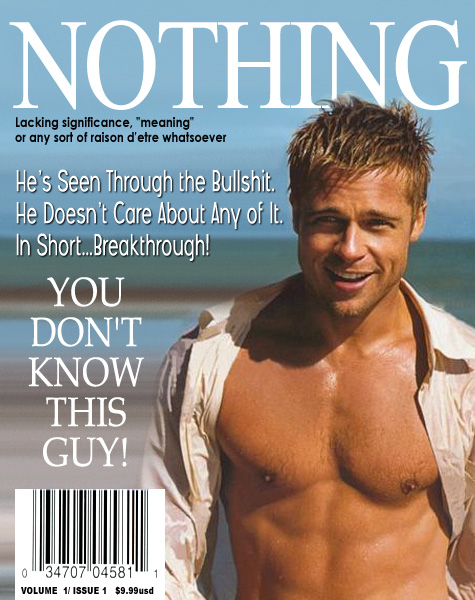
The idea wouldn’t be to suggest that the people profiled or subjects covered in Nothing are empty in and of themselves, but that everything is seeming more accelerated and vacant, and less and less deserving of even our passing attention.
Nothing is all we have, all we’re left with in the end.
It could be kind of a two-tiered thing, actually — satirical as well as existential commentary. I don’t mean to draw a specific reference, but I guess I was half-thinking about Jean Paul Sartre’s Being and Nothingness when I thought up the name.
The magazine wouldn’t so much as cast a glance in Sartre’s direction, of course. It would be aimed, I suppose, at the readers of…I don’t know, Radar or Giant…the usual under-40 males with a sense of humor who’ve had a brush with higher education.
I just know that the culture is about as far away from matters of real substance as it’s ever been, and seems to more and more into pointless diversion. And we need more magazines…well, not exactly deploring this but at least pointing it out in some appropriately dry fashion.
This test cover (thrown together by the intrepid Michael R. Felsher, author of the new HE column “Cinema Obscura”) is what it could look like…maybe. I’ve always imagined something a little dryer, a bit more like Harper’s or The Atlantic.

Another idea I came up with 25 years ago is a regular column called “Hollywood Weltschmerz: The Celebrity in Pain.”
Every damn article about every celebrity is always about how great their life is…how productive, creative, exciting, challenging, etc. I’m not imagining a column that would seek to portray celebrities as gloom-heads but something that would attempt to portray hard-driving filmmaking types in mock-bleak terms…kind of like what Art Linson goes for in his books about producing.
Webster’s Online defines “weltschmerz” as “sadness over the evils of the world…an expression of romantic pessimism.”

New Guys

Here are logo headers for some of the new columns that have been going up. Some of the columnists are just getting going and probably won’t hit their stride for a few weeks yet, but when you get a chance….


The reason Michael Bay’s The

The reason Michael Bay’s The Island (DreamWorks, 7.22) is sneaking nationwide this Saturday (7.9) is because it’s not tracking very well, partly because Ewan MacGregor and Scarlett Johansson are “industry stars” who don’t put butts in seats. I hear it’s not quite the greatest film of the 21st Century, but it must be doing fairly well with Average-Joe audiences or they wouldn’t sneak it to begin with.

On the other end there’s

On the other end there’s Wedding Crashers (New Line, 7.15), a comedy that’s tracking decently but not tremendously (i.e., it’s more or less where Monster-in-Law was a week before its release) and could probably use the exposure of a nationwide sneak….but it’s not getting one. This despite the fact it’s opening only eight days from now and has been getting great word of mouth. I guess New Line is figuring they’re going to get whipped next weekend by Charlie and the Chocolate Factory (Warner Bros., 7.15) anyway, so why go nuts trying to be the #1 film when the word-of-mouth is going to be good enough to keep Wedding Crashers playing well into August.

I’m presuming Ryan Phillipe got

I’m presuming Ryan Phillipe got cast in Cint Eastwood’s Flags of Our Fathers because he was exceptional in Paul Haggis’s Crash (as Matt Dillon’s rookie-cop partner), and that particular attention was paid because Haggis wrote Million Dollar Baby, etc. And I’m figuring Jesse Bradford was also brought aboard because of his performance in Chris Terrio’s Heights . I have to say I detected modest intelligence levels, at best, and a very low energy reading from Bradford’s acting in that recent, relatively unsuccessful New York drama. Look deep into Bradford’s dark eyes and there’s nobody home….blanko.

What’s with the comma in

What’s with the comma in George Clooney’s Good Night and, Good Luck, the Edward R. Murrow vs. Joseph McCarthy drama that I’ve blurbed a couple of times? The comma after the “and” is there to suggest the pause that Murrow used before saying “good luck” on the air, but wouldn’t an ellipses be better? And is it “Goodnight” or “Good Night”? Pic is a Warner Independent release, having been deemed too indie-ish and dialogue-driven for regular-ass Warner Bros. It’s due in November (a friendly lady in Laura Kim’s office just told me this) and you’ve gotta figure it’ll play the Toronto Film Festival.

Here’s the best rundown I’ve

Here’s the best rundown I’ve read about the story and the meaning of Craig Brewer’s Black Snake Moan. It’s from Brewer himself in a long response to a question from Black Film correspondent Wilson Morales. The IMDB says the Paramount Classics film, due in ’06 with Samuel L. Jackson and Christina Ricci in the leads, is about “a white nymphomaniac” being “cured of her disorder by an older black bluesman.” Like everyone else I had interpreted the title in sexual terms (remember that actor in Full Metal Jacket exhibiting his appendage to a Vietnamese prostitute and calling it a specimen of “Alabama black snake”?) but that’s just the taking-off point.

Leonardo DiCaprio’s Appian Way wants

Leonardo DiCaprio’s Appian Way wants to produce a movie of Kurt Vonnegut’s Cat’s Cradle…cool. I have had the image of an Ice-Nine catastrophe — all of the world’s oceans, rivers and great lakes suddenly freezing solid in a massive chain-reaction — sitting in my head since reading Vonnegut’s novel 30-something years ago. Claude Brodesser’s Variety story describes the plot as being about “a race to recover the world’s most dangerous substance, Ice-Nine, a new form of ice that freezes at room temperature.” Vonnegut’s book explains that Ice-Nine, created by a character named Felix Hoenikker, is capable of creating a chain reaction that would solidify all water and thus destroy all life on earth. Vonnegut studied chemistry at Cornell University and knew about various permutations of ice through his brother, Dr. Bernard Vonnegut (1914-1997), a former professor of atmospheric sciences at the State University of New York at Albany. Garden variety ice (ice cubes, snowflakes) is called ice-one and has a familiar hexagon arrangement. Under different conditions, different chemical arrangements can occur. Ice-nine has not yet been created in a lab, but other permutations (ice-eleven and ice-twelve) have reportedly been cooked up….emphasis on the word “reportedly.”

Speaking of DiCaprio, what’s happening

Speaking of DiCaprio, what’s happening with his intention to produce a film about (and perhaps play) LSD guru Dr. Timothy Leary? Work on a script was begun late last year by L.M. Kit Carson. I know because Kit told me, and because I urged Carson to research it by wading into a book by Jay Stevens called Storming Heaven: LSD and the American Dream, which is by far the most comprehensive and fascinating account of the ’60s psychedelic movement I’ve ever read. I mentioned it to DiCaprio when I saw him at a party last February in Santa Barbara, and was left with a vague impression he hadn’t read it. Here’s an excerpt from the book.

Don’t believe that David Poland

Don’t believe that David Poland clique saying there’s no box-office slump. There is a slump, there is a slump…the average gross per movie has been on a decline since ’03 and average attendance per film has been dropping steadily since ’01. It’s the attendance, stupid — the actual number of people showing up at theatres is dropping year after year.

Another way of boosting theatre

Another way of boosting theatre biz would be to adopt my idea of selling time-passes to plexes, in which the patron buys a ticket to a particular film but also, for an extra two or three bucks, buys a pass permitting him/her to wander around from theatre to theatre free and clear in order to sample the various attractions or simply see another film. I do this all the time under the ushers’ noses. If I don’t like something, I slip out and try some other film…or I see pieces of two or three films, just to get an idea of how they play. This way I never feel burned when I leave. Exhibitors need to remove that feeling of having been taken (“I blew $30 bucks to see this piece of shit?”) that so many moviegoers have these days on their way to the parking lot.

End of Something

End of Something

There’s more than a sense of unease in theatres across the land this summer. It’s something like mild panic, and is based upon fears that the “slump” affecting ticket sales this summer isn’t a slump but something more fundamental.
I’m not saying anything new here, but stories about the months-long slump keep coming and the authors keep missing the overall picture. The issue isn’t that movie attendance is “soft” this summer. The issue is that the fundamental idea of going out to the movies is losing its hold on the film-going populace. And I may be way behind the curve in using the word “losing.”

Certain industry-watchers are in denial about this (and you know who I mean), but there’s no hiding from this any longer: we’re experiencing a seismic shift in attitudes about how, when and where to get our entertainment fix.
It’s not a welcome thing to consider, but the hard fact is that the good old “let’s go to the movies so we can have fun and have something to talk about later over drinks” option is starting to slip down the pole a bit.
Seeing movies in theatres is being slowly de-popularized and retired by different demos for different reasons. I’m calling it the Big Fade.
< ?php include ('/home/hollyw9/public_html/wired'); ?>
The fade is on because the movie-going experience costs too much, which is happening because greedy actors and their agents have pushed their fees into the upper stratosphere. The higher the fees, the bigger the budgets…which in turn has forced studio-based producers to back away from making adult-friendly middlebrow movies and concentrate more and more on theme-park movies, which has pushed away the adults.
The fade is on because everyone knows this weekend’s movies will be in DVD stores in four to six months (if not sooner), so what’s the rush? For people like myself going to a new film in a theatre (especially a really good one) is an essential habit, but for more and more people the urge to see movies as soon as they’re released is not what it used to be.

The fade is on because kids (and you’ve heard this a million times) have all kinds of entertainment options at their disposal — video games, DVD watchings, online diversions, illegal movie downloads — and a lot of them are cheaper than going to movies in theatres.
The fade is on because older people don’t like the prices and having to listen to bozos talk during the movie, along with those laughably absurd prices for popcorn and cokes and having to sit through those awful TV ads.
The fade is on because paying $30 or $35 (minimum) to take yourself and a date to see Mr. and Mrs. Smith, a totally rancid hell-movie you’ll barely want to rent when it hits DVD next November or December, is a repugnant joke.

Che Trigger

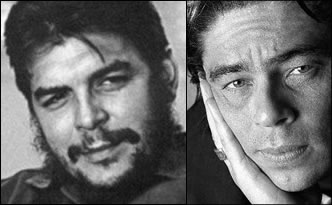
I’m told that Steven Soderbergh’s Che, which has been delayed and delayed and delayed, will finally roll film in Bolivia five months from now (i.e., December), with Benicio del Toro playing the legendary revolutionary Ernesto “Che” Guevara.
When I called to double-check Wednesday morning my guy wasn’t there and he didn’t call back, so check back Thursday for the final confirm.
The script by Soderbergh, Terrence Malick and Benjamin van der Veen isn’t about the Cuban period or any of the triumphs of Guevara’s life, but will focus entirely on the last failed chapter in his life, which was about trying to ignite a violent insurgency in Bolivia.
Guevara’s efforts in this regard resulted in his capture and execution by Bolivian authorities in 1967.

In other words, I’m hearing that Che (which I can’t seem to find a script of) will be the spiritual and political opposite of Walter Salles’ The Motorycycle Diaries, which was about youth and adventure and the birth of Che’s political conscience.
It will be about the end of the road…about death and pushing it too far…about falling out of touch and running out of gas…about manic political thinking taking over everything.
I’ve still no idea whether Soderbergh will shoot the film in English (which would be ghastly…a Richard Fleischer idea!) or in Spanish, or perhaps in both languages to assuage the fears of distributors about alienating both the English- and Spanish-speaking audiences for the film.
The dual-language option seems like the only way to go. It would seem fraudulent for the same director who shot those great Spanish-language sequences in Traffic to film the life of Guevara with various actors speaking in Spanish-inflected English…no?


Steven Soderbergh, presumably during filming of Ocean’s 12 in Amsterdam.

If Fred Zinneman could shoot two takes of every scene in his 1955 film of Oklahoma! (one in 35mm Scope and another in 70mm Todd-AO), Soderbergh can certainly handle a similar discipline.
Soderbergh’s most recent film is Bubble, an under-the-wire Section Eight production about the “residents of a small Ohio town unraveling a murder mystery” (per the IMDB). He’ll presumably start pre-production on Che sometime in September.

Respected

Ernest Lehman, who died Saturday at age 89, wrote a lot of first-rate screenplays, including the ones for Sweet Smell of Success, Who’s Afraid of Virginia Woolf and Somebody Up There Likes Me. But for me, he’ll always be the North by Northwest guy.
I have enjoyed the dialogue from this Alfred Hitchcock film all my life. All right, some of it feels a bit clunky and cornball-y at times, but I’ve always loved the way the actors — Cary Grant, James Mason, Martin Landau, Jesse Royce Landis, Leo G. Carroll — make it work by finessing it just so.


The late Ernest Lehman

If you’re as into this film as I am, you’ll enjoy reading Lehman’s original script. You should also give a listen to Lehman’s commentary track on the North by Northwest DVD.
I’ve always enjoyed the constant references made to Grant’s (i.e, Roger Thornhill’s) acting within the film. His always being asked to play a part, and being told he’s either doing it well or not well enough. As in this scene with Mason’s Phillip Van Damm…

THORNHILL

Not that I mind a slight case of abduction now and then, but I have tickets to the theatre this evening, and to a show I was looking forward to. And I get…well, kind of unreasonable about things like that.
VAN DAMM

With such expert play acting you make this very room a theatre.
And this one in the Chicago auction room….


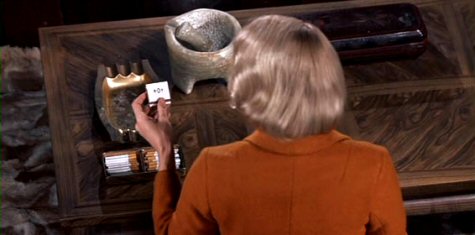
The famous R.O.T. matchbook containing a scrawled message (“They’re on to you — I’m in you room”) being inspected by Eva Marie Saint under the watchful eyes of James Mason and Martin Landau.

VAN DAMM

Has anyone ever told you that you overplay your various roles rather severely, Mr. Kaplan? First you’re the outraged Madison Avenue man who claims he’s been mistaken for someone else. Then you play a fugitive from justice, supposedly trying to clear his name of a crime he knows he didn’t commit. And now you play the peevish lover, stunned by jealousy and betrayal. It seems to me you fellows could stand a little less training from the FBI and a little more from the Actor’s Studio.
THORNHILL

Apparently the only performance that will satisfy you is when I play dead.
VAN DAMM

Your very next role. You’ll be quite convincing, I assure you.
For some reason the following is my favorite Northwest exchange. It never makes any sense trying to explain these things – some lines just do it for you. Thornhill and his mother (Landis) are “hotel-breaking” inside the Plaza, and he goes into the bathroom to inspect the toiletries used by the fictitious “George Kaplan.”
THORNHILL

Bulletin. [A bathroom product of the `50s.] Kaplan has dandruff.
MOTHER
In that case, I think we should leave.

Tradition

Tedium on Ice

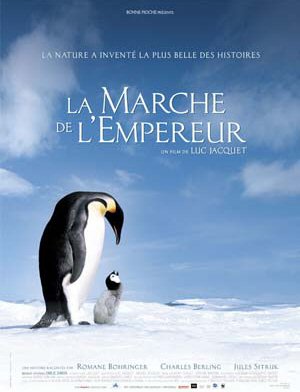
No one has pointed out the one big problem with Luc Jacquet’s March of the Penguins (Warner Independent). The Emperor penguins are cute and likable, etc., but the movie is oppressively boring after 45 minutes or so because the birds spend way too much time walking in caravans.
The females go diving for fish at one point and the males spend weeks and weeks huddling against the blizzard with penguin eggs between their legs, but mostly they just walk and walk and walk and walk and walk and walk and walk.
The reason they do this is because their mating, birthing and feeding patterns are irrational and rather dumb. I’m speaking specifically of the birds’ decision to annually march 100 kilometers from their feeding grounds near the sea to their nesting grounds. All of the penguin lunacy flows from this one thing.

Why march 100 kilometers to lay eggs? Antarctica is cold all over and full of snow and mountains everywhere you look, so what’s the difference where you lay the eggs as long as the chicks have a decent chance of being protected?
Why don’t the penguins lay the eggs closer to the sea so the females don’t have to walk 100 kilometers to catch fish for their young, and the males don’t have to tough it out for weeks with the eggs between their legs? You’d have to be insane to live anywhere except near the water because (hello?) that’s where the fish are and who needs all that relentless trudging around?
With other animal docs you can always figure out why lions do they do what they do, or elephants or hippos or beavers or whatever. There’s a certain natural logic to their game of survival. But not with the emperor penguins.
Why, then, are so many people going to this film and telling their friends about it? Why have so many critics given it a pass? Because cute animals always slide. Way of the world.

Grabs


New York Stock Exchange facade on Wall Street — Monday, 7.4, 7:50 pm.

Portion of Szilvia Seke, diner in John’s Italian restaurant, 12th Street near 2nd Avenue — Tuesday, 7.6, 10:15 pm.

Early 20th Century fountain in park just south of City Hall

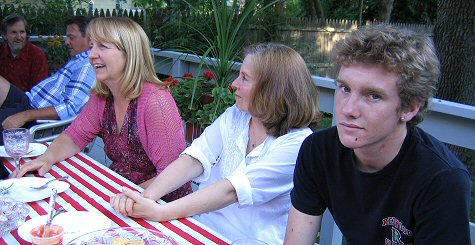
(l. to r.) Nancy Porter, Holly Porter, Jett Wells at 4th of July party at home of Robert Sharer of Westfield, New Jersey — Saturday, 7.2, 7:55 pm.

Last Monday’s fireworks from the South Street Seaport

Restaurant sign in Westfield, New Jersey near train station — Saturday, 7.3, 1:20 pm.

G train to L train, Brooklyn’s Lorimer station — Monday, 7.4., 11:40 pm.