All-Time Downers

There are at least three ways to have a depressing time at the movies, and one is worth the grief.
You can sit through something shoddy, inept, sub-standard, and do everything you can to flush it out of your system when it’s over. You can also sit through a smooth, studio-funded, well-made enterprise that everyone’s loving and is making money hand over fist, but which you happen to despise with every fibre of your being.
But watching a quality downer can be edifying. (Naturally.) I’m speaking of a movie that’s totally comfortable with the idea of bumming you out, because it’s trying to be thoughtful, profound or in some way affecting. Which saves it from being a bummer.

I’m thinking about this because there’s a film opening fairly soon that belongs in the third category. I saw it a little while ago, and I’m not going to identify it except to say that it was made by good and talented people.

It’s a totally honorable effort, in short, although it doesn’t leave you with much besides a feeling of profound spiritual despair. Everything in this movie is down, down, down. Almost every character hates their life or their job or is overweight or dying…or it’s raining or the skies are overcast, or secondary characters are acting in a randomly cruel and hurtful way.

And yet it feels honest; it captures the way life actually feels at times. I’ve been there on occasion and I didn’t exactly welcome the memory, but I recognized it.

I don’t have any persuasive arguments for anyone with a bleak attitude, but I’ve always gotten a laugh from that Woody Allen/Annie Hall joke about a woman complaining about the terrible food at a restaurant and her friend saying, “I know…and such small portions!”
Life is hard, cruel, oppressive, boring…but it’s all we’ve got to hold onto and it’s better than being dead. The “honorable effort” could use a tiny bit more of this attitude.

Movies that relay or reflect basic truths will never be depressing, but those that tell lies of omission by way of fanciful bullshit always poison the air.

Sadness in good movies is not depressing — it’s just a way of re-experiencing honest hurt. Ordinary People is sad, but if you think it’s depressing as in “lemme outta here” there’s probably something wrong with you.

I’ll give you depressing: living a rich full life (children, compassion, wealth, adventure) and then dying at a ripe old age and coming back (i.e., reincarnated) as a chicken at a Colonel Sanders chicken ranch.

My beef is with movies that impart a distinct feeling of insanity by way of delirium or delusion, or a bizarre obsession. Frank Darabont’s The Green Mile (turn on the current! smell that burning flesh! cuddle that cute mouse!) and The Majestic (rancid small-town “folksiness”) are two such films. Ditto Steven Spielberg’s Always .

Martin Scorsese’s Kundun isn’t exactly a downer. It’s worse than that — it’s paralyzing. And yet Scorsese made one of the greatest spiritual-high movies ever with The Last Temptation of Christ.
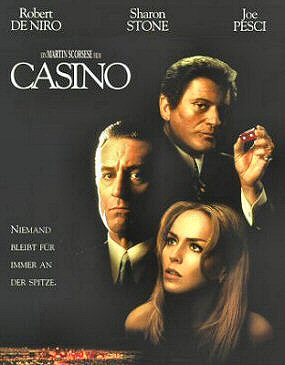
On the other hand, Marty sent thousands upon thousands of moviegoers into states of numbing depression when Sharon Stone bent over in order to give Joe Pesci a blowjob in Casino.

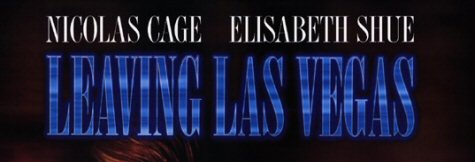
Leaving Las Vegas, Mike Figgis’ film about a lush who’s decides to drink himself to death and doesn’t quit until he succeeds, has never been and never will be depressing. (If you’re engaged to someone who thinks it is, tell him or her it’s over — you’ll be divorcing them eventually, so you might as well get it over with.)

And yet the watching of John Huston’s Under the Volcano, about a somewhat older guy (Albert Finney) doing more or less the same thing, is akin to accidentally overdosing on generic cold medication and having to tough it out until the effects wear off.

In her review of Peter Brooks’ King Lear (’71), a profoundly dreary black-and-white thing with Paul Scofield in the title role, Pauline Kael wrote, “I didn’t dislike this film — I hated it.” I was so intrigued by this review that I eventually saw Brooks’ film, and I knew Kael wasn’t talking about what Brooks had done as much as the way his film made her feel deep down.

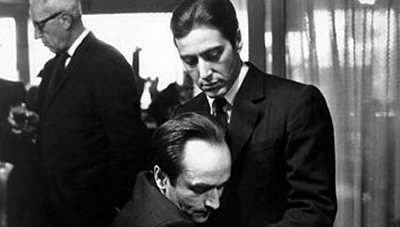
The Godfather, Part II is a fairly gloomy film but it doesn’t lie. It says that the ties that used to bind families and community together in the old days (the `40s and `50s) have been unraveling for some time. As Al Pacino’s Michael Corleone says to his mother in the second act, “Things are changing.”

The Matrix Revolutions is a profoundly depressing film, especially when all those hundreds of thousands of sentinels start swarming into Zion like wasps. Absolutely relentless and thundering empty-drinking-glass bullshit.
Sitting through Ron Howard’s Backdraft is like injecting an experimental psychotic drug concocted by Dr. Noah Praetorious (the frizzy-haired scientist in The Bride of Frankenstein) straight into your veins.

Most of the movies directed by Sean Penn are pretty damn depressing, but even in this context, The Crossing Guard delivers an exceptionally bleak vibe.

Kevin Bacon’s Loverboy, a well-made drama about an obsessive woman who never lets go of her insanity and is finally destroyed by it, is like being locked in a room with this character, and feels like a Bedlam-type thing.

People who think animal-death movies like Old Yeller, Bambi and The Yearling are depressing are, in the words of Claude Rains’ Captain Renault, “rank sentimentalists.”

The idea that someone saw the spirit of Ernest Hemingway in Chris O’Donnell, and cast him in In Love and War…that’s really bad.

Send in your own all-time depressing films quickly, and I’ll put them up this afternoon. And let’s not have any mentions of gross tear-jerkers like Love Story, Dying Young, etc. Let’s keep things dignified.

Nope

Stunt professionals want the Academy of Motion Picture Arts and Sciences to start handing out Oscars for Best Stunt Coordinator.

Good movie stunts will always deserve respect, but I’ve never seen a stunt in my life that, by my calculations, has lent thematic depth to the film or added to the emotional impact. Has anyone?
Stunts just aren’t in the same artisan realm as art direction, costume design, music composing or even main-title design. They’re skillful but never artful. They’re just, you know…stunts.

The people who perform them are obviously nervy professionals, but they didn’t go to Pratt or Julliard or NYU or AFI film schools to learn their craft, and I know this sounds snobby but what they bring to a film isn’t all that special or elevated.
Their work isn’t very original, for one thing. I can count on one hand the fist-fight scenes that have seemed exceptionally realistic. (That fight between Mark Wahlberg and Joaquin Phoenix in The Yards was an exception.) To my eyes, movie stunts never seem to involve average, off-balance, physically clumsy people. They’re almost always rotely performed.

And I’m getting really tired of car-chase scenes, even when they push the boundaries like the one staged in Moscow in The Bourne Supremacy. The cars in car-chase scenes always seem like they’re being driven by professional drivers — they always fishtail and spin out in a certain way, like the driver knows exactly what he/she is doing, etc.

Four stunt organizations have gotten together and written a letter to AMPAS, saying that “stunt performers are the only faction of the movie industry that must literally risk their lives for the sake of their art” and that “the talent and expertise that is required of a stunt coordinator to be both creative and safe is enormous and highly deserving of academy recognition.”

Safe, maybe, but forget creative. To me, movie stunts are the antithesis of that. Hollywood’s stunt professionals are good people, but they’re upper-level proles who are just a step or two removed from carpenters and electricians, and including them with the rest of the Oscar contenders would devalue things a bit.

Conservative Diss

“I predict that the upcoming Oscars will be the lowest rated in recent Oscar history. For the first time I will also not be watching.

“As a recent film school graduate who has loved and devoured film history since a child, I can say that I am truly bored with a great majority of the stories being told through the mainstream of the American/Western film industry. Hollywood has been in an overtly left-wing ideological paradigm for well over a generation now and certainly all of my lifetime.

“This is not a question of politics. It is a question of bad story telling. It makes films predictable.
“As someone born in the 70√¢‚Ǩ‚Ñ¢s, old-fashioned to me is not a rigid evangelical going to church on Sunday. Old-fashioned to me is wife-swapping, wicca and gay bath houses. Ideologically, for as long as I can remember, and with precious few exceptions priests, evangelicals, businessmen, corporations, conservative politicians, uptight white folk and (insert bad Hollywood stereotype here) are always the villains.
“I did not need Michael Medved to tell me the third-act twist in Million Dollar Baby. I had my suspicions as soon as I saw the religious imagery in the trailer released in November and read web-columns saying how shaken people were from the initial pre-screenings. The day it went into limited release in mid-December, I waited until about 3:30 pm (after the first early matinees), went onto some Eastwood fan chat rooms and had my thoughts confirmed.

“I have admired and championed Clint Eastwood since long before it became hip and fashionable in film circles to do so yet I found the last third of M$B very predictable. It would have been unpredictable had his character not euthanized Hillary. I don√¢‚Ǩ‚Ñ¢t for one minute believe that you thought there was a chance the film wouldn√¢‚Ǩ‚Ñ¢t end the way it did.

“I saw M$B and The Sea Inside when they were called Brian√¢‚Ǩ‚Ñ¢s Song and Whose Life Is It Anyway?. Hearing Julia Roberts in Closer talk about the taste of cum was about as shocking to someone my age as hearing Julia Roberts talk about the taste of cum.

“‘Prestige’ films like Vera Drake, Kinsey, Frida, The Motorcycle Diaries, The Hours, The Dreamers, etc. do not titillate or offend…they bore. They don’t speak to people of a younger generation because we have had their ideology rammed down our throats from birth.

“These films are well-made but indulgent and poorly researched polemics made by people who still pine for an era that no longer exists — the ’60s. The counter culture that lived 30 or 35 years ago and refuses to die bores more in my generation than the media would have you believe. The new generation of film fans are not shocked by Deep Throat. We were weaned on Trey Parker and yawn in the face of it.

“As I said to an older, very left-wing reporter friend of the family after the election who could not understand why I would support GW, I√¢‚Ǩ‚Ñ¢ve never been silenced or censored by an evangelical, but I do have first-hand experience of a raging, foaming at the mouth p.c. university student pointing his finger and saying I am a ‘poor quality human being’ because I ‘dared’ to make a short film with the phrase ‘chick√¢‚Ǩ‚Ñ¢s ass’ in it.

“I know first-hand of a film professor who found himself as the subject of a tribunal because he dared — dared! — to show an excerpt of Blue Velvet during a class on voyeurism. The more ‘enlightened progressive’ types decided that he was implicitly endorsing rape.
“Hollywood now forsakes art for ideology and films that truly break new ground artistically (The Passion of the Christ, Fight Club, Hero) are derided or not rewarded because of their ideology.
“It says something about our times and the history of film that we are constantly told how shocking, daring and controversial left-leaning films are/were (Fahrenheit 9/11, Midnight Cowboy, Last Tango in Paris, Last Temptation of Christ), yet by any standard, the most controversial film since 1915√¢‚Ǩ‚Ñ¢s Birth of a Nation was made by a conservative Catholic director who made an R-rated film about a man on a cross who died 2000 years ago.

“For a community that says it is so culturally curious about all walks of life, where are the stories depicting the plight of the millions slaughtered under Joseph Stalin?

“For every ten Hollywood love songs to Marxism/communism, where is the director who dares tell the story of those brave students who died in Tianamen Square?

“How about an Oscar-caliber film detailing the slaughter of the three million Polish Catholics killed in the Holocaust?

“For every story about how repressed America was sexually in the ’50s, how about a film detailing the pure intellectual repression caused by leftist speech codes on modern university campuses?

“Can you actually make a case that the creative team of Vera Drake is being nominated over films like Kill Bill Part 2 or Man on Fire because of quality, or is the message of the film what√¢‚Ǩ‚Ñ¢s being voted for?

“Can you make the case that in 50 years more film students will be talking about Sideways or The Aviator over The Passion of the Christ? That people such as Stanley Kubrick, Alfred Hitchock, Orson Wells, Akira Kurosawa, Ingmar Bergman, Cary Grant and Stanley Kramer never won a legitimate Oscar does more to invalidate the Oscars than anything anyone can say.

“Most modern Hollywood/Western films don√¢‚Ǩ‚Ñ¢t dare me to think — they ask me not to. I suggest that if Hollywood artists want to become relevant again, perhaps they should quit calling everyone who disagrees with them ‘uncurious’ and become a little bit more curious themselves. If they don√¢‚Ǩ‚Ñ¢t, they will find more and more Bubbas like myself who care less and less.” — Nicole DuMoulin.

Oscar Expectations

“I’m from one of the dreaded red states — Houston, Texas, to be exact. I’ve seen and loved both Sideways and Million Dollar Baby — especially the former. I suppose I’m an exception to the rule, but you’re probably right that the majority of people who have seen it live up north. That’s too bad because they’re great films.

“I for one am happy with the change in the Oscars, and I’m glad that smaller films that haven’t made $100 million or over have gotten recognition. I just wish Paul Giamatti had been nominated.” — Richard Scandrett.

“Interesting insights on the Oscars and Oscar-nominated grosses in your 2/11 column. I’m a blue-state guy living in a red state (but a weird one with a Democratic Governor and Dem-dominated state assembly who voted overwhelmingly for Bush).

“I finally caught Sideways yesterday in a pretty crowded theatre in Winston-Salem, North Carolina, and I was talking with some folks in line and in the theatre beforehand about the Best Picture nominees. I found some other reasons for both the declines in ratings and money among the ‘common man’ types (something that people in NC overwhelmingly believe they are).

“First of all, the biggest movie of the last three years, both in terms of money and Oscar nods was what? That’s right — the Lord of the Rings trilogy. Some people I talked to in the theatre said that since that experience, they haven’t seen any other ‘big’ movies that they were interested in. One guy even said he didn’t even want to give The Aviator a shot, not even on video.

“Similarly, there seems to be sort of a weird backlash against nominated ‘small’ films. People around me in line going to see other stuff said they were disappointed in Lost in Translation, The Hours…one lady even mentioned Gosford Park…other movies that were not blockbusters the last few years but were liked by critics and nominated for Oscars. They didn’t want to see Sideways or Finding Neverland.

“Also, some people just don’t like Clint Eastwood’s movies, and I’m one of them. I hated Unforgiven, tolerated Midnight in the Garden of Good and Evil and will not watch Mystic River or Million Dollar Baby. Some others in the theatre agreed.

“Anyway, I came out of Sideways very satisfied. It was a great story and well-acted. Other people seemed to enjoy it, too, although I did experience one of the great horrors of being in a movie like that: the couple with the four or five kids clearly not old or smart enough to understand a movie like that who keep getting up to go to the bathroom and get candy every five minutes. At least the parents kept them from talking.” — Marc Allen
Wells to Allen: Those people you were speaking have taken the concept of “unsophisticated” to new lows. People should see what they want to see, but it sounds to me like they’re much more into shutting doors than opening them.

“Don’t you think that the biggest problem with Oscar’s popularity is the fact that there’s an awards show on television at least once a week? It’s ridiculous. There’s the Golden Globes, SAG, some British thing, Blockbuster, MTV, People’s Choice, blah, blah, blah. There’s a complete over-saturation, to the point where these award shows seem to be more about celebrity than they do about films. I used to love the Oscars when I was younger, I never missed a second, but now I’m just burned out on the whole celebrity scene, to the extent that I don’t really want to see any of it. Not even the Academy Awards.

“For me personally, the problem is that the winners of the past two Best Picture awards have really bummed me out. Lord of the Rings: Return of the King over Mystic River for Best Picture? Its wrong to give the Best Picture award for an overall achievement, instead of the year’s best film.

“But that’s not nearly as egregious as Chicago‘s Best Picture win two years ago. I dare someone to explain to me how Chicago, which I couldn’t even sit through, is a better movie than The Pianist. Total crap.

“Every year has its Oscar omissions, but the past two years the Best Picture award should have been named the Picture that Makes People Feel the Best award. If Finding Neverland were to win this year, I don’t think that I could watch another Oscar night. Ever.” — Jeff Horst.
Wells to Horst: Don’t worry about Neverland — it’s in there strictly to round out the pack.
Here’s a Chris Rock observation

Here’s a Chris Rock observation from that same Entertainment Weekly/Josh Wolk interview that started all the trouble…or rather, the interview that gave Matt Drudge the opportunity to selectively quote from and ignite all the trouble out of context. Wolk asks Rock if he thinks movies are “better or worse than they used to be?” and Rock answers, “Definitely worse. Studios used to make visions. When a director has control, what you’re seeing on the screen is a vision. Now what you see is a consensus. There’s a big difference. Sideways is a vision. The Day After Tomorrow is a consensus. It’s 30 people agreeing.”

Give Constantine this much: after

Give Constantine this much: after who knows how many hundreds of mainstream films over the last 60 or 70 years that have essentially served as advertisements for the existential coolness of sucking in cigarette smoke, here’s a flick in which the hero (Keanu Reeves) is presented as inescapably doomed because he’s been smoking since he was 15. I stopped smoking eons ago, but I’ve gone back to it now and then, and this movie made me feel horrible about this. I can’t remember a more effective anti-smoking argument projected on a big screen.

How’s this for a Howard

How’s this for a Howard Hughes triple bill at the American Cinematheque somewhere down the road? Open with Martin Scorsese’s The Aviator, follow up with Edward Dmytryk’s The Carpetbaggers (1964), featuring the always-icy George Peppard as a cold, misogynistic movie mogul-slash-industrialist, a character based on Hughes, and conclude the evening with Jonathan Demme’s Melvin and Howard (1980), mostly about a middle-class American schlub (Paul LeMat) but featuring an inspired Jason Robards cameo perf as a rickety, weather-beaten, half-looney Hughes.

The mentality of those 77

The mentality of those 77 year-olds who’ve bristled at Oscar Awards emcee Chris Rock’s comments about the show (“It’s a fashion show” that’s “mostly for gay people”) and who are muttering that he’s “not suitable for the job” (according to Hollywood Reporter columnist Martin Grove)…this harumph-y attitude is precisely why the Oscar Awards are seen as going downhill and increasingly irrelevant. Especially now that the specifics of Rock’s comments in the Entertainment Weekly interview (offered here as a link to a Movie City News transcript) make it clear that what Rock actually said (without the quotes taken out of context) are perfectly valid and have been articulated before by others, including George C. Scott 30-something years ago when he called the Oscar show “a meat parade.”

A non-scientific Newsweek/MSNBC poll has

A non-scientific Newsweek/MSNBC poll has asked readers which super-expensive popcorn movie they’d most like to see in 2005, and right now (Tuesday, 2.15, 9:37 am) the most eagerly awaited (favored by 32% of voters) is George Lucas’s Star Wars III: Revenge of the Sith (20th Century Fox, 5.19). Mike Newell’s Harry Potter and the Goblet of Fire (WB, 11.18) is the second most anticipated with 18%, Tim Burton’s Charlie and the Chocolate Factory (WB, 7.15) is third with 11%, and Steven Spielberg’s War of the Worlds (Paramount, 6.29) is fourth with 10%. Peter Jackson’s King Kong (Universal, 12.14) got 4%, but it’s early yet. Adam Sandler’s The Longest Yard (Paramount, 5.27) gathered a 3% rating…hmmmm.

“When you say ‘no’ a

“When you say ‘no’ a lot as an actor, you’re going to go broke, and that’s been the hardest thing to go through in the last ten years,” Sideways costar Virginia Madsen says in a recent Guardian interview. Such confessions will not stop junket-press journos from asking actors “what artistic motives led you to play this role?” when the truthful answer, more often than not, is “I have two kids and brutal mortgage payments.” Or “I could have taken this far more interesting role in this indie film, but I’ve become lazily accustomed to my lifestyle and my kids like their I-Pods and their wardrobes, so I took the slightly dumber and shittier role in this big-budget genre film.”

So Lewis Beale and his

So Lewis Beale and his New York Times editors plugged me, Variety‘s Pete Hammond, Gold Derby.com’s Tom O’Neill and blogger Emanuel Levy in Sunday’s (2.13) piece about Oscar prognosticators …but they cut Movie City News’ David Poland, which, by anyone’s barometer, makes it an incomplete presentation.

“There’s a difference in how

“There’s a difference in how I vote on my ballot and how I vote in the office pool,” an Academy voter tells Fade In writer Nelson Handel. It would be better if the Oscar awards were only voted upon by peers “but it’ll never happen,” the voter admits. “Everyone enjoys voting, and won’t be dissuaded by the fact they they’re ignorant.” The entire piece, which has been getting a fair amount of attention over the last week or so, can be found here .

Eucalyptus is the title of

Eucalyptus is the title of a Jocelyn Moorhouse-Fox Searchlight film that was recently put on hold because the script isn’t ready yet. Actually, because star and executive producer Russell Crowe had problems with it. The film, which would have costarred Nicole Kidman, is about “an Australian widower who plants hundreds of eucalyptus trees on his land,” according to a Reuters news story “He tests his daughter’s suitors by making them identify every species. One succeeds, but by then Ellen (Kidman) already has lost her heart to a handsome stranger (Crowe).” I’m sorry, but that sounds like fanciful chick-movie horeshit.

My most affecting Arthur Miller

My most affecting Arthur Miller moment was seeing Death of a Salesman in ’84 on Broadway, with Dustin Hoffman as Willy Loman and a 30 year-old, totally-on-fire John Malkovich as Biff. Miller led an amazing life in an incredibly rich and turbulent time, and now, at age 89, he’s no longer among us. Nothing recedes likes success, but rest comes to us all.

Damn Numbers It was being

Damn Numbers

It was being predicted a couple of weeks ago that the February 27th Oscar telecast will be among the lowest-rated in history, if not the lowest rated. Are we supposed to be concerned? All right, let’s say we are.
In the early to mid 1930s, back when Irving Thalberg had something to say about the way this town was being run, the Oscars were intended as a classy promotion for the studio’s higher-quality films.

The industry was saying to the public, “Enjoy your westerns and your Wallace Beery movies, but keep in mind that every so often the movie industry tries to make films of lasting value, and we’d appreciate your support in these efforts.”
That concept went into the toilet a long time ago, largely due to the interlocking rules of TV ratings and advertising revenues.
People are said to be scared because the Golden Globes awards telecast in mid-January attracted only 16.8 million viewers — 37% less than it enjoyed last year. But this is because it played opposite ABC’s Desperate Housewives, or so goes the rationale.
< ?php include ('/home/hollyw9/public_html/wired'); ?>
If the Oscar ratings go south, it’ll have nothing to do with Chris Rock being the new host (although I’m sure some industry journos will take a stab at this if the ratings debacle happens). Most of the blame will rest on the shoulders of three Best Picture nominees — Million Dollar Baby , Finding Neverland and Sideways — for not having sold enough tickets, and therefore weakening rooting interest on the part of mainstream viewers.
Ray and The Aviator are the Best Picture nominees that have made reasonably decent coin so far — $74 million and $77 million, respectively. Decent but not humungous.
Actually, Sideways is doing fairly okay for a small film — $15 million earned since the Oscar nominations were announced on 1.25 for a total of close to $48 million. Million Dollar Baby has taken in a post-Oscar-nom $28 million for a $36 million tally. Finding Neverland has received the smallest post-nomination benefit, bringing in almost $7 million for a $36 million gross.
What the doomsayers mean, I suppose, is that none of these films have brought in over $100 million, which implies they aren’t doing as well as they should in the hinterlands. (Most of the money, I’m assuming, has come from blue-state cities, largely because the weakest three haven’t played Bubbaland theatres until fairly recently.)

And so this means…what? That Academy members need to forget about nominating movies and filmmakers that fit their “best” criteria? (Not that they do this with any focus or sincerity now, but that’s another story.) And from here on they need to concentrate on nominating only the movies (and the people who’ve made them) that have sold the most tickets?
This, of course, would be tantamount to turning the Oscars into the People’s Choice Awards, but everything’s swirling in a downward direction anyway so why not?
The Aviator might have a chance at breaking $100 million because of all of its nominations,” Box Office Mojo’s Brandon Gray told USA Today‘s Scott Bowles in a recent piece. “But that’s a long shot. The other movies are middling performers that people don’t care about.”
People don’t care about seeing Million Dollar Baby or Sideways? What kind of dead-to-the-world, potato-chip-munching attitude is that?
On the other hand, I half sympathize with people saying “naahh, later” to Finding Neverland. It’s a decent heartfelt little film, but Kate Winslet and her coughing…oy. And it’s hard to suppress the urge to strangle Johnny Depp and be rid of his burry Scottish accent for good.
I don’t know why I’ve even getting into this. It’s appalling that people are saying that the Oscar show, or the concept of the Oscars, needs to adapt to the aesthetic vistas of a nation of rurals who wear flip-flops and don’t read Anthony Lane (much less anything hardbound) and spend too much time on the couch.
Isn’t the Oscar-choosing process polluted enough? I guess not.

My son Jett, 16, doesn’t respect the Oscars, and is saying he doesn’t care that much about watching the show this year. A lot of people have written in and said the same thing. This probably means that the show needs to change, get loose, get a new spikey haircut…but in what fashion or direction?
Or is it the movies themselves that aren’t working, or are missing, to an increasing degree, something fundamental?
A friend explains the basic problem as follows: The studios and the “dependents” aren’t making movies for the Big Middle anymore, and the backwash of this policy has been affecting interest in the Oscar awards. And it’s only going to get worse.
The studios are primarily in the super-budgeted, theme-park, Brad Pitt, make-sure-it-plays-in-Germany-and-Croatia business. Some good big-studio pics are getting made here and there, but mostly we’re getting C-level projects at A-level budgets.
(There are only two possible big-studio Oscar contenders opening between late April and Labor Day: Ron Howard’s Cinderella Man and Cameron Crowe’s Elizabethtown.)
And the smaller outfits, my friend said, are mostly about making or acquiring films aimed at better educated blue-state audiences (i.e., Sideways).
I don’t like that people have been labeling Alexander Payne’s film this way. It’s not about a couple of celestial physics instructors, but about the kind of guys everyone knows or at least rubs up against. But when you keep hearing the same things over and over, it’s hard to keep arguing.
A friend who loves Sideways took a Manhattan-raised ex-boyfriend to see it last week and he started seriously complaining about it about 45 minutes in. “I can’t take this…it’s all about drinking,” he said. He insisted on leaving. They went across the lobby and saw Hide and Seek instead.
Obviously this guy’s a lowbrow (with a past alcohol problem, I’m told, which explains his reaction) but avoidance scenarios like this have probably happened with others.

For some reason, and despite being called the Best Picture of the Year by almost every critic in the country, Sideways is doing only pretty well. It hasn’t really caught on, and I keep sensing that people are smelling something they don’t like about it. This sounds cruel, but they seem to have some kind of problem with movies starring (or are largely about or cuddle up to) balding, bearded, whiny-voiced pudgeballs.
I just can’t accept that would-be moviegoers are asking each other what they want to see on a Friday night, with one saying “what about Million Dollar Baby?” and the other saying “naaah.” I refuse to live in a world that shuttered.
And yet I think people should at least go to The Aviator, despite the several irritations. (DiCaprio is brilliant, despite his not being quite the right guy to play Howard Hughes, and it is, you know, a Scorsese film.)
It’s ironic, of course, that the one Best Picture nominee that people haven’t had to talk themselves (or their dates) into seeing, is arguably the weakest candidate. And I loved watching it last fall, and I’ll watch it again this week on DVD. What’d I say?

Smart Bomb

My natural tendency is to side with a critic or journalist when there’s some kind of scuffle, but I thought the writing that went into Owen Wilson’s hammering of New Yorker critic David Denby for his slice-and-dice of Wilson’s longtime homie and costar Ben Stiller was pretty tasty.
I know, I know…I should have run with this last Monday or Tuesday.

At the very least, Wilson’s witty tirade makes for a more elevated contretemps than the one that went down between actor Rob Schneider and L.A. Times columnist Patrick Goldstein, which was largely about Schneider’s attempt to trash Goldstein’s rep by pointing out he’s never won any journalism awards, whatever that infers.
Here’s Wilson’s thing:
“I read David Denby’s piece on Ben Stiller with great interest (“The Current Cinema,” January 24th & 31st). Not because it was good or fair toward my friend but exactly because it wasn’t,” he began.
“I’ve acted in two hundred and thirty-seven buddy movies and, with that experience, I’ve developed an almost preternatural feel for the beats that any good buddy movie must have. And maybe the most crucial audience-rewarding beat is where one buddy comes to the aid of the other guy to help defeat a villain.

“Or bully. Or jerk. Someone the audience can really root against. And in Denby I realized excitedly that I had hit the trifecta. How could an audience not be dying for a real `Billy Jack’ moment of reckoning for Denby after her dismisses or diminishes or just plain insults practically everything Stiller had ever worked on?
“And not letting it rest there, in true bully fashion Denby moves on to take some shots at the way Ben looks and even his Jewishness, describing him as the `latest, and crudest, version of the urban Jewish male on the make.’ The audience is practically howling for blood! I really wish I could deliver for them–but that’s Jackie Chan’s role.”
Here’s the link to Denby’s Stiller piece.

Downfall

There’s a nicely written, highly persuasive piece by Louis Menand in this week’s New Yorker called “Gross Points.”
Here’s Menand’s entire piece and here are some excerpts:
“The people who make the popcorn basically know what they’re doing. The people who make the movies basically don’t, at least not until the product is out there, and then it’s too late.
“The history of Hollywood is a comic routine of bad guesses, unintended outcomes, and pure luck. Half of the failures were well-intentioned, and half of the successes were, by ordinary standards of fairness and decency, undeserved. People do get rich making movies; more often than not, they’re the wrong people. That’s why moviemaking is so much fun to read about. Unless, of course, it’s your money.
“The cinema, like the novel, is always dying. The movies were killed by sequels; they were killed by conglomerates; they were killed by special effects. Heaven’s Gate was the end; Star Wars was the end; Jaws did it. It was the ratings system, profit participation, television, the blacklist, the collapse of the studio system, the Production Code. The movies should never have gone to color; they should never have gone to sound. The movies have been declared dead so many times that it is almost surprising that they were born…”

Of course, ‘death,’ in this context, does not mean ‘extinction.’ What it means depends on the speaker.
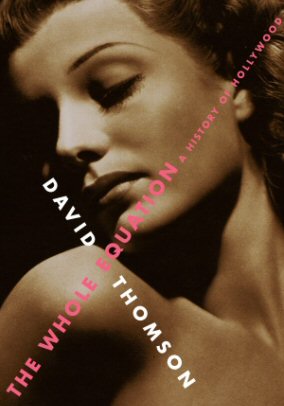
“David Thomson’s The Whole Equation: A History of Hollywood (Knopf; $27.95) is a coroner’s report. The title is misleading. The book gives roughly two hundred and ninety pages to the first fifty years of Hollywood and about eighty pages to the last fifty, and the true scope of its interest is even narrower.
“Thomson thinks that Hollywood had only two phases of first-class product: from 1927 to 1948, The Jazz Singer to the Paramount decision (the Supreme Court case that broke the studio system by forcing the studios to divest themselves of the theatre chains they owned); and from 1967 to 1975, Bonnie and Clyde to Jaws.
“If you think that our interest in movies has everything to do with our feelings about them, and if you have a tolerance for repetition, digression, first-person indulgence, and general narrative shagginess, then you are not likely to find a more affecting and intellectually absorbing book on film as a popular art. Thomson’s subject is not, strictly speaking, the history of the movies; its subject is the history of caring about the movies. That calls for something more than just the facts.
“Giants like [Independence Day, Godzilla, Pearl Harbor and the two Matrix sequels] continue to stalk through the multiplexes, shaking gold from the heavens with their thunderous, THX Certified footsteps; but inside their high-definition, digitized craniums their tiny brains are dead.
“[This] wouldn’t matter so much now if the industry didn’t care. But the industry does care. The people who make movies need to be able to take themselves more seriously than the people who make popcorn do. The situation would be simpler if everyone was certain that the movies making money today have no more creative integrity or cultural significance than a beer commercial. But no one is certain. People fear that they’ve lost the key to the distinction.

“Most autopsies of the cinema tend to be `it all started to go wrong when…’ narratives. They’re appealing in the same way those `wise old person who knows the secret’ stories that turn up in so many fantasy-adventure movies today are appealing, and they have the same shortcoming, which is that in life there never is just one secret, and there never is just one cause.
“In the case of a collaborative, semi-regulated, high-cap, worldwide, mass-market entertainment like a Hollywood movie, identifying causes is like predicting next year’s weather. A butterfly flutters its wings in Culver City, and a decade later you get The Terminator.
“One of the merits of The Whole Equation is that it avoids isolating a cause of death. It maintains a kind of analytic deep focus; it tries to take in everything. Thomson thinks that some of the explanation for what happened to the movies has to do with the movies and the people who make them, but some of it has to do with the audience. `It’s not so much that movies are dead,’ he suggests at one point, `as that history has already passed them by.’
“Today, there are thirty-six thousand screens in the United States and two hundred and ninety-five million people, and weekly attendance is twenty-five million.
“And what is the main cinematic experience? The tickets, including the surcharge for ordering online, cost about the same as the monthly cable bill. A medium popcorn is five dollars; the smallest bottled water is three. The show begins with twenty minutes of commercials, spots promoting the theatre chain, and previews for movies coming out next Memorial Day, sometimes a year from next Memorial Day.
“The feature includes any combination of the following: wizards; slinky women of few words; men of few words who can expertly drive anything, spectacularly wreck anything, and leap safely from the top of anything; characters from comic books, sixth-grade world-history textbooks, or ‘Bulfinch’s Mythology’; explosions; phenomena unknown to science; a computer whiz with attitude; a brand-name soft drink, running shoe, or candy bar; an incarnation of pure evil; more explosions; and the voice of Robin Williams.

“The movie feels about twenty minutes too long; the reviews are mixed; nobody really loves it; and it grosses several hundred million dollars.
“The blockbuster is a Hollywood tradition, but blockbuster dependence is a disease. It sucks the talent and the resources out of every other part of the industry. A contemporary blockbuster could almost be defined as a movie in which production value is in inverse proportion to content.
Troy is a comic strip, but what a lavish, loving, costly comic strip it is. The talent, knowledge, and ingenuity required to make just one of the battle scenes in that film, or one mindless James Bond chase sequence, interchangeable in memory with almost any other Bond chase sequence, would drain the resources of many universities.
“But why doesn’t anyone put more than two seconds’ thought into the story? The attention to detail in movies today is fantastic. There is nothing cheap or tacky about Hollywood’s product, but there is something empty. Or maybe the emptiness is in us.”

Forecast

David Poland ran a list this morning of some ’05 films he thinks will be Oscar nominated as of 1.25.06. I agree with all of them except two.
Forget about Columbia’s Memoirs of a Geisha. I realize how lowbrow this sounds, but any movie title with the word “geisha” is out, as it obviously portends something excessively delicate and (let’s be honest) probably dreary.
And forget Universal’s King Kong — double-triple-quadruple forget it. A remake of a classic ape movie with Andy Serkis as the ape can’t be Oscar material, and no rational person out there expects it to be…especially under the hand of Peter Jackson.

Tribute