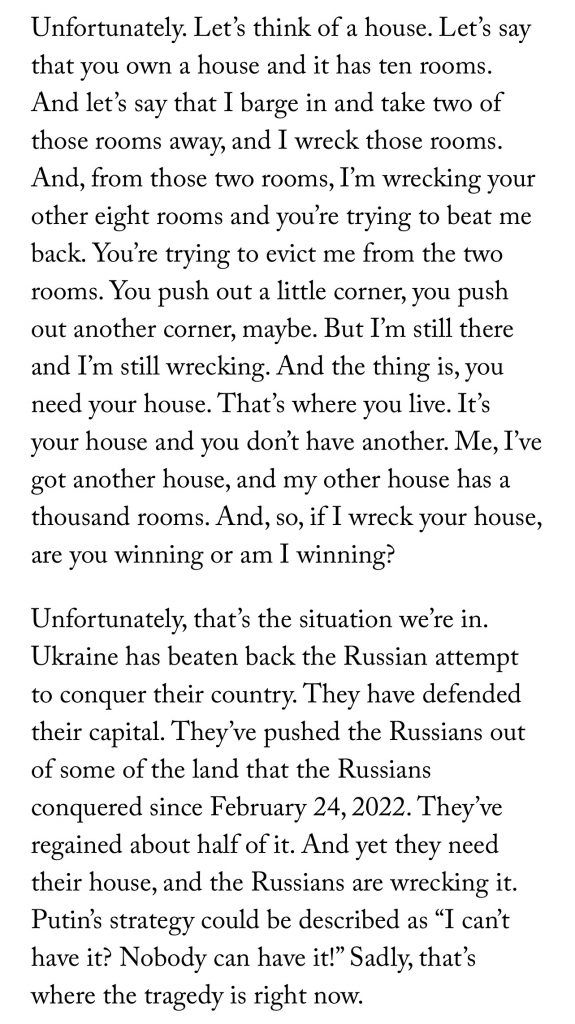
I can only hope that later today somebody on the Oscar champagne carpet will say something like this.

I can only hope that later today somebody on the Oscar champagne carpet will say something like this.
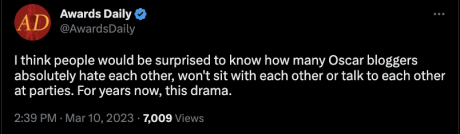
I for one feel nothing but love and respect for those relatively few columnists and award-season bloggers who seem to enjoy friendliness for its own sake, and who behave in a relatively humane manner for the most part and who tend to hold back on the backstabbing accusations — Sasha Stone of Awards Daily (annual winner of HE’s Human Being Award), World of Reel‘s Jordan Ruimy, THR‘s Scott Feinberg, Deadline‘s Pete Hammond, Above The Line‘s Jeff Sneider, Manhattan get-around humorist and gadfly Bill McCuddy, BlackFilm&TV’s Wilson Morales, director and ex-critic Rod Lurie, former Entertainment Weekly and L.A. Calendar colleague Pat Broeske.
There are actually several dozen human beings in this racket if you count certain working critics plus the various producers, directors, screenwriters, managers and agents whom you might call or run into from time to time. Several dozen among thousands.
If I was running the show I would say to all the gown designers and fashion consultants who’ve complained that traditional arterial crimson red doesn’t blend well with certain colors…I would say to them “gee, that’s too bad, I’m sorry to hear this but my answer is “tough shit and you can all kiss my ass because the red carpet is staying.”
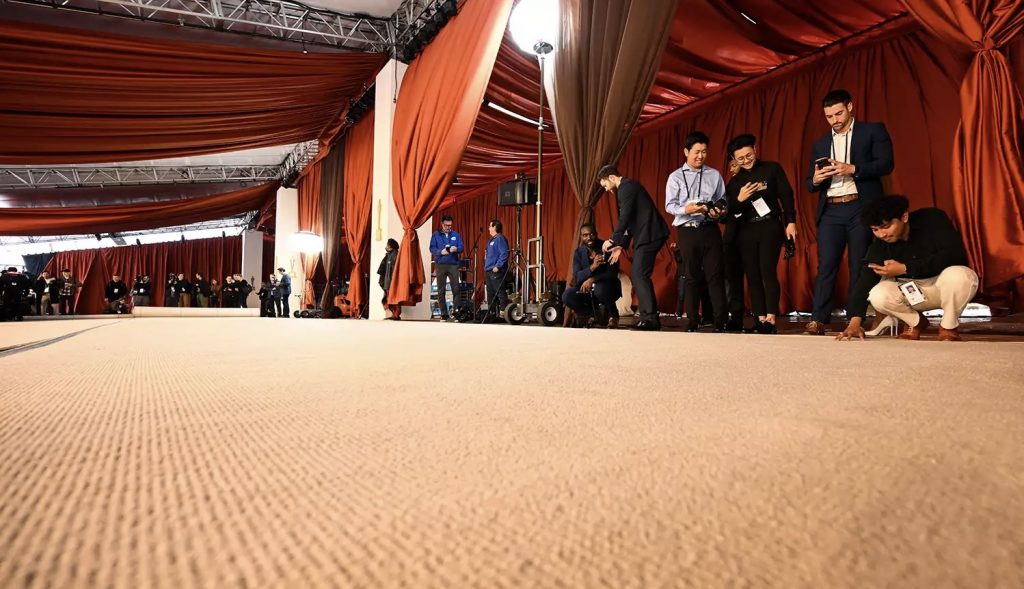
From Sara Bahr’s 3.10.23 N.Y. Times story:
Since Thursday I’ve been dog-sitting in West Orange while Jett, Cait and Sutton are in Massachusetts for a weekend funeral. Joey, a pit bull with a bum hind leg, and Luna, a sausage beagle, are both older but they love me and I them.
But they insist on fairly close proximity and almost constant affection at all times, and after three days and nights I’m exhausted from lack of sleep due to sharing the guest room bed with these guys as they take up most of the mattress space. Three nights of bad sleep, mainly due to Joey.

Right now I’m trying to get a little extra shut-eye (I was up half the night from the sprawling bodies and dog farts, plus we just lost an hour to daylight savings) by locking Joey downstairs behind the plastic staircase gate.
And of course, Joey is whining and moaning and banging against the gate as we speak.
Update: Joey has somehow crashed or squeezed through the gate. He’s up here now with us, and of course he’s back on the bed. I love these guys but I’m getting sick of this — I’d like a little peace.
New update: Lying on the couch and of course they have to sleep either right next to me or on top of my legs.
Jett scolding: “U trained them, dad. U give Joey too much love and attention and let him walk all over u. My [disciplined] way may seem cruel but it’s the only way to have any sanity.”


I’ve spoken from time to time about my love for British kitchen-sink films. Actually only once or twice, the first time being 15 years ago. Raw, sometimes rowdy, grimly realistic black-and-white films…late ’50s to early ’60s…youngish working-class fellows plus Leslie Caron and Rita Tushingham…grappling with despair, too much alcohol, bum paychecks, sullen attitudes and a sense of entrapment or even panic.
There were only eight or nine of merit — Look Back in Anger (’59), Room at the Top (’59), Saturday Night and Sunday Morning (’60), A Taste of Honey (’61), A Kind of Loving (’62), The L-Shaped Room (’62), The Loneliness of the Long Distance Runner (’62), This Sporting Life (’63) and Billy Liar (’63).
The leading-light directors were Karel Reisz, Tony Richardson, Bryan Forbes, John Schlesinger, Jack Clayton. The principal actors were Albert Finney, Alan Bates, Tom Courtenay, Tushingham, Rachel Roberts, Richard Harris, Caron, Colin Blakely, Norman Rossington, etc.
I’m mentioning this because I have a confession: until last night I’d never actually watched Saturday Night and Sunday Morning…costarring the blazing, incandescent Finney and Roberts, directed by Reisz, produced by Richardson and written by Alan Sillitoe, based on his own 1958 novel.
The usual kitchen sink dynamic, of course…the 23 year-old Finney as Arthur, a cynical, blunt-spoken machinist (technically a teddy boy but not a rocker) doing a lot of drinking and partying while simultaneously having it off with a 30ish married woman (Roberts) and romancing a pretty 22 year old (Shirley Anne Field).
Finney is so fierce and nervy, which of course is an act that hides his despair and depression over eventually becoming just another factory-working bloke with kids and a wife and too many bills to pay…stuck for the rest of his life.
It just feels so lean and vaguely miserable and pared to the bone…there isn’t a line or a scene that doesn’t feel like a perfectly designed belt or bearing in a well-oiled engine, or a supporting character who doesn’t fit right in like a natural piece of a puzzle, although there isn’t a single aspect of Saturday Night and Sunday Morning that feels the least bit puzzling or vague or off the mark. No fat or fatuousness; no digressions. Most of it (but not all) is “lemme outta here,” and that’s the point.
To-die-for cinematography by the great Freddie Francis (Sons and Lovers, The Innocents, The Elephant Man, The French Lieutenant’s Woman).
I made this point a few years ago, but if someone were to remake Saturday Night and Sunday Morning as a 2023 tale of aimlessness and gathering desperation…a Zoomer or young Millennial character (man or woman) working at sone kind of underwhelming job, vaguely enraged, living with a boring roommate or an older brother or parents in suburban New Jersey, Maryland, New Mexico or northern Florida…I would watch it in a second.
Just leave out the superficial crap and just tell it plain and straight.
That’s all I’ll be asking for tomorrow night. I’ve accepted that as far as EEAAO is concerned, Sunday night’s grief will be a fallen leaf and I will weep as much (or as little) as necessary. But don’t give the Best Supporting Actress Oscar to Wakanda Forever’s Angela Bassett…please. Condon’s Banshees of Inisherin performance was so rich and real and open-hearted (so far above Bassett’s high–strung histrionics that it’s not even worth comparing the two)…just pan things out in Condon’s favor and I’ll find a way to live with the rest.

The New Yorker‘s Richard Brody has really, seriously, earnestly chosen David O. Russell‘s Amsterdam as one of the ten films he’d like to see nominated for the Best Picture Oscar of 2023. Russell’s film sent me into a pit of depression and confusion…it struck me as so damn infuriating and unsatisfying that I nearly wept.
But I also admire Brody’s choosing James Gray‘s Armageddon Time for the same honor. I admire his sand.

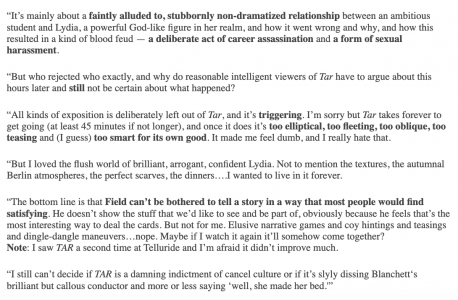
I’ve had a problematic relationship with Todd Field‘s Tar since first catching it six and a half months ago in Telluride, but I would vastly prefer it winning the Best Picture Oscar over the infuriating EEAAO. Because it’s a much richer and far more interesting package, for one thing. Anyone with any standards understands this.
But of course, Tar was never a serious Best Picture contender because Field refused — bravely or admirably, you could say — to make a film that was semi-accessible to your average none-too-bright or mental lazybones.
Field had a choice between making a film for the popcorn munchers or one that would delight Martin Scorsese and/or your typical Criterion Channel subscriber, and he obviously went for the latter.
Posted on 10.6.22: TAR is such a brilliant, odd-duck, upper-stratosphere thing — elliptical and elusive, neither here nor there but at the same time alluring and fearless — that it makes insider types feel like outsiders.
It’s more about aroma than actual taste, and it refuses to come to you. And for a while that’s a turn-on…”piece by piece I’m putting it together,” you tell yourself during the first hour, “and eventually all the strands will cohere…all will be revealed and known.”
Field is saying “no, you come to the film…it’ll require work on your part and maybe some feelings of uncertainty or frustration even, but when you finally get there you’ll feel sated and satisfied.”
Except that never happens. Not really. A certain itchy feeling builds up as it goes along, and although TAR tantalizes and intrigues as it feeds you little hints of information and motivation (it’s basically about a brilliant Berlin-based conductor getting #Me-Too’ed to death) but without any of the meat-and-potatoes, Adrian Lyne-ish plot points and shock revealings that would tie it all together, at least for the dumb people in the room.
That’s what I didn’t like about TAR — it made me feel like a dumb-ass. I had to ask friends what had actually happened (or had seemed to happen) and even now I still don’t really get it. That’s why I want to see it for a third time, crazy as that might sound. Plus the fact that I love the cushy affluence of it all. The scarves, the great apartments, the five-star restaurants, the sublime lighting, etc. I wanted to move into TAR and never leave.
The term “love affair” has long signified a sexual relationship cemented by deep profound feelings. But not so much lately, it seems.
Leo McCarey‘s original Love Affair (’37) captured what an affair really feels like. Ditto the hot-and-heavy between Kirk Douglas and Kim Novak, both married to other people, in Richard Quine‘s Strangers When We Meet (’60), or the thing between Albert Finney and the married Rachel Roberts in Saturday Night and Sunday Morning (also released in ’60).
Edward Dmytryk‘s The End of the Affair (’55), based on Graham Greene’s 1951 novel of the same name, was partly about a sexual affair between Van Johnson and Deborah Kerr during the London blitz, but primarily about emotional resentments. McCarey’s An Affair to Remember (’57) wasn’t about a sexual thing between Cary Grant and Deborah Kerr, but was certainly about an emotional entanglement that seeped deep inside.
Affairs are sometimes (often?) more intense and deeply felt than relationships that result in marriage. Glenn Ford has a years-long thing with Rita Hayworth, and from what I’ve read it mattered a great deal to both of them for many years.
I had an affair with a married journalist that lasted nearly three years (early ’98 to late ’00), and that, trust me, was the most painful thing I’ve ever been involved with. If it’s real, it hurts.
All to say that the word “affair” has been cheapened over the last couple of decades.
Time and again I’ve read about an “affair” between JFK and Marilyn Monroe, when most reliable biographers say they got together exactly twice — once at Bing Crosby‘s place in the desert, another time at Peter Lawford‘s beach house in Santa Monica. (And some biographers are unsure about the Lawford thing.) Two boinks does not an affair make. An affair has to involve at least four or five boinks, and even that is only scratching the surface. (I actually shouldn’t use the term “boink” — erotic minglings or spiritual mergings is better.)
Over the last few years the thing between Donald Trump and Stormy Daniels, which was described by Daniels as a one-off, has been routinely described as an “affair”. A total no-go. Even a brief affair involves a few furtive encounters. Three or four, I suppose, but somehow that doesn’t feel sufficent. A classic affair involves a sexual-emotional relationship that goes on for weeks, months, perhaps years.
BTW: Yesterday’s ruling from District Judge Lewis Kaplan in the E. Jean Carroll rape defamation case was bad for Donald Trump, which is good for everyone else. Kaplan ruled that the infamous Access Hollywood tape (“grab ’em by the pussy”) and the testimony of two other women who have accused former President Trump of sexual assault (Natasha Stoynoff, Jessica Leeds) can be used as evidence at the trial.

Roughly 50 years ago Marlon Brando and Sacheen Littlefeather were the first to inject a social justice warrior ethos into the annual Oscar telecast, which had been purely entertaining (i.e., unsullied by political opinion) since its inception in the late 1920s.
Their attempt to redirect Oscar attention from the Italian-American, amber-lighted legend of Don Corleone to the plight of struggling Native Americans was a ground-floor cultural ignition moment that, as Bill Maher put it last night, “transformed the Oscar telecast into what it is today — a four-hour lecture on how bad most people have it, by the people who have it the best.”
It was basically an acknowledgment of how progressive improvements always take a while to be adopted. It never happens with a snap of the fingers. Important people and powerful organizations are always late to dinner when a new dish is being served.
On the other hand Maher’s “Oscars, No White” rant, which focused on the announcement of Oscar representation and inclusion standards two and 1/3 years ago, had a little more bite.
Key quote: “Art and coercion is a bad combination. People don’t want to be hired because they filled the quota. They want to be hired because they’re good, and [many] of them are.”