I turn around and things that happened 20 or 30 years ago rise to the surface like air bubbles…they appear of their own volition…who am I to ignore that faint popping sound?

I turn around and things that happened 20 or 30 years ago rise to the surface like air bubbles…they appear of their own volition…who am I to ignore that faint popping sound?
After visiting Jett, Cait and Sutton in West Orange last Sunday, the VW Passat suffered a seizure (call it a coughing fit) while driving back to Wilton. I was afraid of a painful financial gash, but the total tab (including an oil change) was only $418. I’ll be training down to New Rochelle Auto Care this morning to settle up and retrieve.

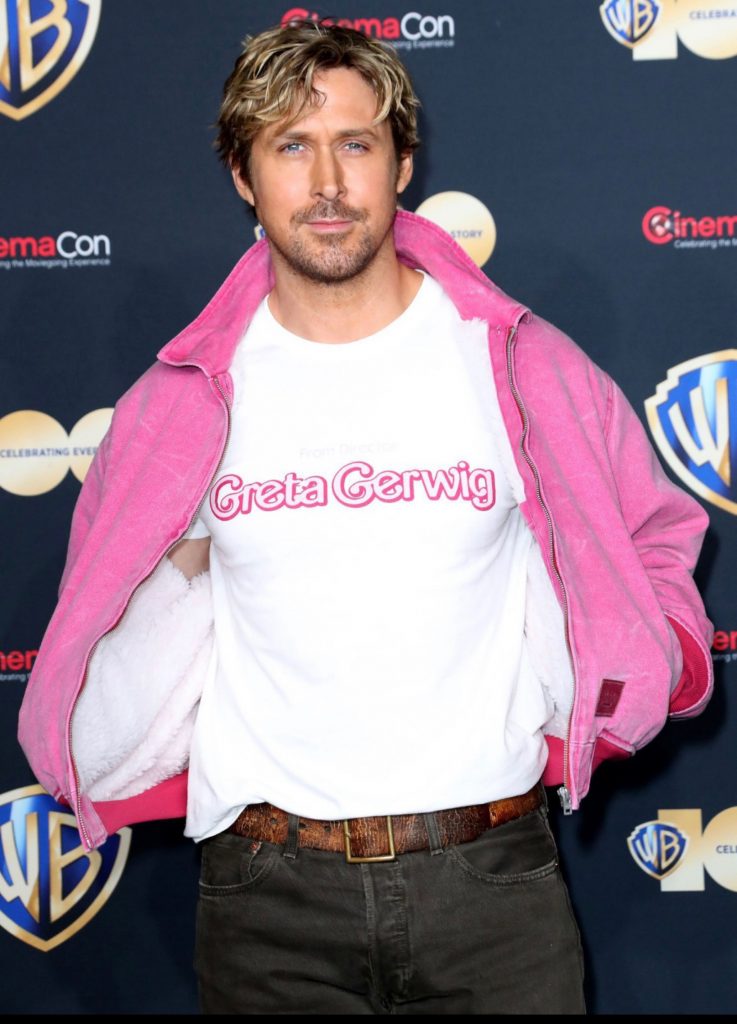
Friendo to HE: “If I buy you this shirt, will you wear it in Cannes?”
HE to friendo: “Absolutely! But I’d have to wear the jacket also.”
Seriously…if WB is selling the pink Barbie jacket in a men’s size I’ll snap it up in a second.
Until proven to be a lucid, smartly-plotted, grade-A film (which it might conceivably be), I’ll be assuming that The Flash (Warner Bros., 6.16) is the same old gotterdamerung, CG-overload D.C. shite…tortured, over-emotive, anguished adolescent stuff.
“My payurants, my payurants…I lost my payurants,” etc.
I was a fanatical admirer of director Andy Muschietti‘s Mama, but I went cold on the guy after seeing his two It films. The return of Michael Keaton‘s Batman / Bruce Wayne holds no allure for me; ditto the return of Michael Shannon‘s General Zod. “Let’s get nuts”…yeah, no thanks.
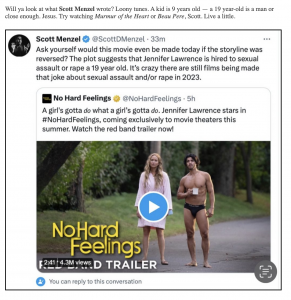
Yesterday the No Hard Feelings redband trailer generated fresh energy at Cinemacon. It made me laugh several weeks ago, and it still rubs me the right way. And I adore the fact that shrieking wokesters like Scott Menzel are upset by the bawdy premise. The more alarmed Menzel is, the better.
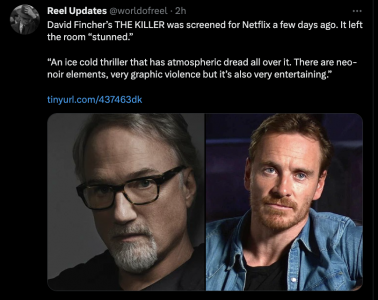
Innocent question: What’s so stunning in this day and age about a graphically violent “ice-cold thriller” flooded with “atmospheric dread“? What else could a film about a conscience-stricken hitman be?
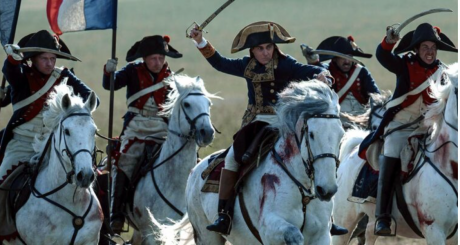
The Playlist‘s Gregg Ellwood on a recently-viewed Cinemacon clip of Ridley Scott‘s Napoleon: “The scenes featured hundreds (a thousand?) extras on horseback (Kingdom of Heaven vibes) and almost entirely in-camera visual effects (lots of on-the-ground explosions). There were at least three or four individual shots that anyone in the room will still remember weeks from now, which obviously a very good thing.
“The only concern is [that] Scott has allowed all the actors to speak in their native accents which in this case means Napoleon sounds American. Scott got away with it on his last film, The Last Duel, but we’re a bit concerned [that] it won’t work in this particular historical context.”
HE comment: Inauthentic foreign “accents” are usually avoided when American or British actors are playing European-continent characters (French, German, Italian, Russian). The general rule, however, is that everyone of a certain class or station has to more or less sound the same. Varying accents generally don’t work, as Valkyrie director Bryan Singer discovered when he had Tom Cruise‘s Col. Claus von Stauffenberg speak with an American accent while the mostly British cast members (i.e., Kenneth Branagh) used their own native accents.
Example: The rebellious slaves in Spartacus all spoke like working-class Americans while the Romans spoke with rarified mid-Atlantic accents.
Question for HE community: How would you play it if you were directing Napoleon? I personally wouldn’t have minded if Joaquin Phoenix and every other French character had spoken with French-accented English (i.e., Charles Boyer). The important thing is that everyone needs to sound the same. Didn’t Marlon Brando play Napoleon in Desiree with a French accent? Or am I misremembering?
This longish (over six minutes) recap scene in The Big Sleep explains what’s already happened for those who may be lost or confused. And yes, Phillip Marlowe‘s meeting in the District Attorney’s office obviously fits the very definition of what a good film isn’t supposed to do — i.e., tell rather than show. Which is why it wasn’t included in the final 1946 version.
And yet the general consensus is that The Big Sleep is one of the most convoluted, perplexing, nearly-impossible-to-follow crime films ever made (even co-screenwriter William Faulkner was unsure about who’d done what), so I actually wouldn’t have minded if this scene had been left in.
As Big Sleep aficionados know, the sexually suggestive restaurant scene between Humphrey Bogart and Lauren Bacall (i.e., trading double entendres about horse racing) replaced (a) the District Attorney’s office scene plus (b) Rutledge/Bacall coming to Marlowe’s office a second time.
On the occasion of Al Pacino‘s 83rd birthday, here, in this order, are HE’s top twelve Pacino performances:
(1) Michael Corleone, The Godfather, Part II; (2) Lowell Bergman, The Insider, (3) Tony Montana, Scarface, (4) Michael Corleone, The Godfather, (5) Lt. Vincent Hanna, Heat; (6) Tony D’Amato, Any Given Sunday (the”inches” speech); (7) Frank Keller, Sea of Love; (8) Frank Serpico, Serpico; (9) Sonny Wortzik, Dog Day Afternoon; (10) Jimmy Hoffa, The Irishman; (11) Will Dormer, Insomnia; and (12) Frank Slade, Scent of a Woman (“I’m just gettin’ warmed up!”).
Obviously Pacino’s peak decades were the ’70s and ’90s. He’s so far made only two grade-A 21st Century films, Insomnia and The Irishman.
Directed by Antoine Fuqua and lensed by the great Robert Richardson, The Equalizer 3 (Sony, 9.1.23) was mostly filmed on Italy’s Amalfi Coast in Italy with supplementary shooting in Naples and Rome.
I met and listened to the great Harry Belafonte only once. It was during a press junket round-table for Desmond Nakano‘s White Man’s Burden (Savoy, 12.1.95), a racially reversed fantasy about American prejudice and injustice.
I immediately fell in love with Belafonte’s sparkling eyes, bountiful spirit and somewhat bawdy vocabulary (i.e., lotsa fucks), and within 30 seconds I was muttering to myself that this guy should have been the star of the movie, and not so much “Thaddeus Thomas,” the powerful pillar of society whom Belafonte played in the film.
This was my first Belafonte recollection when I read of his death this morning. The second was the fact that in his late 20s and 30s the Jamaican-born Belafonte was easily one of the most handsome…indeed one of the most beautiful famous guys in the big-time showbiz orbit. He was 68 when I met him in late ’95, and in my eyes wasn’t the least bit diminished.
The third was his magnificent, made-for-Calypso singing voice — “Jamaica Farewell,” “Man Smart, Woman Smarter,” “Jump In The Line,” “Day-O”, “Matilda,” “Scarlet Ribbons.”
The fourth was his ballsy endorsement of Bernie Sanders in early 2016, which meant something given that most POCs felt that Bernie, despite having proven his liberal humanist bona fides time and again, was too much of a Vermont white guy to warrant their support.
The fifth was the fact that Belafonte was among the first big-time celebs to ally with Martin Luther King in the early ’60s, not only marching shoulder to shoulder but providing financial support.