The greatest “holy shit, this marriage is so totally fucked” finale is delivered by Francis Coppola‘s The Godfather (’72), but what are some of the strongest runner-ups?
In the same vein, what are some of the most dishonest upbeat finales in the history of movies about marriages and families? Upbeat endings that you’d like to believe and invest in, but you can’t possibly do so because of all the emotional corn syrup and forced fakery?
It’s A Wonderful Life is surely the fakest of them all, although I’ve always melted (and will continue to melt) when James Stewart cries out “Clarence!…I want to live again!” That’s always moved me, but the happy-schmappy stuff at the Bailey home with all the community joy and donated money…that has always felt to me like happy crap.
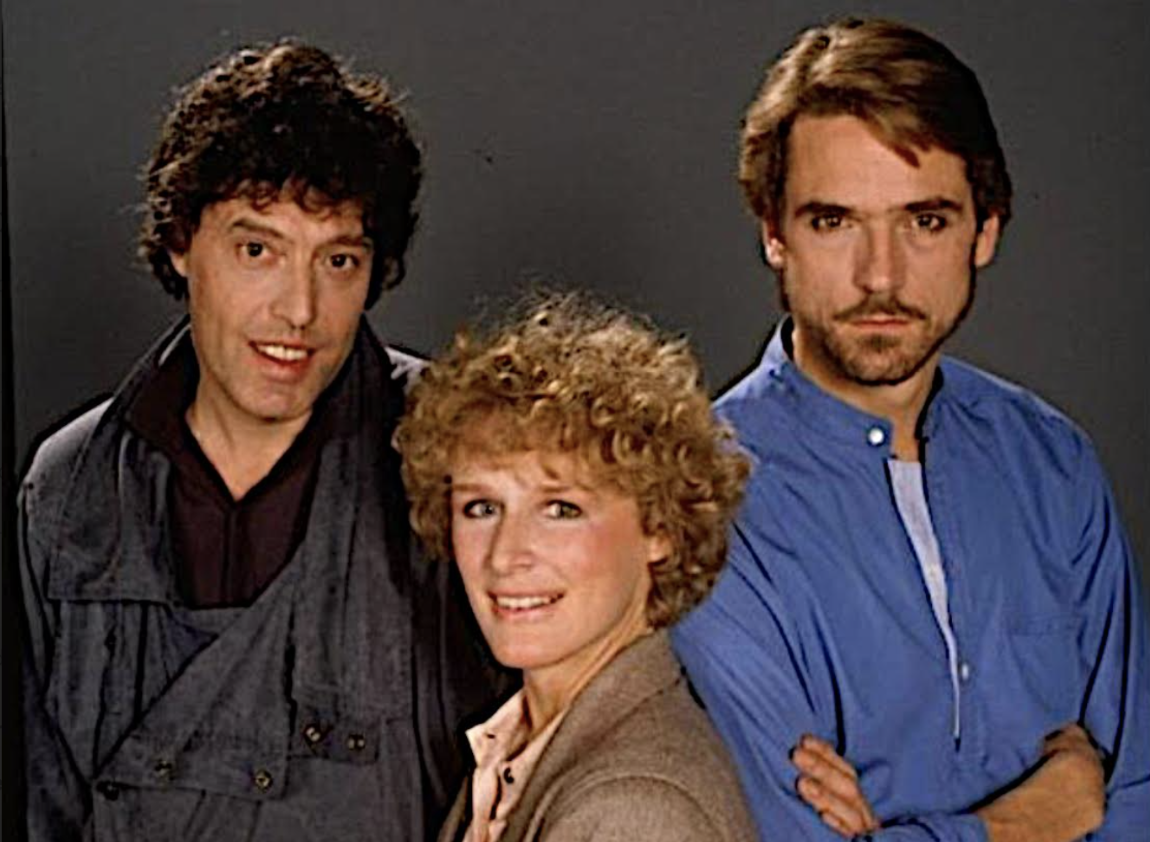
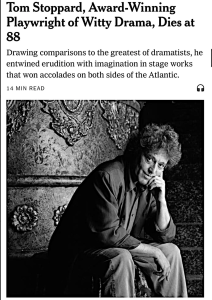
The sublimely gifted Tom Stoppard, the Czech-born, British-seasoned author of Rosencrantz and Guildenstern Are Dead (’66), Jumpers (’72), Travesties (’74), Night and Day (’78), The Real Thing (’82), Hapgood (’88), Arcadia (’93), The Invention of Love (’97), TheCoastofUtopia (saw it at the Vivian Beaumont in ’07), Rock ‘n’ Roll (’06) and Leopoldstadt (’20)….one of the greatest fellows I’ve ever “known”, so to speak, has passed at age 88.
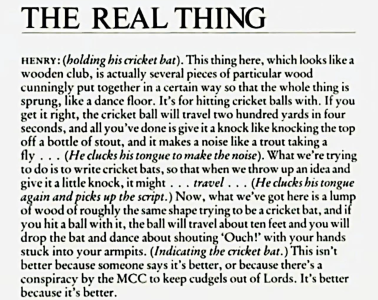
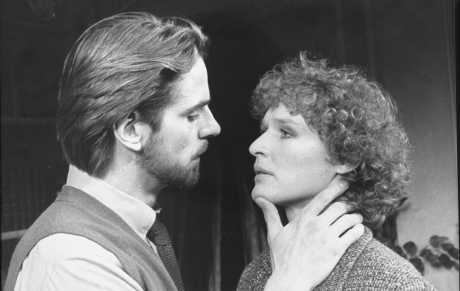
Posted on 10.16.22: The Reagan-era play that lifted me up and melted me down like none before or since was Tom Stoppard‘s The Real Thing (’84).
“Sappy as this sounds, it made me swoon. Okay, not ‘swoon’ but it struck some kind of deep, profound chord. Partly because I saw it at a time when I believed that the right relationship with the right woman could really make a difference. That was then and this is now, but I was in the tank for this stuff in ’84. The play used the Monkees’ “I’m A Believer” as mood music, and I pretty much was one at the time.
“I’m speaking of the original B’way production, of course, directed by Mike Nichols and costarring Jeremy Irons and Glenn Close. My admiration for Irons’ performance as Henry, a witty London playwright who resembled Stoppard in various ways, was boundless. Close, whom I was just getting to know back then, was truly magnificent as Annie.”
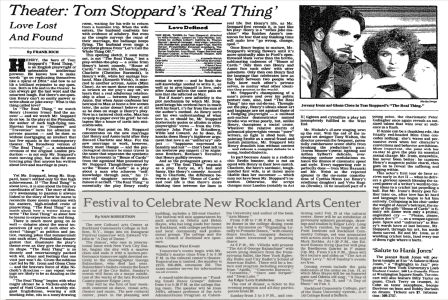
N.Y. Times critic Frank Rich called it “not only Mr. Stoppard’s most moving play, but also the most bracing play that anyone has written about love and marriage in years.”
“Love has to do with knowing and being known. I remember how it stopped seeming odd that in biblical Greek, knowing was used for making love. Whosit knew so-and-so. Carnal knowledge. It’s what lovers trust each other with. Knowledge of each other, not of the flesh but through the flesh, knowledge of self, the real him, the real her, in extremis, the mask slipped from the face.
“Every other version of oneself is on offer to the public. We share our vivacity, grief, sulks, anger, joy…we hand it out to anybody who happens to be standing around, to friends and family with a momentary sense of indecency perhaps, to strangers without hesitation. Our lovers share us with the passing trade. But in pairs we insist that we give ourselves to each other. What selves? What’s left? What else is there that hasn’t been dealt out like a pack of cards?
“[The answer is] carnal knowledge. Personal, final, uncompromised. Knowing, being known. I revere that. Having that is being rich, [so] you can be generous about what’s shared — she walks, she talks, she laughs, she lends a sympathetic ear, she kicks off her shoes and dances on the tables, she’s everybody’s and it don’t mean a thing, let them eat cake.
“Knowledge is something else, the undealt card, and while it’s held it makes you free-and-easy and nice to know, and when it’s gone EVERYTHING IS PAIN. Every single thing. Every object that meets the eye, a pencil, a tangerine, a travel poster. As if the physical world has been wired up to pass a current back to the part of your brain where imagination glows like a filament in a lobe no bigger than a torch bulb. Pain.”
— from Tom Stoppard‘s The Real Thing, directed by Mike Nichols and costarring Jeremy Irons and Glenn Close. It opened at the former Plymouth Theatre (now the Gerald Schoenfeld Theatre) on 1.5.84.
…between a movie lover who reveres Jacques Tourner’s OutofthePast (‘47) and a Netflix couch potato who pants and yelps like a chihuahua over the prospect of watching the latest season of StrangerThings?
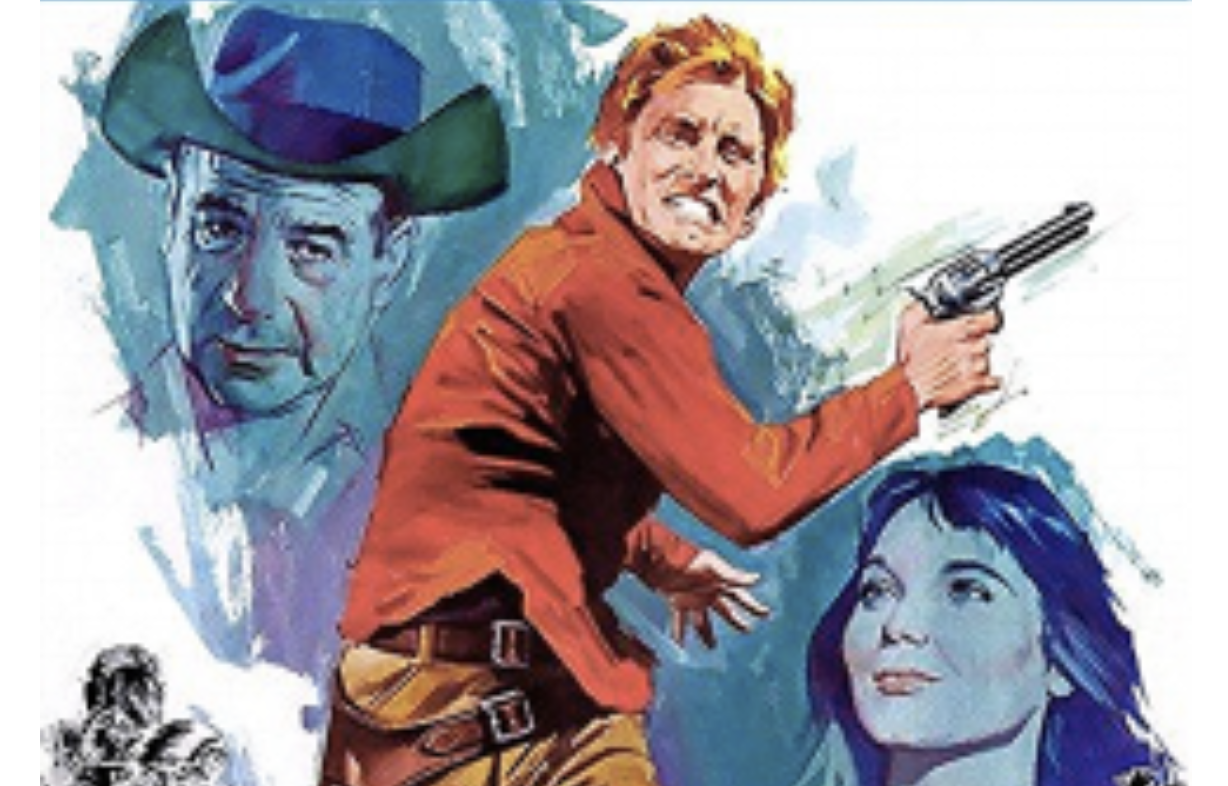
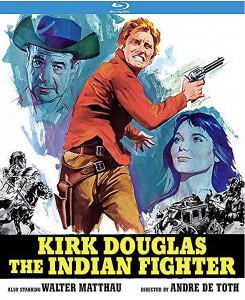
The Indian Fighter (United Artists, 12.21.55) was a passable-but-no-great-shakes western, starring Kirk Douglas and directed by Andre de Toth. It served the usual brawny action stuff in eye-filling CinemaScope, but the main hook was the sexual rapport between the 39-year-old Douglas and the 20 year-old Elsa Martinelli, a native of Tuscany and a fashion model, playing a willing Sioux squaw.
Douglas was a legendary hound, of course, and given the fact that (a) he hired Martinelli after seeing her photo on a European magazine cover, and (b) his company, Bryna Productions, produced The Indian Fighter, you can guess what happened off-screen.
12.22.55 N.Y. Times review excerpt: “Douglas’s Johnny Hawks, a free soul, thinks nothing of detouring a wagon train he is leading towards Oregon in order to keep a nocturnal tryst with the chief’s comely daughter; and only one reel before he nearly had succumbed to the blandishments of an equally beauteous widow.
“It must be noted of course, that the script by Ben Hecht and Frank Davis has a fair sense of humor, and that the forests and mountains of Oregon, where this fiction was filmed, are sweeping and picturesque in color and CinemaScope.
“In the brunette Elsa Martinelli, who plays the Indian lass with a minimum of words and a maximum of feline grace, Mr. Douglas has come up with a pretty photogenic newcomer.
“Eduard Franz as Chief Red Cloud, Walter Matthau and Lon Chaney as the bad men of this escapade, Diana Douglas as the marriage-minded widow and cavalry officer Walter Abel do not contribute spectacular performances.
“But Mr. Douglas’ characterization is properly muscular. As a hard though not faultless gent, he sits a horse well, looks great in buckskins and sometimes gives the impression that he could take over a pioneer’s chores. Mr. Douglas has not blazed a cinema trail with The Indian Fighter, but he has come up with a sturdy entertainment that should please the action fans.”
I was watching Ken Burns The American Revolution, his epic-length PBS series about the Revolutionary War, and I don’t know if it was me or the series but something felt vaguely off. After a half-hour or so I began saying to myself, “This feels staid…Burns’ Civil War series (35 years ago) felt more alive and engaging on some level…this doesn’t seem to have much in the way of primal forward thrust.”
That said, I don’t see what’s so woke or twisted or threatening about Burns suggesting that the Iroquois Confederacy, a union of six Indian tribes or nations in New York state, influenced the structural thinking behind the U.S. Constitution.
Narrator Peter Coyote: “Long before 13 British colonies made themselves into the United States,” the Iroquois had “a union of their own that they called the Haudenosaunee — a democracy that had flourished for centuries.”
The legend is that Benjamin Franklin was so taken with the Iroquois Confederacy that in 1754, he suggested that the 13 colonies should form a similar union, which became known as The Albany Plan. The plan was rejected but was a forerunner for the Articles of Confederation and the United States Constitution.
Canassatego, a leader and spokesman of the Iroquois Confederacy in the 1740s. In 1744 he urged that the British colonies emulate the Iroquois by forming a confederacy.
What’s so terrible about passing this verified history along?
Iroquois Wiki excerpthttps://en.wikipedia.org/wiki/Iroquois#Confederacy: “When Europeans first arrived in North America, the Haudenosaunee (Iroquois League to the French, Five Nations to the British) were based in what is now central and west New York State including the Finger Lakes region, occupying large areas north to the St. Lawrence River, east to Montreal and the Hudson River, and south into what is today northwestern Pennsylvania.
“At its peak around 1700, Iroquois power extended from what is today New York State, north into present-day Ontario and Quebec along the lower Great Lakes–upper St. Lawrence, and south on both sides of the Allegheny Mountains into present-day Virginia and Kentucky and into the Ohio Valley. From east to west, the League was composed of the Mohawk, Oneida, Onondaga, Cayuga and Seneca nations.
“In 1722, the Iroquoian-speaking Tuscarora joined the League, and thereafter the Iroquois League become known as the Six Nations.”
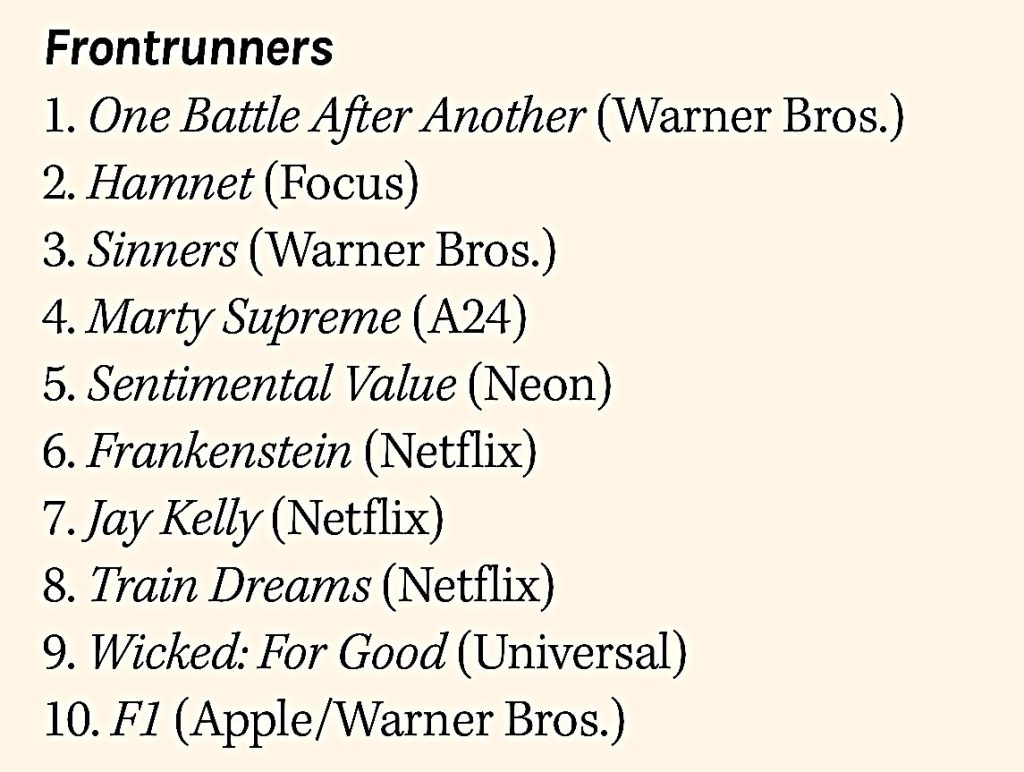
Scott Feinberg’s Oscar handicap lists are self-perpetuating, especially during November and December. There is no “I have no dog in this as I’m just forecasting what I think will happen without judgment or prejudice aforethought ”…bullshit!
And Scott’s persistent favoritism toward Paul Thomas Anderson’s OneBattleAfterAnother, a skillfully directed leftist propaganda film that is basically a racially–flippedremake of D.W. Griffith’s BirthofaNation, has become a culturalalbatross and is therefore untenable in terms of the film industry’s attempt to win back (if this is even possible) Joe and Jane Popcorn, who have long despised wokeism and are sick to death of being politically goaded or gamed or instructed by nutbag lefty fantasies.
And please, please…enough with the “because Ryan Coogler has blended the musical tradition of Robert ‘Crossroads’ Johnson with the coarse tropes of a schlocky AIP vampire film…and because he finished Sinners off by not only melting the wicked vampires but also by machine-gunning some overweight KKK crackers, and because Sinners made money…because of all this Coogler has to be Oscar-toasted for identity reasons alone”…please stop this self-ridiculing, identity-campaign bullshit. Stop it! The second half of this movie is low–rentjunk. It’s a Wendy’s burger with arterial blood sauce.
The Best Picture competish is Hamnet vs. MartySupreme vs. SentimentalValue…period.
Average schmoes will hate Hollywood all the more if OneBattle AfterAnother wins the Best Picture Oscar. Save yourselves, industry voters! Celebrate heart and verve and leave the progressive lefty shit behind. Plus OBAA lost $100 million!
Lead protagonists facing tough odds have to come to a decision of some kind. They have to act, even if it means a worsening or self-destruction. Catharsis is essential. They can’t just sit there and gloom out and become empty-vessel nihilists or downspiralling wimps.
K-pop is bad for my soul, and vapid synth-pop of of any origin makes me collapse into a fetal position, but four-year-old Sutton likes this song (she sings along!) so I have to shut up about it. I will never ever sit through KPop Demon Hunters, but “Golden:” is apparently fated to be Oscar-nominated.
Exquisite vocals elevating HE’s Thanksgiving Day mood. Thanks, bruhs! Perfect harmonic accompaniment for the crooning, commanding Jeff Goldblum from National Anthem guy Anthony Gargiula and pop singer Jonathan Tilkin.
But I hate, hate, HATE Gargiula’s black cutoffs, white socks and black hat. Plus he’s a ginger…Jesus! If only Anthony had a decent dress sense, but of course he doesn’t.
Oh, and it’s pronounced “poppa-you-lur” (four syllables),
I’ll be catching my second viewing of Hamnet fairly soon, but based upon my first viewing I don’t recall many specifics about the demanding, burdensome life of William Shakespeare. Until the film’s final third, I mean, which is when your under-educated Joe and Jane Popcorn viewers begin to understand that he’s doing well as a combination playwright, director and actor.
Maggie O’Farrell and Chloe Zhao‘s script mainly focuses on how things were in Stratford-upon-Avon for Shakespeare’s eight-years-older wife, Agnes Shakespeare (aka Anne Hathaway), and particularly the arduous responsibilities and domestic family strife that Agnes/Anne had to cope with.
But not much is offered about Will, who, for half or two-thirds of the film, is off galavanting in London doing God-knows-what but was actually working on the writing and performing of his plays. This is what an under-educated viewer might gather or infer.
The film offers damn few specifics about Mr. Shakespeare, particularly (a) his living situations in London, (b) his work habits (i.e., did he write most of his plays in Stratford-upon-Avon or in London?…apparently the former but the film is vague), (c) his all-around success as a playwright beginning in the early 1590s (he wrote and produced most of his plays between 1589 and 1613), and (d) Shakespeare becoming wealthy enough to purchase, at age 33, a sizable, bordering-on-grandiose family home in Stratford, known as New Place, which he bought for about 120 pounds in 1597.
Shakespeare purchased New Place roughly a year after the death of his 11-year-old son, Hamnet Shakespeare, who had succumbed to the plague.
If Hamnet acknowledges the purchase of New Place, I missed it due to muttered speech or murky dialogue, or a combination of the two.
London and Stratford-upon-Avon are roughly 100 miles apart. In the 1590s, travel between these cities would take about 2 to 3 days by horse, or 4 to 5 days on foot. For some reason horse-drawn carriages were much slower, taking around 10 days.
A general lack of sanitation caused the bubonic plague and Black Death, which “swept through Asia, Europe, and Africa in the 14th century and killed an estimated 50 million people, including about 25% to 60% of the European population,” the Wikipage says.
London had no working sewer system. Waste was often dumped in streets or rivers, contributing to a general foulness and stench.
Shakespeare’s most notable London residences were in the St. Helen’s parish (near the modern-day Lloyd’s Building) and later on Silver Street, near St. Paul’s Cathedral. He also lived briefly in Southwark near the Globe Theatre. Will purchased his first London home in the Blackfriars area in 1613. He moved back to Stratford-upon-Avon that same year. He died three years later at age 52.