Beethoven’s Funeral March

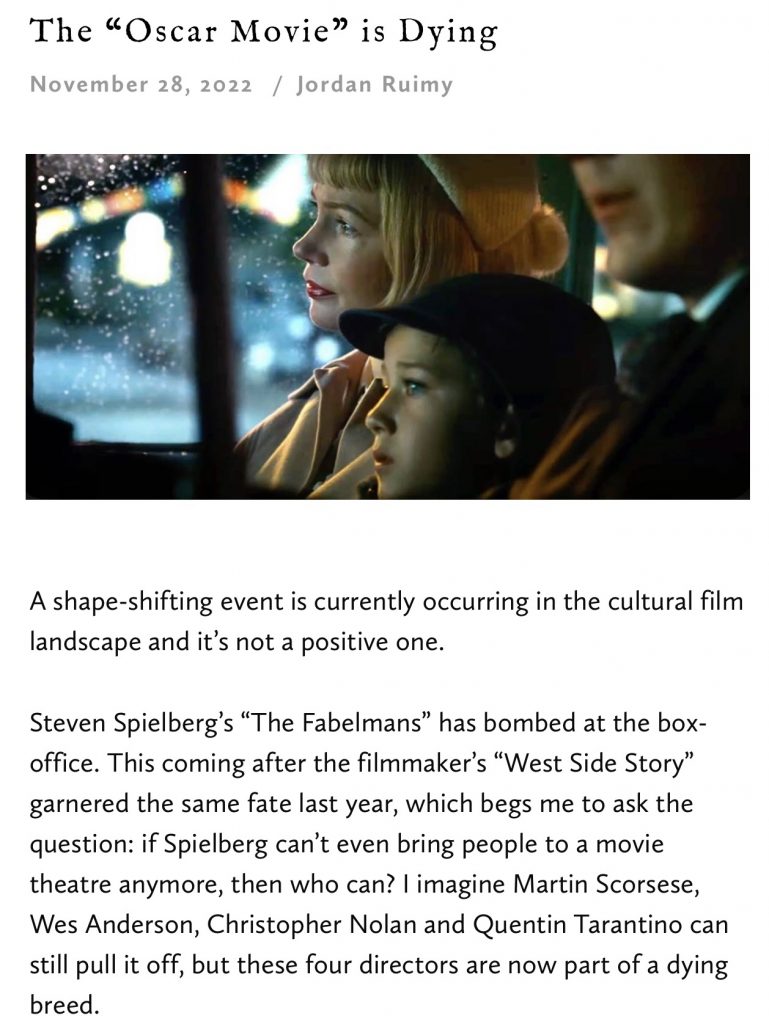
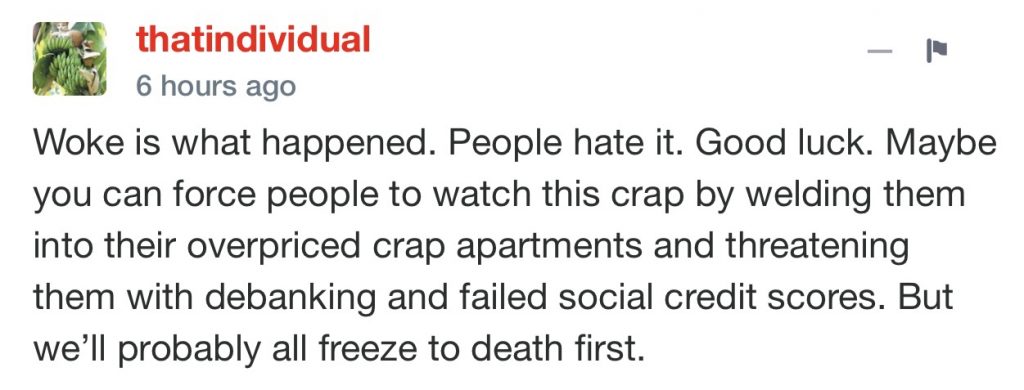
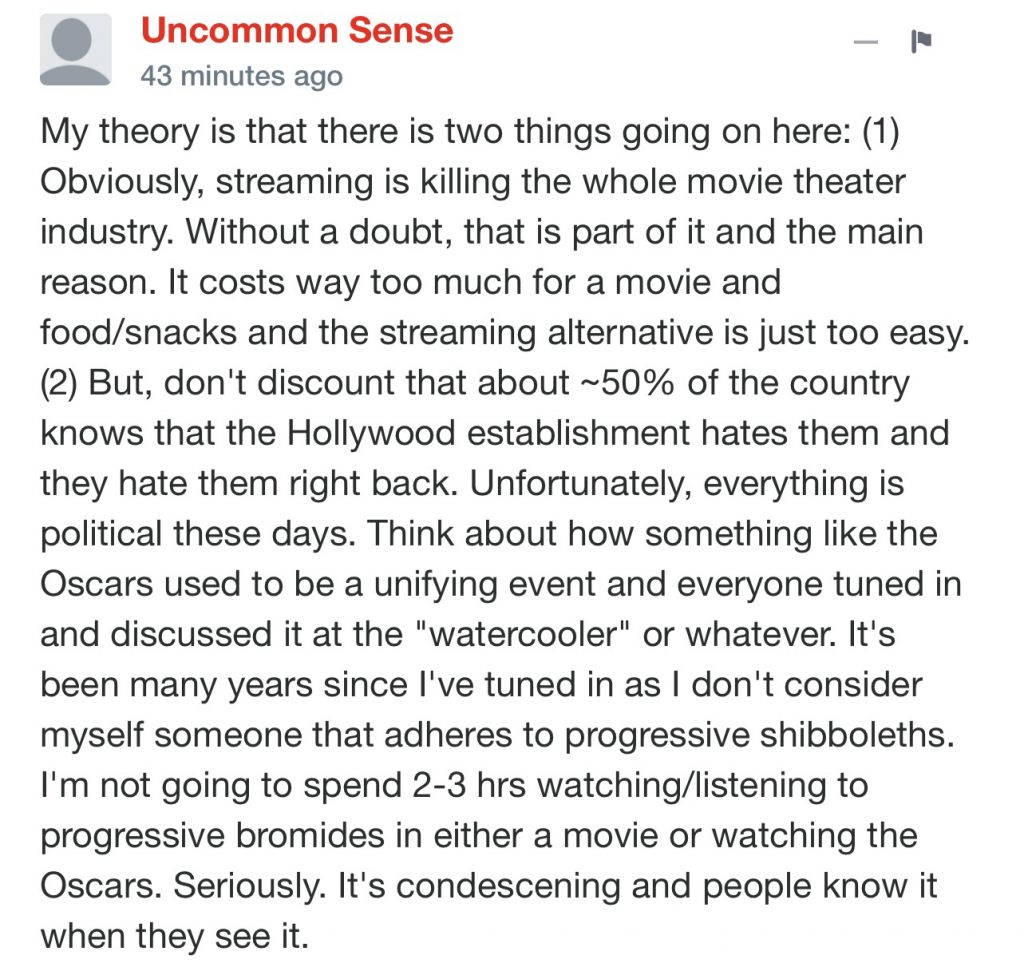
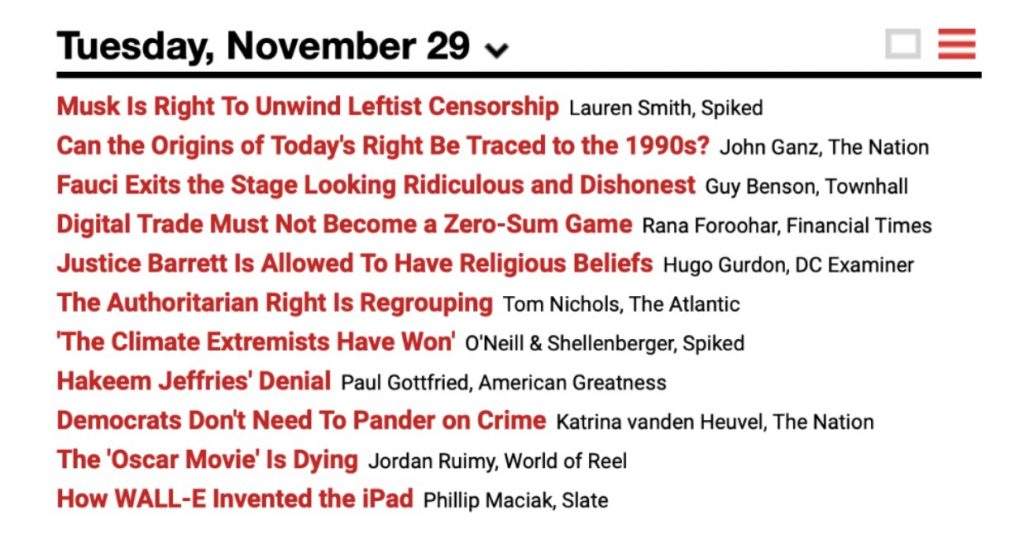
TheOscar MovieIs Dying,” an 11.28 lament by World of Reel’s Jordan Ruimy, was linked to yesterday (11.29) by Real Clear Politics — congrats.

Owen Gleiberman’s 11.29 review of the apparently loathsome Violent Night (Universal, 12.2) acknowledges the same dynamic — on top of 2022 award-season films exuding a curious “meh” lethargy, Joe and Jane Popcorn (especially the 40-plus crowd) have mostly shined the notion of seeing these films in theatres:
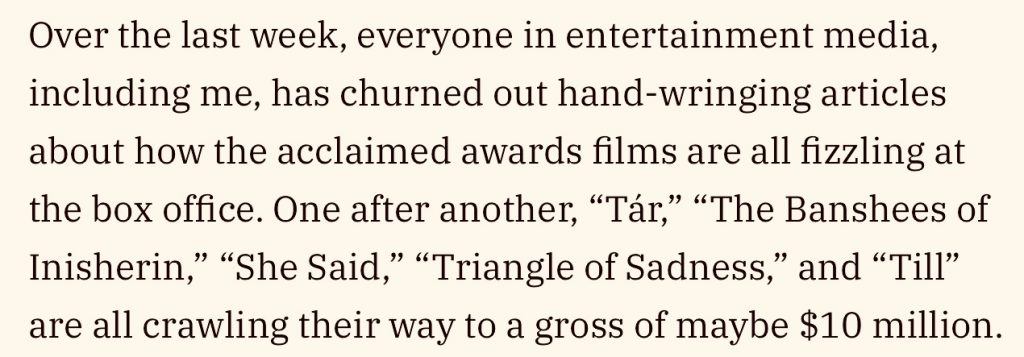
One key reason is that there’s zero overlap between elite industry sensibilities and the generally coarse, cynical and fed-up attitudes of popcorn inhalers.

The introduction to that brilliant 11.28 video essay on the Oscars’ 94 year history reminds that over the last decade award-season films have become their own separate and myopic genre — and with the pernicious SJW factor the vast majority has simply tuned them out.

The decisive gutshot bullet that killed the award-season brand (I’ve said this over and over) was fired on 4.25.21 by Steven Soderbergh, producer of the 93rd Academy Award telecast.

From “Norma Desmond: It’s The Oscars That Got Small,” posted on 9.30.21:
Ridiculous

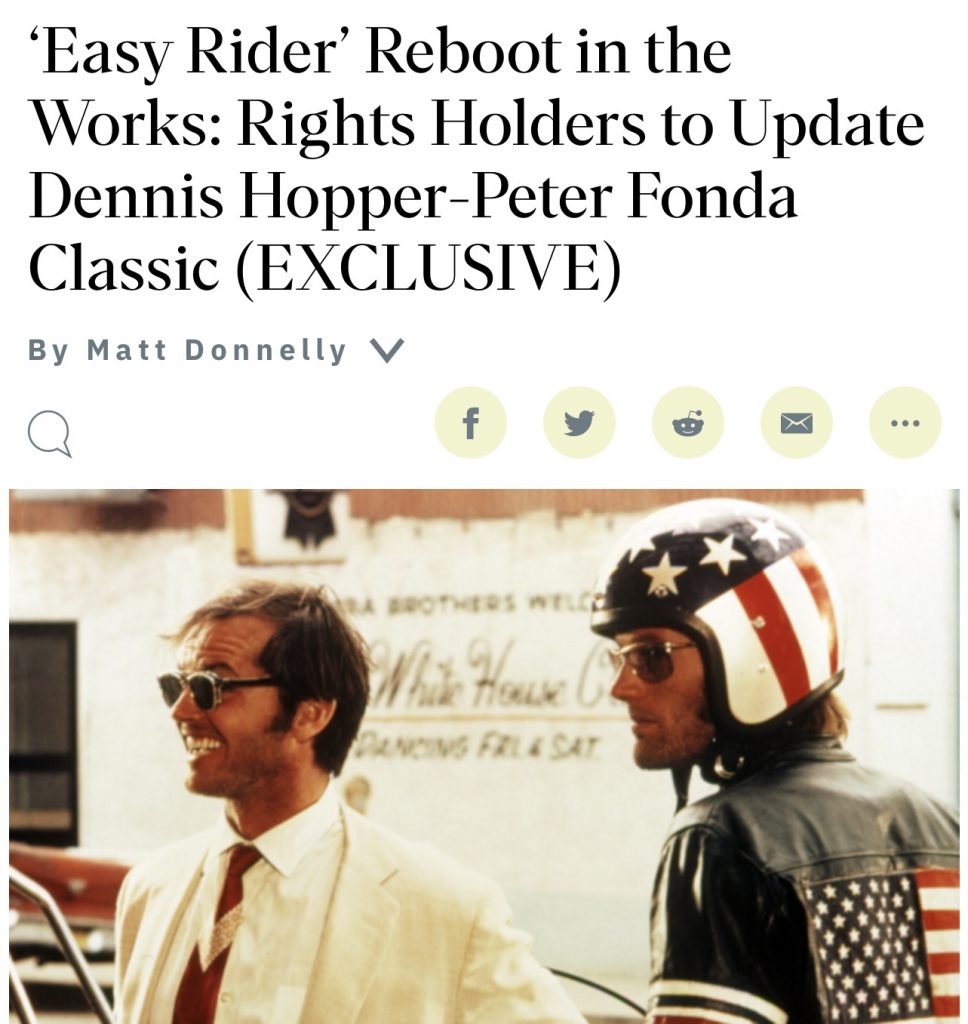
You can’t “update” Easy Rider any more than you can reboot the half-century-old cultural elements (motorcycle-riding counterculture types, Jimi Hendrix & The Band on the soundtrack, cruising across the Southwest only to be murdered by rural bumblefucks). That was then, this is now.

But the idea of Zoomer wokesters clashing with Lauren Boebert gun freaks in some rural setting…that could work. I just don’t know about the choppers and the greenbacks in the gas tank.

Morally Deplorable

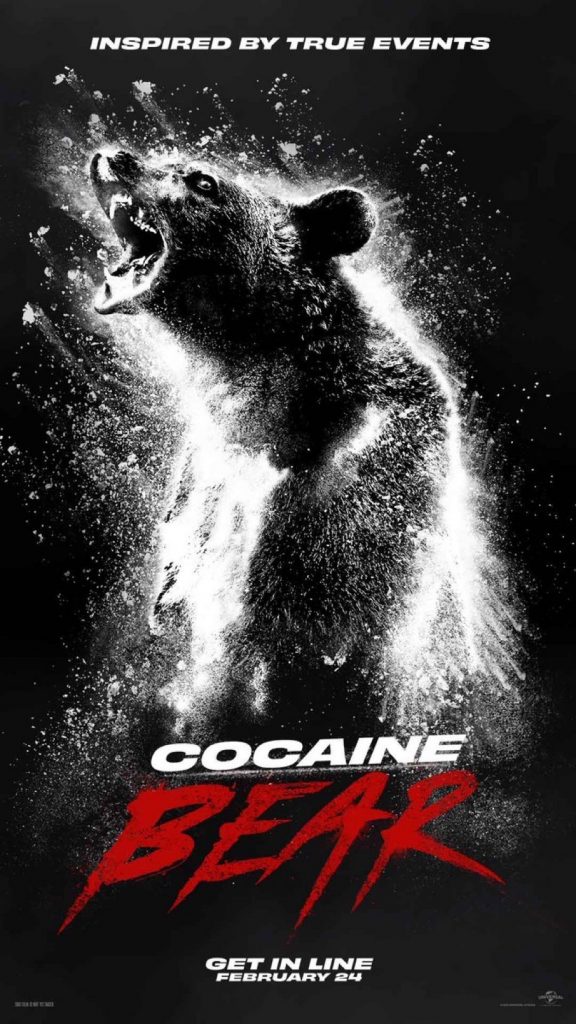
The 2.24.23 release of Cocaine Bear (Universal), a heartless, cruel-minded thriller if there ever was one (or so it would seem), is fast approaching.

Posted on 8.1.22: In November 1985, a dead black bear was discovered in Chattahoochee National Forest. Nearby was a torn-open duffel bag that had apparently contained 75 pounds of Bolivian marching powder, and which had apparently fallen out of a smuggler’s plane. (Flown by Tom Cruise’s Barry Seal?) The clueless bear had eaten a good portion of the coke and overdosed.

The guy who found the bear’s ruined body didn’t alert authorities (one guess why) and it wasn’t until 12.20.85 when authorities discovered the carcass. A medical examiner at the Georgia State Crime Lab said that that the bear’s stomach was “literally packed to the brim with cocaine.”

Elizabeth Banks has directed a “character-driven thriller” about the poor bear’s misfortune as well as, one presumes, certain humans who quickly developed an interest in the free cocaine. It’s called Cocaine Bear (Universal, 2.24.23). The film costars Keri Russell, O’Shea Jackson Jr., Alden Ehrenreich, Jesse Tyler Ferguson and the late Ray Liotta.

The title alone suggests that Banks and her producers see the story as an opportunity for bear thrills, or at least partly that.

The body of this poor, poisoned animal eventually found its way to a taxidermist, and is now on display inside the Kentucky for Kentucky Fun Mall (720 Bryan Ave., Lexington, Kentucky). There’s a sign around the bear’s neck that refers to him as “Pablo Escobear.”

In short Kentucky bumblefucks regard the idea of a furry beast dying of a cocaine overdose as a hoot.

HE to Banks and Universal marketing: HE believes that the death of an innocent animal who died of cocaine ingestion is not in itself an opportunity to do “funny” or “thrilling”. It sounds to me like a metaphorical tale about our casual greed and cruelty and indifference to the natural order of things — about the fact that forest animals have a certain nobility while we have none.

Read more

“White Lotus Sicily” Is Actually Damn Good

I’m still deeply uncomfortable about Mike White‘s anal fixations (analingus, suitcase pooping), but last night I marched through episodes $2, #3, #4 and #5 of season #2 of The White Lotus, and I was impressed. I was vaguely irked by the wealth porn (alright already!), and Tanya McQuoid-Hunt (the wide-faced, buffalo-shaped Jennifer Coolidge, who looks like a dude in a blonde wig) is still pathetic and her husband Greg (Jon Gries) is still cruel and aloof, but otherwise I found the randy characters mostly appealing and compelling. And I thought “what a pleasure to take the measure of all these wealthy travellers…what great adult stuff.”

The 30something Ethan and Harper Spoiler (Will Sharpe, Aubrey Plaza) are easily the most miserable couple — hung-up, uptight, haunted. And their opposite number — the morally unconstrained Cameron and Daphne Sullivan (Theo James, Meghann Fahy) are the most accepting of their basic natures and seemingly happier for it. Poor Bert Di Grasso (F. Murray Abraham) laments that he’ll never see a naked woman again. His grandson Albie Di Grasso (Adam DiMarco) has a passonate fling with Lucia (Simona Tabasco), a local sex worker. Lucia’s friend Mia (Beatrice Granno), who has a great lounge-singing voice, winds up accidentally dosing the hotel’s resident piano player (a 50ish dude) with “Molly.” And the hobbit-sized Quentin (Tom Hollander) turns out to be the kindest and wisest of the bunch. It’s all good, (almost) every bit of it, and I can’t wait for the remaining episodes.

Read more

Effing Safdies

Adam Sandler‘s Gotham Awards speech (starting around the 6:10 mark) made me laugh early this morning, and then I forgot about it. But this version is a drag because is starts with six minutes of the Safdie brothers (balding Josh, cute Bennie) doing a painfully long-winded introduction. Which films and filmmakers won Gotham trophies last night? Nobody cares. Okay, Everything Everywhere All at Once won two — the Best Feature Award as well as the Outstanding Supporting Performance award, which went to Ke Huy Quan (i.e., Short Round). Nobody cares.

“Fabelman” Fix Is In

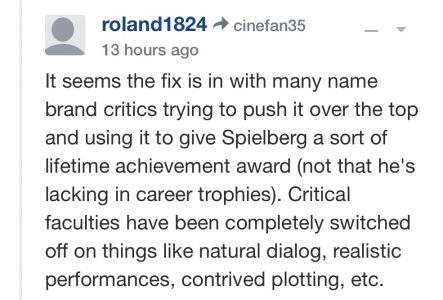
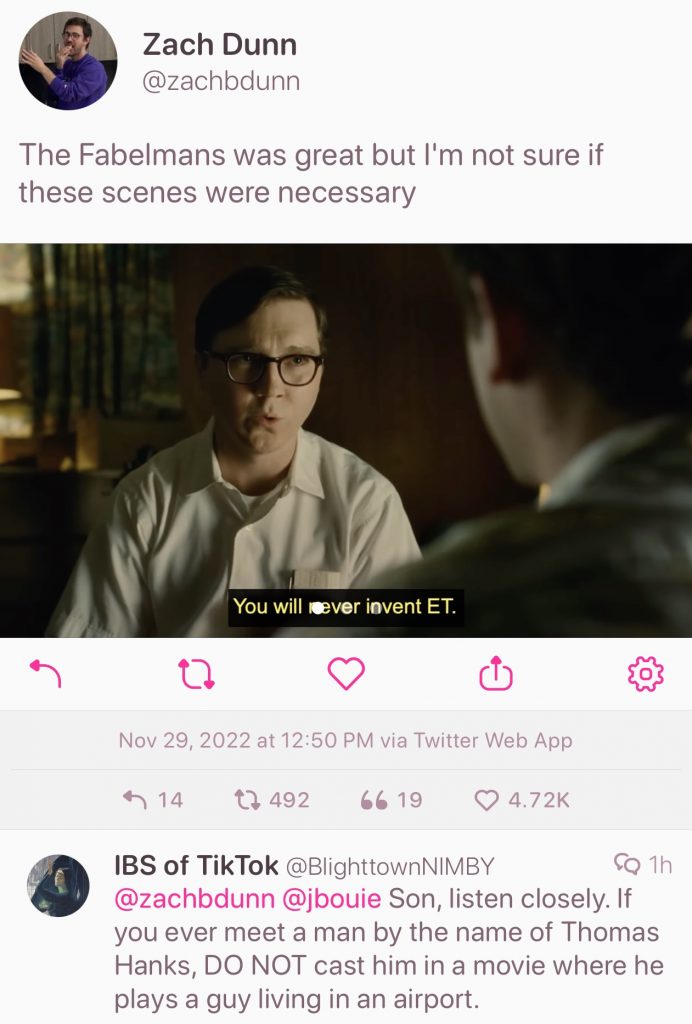
What does it mean when a plurality of mainstream media types decide that a certain critically lauded, high-profile biopic by a major-brand, boomer-aged filmmaker…a film that Average Joes & Janes are not exactly rushing out to see (the reception so far has been West Side Story-ish)…what does it mean when a film that, by the measure of Howard Hawks, has three good scenes (Judd Hirsch rant, Nazi war film shoot in the Arizona desert, John Ford barks out lesson about horizon lines) and several meh ones…a “good” but subdued Amarcord film that unfolds in a reasonably compelling fashion but isn’t, on its own story terms and minus the Spielberg coat of arms, what anyone would call a fascinating tale…

What does it mean when the go-along media bros decide nonetheless that this is the safest, most reliable, most steady-as-she-goes Oscar pony to get behind?

I’ll tell you what it means. It means that elite brand fortification matters to a lot of people. Speaking as one who’s been proud to selfidentify as an honorary Jew since the ‘70s, I understand it all.

South Pole, “Emancipation”, “A Horrific Night,” etc.

Will Smith: “I was gone, man…I was gone…that was rage that had been bottled up for a really long time…it was a mess.”

Antoine Fuqua and Will Smith‘s Emancipation opens in four days (12.2), and Apple is still being cagey and selective about showing it to the critical community. Several Manhattan critics saw it on Monday. I’ve spoken to two who’ve seen this saga of Whipped Peter, this 19th Century escape-and-survival tale, and their reactions were on the slumping or downbeat side. Critic to HE: “Meh, middling, a slog.” HE to critic: “So it doesn’t totally suck eggs? it’s sorta kinda half good? Not awful? Moderately tolerable?”

What We’ve Been Through & Who We’ve Wanted To Be

Posted only a few hours ago (Monday evening, 11.28), “What Each Best Picture Winner Tells Us About Hollywood” is one of the most perceptive and sweeping assessments of the whole 94-year history of the Oscar awards — what they’ve meant or symbolized or reflected on a decade-by-decade basis. How not just the business but American culture has gradually evolved from the late 1920s to today. And before the era-by-era recap begins, the first six minutes and 50 minutes deliver an excellent reading of where things stand now and have recently been. The only thing it doesn’t really get into is woke Stalinism and the general demonizing of older white males.

The guy who put it together is allegedly named Dalton, but his YouTube handle is “All Talking Pictures.”

I Understand Both Sides

A few days ago Next Best Picture‘s Matt Neglia tweeted that he was feeling “gutted” after he and his parents had sat down to watch Everything Everywhere All At Once. He was feeling bummed because his dad had walked out during the film’s “emotional climax” (whatever that refers to).

On one hand I agree that Matt’s dad acted inconsiderately and that he shouldn’t have missed the film’s best moment, which comes at the very end in the IRS office. On the other I can relate to his father’s reaction (I mostly hated this godawful film) and I admire his resolve — he knew his son had a great amount of affection for EEAAO and yet he just couldn’t stand it and felt he had to leave in order to maintain his sanity.

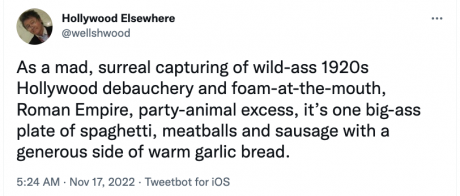
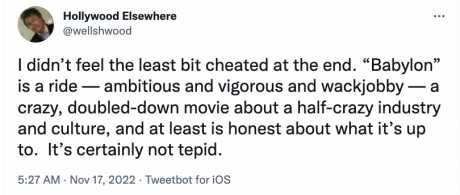
“Babylon” Ain’t Changin’ Its Spots

Babylon director-writer Damien Chazelle “wanted to plumb the lower depths — to juxtapose La La Land’s gorgeous, Hollywood-glam set pieces and Whiplash’s darker examination of ambition’s toll. “It was really a wild West period for these people, this gallery of characters, as they rise and fall, rise, fall, rise again, fall again,” he says, adding that “the thing that they’re building is springing back on them and chewing them up.”

“Everything is shifting underneath people’s feet and I became really fascinated by the human cost of disruption at that magnitude, at a time when there was no road map, when everything was just new and wild.” == Vanity Fair‘s Rebecca Ford, 9.7.22.

Tell All You Know About Clara Bow

In a 9.2.22 Vanity Fair piece about Babylon, Rebecca Ford described Margot Robbie‘s character (“Nellie LaRoy”) as “an amalgam of early stars like Clara Bow, Jeanne Eagels, Joan Crawford and Alma Rubens.”

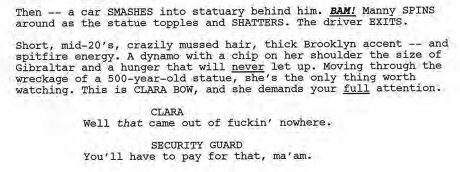
But in a May 2019 draft of Damien Chazelle‘s screenplay, Robbie’s character is flat-out identified as Clara Bow, and right now there doesn’t seem to be much of an effort on Chazelle, Robbie or anyone else’s part to deny that LaRoy is modelled upon this spunky, irrepressible, flapper-type actress who came to represent the wild-ass, bathtub-gin spirit of the 1920s Hollywood.

From “Scandals of Classic Hollywood: Clara Bow, ‘It’ Girl.” by Hairpin‘s Anne Helen Petersen:

“Clara Bow doesn’t look like a relic. She doesn’t look like she belongs in the ’20s, or even in black and white. She looks nothing like the other stars of the silent era, who either seemed frozen in puberty (Mary Pickford, Lillian Gish), outrageously “exotic” (Theda Bara, Pola Negri), or untouchably glamorous (Gloria Swanson). This girl’s got something like whoa.

“Look at her. She looks so…MODERN. Like she could be a star today, right? When I show footage of Bow to my undergraduates, who generally consider the viewing of silent film as the sixth level of hell (trumped only by the viewing of Soviet silent film) they can’t take their eyes off her. It’s her movement, her eyes, the way she flirts with the camera.

“But it’s something else, too – something Billy Wilder once referred to as ‘flesh impact,’ a rare quality shared only with the likes of Jean Harlow, Rita Hayworth and Marilyn Monroe. Flesh impact meant having ‘flesh which photographs like flesh,’ flesh you felt you could reach out and touch — or flesh with which you would very much like to have sex.

That desire made Clara Bow a star, but would also make it easy to tell outrageous stories about her, and for people to believe those outrageous stories. In 1927, she was the No. 1 star in America. When she retired in 1931 amid a tangle of scandals, she was all of 28 years old.”

Read more