…and they are selling such books (I read them to Sutton last night), why not create children’s books based upon The Wild Bunch and The Towering Inferno? Hell, why not go real-world? Tyke books based upon the 9/11catastrophe, the Kennedyassassination and the Cambodian genocide of the ‘70s, say.
Howard Hawks, Paul Newman and HE are now a power-sharing, chrome-steel triumvirate.
From this point on the guiding light perceptions of HE (all high-quality films feature a late-second-act pivot), Hawks (“three great scenes and no bad ones”) and Newman (Newman’s Law of 15 at the front and back) comprise the core of our movie-assessing philosophy.
Hawks, Newman and HE are hereby resolved to move forward in this moviegoing life based on the clarity and radiance of shared perceptions and accumulated life wisdom (i.e., long is the way and hard that, out of darkness, leads up to light).
Apparently the late, great Paul Newman once passed along a rock-steady cinematic truth — one that rivals Howard Hawks’ declaration that all award-worthy films have “at least three great scenes and no bad ones.”
Newman’sLaw states that all first-rate, award-worthy or at least commercially successful films start and end with a certain gravitational punch or pizazz. They grab the audience during their opening 15 minutes, and then really bring it home during the final 15. If the opening and the closing deliver the right stuff, the film is a keeper.
Like TheWild Bunch, say. Or Dr. Strangelove or OutofthePast or FromHeretoEternity or TheFrenchConnection or TheExorcist or TheBestYearsofOurLives or PathsofGlory or Viva Zapata or…
Think of TheHustler’s opening sequence (Newman and Myron McCormack using subterfuge to take several tavern patrons) and the 15-minute finale (Newman beats JackieGleason, has it out with GeorgeC. Scott over the death of Piper Laurie).
Or Butch CassidyandtheSundanceKid (beginning with Robert Redford being accused of cheating at poker, “hey, kid…how good are ya?”, and closing with that doomed, small-town shoot-out with Mexican militia).
Or TheVerdict (alcoholic Newman enduring the humiliation of ambulance-chasing vs. semi-sober Newman’s big jury sermon + the jury finding for the plaintiff and against St. Catherine’s).
How does Newman’s Law apply to OneBattleAfterAnother? As much as I hate admitting this, Paul Thomas Anderson’s agitprop film does the double bang — a great opening 15 or 20 with the French 75 pulling off an immigration-camp raid, and a great car-chase finale out in the barren rolling hills.
How does Newman’s Law apply to Hamnet? It doesn’t because the effectiveness of Chloe Zhao’s drama is all about the final 15 — the opening 15 don’t really do the drill.
SentimentalValue delivers Newman satisfaction because it more or less begins with Renate Reinsve’s stage-fright breakout, and ends with a sound-stage filming scene that ties it all together.
Name one classic film (critically approved or popular with the mob) that doesn’t deliver the Newman.
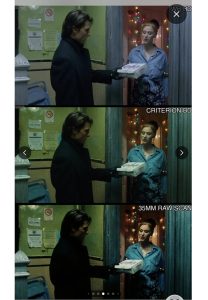
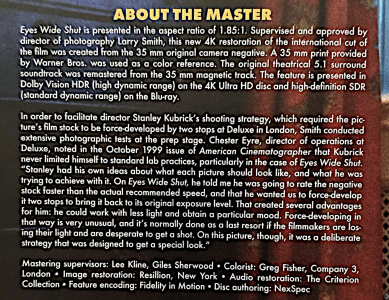
HE to knowledgable friendo: “This Eyes Wide Shut argument has been nothing if not a surreal experience. On one side, LarrySmith, LeeKline and their allies have been saying ‘this film wasn’t properly color-timed in ‘99, and now we’ve finally saved the day.’ On the other side the rational, non-fanatical contingent with an unfortunate tendency to trust their lying eyes (i.e., people like me) have been saying ‘what the hell have these teal vandals done?'”
“All I know is that when I saw Lee ‘teal maestro’ Kline listed as one of two mastering supervisors, I experienced an inner ‘aha!'”
Do readers understand that Smith and Kline are reprehensible monsters? They don’t like subdued grays — they prefer flaming greens.
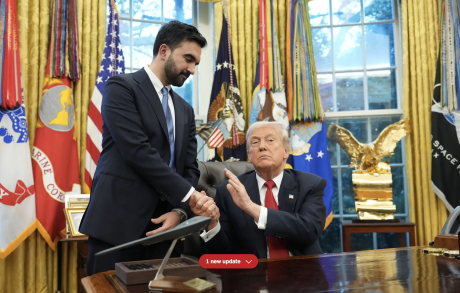
Journalist: “Are you comfortable, President Trump or Mayor-Elect Mamdani, with the teal-saturating of Criterion’s Bluray of Eyes Wide Shut?”
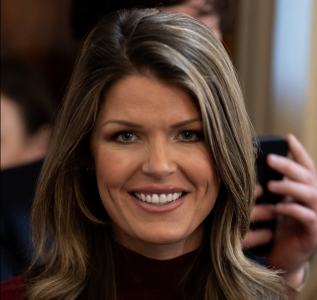
Poor Lindsey Halligan, 36, is suffering a career setback over mishandling the government’s vindictive (i.e., revenge-driven) prosecution of former FBI chief James Comey. Two months ago President Trump appointed Halligan as interim United States attorney for the Eastern District of Virginia, despite her lack of experience. Now she’s dropped the procedural ball, and the Commey case may be thrown out as a result.**
But if you know anything about rightwingers in general or Trump in particular, you know they all tend to hire model-pretty women who exude a certain Charlie’s Angels vibe. It goes with the territory. This is not suggest or imply that the dishy hires can’t necessarily handle the job on its own terms, but their attractiveness is certainly a key factor as far as their career ascensions are concerned.
For what it’s worth, 30 years ago I tried to help a pretty, dark-haired 20something woman — a good egg in my book — get a job interview with producer Don Simpson. I began by telling Simpson that she was sharp and well-educated with a disciplined social manner.
Then I made the mistake of telling him she was good-looking. “In my experience that’s a negative,” Simpson replied. “Pretty women are accustomed to being flattered and catered to in certain ways. They’ve been told all their lives that the world will often defer to them or bend the rules to some extent, and so they’re not as hard-working and soldier-like as women who are are equally qualified but less attractive.”
I rarely spoke with Simpson about women or sex or anything in that realm; I loved talking to him because he was so shrewd and whip-smart about all the Hollywood players — who they were deep down, what their basic personalities and mindsets were, etc. I’ve mentioned the prejudice he had about interviewing attractive women for office or production jobs to point out that at least Simpson, who’s been dead for almost 30 years now, was no Brett Kavanaugh.
A 9.20 Guardian article reports that Yale Law School professor Amy Chua, who has strongly endorsed Supreme Court nominee Brett Kavanaugh, privately told a group of law students last year that it was “not an accident” that Kavanaugh’s female law clerks all “looked like models.”
The story reports that Chau has suggested to female students who wanted to work for Kavanaugh that they should “dress to exude a ‘model-like’ femininity.”
The article adds that Chau’s law-professor husband, Jed Rubenfeld, “told a prospective clerk that Kavanaugh liked a certain ‘look'” — a presumed allusion to a fashionably-dressed, hot-to-trot “fuck me” appearance.
Which indicates that the adult, judicially-focused Kavanaugh was looking for a certain atmosphere of tumescent arousal in his law office, and that right now he’s probably a middle-aged version of the 17-year-old horndog who tried to drunkenly have his way with Christine Blasey Ford back in the early ’80s.
Then again working with hotties is a standard Republican thing. We’re all aware that powerful right-wing guys tend to hire foxes — sexy, slender, alluring — and in many cases icy Nordic blondes, which is the template for pretty much every female Fox News employee.
Consider a 2.20.17 Guardian piece by Hadley Freeman called “Why Do All The Women on Fox News Look and Dress Alike? Republicans Prefer Blondes.”
Freeman notes that right-wing women (i.e., Kellyanne Conway, Scottie Nell Hughes, Tomi Lahren, Ann Coulter, Laura Ingraham, Ivanka Trump) all present “a uniform vision of girlishly long bottle-blond hair. [And they] all dress exactly the same, which is to say, mainstream feminine — dresses, not trousers; heels, not flats; no interesting cuts, just body-skimming, cleavage-hinting, not-scaring-the-horses tedium. These are the kind of women who take pride in saying things like ‘I’m not into fashion — I like style’, and by ‘style’ they mean ‘clothes that men like me to wear.'”
So yes, Kavanaugh is apparently a dog, but he isn’t an outlier — he’s just looking for the same kind of tingly stimulation from his female law clerks that Roger Ailes wanted from female Fox News staffers.
** In November, a federal judge heard Comey and James’s challenges to the legality of Halligan’s appointment. Days later, a magistrate judge, William E. Fitzpatrick, found that Halligan may have committed misconduct by falsely stating that the Fifth Amendment precluded Comey from avoiding to testify at his trial. Fitzpatrick added that Halligan had told jurors that the Department of Justice had additional evidence that would be revealed at trial and noted the discrepancy between the indictment presented and the indictment approved by the grand jury. Halligan later told judge Michael S. Nachmanoff that the foreperson in the grand jury proceedings for the Comey case had approved a second version of the indictment that had not been seen by the grand jury.
The headline for Chang’s review in the New Yorker print edition (dated 12.1.25) is “To Die, To Weep”, which sounds fitting if lacking in terms of the usual urban edge and smart-assery. And yet, oddly, the online edition’s headline defaults to the commonly used “griefporn” dismissal.
During a summer day-trip to Washington, D.C., my young sister Laura and I experienced a short period of bathroom panic as we drove around with our mother, Nancy, at the wheel. Nancy said it was partly because of all the large fountains…all that gushing water was weakening our resolve.
It follows that millions of Los Angelenos felt the same psychological pressure yesterday due to the city coping with constant rainfall.
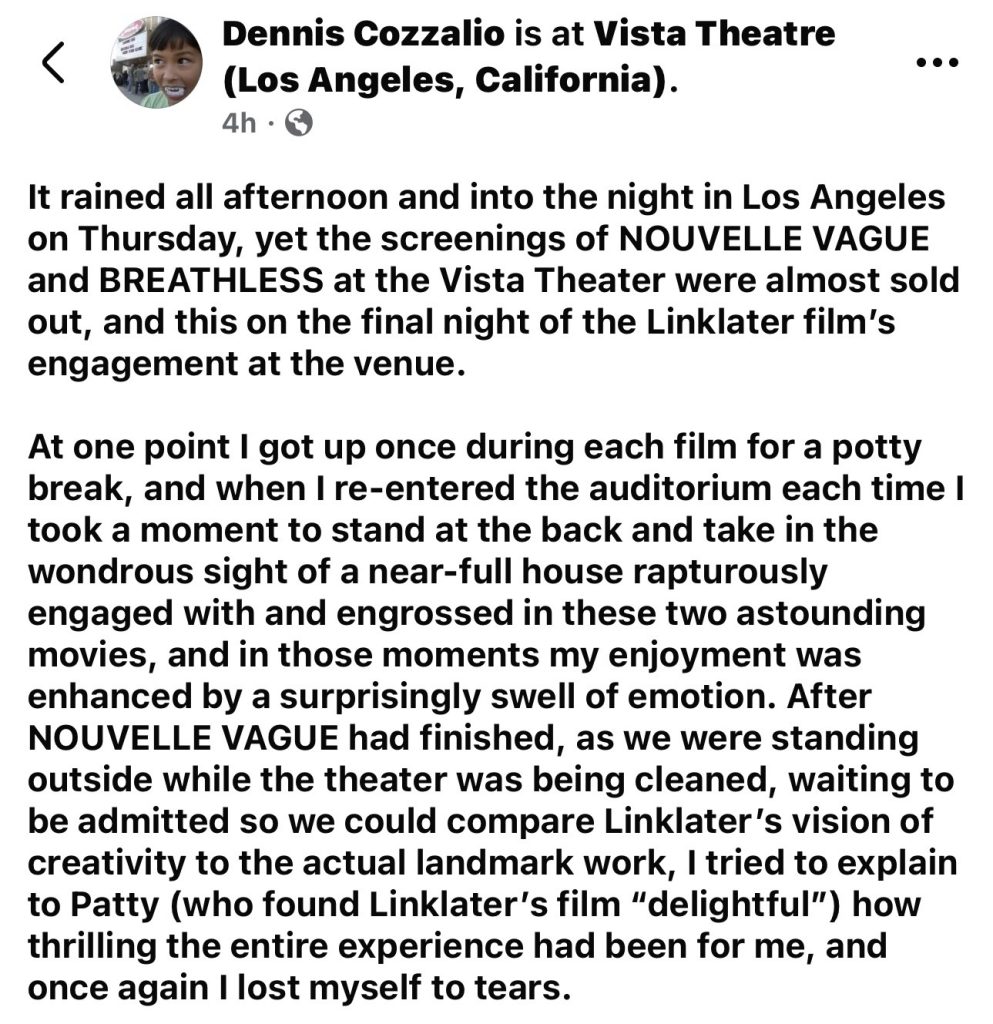
HEtoCozzalio: One “potty” break during the screening of Nouvelle Vague, and then another during a subsequent showing of Breathless?
So no attending to business BETWEEN these films, as some of us might do. Instead you sit down and watch both films and then in the middle of each one you go “whoops!…sorry, heh-heh, excuse me!” Then you get up and miss maybe three or four minutes of each film.
Whatisthat? This is not serious movie-watching. Godard would have sneered at this. Ask anyone. Ask Scorsese or DeNiro.
So you go through your daily life submitting to bathroom breaks…what, six or seven times each waking day, not counting waking up at 2 or 3 am (or 3 or 4 am) to take a whiz or a dump?
Forgive me for making a coarse assumption, but “potty break” sounds to me like sit-down action. It’s basically a child’s term like “I went poopie” (I have a four-year-old granddaughter so don’t tell me) or, if you’re standing up, “I went pee-pee” or “wee-wee”.
I would have gone for more oblique terminology like “I used the facilities” or “I hit the head” or “I heeded the call of nature”, all of which allude to or allow for the possibility of stand-up action.
I shudder at the idea of hitting a bathroom this many times per day. It sounds like a form of tyranny.
Speaking of “sit-down action”, I posted a relatedpiece 14 years ago.
I hit the smallish bathroom after it ended. Two urinals and a toilet stall with six or seven guys lined up. I should have bailed right then and there, but I was looking for a little sit-down action and wasn’t sure of my alternate options.
A guy left the stall and a 30something black dude took ownership and, like, didn’t come out. Three, four minutes. Five minutes. Six. Could he be undergoing self-administered surgery? Filling out a mortgage application?
Then, still on the pot, he began talking to his girlfriend on his cell, flirting with her, settling in. “How ya doin’? Movie’s over…yeah. You wanna eat somethin’?,” etc.
If I had any balls I would have knocked on the stall door and, just like TomCruise in Collateral, said, “Yo, homey!” I didn’t, of course. I just stood and waited like a sap, listening to this jerkoff go on and on. The idea of showing consideration to others simply hadn’t occurred to him.
Around the seven- or eight-minute mark I gave up and went outside and used the facilities at a nearby Barnes and Noble.
It’s simply a matter of culture and manners. Let’s face it — some people are low-lifes.
I’ll be attending an invitational screening of George Clooney‘s The Ides of March at the Museum of Modern Art on Wednesday. If I happen to hit the bathroom after it ends I can absolutely guarantee that nobody will sit in a toilet stall for several minutes, ignoring the fact that several others are waiting, while chit-chatting with a girl. I’ll put $100 on this right now. I’ll bet anything.
Posted by Sasha Stone on 11.11.25 (one day before my birthday): “You’ve heard people say Hamnet ‘wrecked’ them, that they couldn’t focus on anything else after seeing it. This will be true for many people, but not all, certainly not those who feel locked out by the intense emotion on-screen.
“But when you see the film for yourself you’ll see what I saw. Some of you. You’ll see how it was all the path to getting there, to where we understand the need for art. It is just a look between the two characters that says, ‘This is all I have because I couldn’t do anything else.’
“And in that moment, at least for me, I was not able to breathe. The choking sobs were too much for me, and I was overcome. That is catharsis, but it is also the way out of misery, the way out of grief, the way out of madness. We need art like we need oxygen. This movie shows us why. Zhao can see and she has the courage to say this, and she does so with minimalist discipline and an artist’s eye.
“Life is a tale told by an idiot, full of sound and fury, and signifying nothing. Truer words were never said. Art, however, signifies everything. Hamnet is a masterpiece, and if not the best film of the year, one of the best I’ve ever seen. And suddenly, at least to me, the Oscar race just got competitive.”
Film critic colleague: “You can get an AARP membership at age 50. Once upon a time you could get great rental car discounts with it. Now not so much. Also — the AARP magazine is the biggest print rag in the country. Plus it and the website pay phenomenally well. They pay $250 for 125 words. Do the math. They used to cough up a grand just to submit a list for their end-of-year roundup.”
HE to colleague: “‘Do the math’? I got $2.00 per word from Entertainment Weekly in the early to mid ‘90s.”
Colleague: “So did I except nobody earns that now. Okay, maybe a New Yorker writer.”
HE to colleague: “$2.00 per word in ’92 works out to $4.62 per word in the 2025 economy. What’s the per-word norm these days?”
Colleague: “Online, one is lucky to get 50 cents per word. In some cases it’s ten cents.”
Alternate headline: “Oldsters, AARP and Cunnilingus, Part 2.”
I’m happy to learn that Maria Muldaur is alive and well and still kicking and shimmering at 83. The way she sings “rohMAAHNNCE” in “Midnight at the Oasis“, a sex song if there ever was one, makes you wonder if the former Maria D’Amato might be some kind of earthy, twangy hick from Texas or Oklahoma or Arkansas. But she was born in Greenwich Village and attended Hunter College High School on the Upper East Side.
Maria married fellow Jim Kweskin Jug Band performer Geoff Muldaur in 1964. The same year a daughter, Jenni Muldaur, came along. Geoff and Maria’s marriage lasted until ’72.
True Geoff Muldaur story: I saw him perform with his band at the Westport Player’s Tavern in ’76 or ’77. The opening song was “Sloppy Drunk“, and Muldaur, playing acoustic guitar, was pissed at the audience for chatting and yapping so loudly he and his fellows could barely be heard.
Just before or just after the first song Muldaur leaned into the mike and said in a steady, mellow tone of voice, “I really hate you people…I do, I really do.” He was basically scolding them for refusing to look past themselves by showing a little respect and humility. I loved Muldaur for saying this because the folks in the tavern were acting like obnoxious twats…he was right. I clapped and went “go, Geoff!” and “”whoo-hoo!”