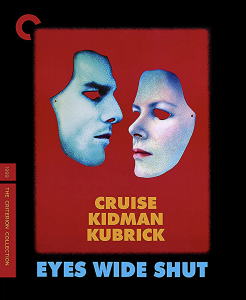
Two days ago the highly distinguished Robert Harris, the Obi Wan Kenobi of film restorationists, a man whose authoritative word on Bluray remasterings has been radiant and ultra-trustworthy for decades…two days ago Harris went over to the dark side by more or less giving a pass to the monsters behind Criterion’s teal-poisoned Eyes Wide Shut 4K Bluray.
Harris took a look at the EWS disc and wrote the following in a Home Theatre Forum post on Thursday, 11.13: “I’ve been hearing / reading about teal ‘problems’ with Criterion’s new 4K, and after having sampled the film, I’m just not seeing it.”
Stab me in the neck with a letter opener! How could you do this, Bob? You’ve sided with the bad guys!
Possibly imaginary debate between HE and a knowledgable fellow whom for the purposes of attribution, I’ll call KF…a guy who agrees with Harris:
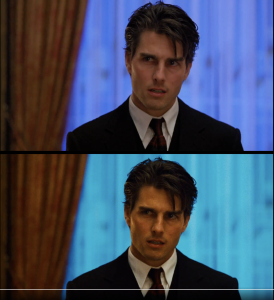
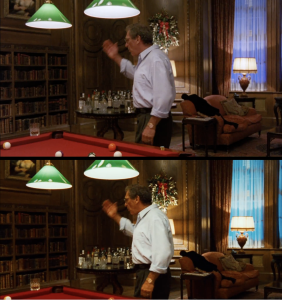
HE: “Bob can’t say ‘I don’t see it.’ It’s right there. Teal greens saturate. He can’t say this!”
KF: “I’m aware. Of course I see it. My point is that Kubrick’s dp should know what things should look like. How can you complete a final cut or color when you’ve passed into the next realm?”
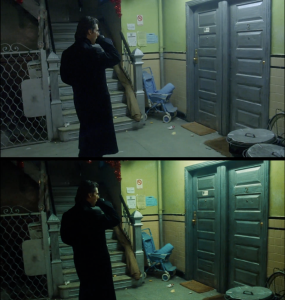
[Insert: Top frame grab is how the envelope scene has always looked since 1999…the iron gates are vivid blue, freshly painted. Bottom frame grab is from the Criterion 4K Bluray…somber greenish teal.]
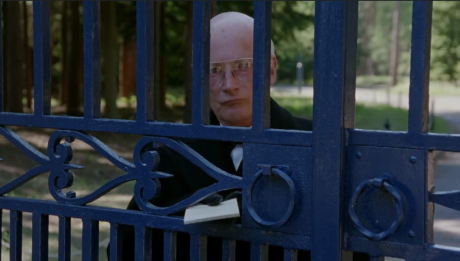
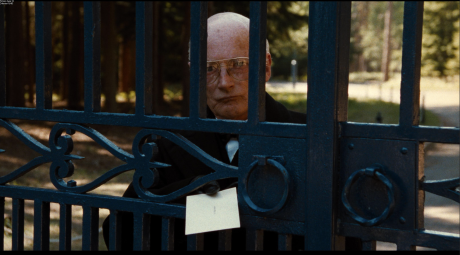
HE: “Oh, my God. You’re saying that Criterion’s teal-green tinting was supposed to be there all along and that the various versions I’ve been looking at since ’99 were wrongly calibrated? I’m having convulsions. This is deranged thinking, bruh. It breaks my heart to see Bob siding with the Criterion teal monsters. How can he say this stuff?”
KF: “Bob is saying it’s possible, especially as prints were struck on Agfa stock.
HE: “So far Bob has more or less said that the DVD Beaver frame captures and Men on Film guys who posted that comparison reel…he’s saying they’re corrupt or technically deluded or otherwise unreliable. What if a third source comes along with frame captures that convey the same thing? Is Bob going to continue with his ‘I don’t see it’ regardless?”
KF: “I’m saying that frame grabs are not the way to view much of anything.”
HE: “The people behind this Criterion 4K obscenity need to be brought to The Hague. They are criminals.”
KF: “I don’t care about frame grabs. Nor previous videos.”
HE: “I need to stop relying on my lying eyes, you’re saying.”
KF: “Don’t put words in my mouth. I’m speaking of frame grabs in general. I look at the actual moving image.”
HE: “Evil is staring Bob right in the face, and he’s saying ‘I don’t see it.’ How can Bob, the grand arbiter and ultimate authority godfather….how can he say this stuff? He’s siding with the bad guys.”
KF: “The question you’ve neglected to ask is ‘What did Kubrick want the film to look like?’ End.”
Full Harris review: “Released in July of 1999, Eyes Wide Shut was Stanley Kubrick’s final work, but he may have never approved a final answer print, as he passed away in March of that year.
“Which leaves us with some unanswered questions. (a) Did Stanley have final fine cut? and (b) Was he able to perfect his color and densities to perfection? Eyes Wide Shut has been released multiple times on home video, and I don’t know if those questions have ever been accurately answered.
“Which leads me to believe that one may not be able to use a release print or answer print as reference, and presumably not an earlier incarnation of home video.
“I’ve been hearing / reading about teal ‘problems’ with Criterion’s new 4K, and after having sampled the film, I’m just not seeing it.
“Are the blues deep, rich blues? No. They do lean toward a teal.
“But the question remains, what were the intentions of the filmmakers? And a quarter of a century later, I’m aware of only one person on the crew that can adequately answer that question — director of photography Larry Smith. And we now have his answer.
“The design was always amber interiors / blue exteriors, and with that design, one is always going to get a bit of bounce, especially on whites. But I’m not only seeing zero problems here, I like what I’m seeing. I believe that Mr. Smith, who was behind the camera, has done a beautiful job, and I have no doubt that his heart and soul were in the right place to deliver something of which Mr. K would approve.”
“Grain haters need not apply.”



 ,/p>
,/p>