An “annoyingly whimsical ditty — notable solely for its key change from D major to F sharp major”? Maybe so, but (a) it settled my soul as I listened last night in the car and (b) I dearly love that chord change!
The Anthology 3 version is shit.

An “annoyingly whimsical ditty — notable solely for its key change from D major to F sharp major”? Maybe so, but (a) it settled my soul as I listened last night in the car and (b) I dearly love that chord change!
The Anthology 3 version is shit.
The release dates of Sydney Pollack‘s Three Days of the Condor and Bobby Deerfield were exactly two years apart — 9.25.75 and 9.29.77, respectively. But oh, what a difference.
Condor is a fully satisfying paranoid classic that I’ve seen at least ten or twelve times over the years, plus it made impressive dough upon initial release ($7.8 million to produce, earned $41.5 million).
Deerfield wasn’t just a modest financial failure — it was deeply loathed by those who saw it on opening weekend (I caught it in Westport, once) and avoided like the plague by almost everyone else.
One reason: An emotionally gutted or neutured race car driver (Al Pacino) is gradually restored to spiritual health by a pretty woman dying of cancer (Marthe Keller). Potential viewers immediately smelled the cloying calculation and howled “no fucking way!” And despite being filmed in France and Italy by the respected Henri Decae, it somehow didn’t “feel” European, and thus felt curiously artificial on top of the cancer contrivance.
I will never, ever sit through Bobby Deerfield again.
And I don’t mean the second one.
If you don’t have a pet, get one. No birds or reptiles, of course. The usual small or smallish four-legged furry kind. A nice little kitten or two. Or a puppy. Preferably a golden retriever.
Right now your mom is all memories and floating spirit. But once you bring the pet home, she’ll begin to re-manifest.
How to handle her absence longterm? Very simple: Write an e-book about her journey. She will know you’re doing this, meditating as she is upon her heavenly, mystical cloud mattress, and this effort will warm her heart. And yours.
Maybe a short book. Maybe a 20-page article at first, chapter by chapter but not necessarily in the usual biographical sequence. Include as many photos, videos, audio recordings as you can get your hands on. Make it as long or as short as you deem fit, but chisel it down to the nub. Keep the sentiment but remove all the hot air.
Keep working on it until a little whisper tells you “okay, you’ve done it, or mostly at least…you’ve captured the best stuff and perhaps even the essence.” Number the pages and print them out on some kind of upscale, above-average paper stock. Or make it into a perfect-bound hardcover book. Whatever seems right.
Writing it all out, trust me, will make the grief dissipate and weaken and gradually float into the ether. Plus you’ll always have the book to have and to hold.
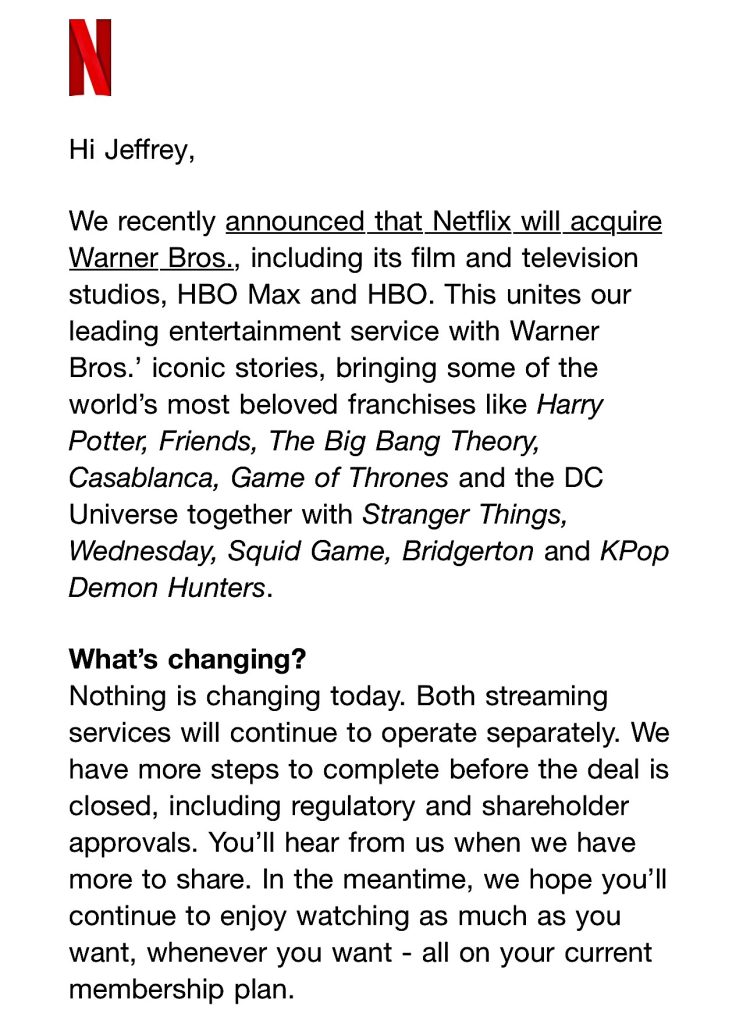
I feel hugely deflated by the impending engulfment of Warner Bros. by the streaming oxygen killer and cultural suffocation device known as Netflix. I also feel lucky to have not only lived through but truly experienced movie theatre rapture as only a kid and a younger go-getter careerist could…I was not only gifted but levitated as a 20th Century movie hound …I knew and savored the blessings of that world …I was fortunate enough to have revelled in the golden age of monoculture Hollywood…huge Times Square theatres, glorious sparkling marquees, block-long billboard art, big drive-ins…reserved seats, 70mm presentations, a feeling of excitement and aliveness and specialness…a vibe that will never, ever return. It’s gone, man, and of all the bad-vibe, killjoy forces out there, Netflix has probably done the most to kill it.
Did they not get the memo? Are they under an impression that it’s still 2021? Vampire schlock is vampire schlock. Praising mediocrity is a sin…seriously. Bad for the soul.


What are the positive benefits for film culture in the Netflix-devours-Warner Bros. scenario? I’m not necessarily saying the buy is a bad or unfortunate thing. I’m just asking “what’s the upside?”
I felt the same way when 20th Century Fox was eaten by Disney.
Which senior WB employees are likely to get whacked? Maybe I should ask “who WON’T Get whacked?”
I saw it again tonight, and holy moley…it was shot in 1.66:1. A result of the European sensibility of dp Lucasz Zal (Ida, Cold War, The Zone of Interest). Chloe Zhao agreed, I’m guessing, because 1.66 is an older a.r. (European “flat”, common in France and England in the mid 20th Century) and this seemed to vaguely augment the Elizabethan vibe.
I’ll be very surprised if a single film critic or puff-piece profiler has mentioned this. One reason is that 98% of your mainstream media kiss-assers don’t even know what a 1.66 aspect ratio is.
I was more or less okay with Albert Brooks‘ Defending Your Life (’91) and I’ll always adore the last 25 minutes of Warren Beatty and Buck Henry‘s Heaven Can Wait (’78). Because, deep down, I’m susceptible to this brand of romantic fantasy…fate, happenstance, eternal connections, etc.
But I would never so much as flirt with the idea of submitting myself to an afterlife romcom as obviously puerile and vomitous as Eternity (A24, 11.26).
Which youngish afterlife dead guy (Miles “don’t be a pervert, man” Teller or Callum Turner) should the also-dead-but-reborn Elizabeth Olsen choose for her eternal afterlife partner? Jesus, man…who the hell cares?
Imagine if 2001‘s Dave Bowman (Keir Dullea) had realized at the very end of Stanley Kubrick‘s 1968 classic, just he was about to transform into a cosmic star-child, that the only thing that really matters is somehow finding and hooking up with Pamela Byrge, a girl he was head-over-heels in love with in high school, etc.
It obviously required an extraordinary degree of shallowness and not even a glimmering of cosmic consciousness for cowriters Pat Cunnane and David Freyne (Freyne also directed) to dream up this crap.
I noted eight years ago that Turner has eyes like a northwestern timberwolf. This is still the case.
In Alfred Hitchcock‘s Lifeboat (’44), a German submarine survivor, Willie (Walter Slezak), admits that his crew shelled the lifeboats of a sunken British ship. He explains through Tallulah Bankhead‘s Connie, who translates his German, that they were “just following orders” to fire on the lifeboats, even though they posed no military threat.
“This admission sparks a hushed debate among the survivors about how to treat an enemy who participated in such a deplorable act.
“Ultimately, the survivors, driven by a combination of anger, suspicion (Willie is later found to have a hidden flask of water and food tablets that the others lacked) and a struggle for survival, savagely beat Willie and throw him overboard to his death.”
Political cartoon by Nick Anderson:

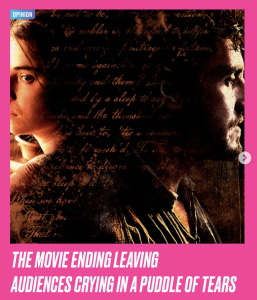
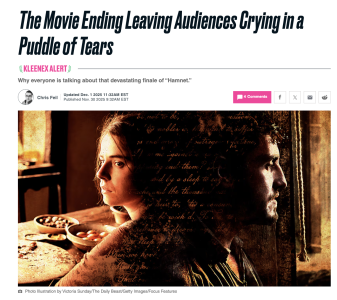
Make that two figures of speech, and both involving H20. I encountered them earlier today while reading a four-day-old Hamnet review, written by the Daily Beast‘s Chris Feil.
The deplorable terms are (a) “pool of tears” and (b) “puddle of tears.” I’m not saying that Hamnet‘s Globe Theatre finale doesn’t deliver a meltdown. It surely does. I’m saying that any and all allusions to pools or puddles of tears are verboten.
In traffic violation terms, writing “puddle of tears” or “pool of tears” is equal to drunk driving, or perhaps even hitting a pedestrian and leaving the scene with squealing tires and burnt-rubber smoke in the air.
Feil: “The first thing you’ve likely heard about Oscar-winner director Chloé Zhao’s latest film, Hamnet — before even predictions about its Oscar chances — is the degree to which it is leaving crowds in a pool of tears.”
Less than two seconds after reading this sentence, I was telepathically muttering epithets….”You shameless motherfucker…pool of tears?…you craven shoveller… you should be bitchslapped for that”, etc.