Which sounds decent or semi-acceptable (it’s taken from Dylan’s “Like A Rolling Stone“) until it hits you that Martin Scorsese‘s No Direction Home (’05), a landmark doc about Dylan, also took its title from “Like A Rolling Stone” and in fact from the same chorus — “How does it feel, how does it feel? / To be on your own, with no direction home / A complete unknown, like a rolling stone.”
In short, Mangold’s title sounds lazy. His Dylan biopic is already covering the same territory as Scorsese’s film (the early ’60s folky troubadour years, ending with the 1966 motorcycle accident). He clearly needs to poach another Dylan lyric, but which?
HE suggestions: (a) The Ghost of Electricity (obvious allusion to the original title), (b) Darkness At The Break of Noon, (c) Shelter From The Storm, (d) All Along The Watchtower, (e) Simple Twist of Fate, (f) My Weariness Amazes Me.
Any of these six would make for a fascinating, catchy title — the only problem is that they might seem a bit too poetic for the dumbasses. Other suggestions? Remember that the title has to suggest something about the difficulty of change and finding a new direction.
Seriously, my favorite is The Ghost of Electricity followed by My Weariness Amazes Me.
HE correspondent “KJ” has hit upon something. Everything Everywhere All At Once is either a direct descendant or a very close relation of Scott Pilgrimvs.The World (‘10). Edgar Wright and theDaniels are similar nerd birds, all right. Invested in cyber mythology, alternate realities, VFX realms. A notion that dull, deflated, frustrating lives have an amazing imaginary flipside.
HEtoKJ: “You’ve hit upon something…EEAAO is distinctly related to and perhaps influenced by Edgar Wright’s SCOTT PILGRIM.VS. THE WORLD — obviously a different ball of wax, but also a Marvel-forecasting, cyber-nerd fantasy slash bullshit comic-book film that I despised back then & will despise for the rest of my life.”
EEAAO is a slightly better film than Scott Pilgrim — the final scene is the clincher — and yet it made me feel a similar kind of revulsion. Both films have triggered brief suicide fantasies.
“Pilgrim Reckoning,” posted on 8.12.10: Edgar Wright (Shaun of the Dead, Hot Fuzz) is obviously a nervy, fairly bright and moderately gifted director — seriously, no jive — and Scott Pilgrim vs. The World, even though it seems to be putting out a kind of aesthetic nerve gas, is some kind of cool-ass, smarty-pants, richly stylized…uhm, waste of time?
It’s kind of nifty if you want to feel connected to a movie that under-30 moviegoers are responding to. It’s empty and strained and regimented, but…you know, cool and funny and clever, heh-heh. It has wit and vigor and smart music, and it gradually makes you want to run outside and take an elevator to the top of a tall building and jump off.
Did I just say that? I mean that it’s a masterpiece of its kind. That sounds facile, doesn’t it? I think I might actually mean that Scott Pilgrim is a seminal and semi-vital thing to experience right now. My kids set me straight on this. Call me unstable or impressionable but I’ve also come to think that Michael Cera might be a fresh permutation of a new kind of messianic Movie God — a candy-assed Gary Cooper for the 21st Century.
No, seriously, it’s not too bad. I mean, you know…just kill me.
I was sustained, at times, by the meaning of the seven ex-boyfriends. They’re metaphors for the bad or unresolved stuff in Mary Elizabeth Winstead‘s life. If you’re going to really love and care for someone, you have to accept and try to deal with everything in their heads and their pasts, and not just the intoxicating easy stuff. Scott has to defeat these guys in the same way that any boyfriend or husband has to defeat or at least quell the disturbances in his girlfriend’s or wife’s head. That’s how I took it, at least.
I’m not doubting that Cera has been a Scott Pilgrim graphic novel fan for years, but the movie, I think, came out of his wanting to transform into a tougher, studlier guy in movies by becoming a kind of ninja warrior fighting the ex-boyfriends in a Matrix-y videogame way. I really don’t think it was anything more than that. Seriously.
“No offense, Michael, but the world thinks you’re a wuss,” Cera’s agent said one day on the phone. “They see you as a slender reed, a worthless piece of shit girlyman with a deer-in-the-headlights expression and a little peep-peep voice. Somehow we need to toughen you up, and having you fight a bunch of guys, even if it’s in a fantasy realm, is certainly one way to do that.”
I didn’t want to kill myself while watching Scott Pilgrim vs The World. That notion or impulse came later. I know that if movies are in fact going to be moving more and more in the direction of Scott Pilgrim in the coming years — video-game inspirations, glib dialogue, wimpy girlymen in lead roles, bullshit video-game fight scenes, laid-back gay guys engaged in threesomes in shitty basement apartments — then I really would rather die. Because movies as I’ve known them all my life would in fact be dead, and there’d be nothing to live for.
Then again I really liked the music that Scott’s band plays. It throbs and churns with a wowser bass line — not at all like the gay music my two sons seem to prefer these days. And I liked Kieran Culkin, who plays Scott’s gay roommate, and at the same time I wanted to see him cut in half (or into several pieces) with a chainsaw. And I liked the little lovesick Asian girl (Ellen Wong) who has a crush on Scott, and I despised Scott for not being able to summon the puny amount of courage it would have taken to simply lay it on the line and tell her he’s fallen in love with someone else. But…you know, as Scott says early on, “That’s haaaaard.” What a guy.
Lurie started me off with a taste of 20 performances, and right away I was saying to myself “these are too familiar, too boilerplate…where’s that special-passion choice that defies conventional thinking?”
What is a greatest-ever performance anyway? My theory is that picks in this realm have less to do with skill or technique or even, really, the actor, and a lot more to do with the viewer and what they choose to see. The choices that people make tend to reflect their intimate personal histories on some level. Because they’re choosing performances or more precisely characters who closely mirror and express their deepest longings, fondest hopes and saddest dreams.
My late younger brother was tremendously moved by Mark Ruffalo‘s portrayal of a loser in You Can Count On Me, in large part because my brother was that character. I know a lady who’s always felt close to Vivien Leigh‘s Scarlett O’Hara in Gone With The Wind for the same reason. Bill Clinton once said on a High Noon DVD documentary that Gary Cooper‘s performance in High Noon is his all-time favorite because Will Kane‘s situation (everyone chickening out when things get tough and leaving him to stand alone) reminded him of what it’s often like for a sitting U.S. President.
When I began to assemble my pantheon the first nominees that came to mind were Gandolfini, Marlon Brando in On The Waterfront, Monica Vitti in L’Avventura, Amy Schumer in Trainwreck (I’m dead serious), George Clooney in Michael Clayton, Gary Cooper in High Noon, Mia Farrow in Broadway Danny Rose, Lee Marvin in Point Blank, Alan Ladd in Shane, Brad Pitt in Moneyball, Marilyn Monroe in Some like It Hot and Jean Arthur in Only Angels Have Wings. This is without thinking anything through or second-guessing myself.
Somebody complained earlier today that I don’t write rich, longish reviews any more. Actually, I do but only if the spirit warrants. The complainer cited my Secretariat review from 12 years ago. Listen, man…I write all day long, every damn day without fail. There’s more cultural-political stuff blended into the mix these days, and that’s what stirs my soul. If the current output doesn’t ring your bell, you know what you can do.
Posted on 10.3.10: In Secretariat (Disney, 10.8), Diane Lane gives an earnest, steady-as-she-goes performance as Penny Tweedy, the conservative housewife who risked financial ruin and defied her husband (Dylan Walsh) and brother (Dylan Baker), who wanted to sell their inherited horse farm for a quick profit, in order to nurture, train and place into competition one of the most celebrated racehorses in history.
The horse was initially named Big Red but eventually became Secretariat — legendary winner of the 1973 Triple Crown. And it’s a thrill to watch (and hear) him run. The film sometimes gives you that amazing charge with exceptional you-are-there photography and sound.
Alas, Secretariat is as rote and regimented and corny as Kansas in August, and I don’t see it selling many tickets beyond its base constituency — squares, tourists and hardcore horse-racing fans.
In short, I loved the story of Secretariat more than the movie. Actually, not the story so much as the horse-racing footage. The problem (and the movie has more than one) is that director Randall Wallace uses every trick in the book to make it seem touching, suspenseful, a cliffhanger…a story that massages your heart. Every. Trick. In. The. Book.
And so you’re not “in” the groove of Secretariat as much as fully aware of everything he’s trying to do to crank you up. You never forget you’re watching a Randall Wallace family-values movie for the schmoes — i.e., white people who stroll around in plaid shorts and white socks and La Crosse golf shirts, and who have an allegiance for old-fashioned Wonder Bread conservatism.
Everything is so right down the middle. And for me, Wallace’s directing style is too tight and straight-laced. There’s a little cut-loose dance sequence when Lane and her team are shown bopping and grooving to a ’70s soul tune, but Wallace doesn’t know how to cut and bump to this kind of thing, or at least not very well. Nor is he especially good at depicting early ’70s counter-culture kids and their behavior. It feels fake, “performed” — like some 1971 Methodist minister’s view of how hippie kids dressed and spoke and acted.
Lane has three moments that play exceptionally — (a) an argument/firing scene with a horse-farm manager in the first act, (b) a moment when she looks into the eyes of Secretariat to see if he’s ready to run, and (c) a financial face-off scene between she, Walsh and Baker. Except the latter scene is brought home by the housekeeper (Margo Martindale) when she spells out the specifics of their father’s will. A solid award-worthy performance needs three powerful moments, not two and a half. Lane’s performance wants to be as good as Sandra Bullock‘s in The Blind Side, but doesn’t quite get there. Sorry.
And Mike Rich‘s script doesn’t really give her any huge killer moments. Solid moments, but not great ones. The staring-at-Secretariat moment might be the best of all. Lane has a hold on the heart and spirit and determination that surely drove her character forward. Nice lady and mildly hot under the circumstances. But why did that wig she was wearing have to look so much like a wig? Don’t hairdressers know how to make wigs a little mussy and more natural-looking?
I quickly lost patience with Scott Glenn, who plays Lane’s ailing dad. Alzheimer’s, a stroke….die, you fucking boring actor!
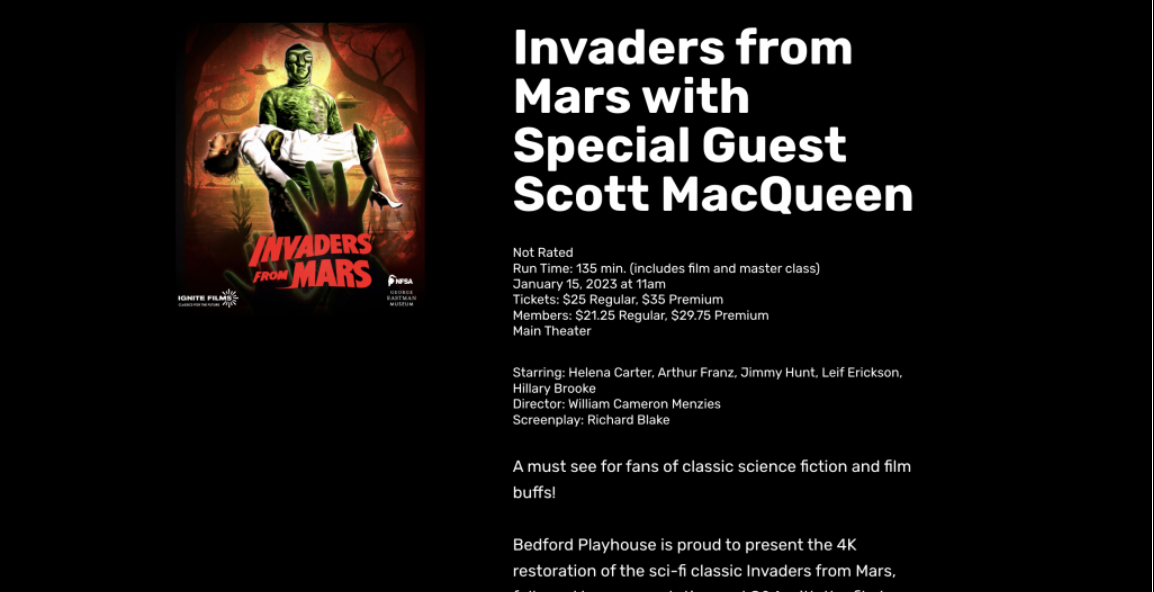
HE is reminding that the next big Bedford Marquee event is a special 4K screening of William Cameron Menzies‘ recently restored Invaders From Mars (’53). A special master class instruction from restorationist Scott MacQueen will also occur. It’ll happen three weeks hence on Sunday, 1.15.23 at 11 am.
How keen will local film buffs be about catching a sci-fi classic on a lazy Sunday morning? Understand this: This will be the only first-rate screening in a AAA first-rate theatre (which the BP definitely is) of an absolutely mint-condition restoration of perhaps the most influential Eisenhower-era space invader film ever made. This will almost certainly never happen again…trust me. Hot chocolate served in the indoor cafe. The more, the merrier!
Thursday morning I went to an orthopedic clinic, cane and all. They X-rayed me, said it was osteoarthritis, gave me an anti-inflammatory (Naproxen) and a cortisone wannabe (MethylPREDNISolone) and taped the ankle. The drugs kicked in a couple of hours later, and the pain was soon gone. By yesterday the swelling had gone down to almost nothing and I removed the black tape wrap. And I’ve abandoned the cane.
The only downside is that the Naproxen-cortisone substitute combination was too much for my system, and I wound up nauseous and barfing. (Twice yesterday.) But the episode is over, thank God. Miraculous as it sounds, it’s almost like the ankle agony never happened…like it was a bad dream or something.
It’s shattering to report that over the last 30-plus hours I’ve become a near-invalid. My left ankle is aching and swollen with osteoarthritis, and I can barely hobble around with a cane.
I started using the cane yesterday, and I could barely sleep through the night for the throbbing ache and discomfort. The first wake-up happened at 2:20 am. Spotty sleep for a subsequent four hours.
RichardRushfield calls himself The Ankler. As of this moment I have just as much of a claim to that term as he does.
Jeff Sneider is a whipsmart, fair-minded guy with that strange intestinal fortitude quality known to very few journos in this racket. Co-panelist Scott Mantz is also part of this fraternity, having showed his own form of courage a few months ago in that Hollywood Critics Association dust-up.
In the minds of woke hive-mind fanatics I am a “divisive” columnist, as Jeff notes, but I care deeply about films and the remnants of the film culture that used to prevail in this industry (i.e., more cinematic, less of an emphasis on political instruction), and at least I’m not some breezy, constantly smiling opportunist (those Noovies promos!) and zeitgeist cruiser like Perri Nemiroff, whose face freezes and whose eyes narrow into a skeptical squint when Sneider mentions me.
“Emotional” sometimes gets conflated with “divisive”. What I am, boiled down, is a devotional, storied (40 years and counting), richly seasoned, aspect ratio-attuned, well-travelled and still strongly relationshipped Film Catholic who’s (a) filing as passionately as always and loving the grind, (b) had a pretty great peak ride for nearly 30 years (early ‘90s to late teens) but (c) has also endured some fairly intense cash-flow trauma over the last three years due to woke fanaticism, hence Sneider’s use of the term “divisive.”
Excepting the sea-change event of embracing sobriety in March of ’12, I haven’t changed that much over the last 20 or 25 years. My film devotion has been steady and reverent since I got into this racket in the late ‘70s, and I still regard myself as a sensible center-left type, but there are some Robespierre loonies (especially those from the absolutist DEI brigade and the older-white-guy-hating #MeToo fringe vengeance squad) who began going over the waterfall in ‘18 and ‘19.
That mad fervor is starting to calm down as we speak. Will woke lunacy last as long as the rightwing Red Scare paranoia did in the ‘50s? Maybe but who knows? It’s very easy to just go along with the mob. Very few have spine or sand. Even I am doing whatever I can to groove along with the loonies — no point in getting into small slap fights that I can’t hope to win.
In sum I appreciate and admire Mr. Sneider’s fairness and his respect for my integrity. Yes, I sincerely meant it when I put Empire of Light at the top of my 2022 list. Ditto my other selections, 30 in all.
Kohn and Thompson have always been sage, sharp and attuned and at the same time careful to stay away from any conversational topic that might translate into some kind of contrary signal as far as the dug-in wokester viewpoint is concerned. In other words they don’t seem to want to discuss anything that might cause political difficulty for them. Plus Kohn is obviously a huge fan of Everything Everywhere All At Once. And so, unless I missed something, they’ve avoided even a brief mention of the significance of EEAAO failing to make the VFX and hair/makeup short lists.**
Obviously I’ve been harping on this story due to HE’s no-retreat EEAAO takedown campaign, but in any sort of dispassionate even-steven realm how can can anyone discuss the shortlists and not at least acknowledge the obvious?
The piece has two titles — “The Final Campaign” online and, on the current New York cover, “Party of One.”
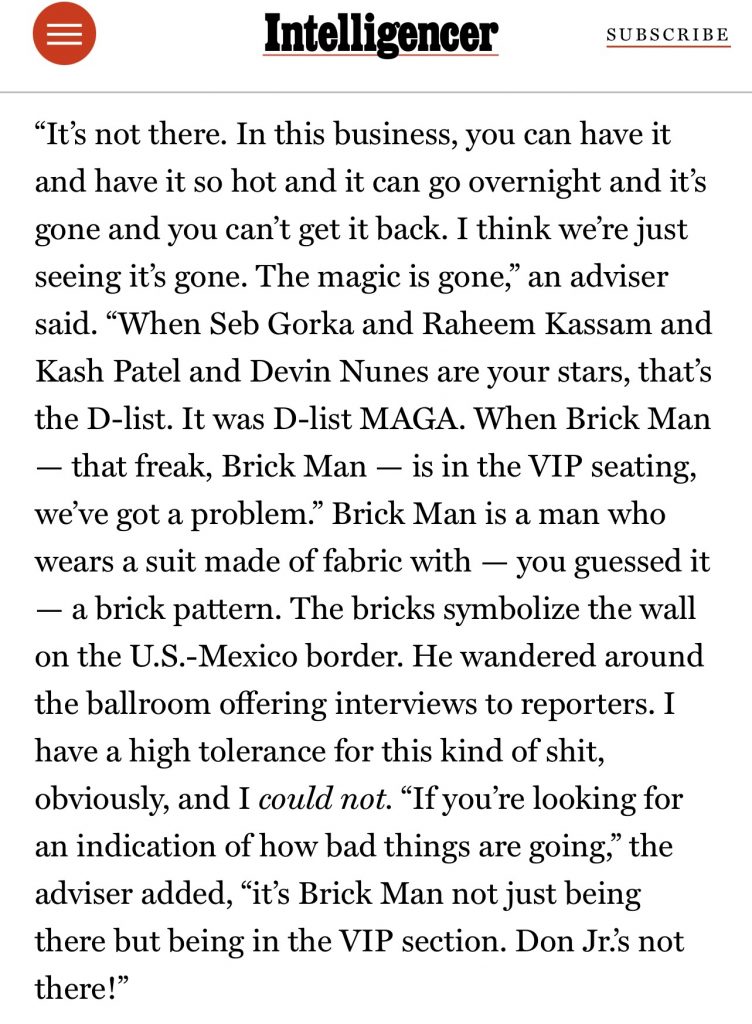
It’s a darkly amusing dig-down piece…fascinating content start to finish…one smirking, devastating paragraph after next. D-List MAGA types (including “Brick Man”) at the Mar a Lago announcement of Trump’s ’24 presidential campaign. Anonymous Trump adviser: “It’s not there. In this business, you can have it and have it so hot [but] it can go overnighty and it’s gone and you can’t get it back. I think we’re just seeing that it’s gone,. The magic is gone.”
The image of Trump basically being fat Elvis Presley during the tacky decline period of ’76 and ’77…this analogy will stick.
The Elvis observation is from 41-year-old Sam Nunberg, a Manhattan-based operator who was an on-and-off political advisor to Trump’s 2016 presidential campaign, and “was subpoenaed by a grand jury for testimony and documents relating to the Special Counsel’s Russia investigation.”