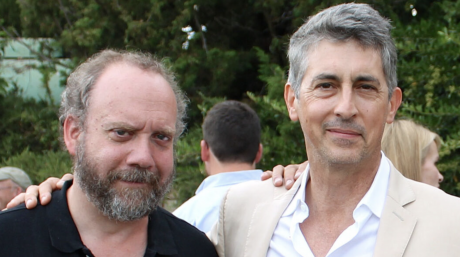
Last night Deadline‘s Michael Flemingreported that Alexander Payne‘s The Holdovers, a low-key, Christmas-themed ensemble comedy with Paul Giamatti as “a disliked curmudgeonly teacher” at an elite New England private school, will be screened this weekend for distributors and marketers in Toronto.
The Holdovers “isn’t officially on the for-sale lists,” Fleming wrote, “but I expect it to be a big deal. And it’s very possible that one of the usual suspects will step up and put this film [into] the awards season race late in the year.”
The film’s Wiki page says Miramax is the distributor but maybe they’re looking to partner with someone or negotiate a hand-off of some kind,
The Holdovers began shooting in Massachusetts on 1.27.22. A seemingly finished version of Payne’s film was research-screened in Santa Monica on Thursday, 8.11, and was well received, I’m told, as a “return to form.” I’ve been presuming all along that it won’t emerge until Cannes 2023 at the earliest, but why show it to distributors during TIFF ’22 if there isn’t at least a willingness to consider an end-of-the-year opening?
Here’s hoping that the celebrated creator of Election, About Schmidt, Sideways, Citizen Ruth, The Descendants and Nebraska is back in that deliciously wise, character-driven groove that we’ve all come to associate with Payneworld and whom we all love and cherish despite the disappointment with Downsizing…here’s hoping that the Payne flag will soon rise again, rippling in the wind at the top of the smarthouse flagpole.
Step outside the woke-critic realm and there’s a sizable body of opinion (or so I determined after speaking with Telluride viewers) that Sarah Polley‘s Women Talking is a static, dialogue-driven #MeToo chamber piece that could be fairly described as a “tough sit.”
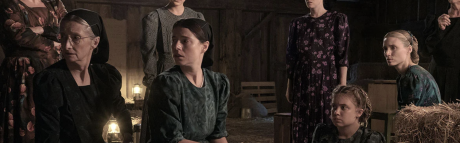
Set within an isolated American Mennonite community, Women Talking focuses on a nocturnal, seemingly dusk-to-dawn discussion inside a barn, and focuses on eight or so women debating whether to leave their community to escape the brutality of several men who have repeatedly drugged and raped them.
Fortified by several first-rate performances (most notably from Jessie Buckley, Rooney Mara and Claire Foy) and currently enjoying a 92% and 90% approval ratings on Rotten Tomatoes and Metacritic, respectively, the post-Telluride narrative is that Women Talking will probably be Best Picture-nominated and will certainly be in the running for a SAG Best Ensemble prize.
The other narrative is that this counted-on support for Women Talking will be largely emotional (particularly driven by the overturning of Roe v. Wade) and certainly political.
As I wrote in a 9.5 piece called “Telluride Hive Mind,” “The elite Telluride critic community feels it has no choice but to worship Polley‘s film…politically speaking there’s no upside to not praising it.”
I added that Women Talking is “sturdy and nicely handled as far as it goes, but sitting through it felt confining and interminable. For me, it was almost totally about waiting for it to end.”
The indisputably brave, lone-wolfish Kyle Smith of The Wall Street Journal: “Critically acclaimed as an oblique commentary on the #MeToo moment, it’s an example of a prestige film that is more focused on point-scoring than coherence.”
A sentence in Jordan Ruimy’s mostly negative Toronto assessment, however, gave me pause: “There were women sobbing all around me during the press & industry screening of Sarah Polley’s Women Talking, so I assume the film will work with a large contingent of people. But it fell flat for me.”
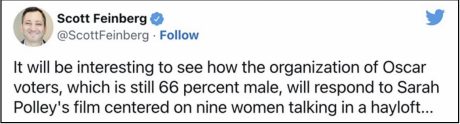
Roe v. Wade plus Toronto “sobbing” means Women Talking isn’t going away and will command repeated salutations in award-season assessment articles between now and early ’23 (the Oscar telecast happens on 3.12.23). The bottom line is that, as THR‘s Scott Feinberg suggested during Telluride, a significant percentage of Academy and guild members will probably be less than enthused.
This won’t stop the wokester cabal, of course. They will push for Women Talking with the same fervor they used to (unsuccessfully) take down Green Book, and which some of them will use to diminish Sam Mendes‘ immensely affecting Empire of Light, which will absolutely be Best Picture-nominated…trust me.
I’ve said before that I’m not especially interested in Disney’s live-action, Robert Zemeckis-directed, Tom Hanks-starring musical Pinocchio (Disney, 9.8), and that my real interest is in Guillermo del Toro‘s fascist-Italy version, which Netflix will premiere on 12.9.22. I don’t think I even want to see the Disney version, to be honest. But what a trouncing by Rotten Tomatoes and Metacritic.
If I, Jeffrey Wells, were to suddenly be thrust into the living pages of Bethan Roberts‘ romance novel and thereby literally become Tom Burgess, a young British policeman in 1950s Brighton, I would not secretly fall in love with Patrick Hazlewood, a 40ish museum curator. I might find him excellent company and a good fellow, but no heavy breathing…sorry.
Primarily because (a) I’m not gay despite lifelong metrosexual tendencies, (b) because David Dawson (who plays Hazlewood) isn’t good looking enough, (c) because I’m more or less committed to being a good husband to Emma Corrin‘s Marion, even if she lacks the sensuality of Ingrid Bergman, (d) because I’ve never found men’s hairy legs the least bit attractive and (e) because I’ve always been profoundly fearful of or turned off by certain physical intimacies that would go with the territory. (Sorry but I don’t think I’m alone on that one.)
Amazon will give My Policeman a limited theatrical release on 10.21 and a streaming debut on 11.4.
Bernard Shaw was a first-rate TV news journalist who peaked during his time at CNN (1980-2001).
Shaw’s second most memorable moment with CNN was reporting from Baghdad on the 1991 Gulf War (“This feels like we’re in the center of hell“).
But there’s no question that Shaw’s most consequential moment happened when he drilled Democratic presidential candidate Michael Dukakis with a highly emotional question that by normal human standards demanded some kind of emotional response. Dukakis’s refusal to answer with his heart did a lot to kill his chances of being elected.
Shaw had asked if Dukakis would support an “irrevocable death penalty” for a man who had hypothetically raped and murdered Dukakis’s wife. Dukakis’s reply was logical, measured and legalistic, and so doing he defined himself as a chilly technocrat.
In the wake of his mother’s passing at age 96, the 73-year-old Charles, Prince of Wakes, has unofficially become the King of England, to be ceremoniously crowned in due time. It was only two days ago when Queen Elizabeth received the new Prime Minister, Liz Truss, in Balmoral Castle. The moment has happened; no one is gut-punched; tradition soldiers on. Ten days of pomp and cirumstance to follow.
Postedyesterday: “You know who radiated an undercurrent of sexuality along with a sexual past, and who would’ve been a perfect Lady Chatterly (albeit one with a slight Swedish accent)? The Ingrid Bergman of 1945, when she was making Notorious or, if you will, Spellbound. There was never the slightest question that Bergman knew her way around a four-poster and then some.
6 pm update: I’ve been wised up about Don’t Worry Darling, and basically the ’50s thing is all bullshit. I won’t say how or why but it’s not to be trusted. So everything that follows is beside the point as the ’50s thing, and therefore the “presentism” I’ve spoken about, is off the table, so to speak.
Earlier today:
Don’tWorryDarling’s presentism was given a good going over in yesterday’s comment thread responses to “When AFilmHasIssues.” Just for the record…
It began with HE’s “HumanaHumana” taking issue with a line in Glenn Kenny’s 9.5.22 Venice Film Festival review, in which he lamented the film’s “condescending racial dynamic.” Darling is set in a 1950s desert community called Victory, and Kenny complained that “the sole Black female with a speaking part is relegated to a martyrdomprop.”
I don’t know what this means as I haven’t yet seen the film, but the mere presence of BIPOC characters in such a community is a woke projection thing.
“Within the suburban realm of 1950s homogenized America,” I wrote, “there were very few BIPOCS or Asian Americans living ‘next door’, so to speak.
“Outside of your liberal big-city enclaves, the US of A of the Eisenhower era was a largelysegregatedsociety**, and especially in planned Wonderbread communities like Victory.
“Where are the BIPOC residents in Martin Ritt’s NoDownPayment (‘57)? There was a Black longshoreman in the Hoboken-based OnTheWaterfront (‘54) but not a single Black motorcycle rider in TheWildOne (‘53), which was set in rural California.
“So if you’re making a film about an isolated suburban community in the mid ‘50s, you have to create an alternate vision of how things were. The key to this alternate vision is a little thing called ‘presentism.’”
At which point the erstwhile Bob Strauss chimed in:
HEreply: “Then why not set it in a more socially liberal time? In the ‘80s or ‘90s or early aughts, say?
“My presumption is that director Olivia Wilde and her screenwriter, Katie Silberman, fell in love with the affluent ranch-style or KaufmanHouse-inspired architecture of the ‘50s (displayed in NoDownPayment as well as 1955’s TheBigKnife) as well as the cool ‘50s retro cars and clothing fashions.
“In 1961’s ParisBlues (also directed by Ritt) Sidney Poitier plays jazz performer Eddie Cook, who lives in Paris, in part, because he despises the racist culture of the U.S. whereas racial attitudes are much more casual in the City of Light.
“When Poitier himself was making ARaisinintheSun in Los Angeles in ‘60 or early ‘61, he was more or less obliged to stay at the liberal-minded Chateau Marmont because no one in the affluent nabes (including Beverly Hills) would rent their home to a black dude, even if he was a big-time movie star.
“If the exalted Poitier (Tony Curtis’s costar in 1958’s TheDefiantOnes) wasn’t able to rent in the nominally liberal Beverly Hills, what are the odds that Kenny’s ‘Black female martyrdom prop’ would have been living in Victory a few years earlier?”
** In the South and, I think, other regions, even public transportation was segregated in the ‘50s. Which, of course, is what triggered the Freedom Rider movement among black activists.
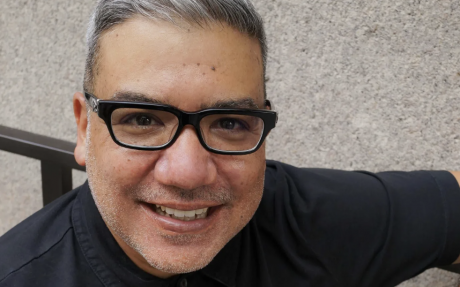
HE congratulates New York Film Festival chief Eugene Hernandez on being named the new director of the Sundance Film Festival and head of public programming, following the departure of Tabitha Jackson three months ago.
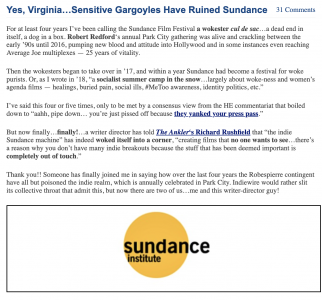
Hernandez has piloted the New York Film Festival for the past three years, and of course was the co-founder and editor-in-chief of IndieWire, the indie-focused news-and-opinion trade that has become synonymous with ardent. dug-in woke-itude.
Eugene certainly has his work cut out for him. Sundance has been stalling for four or five years now, but HE is hoping that he can turn things around. The Sundance glory era ran from the early ’90s until 2016 or ’17, but nothing is forever and all things must pass.
Actors should be allowed to play whomever or whatever. In a perfect world none of us would or should have a problem with a straight actor playing gay or vice versa, or a non-Latino playing Fidel Castro or you-name-it.
Acting is about submitting and becoming, and whenever a particular effort succeeds it’s glorious. I can still enjoy Alec Guinness‘s Prince Feisal in Lawrence of Arabia, his actual ethnicity be damned. I’ve always believed in his storied brilliance. All Guinness has to do is speak a line or two…sold.
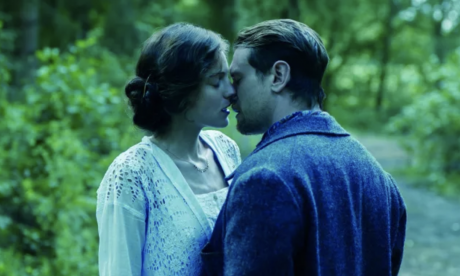
Then why, I was asking myself, did I have trouble submitting to Emma Corrin‘s lead performance in Lady Chatterly’s Lover (Netflix), which I saw Monday night (9.5) in Telluride?
Corrin was a perfect Lady Diana in The Crown, and yet I had difficulty accepting her as a wealthy cis British woman succumbing to runting passion in the 1920s blah blah. Nor did I believe that her earthy gamekeeper lover (Jack O’Connell) had any special passion for her. I felt only the effort.
This is probably at least partly because Corrin has been somewhat pronounced about being queer (she came out in July 2021) and adopting “they/them” pronouns and being nonbinary and wearing breast flatteners and whatnot.
Plus there’s just something about her that seems coy and stand-offish about sensuality in any form.
I said a somewhat similar thing about the late Olivia De Havilland when she passed in late July 2020. To me OdH always seemed to lack a sensual ignition switch. Too goody two-shoes or something. I was immediately disciplined for saying so. Variety‘s Steven Gaydos accused me of “pissing on her coffin.” I replied that detecting an absence of a sensual undercurrent in De Havilland was not dismissive or derogatory.
I’ll never not appreciate Corrin’s first-rate skills, but I just couldn’t believe that her Lady Chatterly was hungry for the proverbial thrusting loins. I kept telling myself “forget Corrin’s stated real-life identities” — just sink into her soul and absorb the feelings and let the movie wash over you and carry you along. But I couldn’t.
And I’m saying this as someone who truly loved Jonathan Groff‘s straight FBI guy in Mindhunter, Cate Blanchett‘s vampy lipstick lesbian in Carol, Kevin Spacey‘s miserable married suburbanite in American Beauty, Peter Finch‘s gay doctor in Sunday Bloody Sunday and so on. Great acting is great acting, but…well, I’ve said it.