For 10 or 11 years Peter Weir lived a charmed creative life. One brilliant film after another — Picnic at Hanging Rock (’75), The Last Wave (’77), Gallipoli (’81), The Year of Living Dangerously (’82) and Witness (’85).
Then God’s light stopped shining and Weir’s perfect string ran out. Weir remained an excellent filmmaker (which he still is today) but like so many gifted directors, he became an in-and-outer.
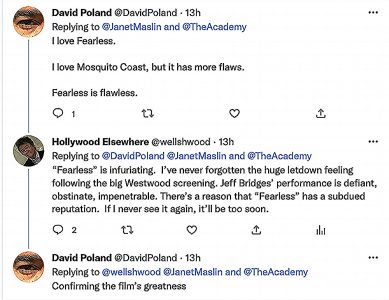
The Mosquito Coast (’86) was his first dud, but he rebounded with Dead Poets Society (’89). Then came the appealing but insubstantial Green Card (’90) and the relentlessly downish and altogether impenetrable Fearless (’93), which only people like David Poland really loved. This was followed by The Truman Show (’98), which self-destructed with one of the worst bullshit “happy” endings ever devised.** Master and Commander (’03) was an awesome rebound but then the candle went out.
Weir’s most recent film, the underwhelming The Way Back, opened 12 years ago. What happened?
If I’m on a plane that crashes and I somehow manage to escape without a scratch despite almost every other passenger being killed or severely injured, I would take a few moments to collect myself…five or ten minutes, I mean. Then I would submit to what I imagine would be absolute happiness. Nothing but pure joy and relief.
The remainder of my life would be a radiant celebration of the mere, magnificent fact that I’m alive. (Which is what we should all be feeling anyway.) I would become a perfect…make that an imperfect smile. I would tingle with ecstasy at every sensation, every thought…every sight, sound and aroma…the precious symphony of living.
What does Jeff Bridges do when he survives a catastrophic plane crash in Peter Weir‘s Fearless (’93)? He becomes a sullen, moody, withdrawn shithead. He snaps at people, looks at them sideways, crawls into his own cave, makes life miserable for poor Isabella Rossellini and generally becomes an asshole. Thanks, Jeff!
I don’t know or care all that much about the fortunes of Lucasfilm and the Star Wars franchise. But the John Campea rumor about Lucasfilm honcho Kathleen Kennedy possibly losing her job between now and next summer (which World of Reel has included a link to) got my attention.
John Campea on rumored demise of Lucasfilm’s Kennedy (11.22): “This is what I have heard: I have heard that the decision to remove Kathy Kennedy has already been made and that she will be gone either sometime before or very, very, very shortly after the release of Indiana Jones 5.
“Now, I want to be very, very clear here: I cannot independently say to you and confirm to you that this is a fact. I will say that one of the two people that have contacted me has a 1000% average on the things they’ve informed me of.”
Funny Ruimy statement: “My advice to Disney is simple: DON’T HIRE RIAN JOHNSON [to make a new Star Wars trilogy]. Not because he’s a bad filmmaker — he’s actually a pretty good one. [This is more] from the fact that a majority of Star Wars diehards just plainly do not like him for what he did with The Last Jedi.”
I’m immensely grateful, by the way, that Sasha used the term “dunzo.” I’d stopped using it and hadn’t heard anyone else use for a good 15 years or so.
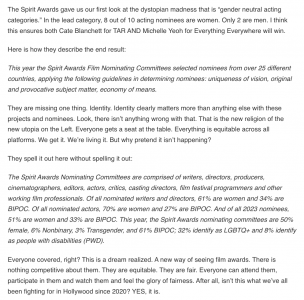
Excellent excerpt: “The Academy should never go down this path or they will be dunzo in the eyes of the public. I promise you, most people in this country and world aren’t utopians. They still want to know that people who accept awards, or are nominated for them, got there because they gave the best performance — the best performance
“Yes, all of the categories at the Oscars are gender-neutral by default. I have always believed this made it much harder for women to compete, especially in the Best Director category. At least with the acting categories, they knew they would always have ten slots no matter what. The same goes for men.
“Ultimately, maybe this awards race, this Oscar game I once helped launch online in 1999 is, by now, No Country for Old (Wo)Men.”
Why did the Spirit Davidians ignore Close for the Best International Film award?
Barry Corbin to Tommy Lee Jones: “You can’t stop what’s coming. It is all waiting on you. That’s vanity.”
It must be clear to every man, woman and child at this point that the people behind the Spirit Awards noms have gone totally insane.
Yesterday I didn’t get around to posting about Mickey Kuhn, the youngish actor of the ’40s and early ’50s who had noteworthy supporting roles in Gone With The Wind (Beau Wilkes, son of Leslie Howard and Olivia De Havilland), Red River (young Mathew Garth) and A Streetcar Named Desire (sailor who gives Vivien Leigh directions at the very beginning).
I’ve watched Gone With The Wind several times and haven’t the slightest recollection of the adolescent Kuhn doing or saying anything. Then again he appears in the boring second half, which I tend to phone-surf through.
Wiki excerpt: “Kuhn worked for American Airlines from 1965 to 1995, and particular at Boston’s Logan airport in administrative positions.” HE to Boston friendo: “Hey, remember that kid who played John Wayne‘s scrappy adoptive son in Red River? I swear I saw him last weekend out at Logan.”
The fact that Kuhn was married five times between the mid ’50s and mid ’80s suggests an unsettled psychology. That or he liked to play around. His fifth and final wife, an American Airlines co-worker named Barbara Traci, was married to Kuhn from 1985 until his death — a 37-year bond.
Kuhn passed two days ago in Naples, Florida, at age 90.
On 12.13.22 a much larger audience will have access to Martin McDonagh’s family-friendly, bloody-finger-stumps drama, and obviously in time for the year-end holidays.
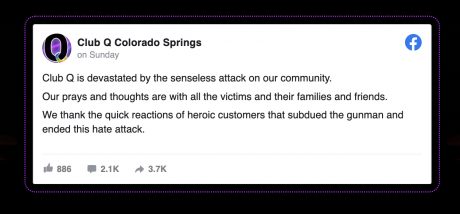
Last night the Daily Mail‘s Paul Farrell and Stephen M. LePore posted a story about the Club Q shooter, a massively overweight, non-binary wackazoid named Anderson Lee Aldrich.
The 22 year old murderer of five patrons at Club Q last Saturday night is the son of Aaron Brink, a former MMA fighter and porn star who has sexually performed under the name of “Dick Delaware”, and Laura Voepel.
And you’re reading about this nightmare and going “good God!!” It’s a story about epic-scale derangement and dysfunction and unbridled rage on the part of ALA, and it just makes you feel sick to read it. There’s some sort of lunatic virus streaming through a white-trash subset of the American middle class right now, and the overwhelming impression is that these people are degraded and diseased and unable to focus their energies in any kind of healthy (or at least non-destructive) direction.
Aldrich, whose birth name was Nicholas Franklin Brink until he changed it in 2016, got into some kind of guns-at-the-ready trouble with the local fuzz in ’21, and you’d think with his history that someone in authority would take his weapons away as a cautionary move while examining his situation.
If I were to tell you that this is a nice Anglo Saxon barista who works at a nearby Starbucks, would that be okay? I’m sitting at a Starbucks right now, and the top guy has a beard and longish hair. I don’t know if they have Starbucks outlets in Jerusalem, but if they do I’m certain the guy at the counter wouldn’t resemble a cheerful Connecticut WASP.
Posted on 10.1.22: “The common consensus is that whatever you may think of Noah Baumbach’s WhiteNoise, a dryly farcical ‘80s period drama set in an Ohio college town, the final sequence — an ambitiously choreographed dance sequence featuring shoppers at an A & P supermarket — is the highlight.
“The sequence affirms the film’s basic theme about nearly everyone turning to all kinds of distractions (including food) to avoid contemplating their own mortality.
“Though brilliantly staged, the dance number is undercut by Baumbach’s decision to use it as a closing credits backdrop. Here’s how I put it to a friend:
“The LCD Soundsystem ‘New Body Rumba’ finale could have been great if Baumbach hadn’t decided to overlay it with closing credits. I almost shouted out loud ‘Oh no!! He’s blowing it!!’
“I’msayingthisbecause once the credits begin we instantly disengage aswetellourselves‘okay, themovie’soversotheaisle–dancingis just a colorful bit, a spirit-picker-upper…whatever.’
“If Baumbach hadn’t given us permission to disengage, the dancing could have been wild and mind-blowing in a surreal Luis Bunuel-meets-Pedro Almodovar way. It could have been a mad slash across a wet-paint canvas…a Gene Kelly consumer-orgy crescendo.
“And then it could have segued into a closing credit crawl. Alas…”
…from wearing Mexican huarache mandals to afternoon parties?
The answer is that you can’t. If guys want to wear these godawful things you have three options — (a) man up and roll with it, (b) avoid looking or (c) thank your host profusely, tell him/her how much you enjoyed the gathering and leave. No offense to the wearer. I just can’t stand mandals in any form.
Sitting second from right on the right side of the sofa is Cold War star Joanna Kulig.
William H. Clothier‘s framings of John Ford‘s The Horse Soldiers (’59) are so visually pleasing…so wonderfully balanced and lighted, not to mention staged and edited to a fare-thee-well. First-rate filmmaking from an old-time era when 1.66 was still a celebrated aspect ratio.
The attack of the children’s army sequence is pure pleasure. There’s a moment when Sgt. Major Kirby (Judson Pratt) is about to take a shot at the approaching Jefferson Military Academy Reverend (Basil Ruysdael, who was 81 at the time), and Colonel John Marlowe (JohnWayne) stops him at the last second. I love the “are you kidding?” look that Wayne gives Pratt — no anger, just mild irritation.
The Horse Soldiers viewer is never unaware that he/she is watching a John Ford/John Wayne film, but the feeling of comfort and assurance is sublime.
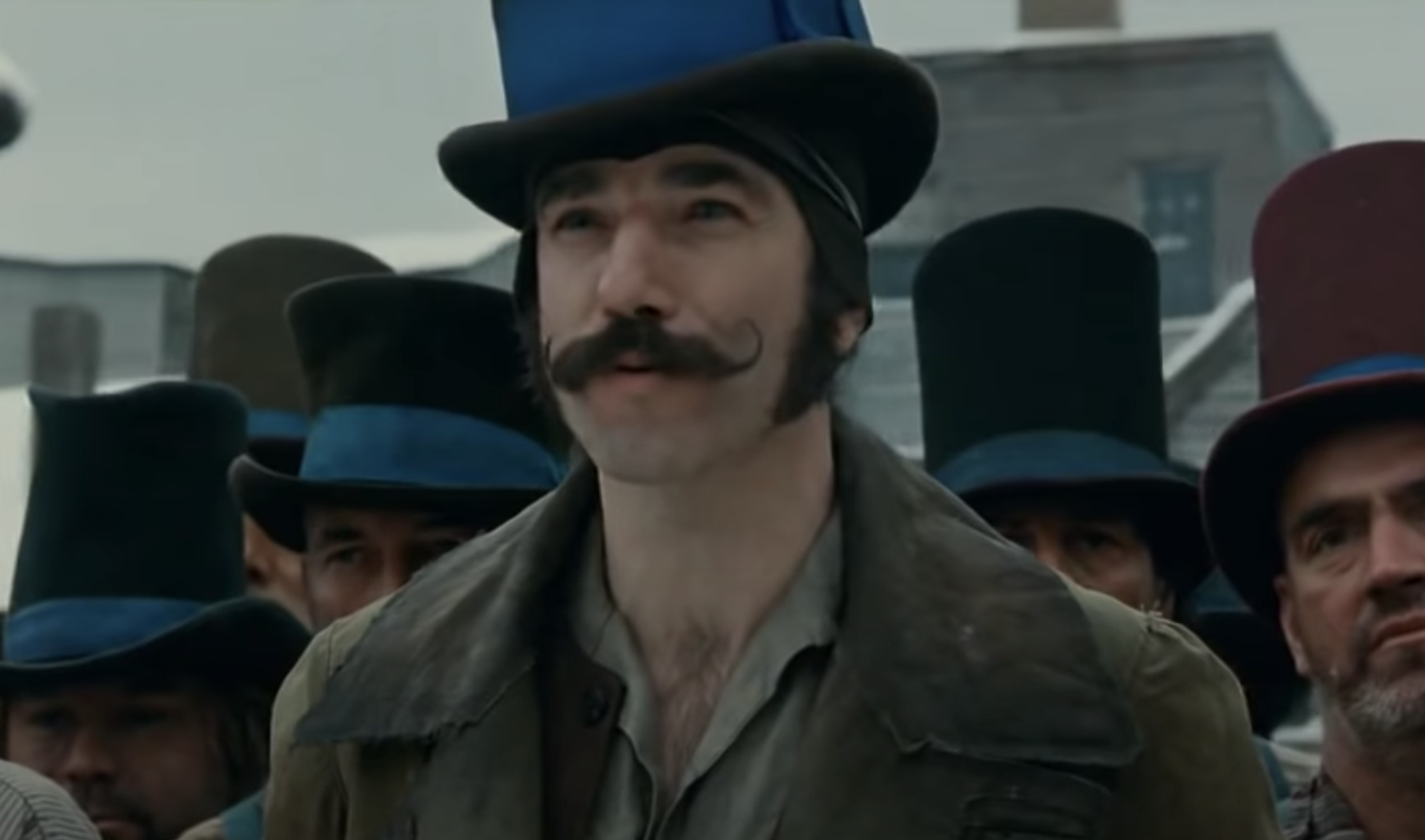
I was told earlier today that the Gangs of New York Wikipedia page mentions a noteworthy piece by yours truly, posted in December 2001, that described the differences between a 1.37:1 work print version of Gangs that I saw on VHS vs. the final 2.39:1 release version. Here’s a link to the original article, and here’s a repost of it:
If Miramax Films and Martin Scorsese had decided to release a polished, cleaned-up version of the Gangs of New York work print they had in the can (or, if you want to get technical, that was stored on Marty and editor Thelma Schoonmaker‘s Avid) sometime in October ’01, we’d all be enjoying a better, more rewarding film than the Gangs that will open nationwide four days from now (12.20.02).
I’ve seen both versions and most of you haven’t, so I know something you don’t. The best Gangs of New York will not be hitting screens this weekend, and may never even be seen on DVD, given Scorsese’s apparent disinterest in releasing “director’s cut” versions of his films, or in supplying deleted scenes or outtakes or any of that jazz.
The work-print version is longer by roughly 20 minutes, and more filled out and expressive as a result, but that’s not the thing. The main distinction for me is that it’splainerand therefore morecinematic, as it doesn’t use the narration track that, in my view, pollutes the official version. It also lacks a musical score, with only some drums and temp music.
This leaves you free, in short, to simply pick and choose from the feast of visual information that Gangs of New York is, and make of it what you will. And if that isn’t the essence of great movie-watching, I don’t know what is.
It also points out what’s wrong with the theatrical release version, which I feel has been fussed over too intensively, compressed, simplified, lathered in big-movie music and, to some extent, thematically obscured.
Miramax and Scorsese had the superior work-print version in their hands 14 months ago. It’s a little rough around the edges, but it’s not tremendously different from the version being released on Friday. It is only missing Leonardo DiCaprio‘s narration, a musical score and some CG effects, which tells me it could have easily been prepared for a December ’01 release. But Miramax decided otherwise and pushed it back it until now. If you ask me their reasons for doing so were short-sighted and wrong.