The Unintentional Alarming of Randos Is Almost Pleasurable
May 14, 2026
Deepest Cavern of Hell
May 14, 2026
Imagine The Enveloping Pleasure
May 13, 2026
From Owen Gleiberman’s Variety riff on Daniel Craig’s dancing-around-Paris Belvedere spot: “If the new Belvedere Vodka commercial, starring Daniel Craig and directed by Taika Waititi, were a scene out of Craig’s latest film, it would be the best scene in the movie, or at least the one that everyone’s talking about. Then again, no one would mistake it for a movie scene.
“The commercial has a postmodern strike-a-pose viral aesthetic — it‘s two minutes of bliss frozen in time. As Craig saunters and dances through a swank hotel in Paris, it becomes the rare commercial in which a movie star isn’t being used to sell a product so much as he’s using the commercial to sell a shift in his own image.
“Yes, the extended spot is hawking vodka, and Craig probably got a paycheck that leaves most movie-star paychecks in the dust. Yet that’s all kind of beside the point. The commercial is Craig’s way of announcing who he is, or might be, now that he’s done with the role of James Bond.”
HE to Gleiberman: “Your Daniel Craig riff is very good. The ad is an inspired image makeover.
But it was a SERIOUS MISTAKE, I feel, for director Taika Waititi to send Craig into the interior of a glitzy-ass Kardashian Paris hotel. Because once inside that golden dungeon the endless organic glories and intrigues of Paris disappear. Because glitzy Kardashian hotels are the same boorishly vapid experience the world over…Paris, Milan, Moscow, NYC, Berlin, London, Seoul, Los Angeles, Dubai, Barcelona, Stockholm…exactly the same damn experience and atmosphere.
“And so the Belvedere ad fails in terms of spirit and imagination. And this failure, I regret to say, rubs off on Craig a little bit. It’s good but it could and should have been a lot better if it had been about silky Craig-as-Fat Boy Slim Chris Walken dancing and shuffling around several Paris nabes, it could have been ten or fifteen times better.”
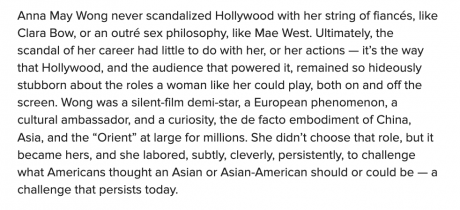
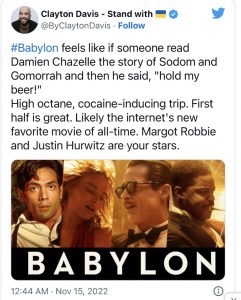
In Damien Chazelle‘s Babylon, Lu Jun Li portrays bisexual Asian actress Lady Fay Zhu, a character based on the groundbreaking Anna May Wong (1905-1961).
From Mark Salisbury‘s “Burton on Burton“: “Warner Bros. management disliked the title Beetlejuice and wanted to call the film House Ghosts. As a joke, Burton suggested Scared Sheetless and was horrified when the studio actually considered using it.”
Just $1 million of Beetlejuice‘s $15 million budget was spent on visual effects, which included stop motion, replacement animation, prosthetic makeup, puppetry and blue screen. It was always Burton’s intention to make the style similar to the B-grade movies he grew up with. Burton: ‘I wanted to make them look cheap and purposely fake-looking.”
Wiki: “Test screenings geenrated positive responses, and prompted Burton to film an epilogue in which Beetlejuice angers a dead witch doctor.”
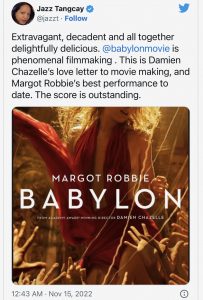
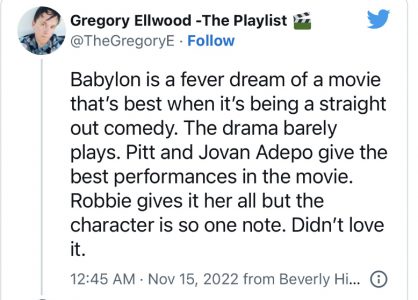
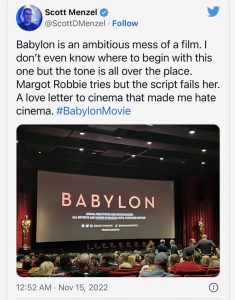
I was told several months ago that Damien Chazelle‘s Babylon is a highly energetic, epic-sized smorgasbord (188 minutes!) in which the excesses of The Wolf of Wall Street serve the basic story template of Singin’ in the Rain (i.e., Hollywood transitioning from silents to sound).
Other influences, according to one who saw a rough cut last spring, were John Schlesinger‘s The Day of the Locust, the orgy sequence from Eyes Wide Shut, and maybe a dash or two of Steven Spielberg’s 1941.
But in the wake of last night’s Academy screening, I’m hearing from one viewer that it’s basically a three-character Great Gatsby film (set primarily in the late 1920s) blended with a grotesque version of American Hustle. Brad Pitt, Diego Calva and Margot Robbie respectively play fading movie star Jack Conrad, ambitious industry climber Manny Torres and the Clara Bow-like Nellie LaRoy — a trio analogous to Gatsby‘s Jay, Nick and Daisy. And it has a delightful ending, I’m told. And it’s true that sometimes a really good ending can save a film.
On the other hand Babylon is all woked up and seemingly angled at Zoomers, who all insist on angelic people of color (in this instance Jovan Adepo‘s trumpet-playing Sidney Palmer, Li Jun Li‘s Anna May Wong-inspired Lady Fay Zhu) being marginalized and pushed to the side by evil whites. The minorities are just their skin color and type because that is how we’re trained to see them now — “gay”, “Asian”, “Black”, “Mexican-American”…check check check.
“You don’t watch Babylon — you endure it,” says a friend. “Chazelle took a lot of risks…it’s such a daring film and Damien goes all the way with it, and one can’t help but be impressed by the end. But it’s really hard to watch…at times very gross, loud, shrill, too long…they all scream their lines. Pitt’s character is the only one you really feel for…Robbie may have pushed it too hard….Diego just stares.”
So who’s seen The Fabelmans and what’s your reaction? Mine was “well made and engaging as far as it goes, but too long, flagrantly ‘acted’ and not, at the end of the day, hugely interesting on its own story terms. Knowing that it’s Spielberg’s saga is what holds us, of course, but what if it wasn’t about Spielberg’s formative years? How would it play if it was just a movie about a boomer kid who wanted to make movies from an early age? The only parts that really sing are the teenaged filmmaking moments in the Arizona desert, and the ending at Radford Studios.”
HE is relieved to report that that Jay Leno isn’t doing too badly following a skin-scorching accident that happened in his garage. The 72-year-old comedian and car aficionado said, “I got some serious burns from a gasoline fire [but] I’m okay. Just need a week or two to get back on my feet.”
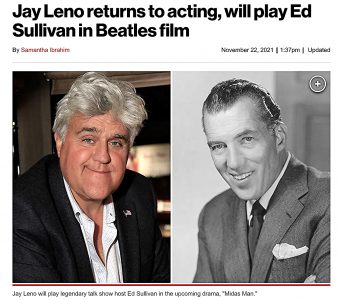
The incident reminded me that Leno is playing Ed Sullivan of all people in Sara Sugerman‘s Midas Man, a drama about the life of Beatles manager Brian Epstein.
Leno looks nothing like Sullivan, nothing at all. Sullivan was a short, slender-built fellow with a narrow face, and his hair was darkish and slicked back with Brylcream — a physical polar opposite of what Leno looks like now with his heavyish face, lantern jaw and white hair.
Former Vice-President and Donald Trump ass-smoocher Mike Pence is on the book promotion trail, hawking “So Help Me God” (Simon & Schuster, 11.15.22). The man is beneath contempt.
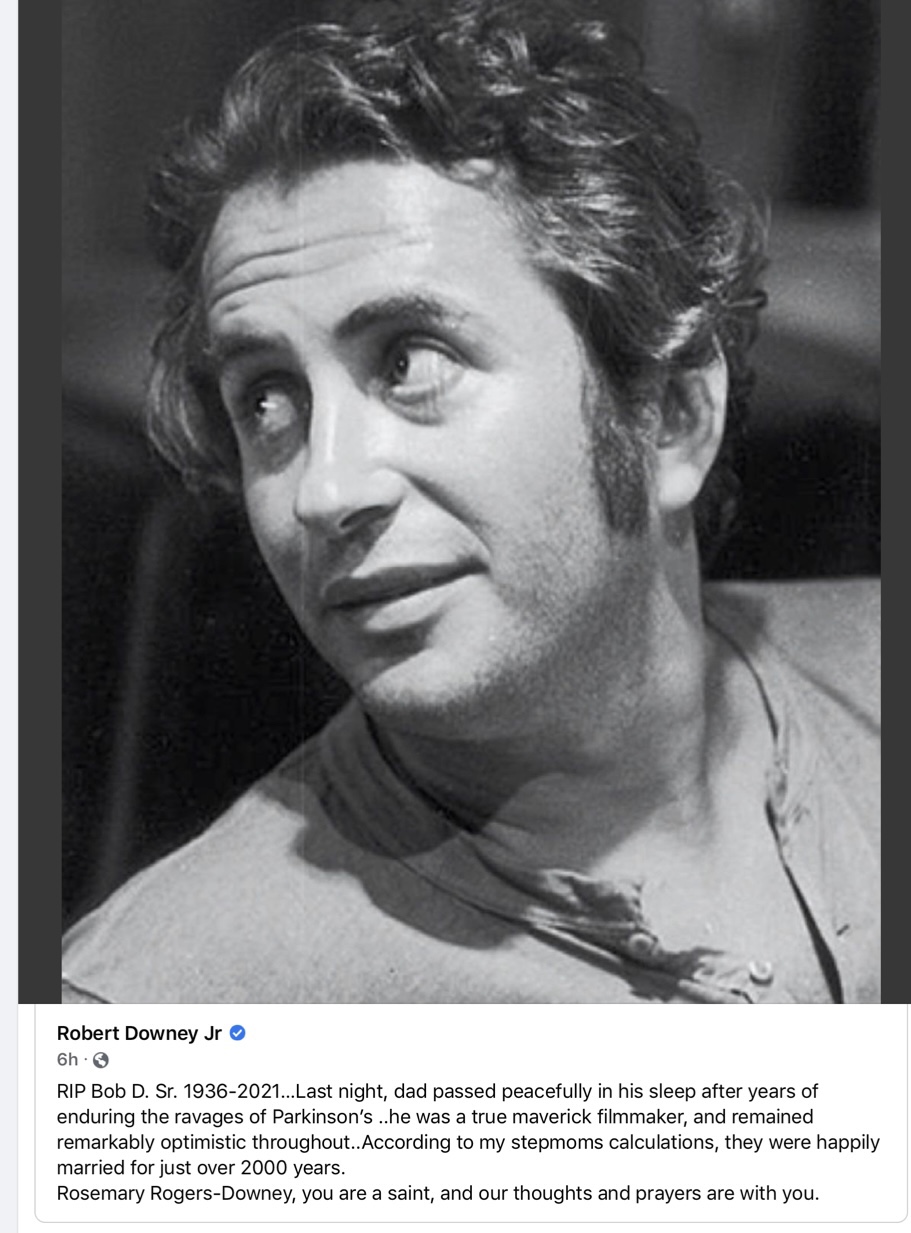
“Respect for Robert Downey’s Genius Dad,” posted on 7.7.21: “Hollywood Elsewhere salutes Robert Downey Sr., the once-legendary director of iconoclastic, guerilla-style, counter-culture stoner classics like Putney Swope (’69) — the deadpan Madison Ave. comedy that put Downey on the map — and Greaser’s Palace (’72), an absurdist western comedy about the second coming of Christ.
Not to mention lesser Downey efforts like Chafed Elbows, Pound, an adaptation of David Rabe‘s Sticks and Bones, Up The Academy, Too Much Sun and Hugo Pool.
Downey died in his sleep earlier today (7.7) at his Manhattan home. He was 85.
I interviewed Downey 24 and 1/2 years ago during the ’97 Sundance Film Festival, where Hugo Pool had its big debut. Nobody thought it was very good (including Downey Sr. himself), but the man was such a legend that all the journalists wanted to chat with him. My sit-down happened at a Hugo Pool party at a handsome chalet-type home in Park City, sometime in the mid to late evening. Downey Sr. was 61 at the time and brimming with personality — fleet, funny and wise. (And totally white-haired.) I liked him immediately, and felt honored to have been given my 20 minutes.
It can’t be over-emphasized what a huge counter-cultural deal Putney Swope was when it first broke; ditto Greaser’s Palace three years later. I’m not saying these films don’t “work” according to classic or present-day sensibilities, but they were much funnier and significantly enhanced if you were ripped.
I’ve never forgotten the silly sexual current in Herv Villechaize’s gay cowboy scene in Greaser’s Palace. Stanley Gottlieb‘s performance as Villechaize’s cabin-partner “Spitunia” is a classic. Villechaize was 28 or 29 when this scene was shot; he killed himself at age 51.
Some critics have sought to dismiss Sam Mendes‘ Empire of Light (Searchlight, 12.9) because they’re unable to buy the curious but ultimately poignant bond between the two leads, played by Michael Ward and Olivia Colman. I myself was skeptical going in, but the fine writing, acting and overall period swoon effect (largely due to excellent production design plus Roger Deakins‘ handsome cinematography) won me over.
Filmmakers are generally required to depict POCs with a paintbrush of presentism these days (i.e., presenting them according to contemporary standards and mindsets), and many critics, knowing this, will get all riled when a Black character is presented “incorrectly” within a period film. Many elite critics see themselves as white-knight figures whose task is to bestow dignity or even majesty upon characters of color.
Ward’s performance will never be criticized, of course, but there’s no dodging the fact that he’s a handsome actor of considerable poise and charisma playing a decades-old period character in a film written and directed by an older white man. (Not unlike Mahershala Ali in Green Book.)
And there’s a fascinating violent moment in this film, by the way, that I haven’t mentioned. Racist skinhead goons are lurking on the fringes of this story, and early on a few of them are taunting Ward’s Stephen character on a sidewalk, and one strikes him with a head slap. And what does Stephen do? He does the smart thing by ignoring the attacker as he continues to walk away. He knows these animals are looking for an excuse to beat him senseless, and so he doesn’t give them that.
A violent moment such as this runs against the presentism aesthetic. A Black man of today would never ignore an attack of this nature if it was depicted in a present-tense film, but Mendes, adhering to the ugly reality of things in rural 1980 England as much as Paul Thomas Anderson’s Licorice Pizza was truthfully immersed in the Los Angeles culture of the ‘70s, does the stand-up thing.
EmpireofLight is my idea of a sublime and deeply moving yesteryear film, and is exceptionally well acted. There was no question in my mind that it was an authentic, emotionally fine-tuned masterwork after I saw it at the Herzog. It seemed “just right” in so many ways.
As a study of a few characters living smallish lives in a somewhat isolated English coastal village in 1980 and ‘81, it recalls the complex textures of another tale of small-town characters, some of them grappling with sexual matters and with a certain movie theatre occupying an iconic space in their lives — Peter Bogdanovich’s TheLastPictureShow (‘71).
“Critics are truiy their own species these days, living on their own politically-attuned planet. Eternally fickle and excitably hair-trigger, they often seem divorced from and in some cases contemptuous of Average Joe perceptions about this or that film, and particularly those, it seems, that have explored racial situations or narratives. (2018’s GreenBook being another example.)
More than any other time in cinema history, today’s elite critics are, to a large extent, living for and within their own realm.
“There are noteworthy exceptions and honorable outliers, thank God, and I’m not saying the elite critic cabal is entirely untrustworthy, but in the matter of films that either touch upon or seriously explore the holy woke covenant (race, gender, sexuality and whitey-very-bad), they’re never been more unreliable than today.”
Friendo: “I dunno. I’ve spoken to folks who don’t like it, and they didn’t seem to be coming from a woke perspective.”
HEtofriendo: “They’re not ‘wrong’ but they’ve allowed themselves to be triggered by the romantic inter-racial dynamic. If Michael Ward’s character (who is only slightly older than Mendes’ age was in ‘80) had been white, the same know-it-alls you’ve spoken to would be much more accommodating. Then again the film wouldn’t stand out as much, of course, if Ward’s character had been a pale-faced Mendes stand-in.”
Bottomline: If you’re dealing with a Black lead character, a director-writer has to play his/her cards in exactly the right way or the elite critics will scold to no end.
Mendes casting Ward as a generational stand-in for himself seemed, at first, like a fashionably woke gambit before I saw it. But the writing and the acting and the overall quality factor won me over. I melted. And Ward is so charming and good-looking.
HE to Friendo #1: “Are these Next Best Picture guys crazy? Women Talking is in third place among Best Picture contenders? On what planet?”
HE to Ruimy: “The truth is that almost every pundit has Women Talking in their predictions, but don’t be surprised if it misses out on a nomination. I’d say right now 60/40 it gets nominated.”
Friendo #2 to HE: “When it comes to Women Talking, the fix is in. A Best Picture nomination is going to happen whether people want it to or not. You could see that in Telluride.”:
HE to Ruimy: “Because of #MeToo tokenism and the fact that the one male character (Ben Whishaw‘s “August Epp”) is passive and tearful?”
Friendo #1 to HE: “The critics will have to drive this movie to Oscar nominations, and I don’t think they’re all on board.”
HE to friendos #1 and #2: “There are more than a few male voices, not just certain critics & columnists but filmmakers who are not on board. The bottom line, I realize, is that most male critics are afraid of #MeToo and are certainly not going to argue the point.”
Friendo #2: “Don’t you remember grown men weeping in Telluride after that?”
HE to friendo #2: “No, I don’t. A wealthy older guy told me he hated it, in fact — unsolicited. And a 40ish straight woman told me she hated it also. Both in Telluride.”
Friendo #2: “All three #MeToo movies — Women Talking, She Said and TAR — are a slog. She Said is the best one.”
HE to friendo #2: “TAR is a #MeToo movie? Since when? Lydia Tar is the architect of her own demise. She’s an X-factor Polanski figure. Nothing #MeToo about it.”
Friendo #2 to HE: “That’s the whole point of the #MeToo movement — exposing people who warrant their own demise by having been abusive.”
Posted on 9.9.22: Step outside the woke-critic realm and there’s a sizable body of opinion (or so I determined after speaking with Telluride viewers) that Sarah Polley‘s Women Talking is a static, dialogue-driven #MeToo chamber piece that could be fairly described as a “tough sit.”
Set within an isolated American Mennonite community, Women Talking focuses on a nocturnal, seemingly dusk-to-dawn discussion inside a barn, and focuses on eight or so women debating whether to leave their community to escape the brutality of several men who have repeatedly drugged and raped them.
Fortified by several first-rate performances (most notably from Jessie Buckley, Rooney Mara and Claire Foy) and currently enjoying a 92% and 90% approval ratings on Rotten Tomatoes and Metacritic, respectively, the post-Telluride narrative is that Women Talking will probably be Best Picture-nominated and will certainly be in the running for a SAG Best Ensemble prize.