HE’s Only Encounter with Bert Fields

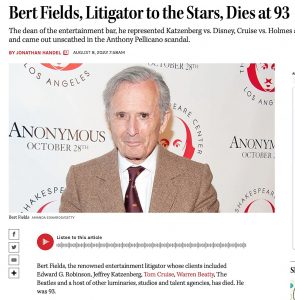
Legendary Hollywood pitbull attorney Bert Fields has completed his journey. The 93 year-old representative of the rich and powerful (and a noted historical novelist) departed late last night at his home in Malibu.

Fields’ client list had included Michael Jackson, Jeffrey Katzenberg, George Lucas, Steven Spielberg, George Harrison, Warren Beatty, James Cameron, Mike Nichols, Mario Puzo, Joel Silver, Tom Cruise, Dustin Hoffman and John Travolta. He was widely and deeply feared.

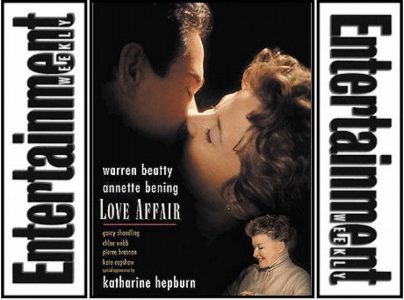
The only contact I ever had with Fields happened 29 and 1/2 years ago, and it was indirect. It involved Warren Beatty and the reporting of an Entertainment Weekly piece about Love Affair. Here’s how I recalled it on 1.9.10:

I’ve just finished reading 24 pages about the making of the embarassing Love Affair (1994) in Peter Biskind‘s “Star: How Warren Beatty Seduced America” (Simon & Schuster).

Biskind offers quote after quote about how Beatty, the film’s star, producer and co-writer (with Robert Towne), marginalized and pretty much ignored and deballed Love Affair‘s director Glenn Gordon Caron.
Using quotes from several sources including Caron himself, Biskind also reports that director of photography Conrad Hall ignored Caron for the most part, treating him with little if any respect.

Towards the end of filming in late 1993 I was told similar stories by two excellent sources (the late production designer Richard Sylbert, a longtime Beatty collaborator and friend, and another insider I’d rather not name).

I included the material in a file submitted to Entertainment Weekly‘s “News & Notes” section, edited at the time by Maggie Murphy, for a story about the making of Love Affair. The file made it clear that Beatty was really running the show and that Caron (hired off his rep as the creative light behind TV’s Moonlighting and Remington Steele) was the director in name only.

I talked to Beatty about these stories, not naming the sources but telling him I’d heard this and that, and he (a) denied that they were true and (b) calmly expressed outrage that EW was working on a story along these lines, which he naturally felt would tarnish the film as a troubled production and perhaps dent its box-office appeal.

He mentioned at one point that he might sic his attorney, Bert Fields, on the magazine.

I don’t know who said what to whom, but I do know that EW ignored the Caron-had-his-balls-cut-off angle when they ran their story a week or two later in mid-December 1993. Anne Thompson, who also did some Love Affair reporting, was assigned to write a cottonball piece called “Love and Warren” that said Beatty was a perfectionist and blah blah. It was basically a valentine.

The Caron angle was removed, I was told, because managing editor Jim Seymore didn’t like the fact that we couldn’t name the sources. I heard second hand that he told Murphy there was “no story here.” I always suspected this was code for “I’m feeling too much corporate heat on this thing so let’s kill it or water it down.”

I later told Beatty that by all appearances he’d played his cards well and had clearly won the round. If you have any sporting blood you have to respectfully acknowledge when you’ve been out-maneuvered.

I got pretty good at imitating Beatty’s voice. I remember calling Thompson during the end of the Love Affair episode. She picked up and said hello. “Anne Thompson?,” I said. Yes? “Warren Beatty.” She fell for it. “Hey-hey….howz it goin’?'” and so on. “Anne, Anne…I’m sorry. It’s Jeff. Foolin’ around…sorry. I wanted to see if I was good enough.”

The key to imitating Beatty is to pronounce the first syllable of his first name so it doesn’t sound like “war” in War and Peace, but “Warren” if you were describing a network of interconnecting rabbit burrows.

Love Affair opened in October 1994 and was panned by just about everyone. I saw it once and found it flat and mundane. Roger Ebert was one of the few critics who gave it a break. It cost about $30 million and made $18 million, give or take. But Beatty would rebound four years later with Bulworth, one of the sharpest and most unflinching political comedies ever made in this country.
Allegedly Good Authority

Seasoned directorwriter friendo: “I’ve heard from [a post-production guy] that the low Batgirl test scores are accurate and that it’s basically not releasable. Quote: ’It makes Catwoman with Halle Berry seem like Abel Gance’s Napoleon.

“Kevin Smith and others are castigating David Zaslav for this, but a stinker is a stinker.”

Followup: “The info is from a transfer house that uploaded a digital internal workprint for online viewing. It was the same version that was test-screened…[he] had heard it hadn’t gone well and knew why.

“There were a copious amount of ‘scene missings’ and incomplete or vacant opticals, but [he] said it plays like a long unsold pilot for the CW.

An 8.2 THR story by Aaron Couch titled “Behind The Cancellation of Batgirl” reported a test score of a “very early version” (also described as a “director’s cut”) of Batgirl in the “lower 60s.”

That’s definitely a subdued, unencouraging response — not necessarily a sign of major difficulty as horror films, according to Couch’s story, tend to test in the 60s. It reportedly tested in that 60something range, and the downish but dynamically styled Black Swan allegedly tested around 55.

But Batgirl is a feminist superhero flick with a Latina star (In The HeightsLeslie Grace) so how exactly would that kind of film be regarded as one that pushes horror buttons and could therefore be afforded a little statistical slack? The noirish D.C. brand is one thing; horror another.

Any way you slice it, it’s hard to imagine a seasoned marketer being enthused about a superhero flick testing in the low 60s.

From a 2.10.17 THR story about an exceptionally high test screening of Guardians of the Galaxy 2:

Read more

“Trainwreck” vs. “Prey”

Dan Trachtenberg and Patrick Aison‘s Prey is obviously not my cup, but I’ve pledged to watch it regardless. (Probably this evening.) If you’ve seen it and feel strongly one way or the other, please share.

I’d much rather see Trainwreck: Woodstock ’99, a three-part doc about Michael Lang‘s infamous boomers vs. GenX/Millennial gathering that descended into rage and bonfires.

Gulager Made His Mark

Full respect and admiration for the late Clu Gulager, who passed two days ago at age 93.

There’s a moment in Peter Bogdanovich‘s The Last Picture Show (’71) when Ellen Burstyn‘s “Lois Farrow” gives the finger to Gulager’s “Abilene”, her ex-lover (or sometime lover, I forget which) and Gulager responds with a slight grin. That, I submit, was his greatest moment as an actor; there’s no question that Abilene was his most respectable role.

Gulager’s performance in that landmark film is best appreciated via Bogdanovich’s 127-minute director’s cut, which is the only version you can stream or buy.

Gulager was also semi-memorable in Don Siegel‘s The Killers (’64) and in James Goldstone‘s Winning (’69). I’m sorry to have never seen Gulager’s A Day with the Boys, which vied for a Best Short Film prize at the 1969 Cannes Film Festival.

Read more

Leguizamo Knows The Truth Of It

So far John Leguizamo hasn’t answered why his role of Chi-Chi Rodriguez in To Wong Foo, Thanks For Everything!…Julie Newmar wasn’t played by an actual cross dresser or trans person. He also played Henri de Toulouse-Lautrec in Baz Luhrmann‘s Moulin Rogue!, despite being neither French nor a midget. He also played an Italian in 1993’s Super Mario Bros..  

What’s good for the goose ought to be good for the gander…no?

The Cuban-born Ana de Armas is playing Marilyn Monroe in Blonde.  Does Leguizamo have a problem with that? Doubtful.

Best Ron Howard Flick in Years

Last night I caught Ron Howard‘s Thirteen Lives (Amazon Prime, 7.29), a 147-minute docudrama about the 2018 Tham Luang cave rescue. I found it admirable in every respect — brilliant, harrowing, gripping — and am sorry I didn’t catch it theatrically instead of in Jett and Cait‘s living room. I can’t imagine how a more riveting narrative feature could have been made.

No, I’ve never seen Tom Waller‘s The Cave (’19) or National Geographic‘s The Rescue (’21). For all I know they both provide a fuller immersion, but Thirteen Lives definitely works. It conveys a feeling of claustrophobic tension and pressure that holds you and damn near instills feelings of subdued panic, especially if you’ve ever felt slightly freaked from being in tight spaces (as I have once or twice).

And yet the Metacritic score is 66%, which is completely insane. For once a higher Rotten Tomatoes score (88%) is far more trustworthy.

Part of the problem is that damn near every critic has used the terms “white savior story” or “white savior narrative” in their reviews. This is because they’ve all been ordered by the woke comintern to look askance or at least suspiciously at any film set in a non-white country (Thailand) in which white guys are the principal heroes.

And so the verdicts have been tainted by phrases like “the film isn’t simply a white-savior story,” “keeps Thirteen Lives from completely succumbing to a white savior story,” “…can sink into a White savior narrative,” etc.

The fact is that the principal heroes behind the Tham Luang rescue — real-life divers Rick Stauton, Chris Jewell, John Volanthen, Jason Mallinson and Dr. Richard Harris — are white (British and Australian) and played respectively by Viggo Mortensen, Colin Farrell, Tom Bateman, Paul Gleeson and Joel Edgerton.

Sorry, asshole critics, if that goes against what you’ve been told to approve and/or disapprove. I understand what your marching orders are and I sympathize with your situation, but facts are facts.

It’s an old complaint but many wokester critics are so completely caught up in their own little bullshit anti-white narratives that it’s almost not worth reading them. This tendency was evident last April in some of the negative reviews of Michael Mann‘s Tokyo Vice, which was trashed by anti-white racists like Rolling Stone‘s Alan Sepinwall and Slashfilm‘s Josh Spiegel.

Hollywood Diversity Standards On The Verge

What, finally, has the dambreak success of Top Gun: Maverick taught us? Basically that mainstream audiences are sick to death of woke shit, and that if Hollywood is ready to dropkick that attitude and get back to the business of crafty, absorbing, grade-A entertainment minus the poison pill of progressive instruction, things may gradually get better.

News flash: Hollywood has gone mental over the last five or six years. You know what I’m talking about. Everything is about race, gender and sexuality now, backed up by the always looming threat of Stasi persecution. And it’s fucking nuts.

One practical way of addressing the awful and possibly turning things around (or at least sensibly counter-balancing the 2024 diversity rules) is to bring in a sensible person as the new Hollywood Diversity Czar. Don’t laugh, but I could be this Changer of Games if enough people find this reasonable. Seriously.

If appointed, fairness will be my basic policy, and statistical proportionality my mantra. and transcendence will always be a contemplation or, you know, a possible “thing.”

For I am “John Leguizamo” in a sense, and I’m also (ahem) “me” — a guy who’s lived, struggled and mostly profited in Los Angeles for nearly 40 years and who knows all about tristate-area attitudes (grew up in New Jersey and Connecticut, did hard time in 20th Century Manhattan and 21st Century Brooklyn) and who’s seen and spiritually merged with God knows how many thousands of movies good and bad (including most of the great classics as well as classic genre fare like The Hidden) and who’s dropped acid and mescaline and just, you know, mixed it up into one big bowl of ghoulash.

Because I’ve been up, down and all around. Because I’m one of the few bigmouth columnists who really and truly gets it…who not only grasps The Whole David Thomson Equation but The Whole Cosmic Equation, and am constantly passing along calculations, permutations and perceptions of same on Hollywood Elsewhere.

You think I’m kidding? Obviously I am but maybe I’m not. Who knows? I’ve seen it, done it, been through it all. I am a white guy, yes, but a cosmic white guy and there’s the difference. I have no axe to grind — only Krishna truths to tell. And I have excellent taste in shoes. And there’s no way I would have approved the realitydefiant casting of Daniel Ranieri and Briana Middleton in The Tender Bar.

Will I make mistakes? Probably. Who doesn’t? But I am fundamentally fair, and at the end of the day my policies and proclamations will help to restore a semblance of what the film industry used to be. We can’t go home again, but we can at least try to behave in a sane, practical, pro-popcorn manner.

How did I get started on this? One of the most fruitful ways to get going on a riff of some kind is to think of something kinda crazy, and then go into a state of creative denial by explaining and justifying the crazy in a way that almost makes sense. Or does make sense in a way.

Frequent Agonies of “Everything Everywhere”

“Most good scenes are rarely about what the subject matter is,” screenwriter Robert Towne (Chinatown, Shampoo, The Last Detail) once said. “You soon see the power of dealing obliquely or elliptically with situations, because most people [in real life] rarely confront things head-on.”

The finest, most realistic and effective screenplays, in other words, are mostly about the things that are not said. And when all the things that are not said and that finally need to be said are finally said…that’s the great catharsis of the movie.

The absence of this, to me, is what’s terribly, agonizingly wrong with Daniel Kwan and Daniel Scheinert‘s Everything Everywhere All At Once, which I’ve been avoiding for months but which I finally sat through last night.

It took me three and a half hours to get through this curiously successful A24 release. Because I needed breathers and time-outs. I needed air. I needed to talk things out with a friend who also had difficulty sitting through it but finally got there after three attempts. But I finally made it to the end, and I have to say that despite my anguish I absolutely loved the ending, or more precisely the last two lines. (I’ll explain in a minute.)

But my head had been aching from all that hammering, on-the-nose exposition, and enduring this gave me great pain. I don’t want to imagine Robert Towne’s response.

All those parallel universes and all that verse-jumping. The constant milking of the Matrix-like idea that there are multi-dimensional hallucinatory realms above, beyond and within our day-to-day regimens and banalities, and how the multiverse is being annoyingly threatened (here we go) by Stephanie Hsu‘s Jobu Tupaki, who “experiences all universes at once and can verse-jump and manipulate matter at will”, etc. And whose “godlike power has created a black hole-like ‘everything bagel’ that can potentially destroy the multiverse”…my head was splitting.

The pornographic overuse of martial-arts battles. Jamie Lee Curtis‘s over-acting as the IRS agent, and the more-more-more of it all, which made it feel all the more synthetic and gimmicky.

There are two necessary stages in good writing. The first stage is turning the spigots on — you have to turn them on and let it all pour out. But once you’ve written it all down, you have to prune the unnecessary stuff (blather, repetitions, darlings) and maybe do a little reshaping.

Kwan and Scheinert’s script certainly began with the spigots, but they didn’t seem to edit much after the first draft or two.

But I love the very last bit, which uses one of my favorite screenwriting practices — refrain. During the first IRS meeting Curtis notices that Michele Yeoh‘s Evelyn Quan Wang, the co-owner of a laundromat, is seemingly day-dreaming and probably not focusing on the matters at hand. Yeoh’s “day-dreaming”, of course, is the doorway to all the trippy imaginative stuff, which is what the film is visually about.

During the second and final IRS meeting, Curtis again asks Yeoh if she’s paying attention. Yeoh gently smiles and says, “I’m sorry…did you say something?” or words to that effect. Perfect.

The film’s $100.5 million gross thus far and especially the enthusiastic Zoomer-Millennial response pretty much seals the deal that Everything Everywhere All At Once will be Best Picture-nominated. But there’s no way in hell it’ll make any serious headway in that regard. No. Way. In. Hell.

Son of Wild Things Run Free

A riff about depression and escape from depression in the midst of the pandemic, originally posted on 8.17.20:

Yesterday it was hot all across the Southwest, Los Angeles included. Hot and somewhat humid. I showered quickly around 5 pm, and despite the air-conditioned living room climate I had to wait and wait for my hair to dry. I needed a drive on the rumblehog, I decided. I went downstairs, turned the ignition key, revved the engine. I then decided on the spur that it was too hot to wear headgear. So I took off with my white helmet under the seat….”fuck it.”

With my faintly damp hair getting whipped around as I motored north through quiet, tree-lined streets, it was one of the most glorious sensations I’ve felt in months.

The angel on my right shoulder was saying “okay, you’ve had your fun, now pull over and put the helmet on.” But the devil on my left shoulder said, “No, don’t…this is way too pleasurable, let’s keep going.” Block after block, slowly cruising, my eyes peeled for the bulls. I became braver and braver. I crossed La Cienega and ducked into another side street. I was ecstatic about the wind fluttering through my Prague follicles; the feeling of coolness and the scent of this and that…absolute heaven.

After a while I began to think that getting a ticket might not be so bad. Well, it would but I was so delighted to re-experience a portion of what it was like to be 16.

It used to be okay to ride around without a helmet. California’s mandatory helmet law kicked in on 1.1.92. Warren Beatty rides his Triumph without one in Shampoo.