Ringleaders

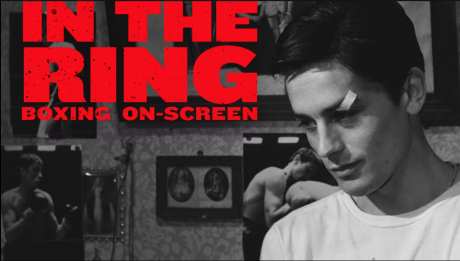
The Criterion Channel is currently running a boxing seriesChampion, The Harder They Fall, Raging Bull, Gentleman Jim, The Set-Up, Requiem For A Heavyweight, Somebody Up There Likes Me, etc. Because of some rights hassle they aren’t including the Rocky films, of which at least two are pretty good.

HE’s top six boxing (or mixed martial arts) movies: (1) Gavin O’Connor‘s Warrior (’11) with Tom Hardy and Joel Edgerton; (2) Leon Gast‘s When We Were Kings (’96); (3) Karyn Kusama‘s Girlfight (’00) with Michelle Rodriguez; (4) Mark Robson and Stanley Kramer‘s Champion (’49) with Kirk Douglas; (5) Robson and Phillip Yordan‘s The Harder They Fall (’56) with Humphrey Bogart, and (6) John Avildsen and Sylvester Stallone‘s Rocky (’76).

If I want a good, fast boxing high I’ll just re-watch the Ali-Foreman “Rumble in the Jungle“…eight rounds, great fight, great finale.

Son of High Tower Drive

“I slept and dreamed that life was beauty / I woke and found that life was duty.” — Ellen Sturgis Hooper, from a book of poems called “The Dial,”

12 and 1/2 years ago I misattributed that line to David Mamet, who had used it for a Hill Street Blues episode called “Wasted Weekend.” I repeated the error in a 7.11.18 riff called “High Tower Drive.” So now we have it straight.

I first heard this line during the original broadcast of this episode on 1.13.87. The guy who said the line was Dennis Franz‘s Norman Buntz, and I’ve never forgotten it.

I was watching Steven Bochco‘s fabled series on a 21″ cable-connected color TV. I was living in a cool little pre-war studio on High Tower Drive, a few hundred yards from the Hollywood Bowl and just down the street from Elliott Gould‘s deco-moderne, elevator-accessible Long Goodbye apartment.

Reanimator‘s Jeffrey Coombs lived in the same complex.

I was working for Cannon Films publicity at the time, writing press kits. My future wife Maggie and I had either just returned from Paris or were planning a trip there. We got married the following October, and Jett came along the following June.

Don’t Mess With These Hombres

So Gina Prince Bythewood‘s The Woman King (Sony, 9.16) is a female Black Panther except fact-based (no super powers) and righteously anti-imperialist.

Viola Davis plays General Nanisca of the Dahomey Amazons, an all-female warrior unit in the Kingdom of Dahomey. Thuso Mbedu plays Nani, an ambitious recruit.

The film depicts how they “fought enemies who violated their honor, enslaved their people, and threatened to destroy everything they have lived for.”

The Story of The Fearless Women“: “From the 18th century to late 19th century, there existed a formidable army of all-female warriors in Dahomey in the present-day Republic of Benin.

“They were called the Mino (our Mothers) or Ahosi (king’s wives) while European observers called them the Dahomey Amazons due to their similarity with the Amazons of the Greek mythology.”

The Dora Milaje in Black Panther (women who serve as special forces for the fictional African nation of Wakanda) was loosely on the Dahomey Amazons.

Grappling With “Amsterdam” Trailer

Superficial reaction to trailer for David O. Russell’s Amsterdam: This is a manic, half-truthful 1930s yarn — a weaving of fact and fiction that seems, at first glance, both intricate and confusing. Amsterdam is a kind of farcical crime comedy about three close friends — a pair of ex-soldiers played by Christian Twitchy-Face Bale and John David Washington, and an ex-nurse portrayed by Margot Robbie –— “who find themselves at the center of one of the most shocking secret plots in American history.” Except nobody wants to mention what the “secret plot” might be vaguely related to.

Slightly deeper analysis: I’ve watched the trailer three times, and all I can say is that Amsterdam feels to me like a hot mess. Whatever it’s actually about, Russell is (a) determined to hide the pertinent plot details, and (b) seems to have committed himself to a hyper hellzapoppin’ that involves juggling several plot threads and several characters. Has Russell bitten off more than he could chew? No idea but the trailer suggests that. It’s going to be fast and eccentric and mannered and wacky. Crazy plot, several affected characters, antsy energy and I swear to God I’ve NO FUCKING IDEA what it’s actually about.

Emmanuel Lubezski‘s warm, amber-brownish cinematography strikes me as pretty (it reminds me of Milos Forman‘s Ragtime) but a tad affected. I’m intrigued, of course, and obviously the dynamite cast will generate all kinds of pleasant distractions. (Talented people always do.) But it doesn’t feel right. Bo honest — the trailer is confusing.

What’s up with Chris Rock acting alarmed about a white guy corpse in a coffin without a top? What’s the issue? No clue. We have three woke musketeers (Bale, Robbie, Washington), fast friends whose history goes back to WWI…friends to the end in the midst of an almost totally segregated society of the 1930s, having formed a “pact” (committed to what or in search of what?).

Is the drop-dead beautiful Robbie sexual with either of them or both or none? Is there a little bit of Lubitsch’s Design for Living going on here, or not at all?

Frizzy-haired Bale says, “Do me a favor…try to be optimistic.” Okay, but optimistic about what? When Robbie says “Amsterdam,” it means what? Obviously not the Dutch city. Manhattan used to be called Amsterdam in the early days of this country, but what did it signify in the 1930s?

The trio is falsely accused of murdering somebody — the same friend of Robert DeNiro’s who was iced after witnessing something horrible. “Cuckoo”? All I know is that the trailer made me feel as if bees were buzzing around inside my head.

Question: Is this in fact the second film in which Bale has to find his false eye on the floor? A Reddit guy says the first time this happened was in The Big Short

Always Hated This Scene

The vulnerable-golden-hero mythology in The Natural is like maple syrup, so thick and gloopy it damn nears smothers everything. And I’m saying this as a devoted admirer of Field of Dreams. I want to see the hero prevail as much as the next guy, but not in fantasyland — his/her struggle has to happen in a shifty, scrappy, serious adult world. And I hate it when when grossly sentimental films of this sort push every button they can think of.

When Roy Hobbs (Robert Redford) broke his Wonderboy bat, when the chubby bat boy gave him a newbie, when the camera saw that his abdomen was bleeding, I said to myself “this is bullshit.” When Roy slams the game-winning homer into the ballpark lights and triggers a fireworks show with lightning bolts crackling in the night sky and that triumphant bullshit Randy Newman music filling the soundtrack, I was disgusted. I was saying to myself “my God, I thought Barry Levinson was the Diner guy, but he’s made a whorish, shameless, audience-pandering piece of crap.”

I was astonished by the reactions when I first saw The Natural 39 years ago. I said to friends “you bought into this shit? The modest, all-American innocent good guy…a masculine angel from the heartland…plus the film is a total perversion of the 1952 Bernard Malamud novel.” Ten years later Forrest Gump came along and touched the hearts of this same hokey crowd.

I appreciated The Natural, but the old Paul Douglas baseball comedy, Angels in the Outfield, touched me in a more genuine place.

Keep in mind that while The Natural was popular, it wasn’t a massive hit. It cost $28 million to shoot, and earned a relatively modest $48 million.

The original theatrical version ran 138 minutes. I never saw Levinson’s 144-minute “Director’s Cut.” Did anyone? Was it significantly better?

Read more

Without Defending Haggis

We’ve all read about director-screenwriter Paul Haggis (Crash, In The Valley of Elah) having been detained by Italian authorities pending an investigation into sexual assault.

Haggis has a sexual history that I won’t get into, but according to a posting by Variety‘s Naman Ramachandran and K.J. Yossman, the accuser’s story is looking a bit dicey. The initial accusation and house-arrest got the headlines, but this refuting or questioning of the accuser’s account isn’t going to going to attract as much attention.

Haggis’ lawyer Michele Laforgia to The Associated Press: Haggis “remains in Italy while prosecutors decide whether to pursue their investigation into claims that he allegedly had sex with a woman” — British, 28 years old — “without her consent over two days.”

Read more

Near-Great Films That Crashed and Burned in Third Act

I can’t recall if I’ve tried to launch a thread along these lines within, say, the last five or so years, but last night I was re-reading a 12.15.05 HE review of Terrence Malick‘s The New World, and I guess I’d forgotten how amazed and delighted I was with this film until the last 30% or 35%, when it betrays the audience and dies on its own vine.

I’ve pasted half of the review below, but please forward any significant films that seemed, in your judgment, to be unfolding wondrously or delightfully or thrillingly until the final act or the second half…looking good, feeling right…oh, no…wait, whoa, what’s happening?

Here’s half of my review: Much of Terrence Malick’s The New World (New Line, 12.25) is masterful, and I’m not just blah-blahing. It’s sensually mesmerizing and caressed with my idea of real genius. It is also, commercially speaking, a kind of kamikaze film, in part because of a certain call made by Malick regarding the love-story plotline.

We’re ten days from its Christmas Day opening and if I know anything, The New World is fixin’ to die. Plus there’s no critics-group awards to sustain interest among the cinefiles or any hope of above-the-line Oscar nominations in January. But forget all of this because The New World should absolutely be seen.
 
It’s the kind of half-great movie that is more than worth the ride because of it has so many wondrous elements. The photography and textures and aromas are nearly all, and for a while they’re nearly enough.  The New World may leave you feeling betrayed, but you won’t feel undernourished.
 Endings are everything, and the final third of this film (lasting roughly 40 minutes) doesn’t make it at all. Because Malick, gifted but mule stubborn, is off in his own realm, and the task of supplying a story that you and your friends might want to see isn’t worth his heavy-cat consideration.
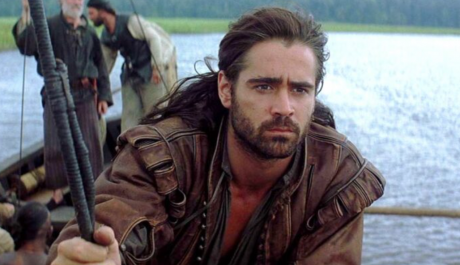
The New World‘s drawn-out, epilogue-like final act is, in fact, an example of abrupt story betrayal and audience abandonment. It should be picked over in filmmaking classes at USC and NYU in years to come as a lesson in what a director looking to survive in the world of commercial filmmaking should never ever do.


A few weeks ago The New World producer Sarah Green told The New York Times that “first and foremost we’ve created a love story.”

This is unmistakably true for the first 100 or so minutes, and in a near-revolutionary sense.  The legendary, historically fanciful saga of British explorer John Smith (Colin Farrell) and the teenaged Pocahantas (Q’orianka Kilcher) in early 1660s Virginia feels vital and pulsing and re-imagined as a gentle culture-clash love story…largely non-verbal, visually haunting…primal atmosphere seeping out of every frame.
 
Green also told the Times, “We’re definitely not doing a historical piece. We try to set it properly…we try to give that background and that feeling, but we focus on the love story.”

As far as the last act is concerned, that’s a distortion.  The Farrell-Kilcher love story is totally abandoned (and in a very brusque and alienating way at that) and the film pretty much sticks to the historically accepted story of Pocahantas’ life for the last third — marriage to a wealthy English tobacco grower named John Rolfe (Christian Bale), bearing a child, travelling to England to meet the King and Queen, and an early death.  The failure of The New World ending is entirely due to the fact that this final section plays like a postscript.

But during those first two thirds, The New World is a truly rare animal and movie like no other…a feast of intuitive wow-level naturalism that feels as fresh and vitally alive as newly-sprouted flora.  This is the forest primeval, all right…the native Americans (“naturals”) and English settlers eyeballing each other amid the murmuring pines and hemlocks and low-lying marshlands, and then prodding, spearing, shooting and finally accepting each other in an evolving, step-by-step cultural passion play.

I’ve respected Terrence Malick as a genius all of my filmgoing life. I knew that before but I was reminded once again when I sat down with this film in late November. And I’m truly glad to live in a world that gives up a Malick film every five or six years.

Read more

Another Drug Deal Gone Bad

I’ve known a few lower-level drug dealers in my time, and apart from the idiots who got high on their own supply, my general impression was that most of them just wanted to do business with a minimum of drama. They were careful and at times a bit paranoid, but only because they feared dealing with immature fools who might rat them out to narcs.

I’m no expert on the drug-dealing world, but I’ve never once heard of anyone on the verge of a big buy trying to rip off the buyer, like this pool-room scene in Carlito’s Way or the famous chainsaw motel scene in Scarface.

The bottom line (and we all know this) is that director Brian DePalma always cared more about delivering his big, carefully choreographed set pieces with knockout camera moves than he did about capturing realistic situations and characters that you can recognize and believe in. But that’s the DePalma tradeoff. You’ll never buy a lot of the stuff that happens in his films, partly because they all seem to happen inside some kind of odd, unreal membrane, but when the big set pieces happen you’ll be wowed.

Allow Your Kids To Get Bruised

Jordan Peterson to parents [3:32]: “You have to understand that you’re a danger to your children no matter what. You can let them go out into the world and be hurt, or [like your mostly boomer and older GenX parents of Millennials] you can over-protect them and hurt them that way. That’s your choice — to allow your children to become competent and courageous, or you can make them safe. But you can’t make them safe because life isn’t safe. So if you sacrifice their courage and confidence on the altar of safety then you disarm them completely, and all they can do is pray to be protected.”

I wasn’t over-protected by my parents, or at least not in the Millennial way. I definitely encountered a lot of bruising, withering judgments from “friends” and teachers, not to mention the bumps and slapdowns any younger person gets from the general rough and tumble.

I definitely felt scolded and over-policed by my parents, but that’s a different thing. There was definitely too much “no, no, no, no” throughout my childhood — “You’re being bad again,” “Didn’t I tell you not to do that?” and so on. By the time I was 14 or 15 my general feeling was that life in the New Jersey suburbs — the day-to-day boredom, regimentation, challenges, cruelties, limitations, humiliations and horrible social pressures from the guys I hung out with and, obliquely, from the women I wanted to get to know — I felt that life as a 15 year-old really sucks, and it took me a long time to climb out of that.

But by the time I was 20 or 21 I had been toughened, so to speak, and able to handle random blows and traumas (like getting tossed into a podunk Southern jail for two days over a suspicion of murder). For all the anguish and misery that I went through in my tweener and teen years, at least I didn’t turn out like a fucking Millennial, whining about needing my safe spaces and taking offense at almost everything and cancelling people who don’t walk the walk in the right way.

Read more

Buzzed Over Movies

Between 15 and 20 years ago (or possibly even in the Reel.com or Mr. Showbiz era of the late ’90s and very early aughts), I distinctly recall suggesting that a drinking talk show — one in which the host and guests would sip whatever and get faintly bombed as the show progressed — would be a lot of fun, and that someone should do it.

This, to me, is what defines Bill Maher’s “Club Random” podcasts — Maher and his guests getting slightly ripped or “happy” and therefore talking with less restraint or inhibition than on a straight talk show.

I’m presuming that are other such podcasts; I just don’t know any off the top of my head.

What I was talking about a couple of decades ago, actually, was a movie discussion talk show with mixed drinks. That, I swear, would be something to follow.

The problem, of course, is that the vast majority of your Rotten Tomatoes or Metacritic members wouldn’t have the courage or the character to do this. They’re too cautious, too guarded, too damp-finger-to-the-wind to risk any kind of public inebriation. They know that many if not most Average Joes despise them and that they generally tend to defer to a woke Planet Uranus way of processing not just movies but cultural values, and are afraid of showing their true colors.

I couldn’t do it myself because I don’t drink or get high.

“Thor” 4 Allegedly Blows; Watiti Downgraded

From Scott Mendelson’s 7.5 Forbes review of Taika Watiti‘s Thor: Love and Thunder: “[Pic] tells a tale of a title character who has lost his drive, his purpose and his mojo. Frankly, it shares those core problems and becomes a metaphor for Marvel’s entire ‘Well, what now?’ Phase Four.

“It has the feel of a party that no one wants to be at, or a film that only exists because Marvel needed a safe sequel amid franchise starters, with the head DJ furiously shouting at the guests to dance, laugh and act like they are having a fun time.

“Like X-Men: The Last Stand, Thor 4 attempts to adapt two fan-favorite comic arcs into a single too-short (110 minutes plus credits) feature and gives both short shrift. It mistakes abstract concepts for deep-dive storytelling. It is fatally hobbled by a super heroic lead who has become cringe-inducingly incompetent since his last adventures.

Thor: Love and Thunder is an unnecessary sequel, existing only because its predecessor was unusually well-received even by those who weren’t all-in MCU fans. Like too many of the most recent MCU projects, it only exists because Disney can’t afford to stop this train. Christian Bale, Tessa Thompson and Guns and Roses tunes aside, this fourth Thor is a real chore.”