




I must admit that I was impressed by Zohran Mamdani‘s razor-quick mind and general debating skills the other night. He’s obviously going to be the next NYC mayor, but his seemingly pro-Muslim, anti-cop, anti-Jewish agenda…I guess I shouldn’t say stuff like this. Give the guy a chance, right?
But his mayoral administration will probably be, I’m guessing, a little bit like London Breed‘s term as San Francisco mayor (2018 to 2025), and you know how that fucking turned out.
Mamdani wants to make bus service free for hard-working plebes struggling to make ends meet…fine. But you know who’s going to become a permanent fixture on those buses, right? Bums. Smelly, drooling bums.
Tippi Hedren’s characters in The Birds and Marnie have always struck me as curiously prim, overly tidy mannequins. She fit that immaculate, early ‘60s department store window persona — not just conservative, but a bit chilly and brittle.
I’m sorry but you don’t believe for a second that either character has ever been possessed by a single erotic impulse. Alfred Hitchcock was once quoted saying that Hedren “didn’t bring the volcano.” He wasn’t wrong.
Grace Kelly had a similar porcelain quality, but one always sensed an undercurrent of suppressed hunger and passion from her performances.
There’s nothing wrong with inhabiting or conveying a curiously chilly and brittle persona, but if that’s your main game there has to be at least a hint of some range implied.
Try to imagine Hedren as Blanche DuBois — you can’t.
She radiates a certain cool officiousness, a real-estate agent vibe. As such Hedren has reminded me of many women of wealth and assurance that I’ve run into or have known in upscale circles. There’s nothing false or ungenuine about this.
Is the private, off-screen Hedren a woman of kindness, elegance, poise, compassion, etc.? Allegedly so and good for her. She’s lived a good, long, healthy life, and she loves her big cats.
But remember Mitch Brenner mentioning that salacious news item about Melanie Daniels having allegedly taken a nude dip in a large Roman fountain? The instant he brings this up you say to yourself “no way…Melanie Daniels isn’t the type to disrobe in public, drunk or sober, and she never will be.”
And that’s fine. No disapproval — just a statement of fact.
This Indecent Proposal scene was written by Amy Holden Jones, who was around 40 when this not-all-that-great Paramount film was released. But Robert Redford‘s subway car recollection is a wee bit devastating. Because I’ve been there myself.
I’ve lost count of how many brief eyeball romances I’ve had with women on the NYC subway, or on the Boston MTA or the Paris Metro. When I was young or youngish, I mean. Each and every one was at least a little bit heartbreaking.
Loss hurts, and that includes lost opportunity. “Of all words by thought or pen, none so said as ‘it might have been.'”
In the immediate wake of poor Diane Keaton‘s death it would’ve been bad form to share my completely honest view of her interpretation of Louise Bryant in Warren Beatty‘s Reds, but I guess I can share it now.
My view is that Bryant is irritating — during the first hour she’s always seething and pouting — because she’s angry about not being talented enough to measure up to Jack Reed.
A friend said that her resentments weren’t really period-accurate — that Keaton/Bryant’s anger was primarily fed by the fires of 1970s feminism. I agreed but added that early feminism and the suffragette movement and free love were certainly starting to bloom in the early teens — it wasn’t as if there was nothing resembling ’70s feminism going on before World War I.
For six long years I’ve been waiting for the demise of Taika Waititi, or, you know, for his streak to run out of gas. At least that.
And now, to go by the Critical Drinker, it finally has. I’ve been secretly hoping for the Waititi torch to go out since sitting and suffering through JoJo Rabbit, which I called “a stylistic wank-off and about a quarter-inch deep” in September 2019.
Only now can it be told: In my 9.25.19 JoJo Rabbit review I reported that “there was a seasoned industry guy sitting behind me who couldn’t stop laughing, and heartily at that. At one point I half turned in my seat as if to say ‘what the fuck?’, but I didn’t turn all the way around.” That industry guy was no one else but Jeff Sneider.
Eureka! Late last night I watched the first three episodes of Rebecca Miller’s Mr. Scorsese, and I felt so roused and super-engaged I didn’t even notice that episode #3 (which ends with the rightwing hate that greeted The Last Temptation of Christ in ‘88) ended just after 2 am.
We’re all fully familiar with the frenzied, 60-year, up-and-down-but-mostly-up saga of the career of Martin Scorsese, of course, but there’s something primal and alive and almost cleansing in the fissures and textures of Miller’s five-hour doc.
Why did it hold me so? Because it didn’t just feel like Scorsese’s story but my own. At every juncture I was “there” in real time, communing with each and every film — emotionally, instinctually, aesthetically — and I mean going all the way back to Boxcar Bertha, which wasn’t much (after seeing it John Cassavetes gave Scorsese a fatherly hug and said “you’ve just spent a year of your life making a piece of shit”) but at least had one good sex scene.
In a phrase Mr. Scorsese is really great stuff. First-rate, up close and searingly personal. It reminds you that Scorsese led a very anxious and shadowed and haunted life for at least his first half-century on the planet. No bowl of cherries, no walk in the park.
I’m thinking now of an on–camera Paul Schrader quote about how Travis Bickle, the proverbial Underground Man, was speaking to “no one” in the early ‘70s…the isolation was all but total back then. Now almost the same kind of guy is online, and he is legion…the solo Underground Man thing has become an online community…the “Internet Man”.
Please re-read Pauline Kael’s 2.9.76 New Yorker review of Taxi Driver.
Friendo: “The persistent sneers of dismissal that now frequently greet Pauline’s name are one more sign that 2025 film culture has lost its marbles.”
Being a highly skilled thesp, Robert DeNiro has always been able to play mellow or solemn or soft-spoken. He’s performed in this vein more often than not.
But except for five low-key, major-value performances — his Vito Corleone in The Godfather, Part II, Jack Walsh in Midnight Run (full of inner conflict, regret about past mistakes), the inwardly chilly, mostly pragmatic Neil MacAuley in Heat, timid Chicago cop Wayne Dobie in Mad Dog and Glory, and that super-moderate, restrained, gentle-feeling performance that he gave in Nancy Meyers’ The Intern — DeNiro has generally failed to make truly vivid impressions unless he’s played characters with some kind of manic vibe or a violent impulse thing or, you know, a loose screw aspect.
The more “normal”, sensible and schlubby his characters were, the less effective DeNiro has been. The more “ruled by inner demons” they were, the better he was.
Those five perfs aside, DeNiro was born to play edgelords.
Think about it — Johnny Boy in Mean Streets (hyper nutter), Jake LaMotta in Raging Bull (animal), Travis Bickle in Taxi Driver (psycho with a messiah complex), Rupert Pupkin in The King of Comedy (delusional would-be comedian), Satan in Angel Heart, Al Capone in The Untouchables (fiendish, baseball-bat-wielding, Prohibition-era monster), Jimmy Conway in Goodfellas (Brooklyn mob sociopath), Max Cady in Cape Fear (evil psychopathic pervert), Louis Gara in Jackie Brown (stupid lowlife criminal), Jack Byrnes in Meet The Parents (obsessive psycho-dad), Pat Solitano in Silver Linings Playbook (obsessive Philadelphia Eagles gambling junkie), Frank Sheeran in The Irishman (contract killer).
These twelve performances are where the DeNiro gold is…twelve edgelords…twelve sociopaths or obsessives…twelve lit fuses.
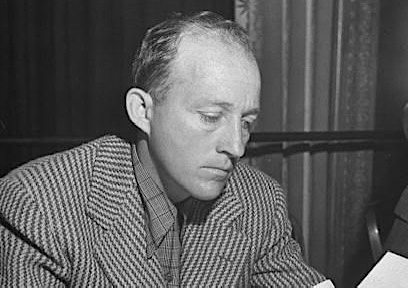
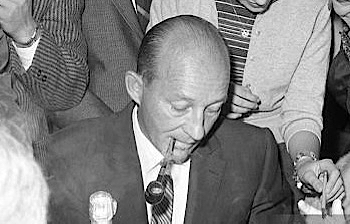
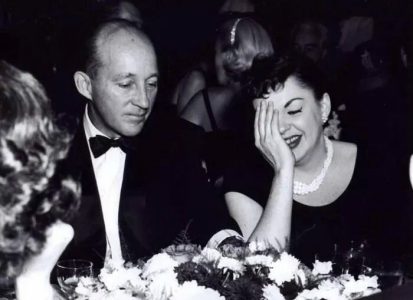
Luca Guadagnino‘s exceedingly thin thatch looks naturally pleasing and fine all around, but Bing
Crosby‘s mostly hairless crown always looked like a bad idea. Surely Crosby knew that and yet he rarely wore a rug. Why was that?
With all due respect, I really, really don’t want to watch a film about George Clooney withering away from the plague condition known in certain circles as “Al Z. Heimer”.
Ditto Annette Bening, playing Clooney’s wife who arranges, at Clooney’s earnest request, to send him off to the next world.
First, a Clooney-type guy would never be married to a woman who’s more or less his age. (He and Bening are both in their mid 60s.) A Clooney-type guy would have tied the knot with…I don’t know, some kind of slender, 20-years-younger, dark-haired, uptown fox.
Second, I might accept or find some way to tolerate Clooney arranging for Bening to buy the farm, but not the other way around…please! Bening has played several morose, beaten-up characters over the last couple of decades, but Clooney is too slender and vital…too much the bon vivant smoothie. He’s Jay Kelly!
Third and finally, this Paul Weitz project is obviously (dare I say nakedly ambitious?) awards bait.
I don’t want Clooney or Bening to die. I want them to…I don’t know, fall into an adventure of some kind. Drive down to Central America and then Venezuela out of boredom and maybe get involved in the drug trade for extra cash. Okay, I’ll accept an accidental death (eaten by a shark?) but no Keverkorian action.
Even the matinee-handsome JFK, arguably the most attractive Oval Office resident in U.S. history…even JFK was impressionistically presented as some kind of hulking Quasimodo figure for a 1962 Time magazine cover. The painter was Pietro Annigoni.
Anyone can look diminished or even grotesque if captured by the wrong painter or snapped from the wrong angle.
I’m certainly no Trumpalo admirer or defender but he’s obviously been torpedoed by Time’s photo editors. They wanted him to look like a balding, Porky Piggy, saggy-faced animal and they certainly achieved that result.
With all his dough Trump could have easily taken care of his neck wattle problem. My Esthe Plastika Prague guy could have fixed him right up.


Consider a brief fencing match between HE commenter JHR (J.R. Ewing with an inserted middle initial) and The Living, Breathing Embodiment of Hollywood Elsewhere in this morning’s “Accepting But Mystified” thread, the subject being a friendly, gracious, middle-aged Connecticut woman having never even HEARD of Anora:
HE: “Anora-wise, there are many concentric circles of passion and interest and engagement. The innermost circle is being an Anora devotee who’s seen it two or three times and can even quote dialogue from it. The outermost ring is, at the very least, having heard of its existence and/or its multi-Oscar triumph. To have not even HEARD of 2024’s Best Picture winner is to have no pulse — you are a flatliner.
“John Huston once famously said that all you need is a healthy sense of curiosity in order to live a well-educated life.”
JHR: “None of my friends (seniors, late 60s, retired college+ educated professionals with $) had ever heard of Anora when I pitched it to them, nor do they have any knowledge of the Oscars results.
“I had lunch with seven of them yesterday, I asked if anyone had been watching the MLB playoffs, and none of them had. They pay little attention to sports except for our big time college football team just down the road where most of us attended college.”
HE: “Seven of your senior chums got together for lunch? Seven? Isn’t that a bit crowded? A group of four is more like it, no? Seven is too conversationally competitive.
“Then again why not go bigger? Why not 10 or 12 having lunch at the same coffin-sized table? Hell, make it twenty! Twenty friends sharing a big luxurious lunch together. Think of all the shouting and guffawing…think of all the shrieking, raucous laughter and the tee-hee giggling!”
JHR: “What do my friends do with their leisure time? They read books, they have hobbies like golf, and they travel a lot — Europe, etc. Lifestyles most people would envy. I do all the above, too, but I am the only movie fan in my crowd, and I think that [Anora ignorance] is more common than you may understand, particularly when it comes to Oscar films.
“I can count on three fingers the number of my friends who are current on movies like me, out of a broader circle of about 40 lifelong friends.”
HE: “’40 friends’? That’s too many. Five’ll get you ten 30 or 35 of those 40 are fair-weather types.”
HE: “To live a life without a semi-active or semi-vibrant sense of curiosity is not living. Have your friends ever heard of Socrates? He was a Greek philosopher…oh, wait, have they ever heard of ancient Greece?
“In any event Socrates once wrote that ‘an unexamined life is not worth living.’ Maybe that’s too historical. Let’s try this…have your friends ever heard the expression ‘the lights are on but nobody’s home?’ Have they ever listened to the 1965 Zombies song ‘She’s Not There‘?”