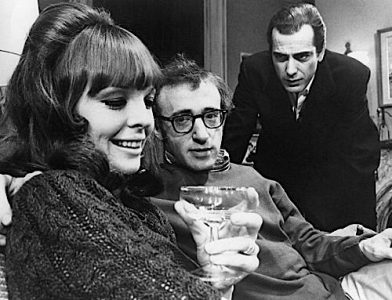
Diane Keaton first began to pop through on stage, initially in Hair (‘68) and then, the following year, as Woody Allen’s object of demure devotion in PlayItAgain, Sam.
Her big-screen dramatic breakthrough, of course, was her pained and conflicted Kay Adams in the first two Godfather films (‘72 and ‘74).
And then, concurrently at first, came the six-film Woody streak — 1972’s celluloid PlayIt Again, Sam (not as good as the play) plus Sleeper (‘73), LoveandDeath (‘75), Annie Hall (’77), Interiors (‘78) and Manhattan (‘79).
LookingforMr. Goodbar (a dud) came out the same year as Hall but nobody much cared.
Then came the final six films of the Keaton peak — Reds (‘81), ShootTheMoon (‘82), TheLittleDrummerGirl (‘84 — abust), Mrs. Soffel (‘84), CrimesoftheHeart (‘86 — an over-acted headache movie), and BabyBoom (‘87).
From ‘88 on Keaton was fine or fun or earnestly mannered or perky or bothered or flaky-eccentric in some agreeable or interesting way, but the heavyweight era was over.
Especially in the matter of Martin Scorsese ‘s TheLastTemptationofChrist (’88), which, for me, delivers the most transportational, mystically-imbued, heart-melting death scene in the history of cinema.
Variety‘s Owen Gleiberman has called Bradley Cooper’s Is This Thing On? (Searchlight, 12.19), which I saw last night at Alice Tully Hall, “a feel-good divorce film”.
That’s a fairly accurate description — it’s a kinder, warmer, far-less-hostile Marriage Story, and the general behavioral drift is amiable. It’s superbly acted all around, but it also has a bit of a flabby belly. For my money it’s way too happy, too mellow, too easygoing, too turn-the other-cheek. No real conflict, no real challenges, no “drama”, no heavy pivots.
Set in the flush environs of Manhattan’s West Village and a handsome home in Westchester County, it’s mainly about Alex and Tess (Will Arnett and Laura Dern), a 40ish husband and wife with two ten-year-old boys (they’re called “Irish twins” due to having been born less than a year apart).
The key situation is that Alex and Tess have decided to call it quits because…well, because they’ve been written this way. The dramatic engine, if you will, is basically about Alex dipping his toe into the waters of Manhattan stand-up comedy as a form of therapy, using his personal saga for material. It’s also about personal renewal.
But the film, directed and co-written by Cooper, is also about gliding and sliding and loping along without pushing any of the usual emotionally fraught buttons.
It’s obvious early on that Cooper has decided to steer clear of Noah Baumbach territory and the usual “we’re getting divorced and boy, it’s pretty hard to do this with kids”, not to mention zero interest in the usual dramatic devices and considerations (lawyers, alimony, etc.)
But mainly it reminded me of a Frenchensemblerelationshipdramedy, except these French films (we’ve all seen dozens over the decades) tend to throw in more in the way of plot surprises, goofball humor, narrative curve balls.
For those who haven’t had the repeated pleasure, French ensemble relationship movies are defined by their complex, character-driven narratives that explore the messy, intertwined lives of a group of friends or family.
I can’t imagine anyone hating or even disliking Is This Thing On?, but it’s not meaty or nervy or risky enough to inspire anything more than easysmiles and shoulder–shrugs.
Is This Thing On? is the kind of film that a loaded, well liked actor-director makes when he has several reasons to be feel pumped and happy about things…a guy who feels abundantly massaged and tickled by his more-or-less fantastic life.
Compare Cooper’s film with another NYC dramedy about four highly perceptive, financially comfortable, middle-aged marrieds coping with divorce — Woody Allen’s HusbandsandWives. That 1992 film has always been aces on its own terms, but compared to Is This Thing On? it’s an earth-shaking Chekhovian classic.
It’s worth noting that Alex and Tess are living flush, bordering-on-financially-opulent lives without the movie even glancing for a split second at where all this money-from-heaven is coming from. (Alex, we’re told, is in “finance”…pretty vague.)
Alex’s reasonably spacious West Village pad rents for, I’m guessing, at least $6K or $7K a month, if not more. Compare Alex’s living situation (he owns a car and probably pays $1500 or $2K a month for the garage-space rental, and yet, early on, he doesn’t want to pay a $15 cover charge at the comedy cellar)…compare Alex’s place to Chris Evans’ appallingly grungy Brooklyn-bro share or even Dakota Johnson’s slightly modest 1 bdr. apartment in Materialists.
If Arnett and Dern were in their early to mid 40s, it would be one thing in terms of the lore of AlanJ. Pakula‘s StartingOver (’79) and middle-aged crazy and hormonal activity and whatnot. But Arnett is 55 and looks it (dyed hair, salt-and-pepper whiskers, not rail thin) and Dern is 58.
That said, I reveled in one of the most vigorous and glorious sexual affairs of my life when I was past my 50s so who am I to talk, right?
Gleiberman: “It’s an observant, bittersweet, and highly watchable movie, yet there’s a softness to it, a slightly pandering quality. It’s like a James L. Brooks movie with hipper camerawork. Arnett, who has the look and demeanor of a less energized Michael Keaton, is a likable enough actor in a rather mopey way, but he’s done a lot of sitcom work and it shows. Arnett seems, in essence, to be playing Alex as a sitcom dad — sharp-tongued yet benign, lost in his daze of self-interest, with an essential quality of harmlessness that’s the opposite of movie-star danger.”
“I’ve been poor my whole life. So were my parents, and their parents before them. It’s like a disease, passing from generation to generation [and] becomes a sickness. That’s what it is.”
I’ve been coping all my life with astrology bigots who’ve been describing me and my flock (Scorpios) as scalpel-tongued, stingingly judgmental, mysterious, secretive and overbearing, not to mention ravenous sex serpents.
To which I’ve been saying for decades, “Okay, sure, here and there… HE would be nothing if not for my surgical precision with words and a natural tendency to cut through the bullshit, but otherwise take your toxic character assassination tropes and shove them up your ass, and sideways at that.”
This is the basis for my empathy with POCs who’ve been fending off crude cultural stereotype descriptions all their lives.
The idea that everyone born each year between October 24th and November 22 shares many of these basic traits is, of course, absurd. Plus whatever I may have been (or have been like) in my youth and early middle age…all that hormonally intense crap sailed a long time ago.
According to The Astrology Bible, Scorpio’s colors are deep red, maroon, black, and brown. Bullshit — all my life I’ve been drawn to deep blues, blacks and grays. I own one deep red garment — a 1950s James Dean Rebel Without A Cause jacket — but I always feel uncomfortable wearing it. Plus I hate maroon, burgundy, or ox-blood colors.
In other words, if Joe Biden had stubbornly refused to drop out and miraculously, incredulously and in a total pig’s eye had beaten Donald Trump in the ’24 election, vp Kamala Harris would have almost certainly become president before the end of Joe’s second term, and probably, to be honest, by early to mid ’26.
He’s obviously not long for this mortal coil.
If Joe had announced he’s a one-term president in, say, early to mid ’23, he could have gone out like a hero. Now his legacy is in the toilet, and it’s not likely to climb out of that porcelain dungeon for decades to come. All because of that pugnacious Irish egotism.
“The same power that burned Hiroshima
Causing three legged babies and death
Shrunk to the size of a nickel
To help him regain his breath
“And I was struck by The Power and The Glory
I was visited by a majestic hymn
Great bolts of lightning lighting up the sky
As the radiation flowed through him”
Mary Bronstein and Rose Byrne’s IfIHadLegsI’dKickYou is about miserable, gloomed-out Linda (Byrne), a weary, facially-lined, stressed-out, emotionally and psychologically gutted therapist and struggling mother of a young ailing daughter (heard but unseen until the very end)…
Call her a 40ish woman under siege…anguished to a fare-thee-well and at her absolute wit’s end…a victim of a tortured, infuriating, harrowing, one-urban-indignity-after-another gauntlet that — surprise! — assaults and saps the life force out of the audience as much as Linda if not more so.
Within the first five minutes I was telling myself “you’re not going to last through this whole thing”. But I decided I would tough it out, dammit, for at least an hour. Which I did. It was agony and I was checking my watch every ten minutes, but I made it!
In JeannetteCatsoulis ‘s N.YTimesreview (10.9), she calls IfIHadLegs “wrenching and at times suffocating”, as well as “a horror movie…a howling maternal desperation spiked with jagged humor”.
There is no humor-spiking at any point in this film, trust me. Zero.
Catsoulis also writes that “some viewers could find the movie’s relentlessness exhausting“.
Famous Steve Martin line in Planes, TrainsandAutomobiles (‘88), spoken to John Candy: “Do ya think so?”
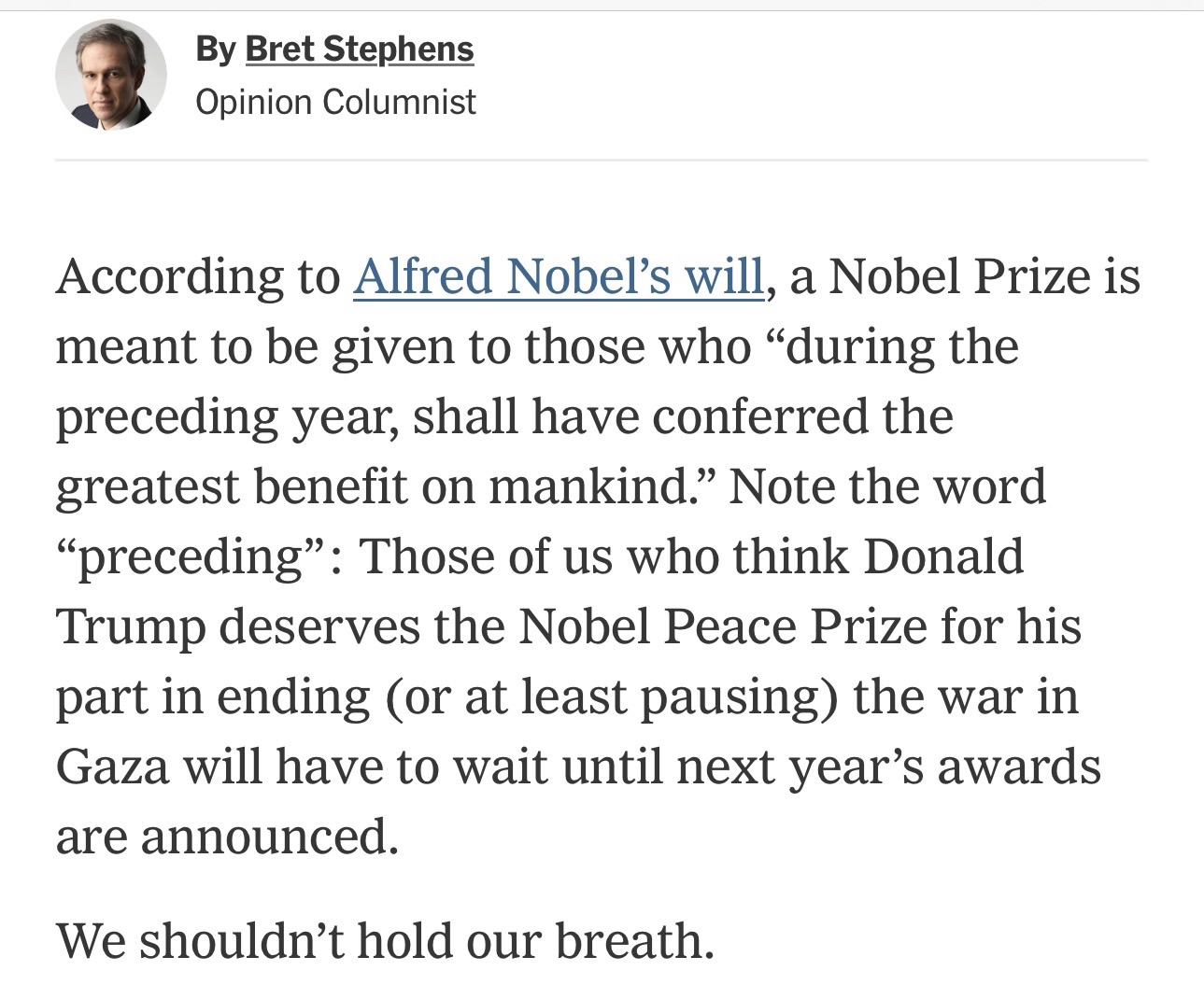
But there doesn’t seem to be any way of weaselling out of giving a certain amount of fair credit to this extremely reprehensible life form for having brought about the Israel-Hamas peace deal. I’d like to come up with a negative take but I can’t find one, dammit.
And if, therefore, Ridley Scott‘s 1979 original had never been made, you know who would make a really great Ripley? If Scott was casting Alien right now, I mean? Chase Infiniti. She’d be perfect.
Ben Foster‘s beefy, balding Tanner Howard knows he’s finished, of course, but in his final moments he feels triumphant all the same. Elated even.
Tanner is brought down by Jeff Bridges‘ Marcus Hamilton, a sweaty, drawlin’, pot-bellied Texas Ranger who’s determined to get revenge for the death of his partner, Gil Birmingham‘s Alberto Parker. And it’s almost as if Tanner is ready for the coup de grace.