Late to Newsom’s “Go To Hell” Speech

Abraham Lincoln on Gen. Ulysses S. Grant following the victorious but costly Battle of Shiloh: “I can’t spare this man — he fights.”

Gavin Newsom‘s anti-Trump rant following the Los Angeles street conflicts was grandstanding…of course it was. Of course he’ll be running for president in ’28…so? Of course the anti-ICE violence was flaming and anarchic and ignoble to a great extent, but then Trump’s federalizing 4000 California National Guard troops, followed by the Pentagon sending in an additional 700 Marines, was pure authoritarian brutalist theatre….needless, unrequired, inflammatory. But who else is standing up to Donald Trump and giving him what for? The HE Newsom haters can’t deny the fact that earlier this week Newsom stood up for state sovereignty and pushed the hell back.

“In five days Gavin Newsom did more practical damage to Trump, and more importantly gave more practical encouragement to Democrats….he did more good than the rest of the zombie Democratic party has done since Joe Biden was elected [in 2020].” — Keith Olbermann on “Newsom’s ‘Eff It’ Moment” (6.12.25). (And yes — Olbermann supplied the Lincoln-Grant anecdote.)

Read more

Insufficient Attention Paid

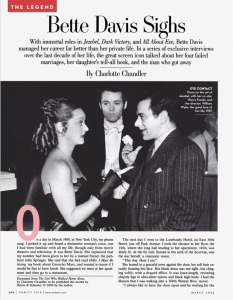
HE to Joe Dante: Thanks for sending this Bette Davis article along, bruh. I had never read this.

William Wyler’s assessment of Davis’s intense personality and what their marriage might have been like was very…uhm, illuminating.

Howard Hughes told her he’d never achieved orgasm before being with her? What shameless bullshit!

Honest confession: I’ve never seen any of Davis’s William Wyler films. Not even Jezebel! I’ve had this idea all my life that she was some kind of Ultimate Super-Bitch, and I never wanted that vibe in my head. Even with Bob Dylan‘s endorsement and all.

The only old Davis films I’ve seen are 20,000 Years in Sing Sing, Elizabeth and Essex with Errol Flynn and The Bride Came C.O.D. with Jimmy Cagney. Plus All About Eve, of course.

I’ve never even seen the one with Paul Henreid when he lights two cigarettes and gives her one of them. What is that, Now, Voyager?

Why did she have an affair with George Brent, of all people? He always struck me as a dullard.

The Girl Who Walked Home Alone” is a fascinating biography title.

“F1” Roars, Rumbles On-Screen in Playa Vista

Elite industry-ites were treated yesterday to a pair of F1 looksees (mid-afternoon and early evening) — Joseph Kosinski, Brad Pitt, Jerry Bruckheimer and Han Zimmer’s high-throttle gutslammer played at IMAX corporate headquarters in Playa Vista, and apparently in whoa-mama full IMAX (1.43:1) from start to finish.

Not even a capsule review, just notes: As you might expect and will be glad to hear confirmed, F1 delivers vise-like dramatic engagement with fully deployed, grade-A acting chops from consummate superstar Brad Pitt, Damson Idris (33 year-old Brit, excellent in the late John Singleton’s Snowfall series), the great Kerry Condon and the always on-target Javier Bardem

All hail the great, still-youngish Kosinski, who has certainly matched and arguably topped his work on Top Gun: Maverick (‘22).

A 156-minute, 21st Century big-boy compadre to John Frankenheimer’s Grand Prix (‘66) and Steve McQueen’s Le Mans (‘71), F1 revs and rouses and vibrates your rib/soul cage, leaving you buzzed, breathless and all the rest of that classic race-car-movie stuff….you know the drill.

Does anyone wipe out a la crash-boom-bang? You don’t want me to answer this so let’s drop it. Okay, someone does but I’m sworn to secrecy, etc.

We all think of howling, high-speed track racing as an individual sport, but the high-torque F1 game can involve a one-team, two-car strategy with one driver running interference for another, depending on the situation. Plus it’s important to know the difference between hot and cold tires, and of course the drivers and pit crew are constantly jabbering while the loudspeaker guy narrates what’s happening…whew.

Pitt’s 50something Sonny Hayes is great company, a great hang. His dominance blends his cocksure Once Upon a Time in Hollywood stunt guy Cliff with, shall we say, a note of approaching-the-big-upward-slope anxiety…fear of not cutting it like he used to.

As hotshot British driver Joshua Pearce, Idris holds his lane and then some, becoming a no-fucking-around foil for Pitt’s old-school Sonny.

And Condon, a deliciously charismatic IRA psychopath in 2023’s In The Land of Saints and Sinners, is the sexy, brainy love interest for Braddy-waddy…a heart-of-gold gal who’s run a few laps around the track herself.

The Hans Zimmer score is said to be double-triple exceptional, especially during the final race when it all happens within a completely visceral, all-alone, immersive, this-is-it, you-are-there fashion without the element of loudspeaker narration or cheering crowds or anything peripheral.…

That’s enough for now. There’s a big all-media IMAX screening on Tuesday, 6.24, as well as a smattering of early-bird AMC fan screenings on Monday, 6.23, not to mention more nationwide advance showings on Wednesday, 6.25

Serious Respect for Harris Yulin

In a manner similar to the passing of Aldous Huxley on 11.22.63, the death of formidable character actor Harris Yulin was announced on the same day as the greatly-mourned departure of Brian Wilson.

Yulin is best known for his performance as Miami detective Mel Bernstein in Brian DePalma‘s Scarface (;83)…”fucking punk…can’t shoot a cop!…fuck you!”.

His second and third best film performances were as White House advisor James Cutter in Phillip Noyce‘s Clear and Present Danger (’94) and Marty Heller, the droll, cat-petting boyfriend of Susan Clark‘s cheating wife in Arthur Penn‘s Night Moves (’75). Gene Hackman‘s Harry Moseby to Heller: “Harry thinks if you call him Harry again he’s gonna make you eat that cat.”

When Maggie and I were married (’87 to ’91) we bought a Spanish-styled home at 705 Superba Ave. in Venice. Yulin lived about 150 yards away on a nearby walk street. I’d see him every so often when we’d walk down to Abbot Kinney Blvd.

A fascinating and accomplished actor, Yulin passed yesterday (6.10). He was 88 years old.

Harry Nillson Delivers Best Emotional Surge In “Materialists”

Before last night I hadn’t listened to Harry Nillson‘s “I Guess The Lord Must Live in New York City” in a long, long time. Not on its own terms, I mean.

I’ve long associated the tune with the Midnight Cowboy soundtrack, but the Wiki page for John Schlesinger’s 1969 classic says that Nillson’s song “was written for the film, but not included in it.” Really? Is this a mistake?

Midnight Cowboy opened on 5.29.69. “I Guess The Lord Must Live in New York City” first surfaced on Nillson’s fourth album, “Harry”, which was released in October ’69.

In any event I felt immediately turned on when Nillson’s song punched through about halfway into The Materialists. It felt like a perfect complement to this saga of struggling under-40s dealing with life in an unaffordable city. I bought the tune online and listened to it over and over on the train home. Song’s film doesn’t really try to warm the cockles of your romantic heart, but Nillson’s song does.

“Materialists” Has HE’s Respect, But Schmoes May Not Warm To It

Last night I saw and generally approved of Celine Song‘s Materialists (A24, 6.13), a cleverly written, agreeably performed, better-than-decent romantic drama about a Manhattan matchmaker (Dakota Johnson‘s 35-year-old Lucy) that has been shamefully misdescribed by A24 and certain critics as a romantic comedy.

Materialists is a good, mostly honest, mid-range relationship film about the misery of urban singlehood while struggling under the ghetto terms of a lower-than-six-figure lifestyle.

It’s a respectable attempt to convey how delusional and child-like people are about how attractive they believe themselves to be and what kind of romantic partner they can land. It’s about how love, money and common sense are fairly incompatible these days, and what learning to settle can feel like, and as such is an admirably non-delusional movie for adults.

This in itself makes Materialists much, much better than Song’s Past Lives (’23), which I found mostly tolerable and at the same time infuriating because I believed almost none of it.

The overall tone of Materialists is not really romantic as much as resigned if not verging on semi-bleak, and while a few moments are briefly amusing it’s certainly not played for laughs — it’s a frank look at the business and terms of urban dating these days, and man, I really felt sorry for the principal characters in this film — the relentlessly analytical Lucy; Chris Evans‘ impoverished John, a 37 year-old barely working actor who is not looking at any kind of career turnaround or financial breakthrough but who absolutely loves Lucy without qualification; and Pedro Pascal‘s rich, mature and smoothly mannered Harry Castillo.

Mostly I was saying to myself, “For all the honesty and reality-assessing this film is putting out, I’m really glad to have lived and revelled in a bygone era in which innocently or instinctually falling in love or even lust was something people occasionally succumbed to and just went with…I really lucked out because the joy of getting lost in the delusional joy of primal attraction…that deep-down, seat-of-the-pants feeling seems to have evaporated or fallen by the wayside as dating among the six-figure set in 2025 seems like a fairly miserable ordeal, and at the end of the day nobody seems all that happy, much less satisfied.

Honestly? Because Materialists doesn’t deliver much in the way of spiritual lift or bounce at the end, I don’t think it’s going to be especially popular with the schmoes.

Like A Streetcar named Desire‘s Blanche Dubois, Joe and Jane Popcorn generally don’t want realism but magic. Illusions and escapism will trump harsh realities each and every time.

And yet I respect Song for making the kind of no-bullshit “romantic” film that she has — for playing it fairly straight and not adhering to the usual romcom tropes. In so doing she earns integrity points and then some.

And yet Song does try to romanticize and bliss things out toward the very end, and I didn’t believe this turn in the story at all. But to explain my thinking, I’ll need to spoil things a bit. So from here on SPOILERS will occasionally surface, although I’ll try to stick to generalities.

Situation #1: If a youngish career woman has broken off a relationship with an all-but-penniless actor because she can’t stand the oppression of poverty, how the hell does she manage to change her mind at the end of the film by saying in effect “Okay, poverty is a drag but I guess I can roll with it in the long run”? What ambitious, well-educated woman has ever come to this conclusion?

Situation #2: If an actor hasn’t experienced a semblance of career combustion by age 37, the odds of him suddenly catching on and enjoying a surge of even limited success are astronomically negative.

Situation #3: How many women over the centuries have married wealthy, nice-looking guys that they’re not head-over-heels in love with, but whom they “like” (i.e., are willing to submit to sexually), admire and get along with? I personally love romantic tales in which people get married for love and love alone, but how realistic is that? There has to be some kind of practical hope that things will get better financially.

And what is so terrible about marrying a rich, Pedro Pascal type of guy even if you don’t love him? He’s handsome, kind, considerate, polite and a well-mannered gentleman. A lot of people get married to this or that romantic partner because they “check a lot of boxes”.

Situation #4: Who the hell chooses Iceland as an ideal romantic getaway destination? Fucking Iceland?

Situation #5: Song casts negative aspersions upon one of Lucy’s female clients, a paleface, because she’s mostly interested in finding a white boyfriend or husband. When this is revealed it’s clear that Lucy (i.e., Song) is vaguely appalled or even disgusted. Which is bullshit wokeism.

What’s so awful about a bird of a particular feather wanting to mate with someone from his or her own flock? Song is presumably aware that some POCs prefer the romantic company of men or women from their own tribe. She’s presumably aware that some years ago Denzel Washington stated that he’s uncomfortable kissing white women in his films, and that he prefers hooking up with women of color. And yet whites aren’t allowed to voice similar feelings.

Situation #6: There are two or three interview segments in which Lucy is asking her clients what they’re ideally looking for and the kind of man or woman they don’t want to end up with, and some of their demands and standards are flat-out hilarious.

An attractive 48 year-old guy with nice hair says he only wants women in their late 20s because they’re too immature in their early 20s and they tend to get too desperate in their 30s. Good God!

My favorite is a blonde, twerpy-looking woman who looks mid-40ish and is frankly close to homely…this woman says to Lucy in all sincerity that she’s “a catch”. Is it better for a woman in her appearance class to say “I’m homely and probably too old for most men and therefore no catch”? No — it’s better to have a positive self-image, but my God, this woman is dreaming! If I was in the market and ran into this woman in a bar or at a party, I’d smile and chuckle and politely duck away at the first opportunity.

Situation #7: Lucy has learned that women on the hunt really don’t like shortish guys. They want tall and then some. I’ver been six-foot-plus since I was 13 or 14 so no problems on this end, and I’ve always had broad shoulders which, from a female perspective, is a plus in the same sense of guys preferring women with large breasts.

But guys making themselves taller through surgical measures (like Ronan Farrow reportedly did) is an actual thing in Song’s film, and a certain character admitting toward the end of the film that he added inches to his height through surgery is…well, it’s weird. As in very.

Situation #8: How does a single professional woman afford a nice, reasonably sized Manhattan or Brooklyn apartment on a lousy $80K-per-year salary?

Situation #9: Cave men who hunted with spears and brought home animal meat for the family did not, as a rule, gaze at their wives with tenderness in their eyes, and they sure as shit didn’t slip rings adorned with flower petals upon their wife’s marriage finger. Materialists begins with such a scene, and it really doesn’t work….it immediately throws the film off its tracks and makes you wonder if Song has gone ga-ga.

Friendo: “I think it plays like a good indie film rather than a romcom. It will therefore most likely do indie-film numbers rather than romcom numbers.”

Brian Wilson Is With The Angels

Rather than an attempt a generic career summary + verdict about the heavenly genius of Brian Wilson, whom I briefly encountered in ’74 and then formally interviewed in January ’95 at the Sundance Film Festival, here’s a re-posting of my two best Brian Wilson stories.

But before you read the following, listen to this.

1974: I was living in an upstairs one-bedroom apartment at 948 14th Street in Santa Monica**, doing nothing, working as a tree surgeon…my lost period. (I began my adventure in movie journalism the following year.) Right below me lived a guy named Eddie Roach and his wife Tricia. At the time Eddie was working with the Beach Boys as a kind of staff or “touring” photographer. Dennis Wilson fell by two or three times and hung out a bit, and one time I was part of a small group that played touch football with him at a local high-school field. Dennis mocked me that day for being a bad hiker, which I was.

Anyway it was a cloudy Saturday or Sunday afternoon and I was lounging in my living room when I began to hear someone tooling around on Eddie’s piano. It sounded like the beginnings of a song. It began with a thumping, rolling boogie lead-in, complex and grabby, and then the spirited vocal: “Back home boogie, bong-dee-bong boogie…yay-ee-yahh…back home boogie, bong-dee-bong”…and then he stopped. One of the chords wasn’t quite right so he played a couple of variations over and over, and then began again: “”Back home boogie, bong-dee-bong boogie yay-ee-yahh!” and so on. Then another mistake and another correction.

Then he stopped again and started laughing like a ten year-old drunk on beer: “Hah-hah, heh-heh, heh-hay!” and then right back into the song without losing a beat. It was great stuff. Who is this guy?

I grabbed my cassette recorder and went outside and walked down the steps leading to Eddie’s place, and I laid it down on one of the steps and started recording. I must have captured two or three minutes worth.

Then I decided to knock on Eddie’s door and pretend I needed to borrow a cup of milk or something. I had to know who the piano guy was. Eddie opened the door and I said “hey, man,” and lo and behold in the rear of the living room stood a tall and overweight Brian Wilson.

He was dressed in a red shirt and jeans and white sneakers, and was cranked and excited and talking about how great some idea might be, gesturing with his arms up high. Then he saw me and almost ran over to the doorway. I suddenly knew who it was and it was a huge internal “whoa!” Wilson looked like a wreck. His hair was longish and sort of ratty looking. His unshaven face was the color of Elmer’s Glue-All and his eyes were beet red.

I didn’t mean to disturb the vibe but a look of faint surprise or shock must have crossed my face because Wilson’s expression turned glum. It was like he suddenly said to himself, “Wow, this guy’s some kind of downhead. Everything was cool until he showed up.” Eddie spotted it too and said, “Sorry to disappoint you.” I said everything was cool and retreated back upstairs.

I must have played that cassette tape of Wilson’s song for at least 15 or 20 friends over the next couple of years, and then it was gone. Lost. A shame.

20 years later I interviewed Wilson at the 1994 Sundance Film Festival. The chat happened in a restaurant on Main Street. His fiance Melinda Ledbetter sat beside him. He was there to promote the Don Was documentary I Just Wasn’t Made For These Times, which was all about Brian’s brilliant, tortured journey.

So I mentioned the piano-playing episode and tried to describe the sound of that song, and for whatever reason this injected a look of tension in his eyes. I thought he was just intrigued or concentrating but he was getting upset. I repeated that I loved that half-baked boogie riff and Wilson blurted out “I can’t talk about this or I’ll freak out.” Uhm, you can’t…? “I’ll freak out!” he repeated.

So I told Wilson that I always loved the reverb guitar-and-keyboard intro for ““The Little Girl I Once Once Knew,” and he quickly agreed. (That same year he told a British interviewer that “the intro is the only good part of it.”) I then told Wilson how I once tried to learn to play the intro on keyboard but I couldn’t “hear” the separate harmonized notes in my head.

Wilson responded with disappointment and even a lack of patience — “You couldn’t figure that out?” That’s how geniuses are. When the stars are aligned they can swoop right in and solve any riddle, and if they’re in any kind of mood people who lack their gift can seem…I don’t know, tedious?

After seeing Love & Mercy I decided to buy a few songs from The Beach Boys Today!, which was recorded a little more than a year before Pet Sounds.

Today! is occasionally experimental and in some ways a kind of Pet Sounds forerunner. It contains similar elements — sophisticated off-rhythms and swirling harmonies, a feeling of sadness and vulnerability in the lyrics, that symphonic white soul thing — that Wilson built upon and made into something extra with Pet Sounds.

The track that knocked me out was “Kiss Me Baby.” It’s not so much a love song as a “we almost broke up last night so let’s not get that close to Armageddon again!” song.

The melody is a bit on the plain and familiar side, but the lyrics are so child-like and emotionally arrested…an immature boy-lover recovering from nearly losing his mommy-lover: “Please don’t let me argue any more…I won’t make you worried like before…can’t remember what we fought about…late, late last night we said it was over,” etc.

But when the chorus kicks in the harmonies and the general meltdown sound of this song are just amazing. This was Wilson’s unique realm — he made it sound just so, and with such exquisite balance and texture.

This instrumental track for “Let Him Run Wild” is also interesting for its resemblance to the instrumental Pet Sounds Sessions tracks.

Read more

Something Laid-Back In 1966 Water Supply

Technically Sopwith Camel‘s “Hello Hello” was released in January ’67, but it was written and recorded in ’66 so it’s fair to lump it in with the other two.

There’s something in this trio that feels shared, settled, planted. Not to mention low-key, contented, self-charmed. Obviously not ambitious or anxious; they don’t dig down or reach for anything deep or searing or crash-bang.

Keith’s one-hit wonder is a smooth, schmaltzy thing, and therefore a good contrast with the cool “whoo-whoo” contentment of “Mellow Yellow”. Okay, “Hello Hello” is a little dopey-sounding but I love the lead (only) vocal and the bridge.

What was it about ’66 that fed into this mood? I used to have a thing about being lightly stoned and not seriously ripped. That’s what these songs are about.

Slap-on-the-Wrist Reprimand Would Have Sufficed

It was obviously unwise of ABC News on-air correspondent Terry Moran to have tweeted a widely shared observation about chief White House rattlesnake Stephen Miller. Alas, cowardly ABC execs, fearful of being on the bad side of the Trump administration, have zotzed his ass. They could have suspended him for a month without pay…something like that. But that would’ve required balls.