Please guys…please let me know who dies in F1 (6.27, Warner Bros.). You’ve all presumably seen Grand Prix so you know what happens to Yves Montand’s race-car driver. Death is built into this sport. It constantly hovers.
It can’t be Damson Idris because POCs aren’t allowed to die because the filmmakers would surely be accused and most likely found guilty of racism…they’d be tarred and feathered and run out of town.
So that leaves Pitt, but nobody (with the possible exception of ShiJoli) wants poor Brad to buy the farm so who dies? Surely not Javier Bardem or Kerry Condon.
The all-media screening happens on Tuesday, 6.24, only two days before the first commercial showings on Thursday, 6.26
There’s an earlier screening next week for “special people”.
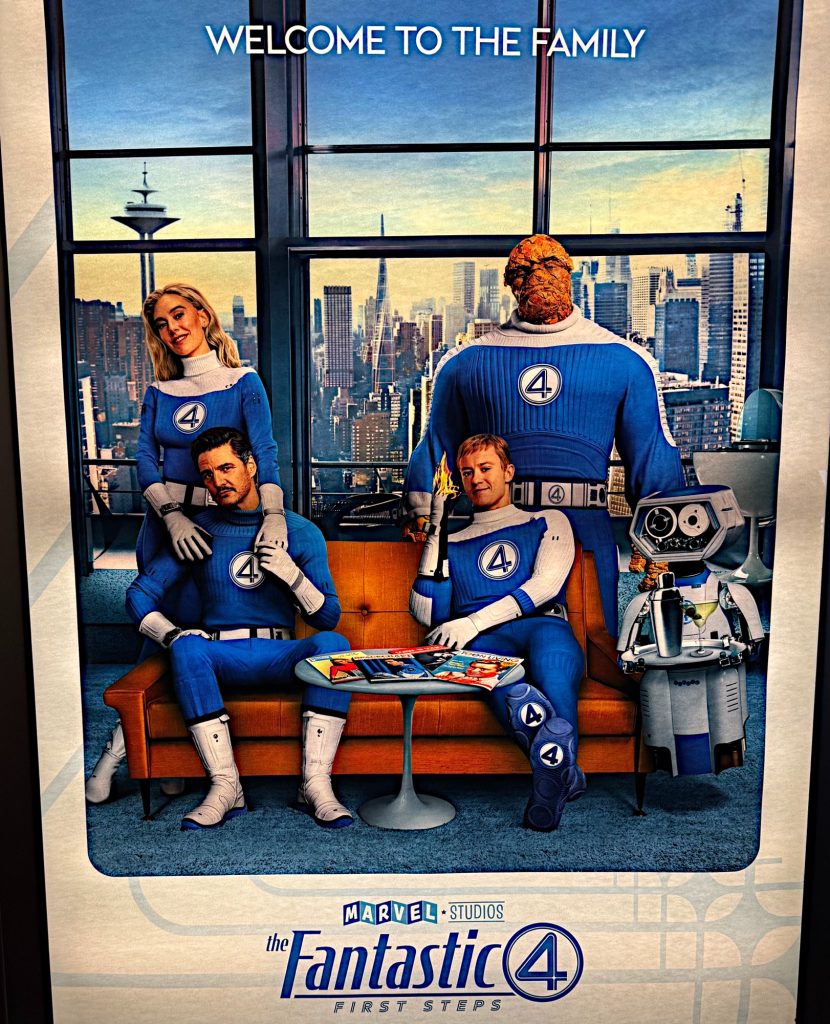
Snapped last night inside the big Danbury AMC, prior to catching Ballerina. Obviously the people behind FantasticFour: FirstSteps (Disney, 7.25) have no shame. Has Pedro Pascal ever said no to anything or anyone? And the gingered Joseph Quinn, who will play the physically dissimilar George Harrison for Sam Mendes later this year…this, ladies and germs, is whoredom personified.
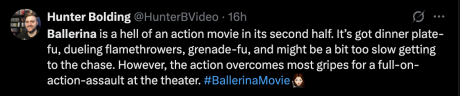
9:15 pm update: I was surprised to discover this evening that a good portion of Len Wiseman’s Ballerinaisactually kick–asserino…enjoyably engaging, I mean, duringthesnowysecondhalf. (The first half is mostly a generic origin story.)
ItakeitbackaboutWisemanbeingan“animal” asBallerinais much betterdirectedthanexpected, effectively shot and oftenwitty(the action choreography rivals the wit of Buster Keaton here and there) andattimesis actually funny — twoorthreetimesIyaw-hawedoutloudandonceIslappedmythighwithenthusiasm.
Ana de Armas isplaying Eve Macarro, a majorbadass, ofcourse, butnotasuperwoman — she’sbelievably vulnerablethroughout andgetssluggedandslammedaroundquiteabit.
John Wick: “Youkilledmydog!” Eve Maccaro: “Youkilledmydaddy!”
There’sanespeciallyfunnybitwhenEveshovesahandgrenadeintoabadguy’smouthandthentrapshimbehindadoorandthen BLAM-SPLATTER-GLOPPITY!!! Bloodandbrainmatterallovertheplace….hair on the walls!!
Ican’tbelieveI’msayingthisbut I had a fairly rousing time duringBallerina‘s secondhour. It’slikeasadisticvideogamewith a wicked sense of humor, made by a team of trulysickfucks withadark–eyed, no-longer-a-spring-chicken humanbeing (deArmasis37) atthecenteroftheaction.
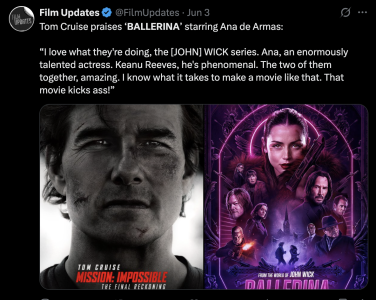
Earlier today: Tom Cruise is not doing Len Wiseman‘s Ballerina (Lionsgate, 6.6) any favors by (heh-heh) praising it.
We know Cruise has chosen his own films very carefully over the last 45 years, and that a John Wick-ian action film by an obvious animal like Weisman…we know that Cruise would never star in a film of this calibre for fear of damaging his brand. [6.3update: Wiseman is not an animal.]
We also know that his praise is generally insincere or at least partial because he’s been (heh-heh) “doing” Ana de Armas over the last few months so c’mon…why say anything about this obviously coarse, low-rent film?
Before yesterday’s Ballerina premiere de Armas called Cruise’s recent public support for the film “unbelievable“….that’s right, it IS unbelievable!
“But you know what, he supports every movie,” de Armas went on. “He really wants the industry and cinema to do well and [get] people going to the theaters. We’re working together, so he got to see Ballerina and he actually really liked it…he loved the John Wicks.”
Bullshit! Wick-y flicks like Ballerina (which I’m actually going to see in a couple of hours) are slick garbage…cancer pills…soul destroyers. C’mon, we know this going in.
…although it wasn’t a major, historical year for movies…certainly not like 1939, 1962, 1971, 1999 and 2007 were.
In my humble opinion, the most loathsome film of 1993 was, is and always will be Chris Columbus‘s Mrs. Doubtfire. Piss on this stupid film forever…soak it in horse urine.
And the finest five films of 1993 were and still are, in this order of enjoyment or admiration, (1) Harold Ramis and Bill Murray‘s Groundhog Day, (2) Jonathan Demme‘s Philadelphia, (3) John McNaughton and Richard Price‘s Mad Dog and Glory (a pair of Bill Murray films among the top three!), (4) Fred Schepisi and John Guare‘s Six Degrees of Separation, and (5) Steven Spielberg‘s Schindler’s List.
#6 through #10: Sydney Pollack‘s The Firm (I’ve watched it at least 10 or 12 times, largely because I love Gene Hackman‘s fundamentally humane performance as Avery Tolar, mitigated by his chuckling, shoulder-shrugging cynicism), Spielberg’s Jurassic Park (two or three viewings), Tony Scott‘s True Romance (minus the ridiculous ending but containing the first great Brad Pitt performance), Martin Scorsese‘s The Age of Innocence (very moving finale), Wolfgang Petersen‘s In The Line of Fire, and Joel Schumacher‘s Falling Down.
Honorable Mentions (in order of preference): Tim Burton‘s The Nightmare Before Xmas, Neil Jordan‘s The Crying Game, Robert DeNiro and Chaz Palminteri‘s A Bronx Tale, Jim Sheridan‘s In The Name of the Father, Robert Altman‘s Short Cuts (Julianne Moore‘s red public hair), Adrian Lyne‘s Indecent Proposal, Brian DePalma‘s Carlito’s Way, Rob Reiner‘s Sleepless in Seattle, AlanJ. Pakula‘s The Pelican Brief, Jon Amiel‘s Sommersby, George Sluizer‘s remake of The Vanishing (which wimpishly changed the ending of Sluizer’s 19888 original), Clint Eastwood‘s A Perfect World, Bruce Joel Rubin‘s My Life (Michael Keaton with cancer), Ivan Reitman‘s Dave, James Ivory‘s The Remains of the Day (15).
Not So Hot: Renny Harlin‘s Cliffhanger, John McTiernan‘s Last Action Hero.
When I consider the finest feature films made without a musical score, I always think first of Call Northside 777 (’48), Henry Hathaway‘s Chicago-based, docu-styled procedural about a tough reporter (James Stewart) gradually managing to prove that an alleged cop killer (Richard Conte) is innocent.
But of course, Call Northside 777has a musical score, composed and conducted by Alfred Newman. But only at the very beginning (opening credits…crashing, bombastic) and at the tail end (final 10 seconds, if that). Otherwise this 111-minute film (the first 9 minutes are annoying to sit through) is completely without musical enhancement, and all the better for it. Get rid of Newman’s intrusion and those first nine minutes and it’s perfect.
Among the better known music-free features: Sidney Lumet‘s Dog Day Afternoon, Alfred Hitchcock‘s The Birds (not even opening- or closing-credit music), Joel and Ethan Coen‘s No Country For Old Men, Ingmar Bergman‘s The Silence, Hitchcock’s Rope. Lumet’s Network has no “score” but aside from the characters and dialogue the first element you always think of is that brassy Howard Beale Show fanfare.
No, I’m not suggesting that when your dog or cat succumbs to the inevitable (and I’ve been through the deaths of one Siamese cat from pancreatic cancer and two from related illnesses so don’t tell me)…I’m not suggesting that you go right out and get a puppy or a kitten. That would be heartless. Pet owners need to commune with the spirit of the dear and departed and settle into a reasonable period of mourning (a month or two) before bringing home a newbie. I get the idea of respectful meditation.
But I do think it’s necessary to affirm the continuum and embrace the natural life process by embracing youth and vitality and the prospect of a new beginning…a full dog life of 12 to 15 years, or a cat life of 15 to 20. You can’t let yourself sink into mourning and never climb out of that hole. I’ve known people who’ve done this (they feel that their deceased pet, residing in pet heaven, will feel terribly hurt and rejected if he/she is replaced…they feel that keeping the flame burning for the dear and departed is all), and it’s really not right. After 30 or 60 days you have to stand up, brush yourself off and move on….start all over again.
There have been several…okay, a few good films about death, and the best of them (like that closing statement at the ass-end of Barry Lyndon) impart a sense of absolute cosmic indifference about what happens or doesn’t happen when the lights go out. But that is almost unheard of.
Most of the good ones impart a sense of tranquility or acceptance about what’s to come**, which is what most of us go to films about death to receive.
They usually do this by selling the idea of structure and continuity. They persuade that despite the universe being run on cold chance and mathematical indifference, each life has a particular task or fulfillment that needs to happen, and that by satisfying this requirement some connection to a grand scheme is revealed.
You can call this a delusional wish-fulfillment scenario (and I won’t argue about that), but certain films have sold this idea in a way that simultaneously gives you the chills but also settles you down and makes you feel okay.
Here’s a list containing some top achievers in this realm. I’m not going to explain why they’re successful in conveying the above except to underline that it’s not just me talking here — these movies definitely impart a sense of benevolent order and a belief that the end of a life on the planet earth is but a passage into something else. I’ve listed them in order of preference, or by the standard of emotional persuasion.
1. Martin Scorsese‘s The Last Temptation of Christ (final scene on the cross).
2. Stephen Frears‘ The Hit (“Death be not proud”).
3. Brian Desmond Hurst‘s A Christmas Carol.
4. Warren Beatty and Buck Henry‘s Heaven Can Wait (“You’re the quarterback”).
5. Henry King‘s Carousel (based on Ferenc Molnar‘s Lilliom).
6. Tim Burton‘s Beetlejuice (“That’s death for the dead!”).
6. Michael Powell‘s A Matter Of Life And Death, a.k.a. Stairway To Heaven.
7. Albert Brooks‘ Defending Your Life.
I’m also giving a pat on the back to that old Twilight Zone episode called “Nothing in the Dark,” in which Robert Redford played a kind of angel of death in the guise of a wounded policeman.
For me the four worst films about death — the shallowest and most phony-manipulative and least reassuring — are (a) Ghost, (b) Flatliners, (c) What Dreams May Come and (d) Death Becomes Her. These are movies that pull down their pants and play cheap little games for the enjoyment of those in the audience who are scared shitless of death and need to fantasize or joke about it in order to allay their fears.
And the single most terrifying film about death as envisioned by fundamentalist Christian wackos is Michael Tolkin‘s The Rapture. One look at that film and you’ll be able to at least consider the idea that hardcore Christians have taken something naturally serene and peaceful and created a terrifying new-age mythology that would give Satan pause.
Update: I don’t know why I forgot to mention Wim Wenders ‘ Wings of Desire. Because it’s doesn’t fit the mold, I suppose. Because it’s not about passage from life to death as much as passage from death to life, being about an angel (Bruno Ganz) who falls in love with a circus girl (Solveig Dommartin) and wants to be mortal so he can experience love and pain and all the rest of it.
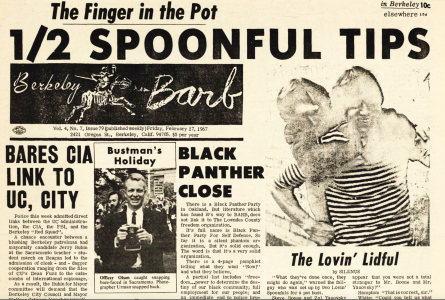
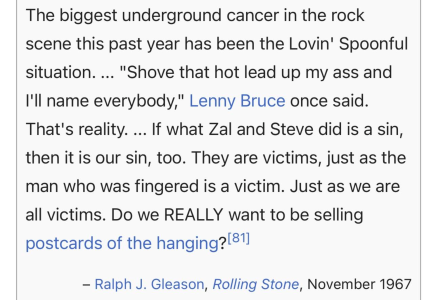
Decades before woke-driven cancellations became all the rage in the late 20teens, arguably the first-ever cultural death sentence was handed down to a pair of big-time musicians — Lovin’ Spoonful singer, guitarist and co-founder Zal Yanovsky (12.19.44 – 12.13.02) and bassist Steve Boone.
Fearful of being deported to Canada, Yanovsky (and also Boone apparently) folded under pressure from narcs and fingered Loughborough.
This led to Loughborough and certain members of the underground press ranting and raving over the uncoolness of such a move. It pretty much destroyed the group’s reputation.
I’m toying with an idea of seeing Michelangelo Antonioni‘s L’Eclisse at the Walter Reade this coming Saturday (6.6) at 8:30 pm. I’ve seen it on Bluray three or four times, but never in a theatre. I know that the projected Walter Reade version can’t hope to match the Bluray quality, but I’m thinking it might be….I don’t know, haunting in a way I’ve never quite experienced.
There’s a social distancing element in this 1962 film that gets me every time. We’re all living in an L’Eclisse-like world…a numbing, vaguely gnawing sense of isolation…an atmosphere of existential stillness and solitude…a portrait of angst and alienation. The 1962 classic is the climax of Antonioni’s alienation trilogy, the first two films being L’Avventura and La Notte.
Consider this excellent assessment of the film and the Bluray by The Dissolve‘s Scott Tobias.
In his My Voyage to Italy documentary, Martin Scorsese describes how this film haunted and inspired him as a young moviegoer, noting it seemed to him a “step forward in storytelling” and “felt less like a story and more like a poem”. He adds that the ending is “a frightening way to end a film…but at the time it also felt liberating. The final seven minutes of Eclipse suggested to us that the possibilities in cinema were absolutely limitless”.
Alfred Hitchcock‘s Jamaica Inn (’39), his last British-produced film before moving to Hollywood, was shot in immaculate black-and-white by Bernard Knowles (The39Steps, Sabotage, SecretAgent) and Harry Stradling (Suspicion, The Picture of Dorian Gray, A Streetcar Named Desire).
And yet this colorized version isn’t altogether offensive. Because it has a certain beige-like, semi-drained quality — colors that appear soft, honey-toned, tea-tinted, amber-ish — that was not uncommon in the early days of color. Or so I’ve been told.
A few years ago I was invited to share a nice West L.A. dinner with former Boston Herald critic James Verniere, whom I’ve known since the early ’80s. Verniere suggested Guido’s, an old-school haunt favored by over-50 types…the burnished spirit of Frank Sinatra and Don Rickles, red-leather booths, old-guy waiters, delicious garlic bread, etc. I loved it, and now I’m sad to report that Guido’s is history, finito, kaput, shuttered, dead as a doornail.
Verniere: “Yeah, I’m very upset. Guido’s was my hangout. I brought all my friends there. We had a farewell dinner a couple of weeks ago with my son and his girlfriend and several others. I got take-out on the last night it was open. Sad.”