
Herewith are four reviews of four Terrence Malick films that opened between 2012 and 2019 — To The Wonder, Knight of Cups, Song to Song and A Hidden Life. Plus a July 2012 essay about how Malick’s enablers have done him no favors. It’s quite a saga.
1. “Malick Enablers Doing Him No Favors,” posted on 7.14.12:
According to a 7.10 posting by terrencemalick.org’s Paul Maher. Jr., Terrence Malick‘s To The Wonder — an Oklahoma-set romantic drama he shot in late 2010 with Ben Affleck, Rachel McAdams, Olga Kurylenko, Rachel Weisz, Jessica Chastain and Javier Bardem — has scared away distributors, who have presumedly been shown the film in its entirety or in portions.
In other words, the same buyers who were going “what the eff is this?” after seeing The Tree of Life are again throwing up their hands and muttering to themselves in the general vein of “here we go again,” “life is too short,” “Jesus H. Christ” and “not me, babe.”
As Maher puts it, “Possibly the difficulties of The Tree of Life and its polarizing effect on the box office may be an underlying issue.”
Maher’s source is either closely affiliated with or working for Film Nation, and of the female persuasion. I’m listening to Maher because he’s a Malick fan, and like any webmaster running a kiss-ass website his default tendency is to praise Malick and otherwise shine favorable lights upon his accomplishments.
Not only is To The Wonder not being released in this country any time soon (although it may open in Europe a few months hence), but “the possibility of any trailer or publicity-related material coming out in the fall of 2012 is still vague, possibly unlikely,” Maher writes. He also reports that “when asked for any kind of teaser image or information, I was told [by my FilmNation source] that there still is nothing in the public domain that they could release.”
What the eff does that mean?
Malick taking two years to cut a film together is SOP (Days of Heaven was in the editing room from ’76 to ’78) but he can’t be moved to even issue a selection of still images from To The Wonder? Or allow a one-sheet to be created? Or put together an appetite-whetting teaser of some kind?
I’ve been saying for years that Malick needs a tough ballsy producer who isn’t afraid to get in his face and read him the riot act and goad him into adhering to a semi-reasonable editing deadline (i.e., between a year and eighteen months, let’s say) and perhaps even influence the shaping of his films in a way that won’t flagrantly agitate the thick-fingered vulgarians in the distribution business, at least to the point that they’ll make semi-serious bids on his finished films, which has not apparently happened on To The Wonder, per Maher.
The fact that To The Wonder is allegedly homeless nearly two years after principal photography is the proof in the pudding. Terrence Malick needs an intervention. He needs a strong partner and counsel who can save him from himself.
More to the point, the indications are overwhelming that Sarah Green and Nick Gonda, Malick’s producers on (a) To The Wonder, (b) the film formerly known as Lawless and (c) Knight of Cups, do not believe in the tough-love approach used by Bert Schneider, Malick’s producer on Days of Heaven. Malick’s endless dithering and dilly-dallying indicates that Green and Gonda are not forcing the issue and have decided to serve him in a passive, whatever-Terry-wants sort of way. They appear to be hand-holders, friends, toadies, facilitators, go-alongers, enablers.
In a 5.18.12 interview with The Hollywood Reporter‘s Pamela McClintock, FilmNation’s Glen Basner said he “hit it off with Sarah Green and Nick Gonda, two of the producers of [To The Wonder]. We were very like-minded people and maintained a friendly relationship. They were looking to make his next movie more outside the system, allowing Terry to have a process that works best for him, and we devised a way to finance the movie that met all of those needs.”
In other words, Malick says “jump” and Green and Gonda say “how high?”
In a 12.13.11 obit, I praised Schneider as “the last producer to semi-successfully micro-manage Terrence Malick and keep him from his own self-indulgent tendencies by somehow persuading him to keep Days of Heaven down to a managable 94 minutes.
“After Heaven, Malick never made a lean, well-honed movie again. When he returned to filmmaking in the ’90s it was all pretty photography and leaves and alligators and voice-over and scrapping dialogue and expansive running times. Mister, we could use a man like Bert Schneider again.
“An avowed leftie, Schneider was a renowned, down-to-business producer of late 1960s and ’70s classics such as Easy Rider (which Schneider reportedly honed into shape when director Dennis Hopper‘s undisciplined editing became problematic), Five Easy Pieces and The Last Picture Show. He also won a Best Documentary Oscar in 1975 for Hearts and Minds.
In his landmark book ‘Easy Riders, Raging Bulls,’ Peter Biskind called Schneider ‘the eminence grise of the American New Wave.’
From Wiki’s account of the post-production of Days of Heaven:
“After the production finished principal photography in ’76, the editing process took over two years to complete. Malick had a difficult time shaping the film and getting the pieces to go together. Schneider reportedly showed some footage to director Richard Brooks, who was considering Gere for a role in Looking for Mr. Goodbar.
“According to Schneider, the editing for Days of Heaven took so long that ‘Brooks cast Gere, shot, edited and released Looking for Mr. Goodbar while Malick was still editing.’
“A breakthrough came when Malick experimented with voice-overs from Linda Manz‘s character, similar to what he had done with Sissy Spacek in Badlands. According to editor Billy Weber, Malick jettisoned much of the film’s dialogue, replacing it with Manz’s voice-over, which served as an oblique commentary on the story.
“After a year, Malick had to call the actors to Los Angeles to shoot inserts of shots that were necessary but had not been filmed in Alberta. The finished film thus includes close-ups of Shephard that were shot under a freeway overpass. The underwater shot of Gere’s falling face down into the river was shot in a large aquarium in Sissy Spacek‘s living room.
“Meanwhile, Schneider was upset with Malick. He had confronted Malick numerous times about missed deadlines and broken promises. Due to further cost overruns, he had to ask Paramount for more money, which he preferred not to do.”
As I wrote on 6.29.11, “Terrence Malick’s 10.1.96 draft of The Thin Red Line was tight and true and straight to the point, and it had no alligators sinking into swamps or shots of tree branches or pretty leaves or that South Sea native AWOL section or any of that languid and meditative ‘why is there such strife in our hearts?’ stuff.” Why didn’t Malick shoot the down-to-it script he wrote? I wouldn’t know, but one reason, surely, is that his producers didn’t say boo when he decided to throw in the alligators and the tree leaves and all but jettison Adrien Brody‘s performance.
Terrence Malick, in short, has been enabled to death by his friends and supporters. He’s a fascinating, highly educated sea captain-auteur who has always followed his heart and has taken his three-masted schooner around the world to exotic and illuminating destinations, but he has almost always been impractical and unreasonable, and he’s been known to allow his canvas sails to become ripped and tattered. He’s almost like a kindly, gentle-mannered version of Captain Ahab — a man tasked with delivering oil to the people of New Bedford but who has other business to take care of. That “other business” has resulted in some great filmmaking, but Malick needs a strong Starbuck in his life.
2. “If You Do The Work,” posted on 3.1.13:
I’ve been dumping on Terrence Malick‘s To The Wonder (Magnolia, 4.12) since catching it at last September’s Toronto Film Festival, but I want to emphasize something important. The trick is to see this thing without expecting it to act like a movie. Because it works if you submit to it like you would an art gallery experience. It’s passive and reflective like the sea on a windless day, but in a Moby-Dick sort of way: “The sea where each man, as in a mirror, finds himself.”
“Malick gives you so little to grapple with (at least in terms of a fleshed-out narrative and that thing we’ve all encountered from time to time called ‘speech’ or ‘talking’ or whatever form of oral communication you prefer) that” — like staring at paintings or sculptures in a museum — “it’s pretty much your responsibility to make something out of To The Wonder‘s 112 minutes,” I wrote on 9.11.12.
“It’s all about you taking a journey of your own devising in the same way we all take short little trips with this or that object d’art, whereever we might happen to find one. The film is mesmerizing to look at but mostly it just lies there. Well, no, it doesn’t ‘lie there’ but it just kind of swirls around and flakes out on its own dime. Run with it or don’t (and 97% of the people out there aren’t going to even watch this thing, much less take the journey) but ‘it’s up to you,’ as the Moody Blues once sang.
“To The Wonder doesn’t precisely fart in your face. It leads you rather to wonder what the air might be like if you’ve just cut one in a shopping mall and there’s someone right behind you, downwind. That’s obviously a gross and infantile thing to think about, but To The Wonder frees you to go into such realms if you want. It’s your deal, man. Be an adult or a child or a 12 year-old or a buffalo. Or a mosquito buzzing around a buffalo. Naah, that’s dull. Be a buffalo and sniff the air as Rachel McAdams walks by! You can go anywhere, be anything. Which is liberating in a sense, but if you can’t or won’t take the trip you’ll just get up and leave or take a nap or throw something at the screen. Or get up and leave and head for the nearest mall.
“I went with it. I wasn’t bored. Well, at least not for the first hour. I knew what I’d be getting into and I basically roamed around in my head as I was led and lulled along by Emmanuel Lubezki‘s images and as I contemplated the narcotized blankness coming out of Ben Affleck‘s ‘Neil’ character, who is more or less based on Malick. Or would be based on Malick if Malick had the balls to make a film about himself, which he doesn’t. If Malick had faced himself and made a film about his own solitude and obstinacy and persistence…wow! That would have been something.
“But Malick is a hider, a coward, a wuss. He used to be the guy who was up to something mystical and probing and mysterious. Now he tosses lettuce leaves in the air and leaves you to put them all into a bowl as you chop the celery and the carrots and the tomatoes and decide upon the dressing.
To The Wonder “is a wispy, ethereal thing composed of flaky intimations and whispers and Lubezki’s wondrous cinematography with maybe 20 or 25 lines of dialogue, if that. It’s basically The Tree of Life 2: Oklahoma Depression. It’s Malick sitting next to you and gently whispering in your ear, ‘You wanna leave? Go ahead. Go on, it’s okay, I don’t care…do what you want. But you can also stay.'”
3. “King of Flakes,” posted on 2.8.16:
Last night I sat through Terrence Malick‘s Knight of Cups (Broad Green, 3.4) at Santa Barbara’s Arlington theatre. I didn’t watch or absorb it — I “sat through” it like I was waiting for an overdue bus. Knight of Cups flatlines. It’s about warm climes and lassitude and a truly profound lack of effort by everyone involved, particularly Malick.
What a tragic journey he’s been on since The Tree of Life. Self-wanking, anal-cavity-residing…the man is so lost it looks like home to him. And it is a kind of home, I gather, that producers Sarah Green and Nicholas Gonda have seemingly created for the guy. Take your time, Terry…take your sweet-ass time.
Once regarded as one of Hollywood’s great auteurist kings (Badlands, Days of Heaven) but more recently renowned for his whispery mood-trip films (a tendency that began with The Thin Red Line) and for indulging in meditative reveries to a point that the reveries become the whole effing movie, Malick, free to operate within his own cloistered realm, lives to “paint” and dither and go all doodly-doo and mystical and digressive when the mood strikes, which is apparently all the time when he’s shooting.
40 years ago I was convinced Malick had seen the burning bush and was passing along God’s-eye visions, and now look at him.
Knight of Cups is To The Wonder Goes To Southern California with a lot more dough and a greater variety of hot women. They could re-title it Terrence Malick’s Wide, Wide World of Delectable, Half-Dressed, Model-Thin Fuck Bunnies. They could also retitle it Terrence Malick’s Beaches…boy, does he love going to the beach at magic hour and sloshing barefoot through the tides! This meandering dream-doze movie is all beaches, all deserts, all swanky condos and office towers and absurdly arrogant McMansions. And all half-captured moods and fall-away moments and conversational snippets.
Who am I? Why am I so damn lazy? Can I do anything besides wander around and gaze at stuff? Either Bale is on Percocets or I need to drop a Percocet the next time I watch this.
The most attention-getting thing that happens in Knight of Cups is a semi-serious earthquake (lasts around ten seconds, feels like a 7 or 7.5). The second is a home robbery by a couple of shaved-head Latinos. The third is a nude blonde standing on an outdoor balcony (possibly Bale’s). The rest is spiritual ether and vapor and kicking sand.
If you know Los Angeles you know Malick is hitting all the visually arresting spots within a 100-mile range — the beaches, downtown LA, Venice, Malibu, LAX, Palm Springs, Joshua Tree rock formations, etc. Malick’s Los Angeles is like Woody Allen‘s Manhattan — all affluent eye candy. I’ve wandered around all these places and looked up at the sky and have channelled the same moods and thoughts that Christian Bale‘s Rick seems to be having. I’ve done it over and over. I know this realm up and down.
Rick is described in the press notes, by the way, as a screenwriter but is way too successful with too many beautiful women to be a scribbler — only directors get laid by women this hot.
I was sitting in my Arlington seat and going “you aren’t worth my time, man …you’ve got lots of money and opportunity and apparently some degree of talent, and all you can do is wander around and fuck beautiful women and feel kind of depressed about it. Asshole!”
Actual dialogue from Knight of Cups, passed along by Brian Dennehy‘s character, i.e., Bale’s dad: “Once there was a young prince whose father, the king of the East, sent him down into Egypt to find a pearl. But when the prince arrived, the people poured him a cup. Drinking it, he forgot he was the son of a king, forgot about the pearl and fell into a deep sleep. And now the prince has all but destroyed his once-potent mystique because the spirits have told him to deliver movies that operate as purely visual dream fugues, which has led to an abandonment of any semblance of conventional narrative. This plus his now-customary prolonged fiddle-faddling in post-production has fed a growing notion that the prince is a gifted but flaky eccentric — i.e., Mr. Wackadoodle.”
Yes, I’m lying — Dennehy’s story ends with the words “deep sleep.”
Press notes: “Rick (Bale) is a comedy writer” — this gloomy Gus is a comedy writer? — “living in present-day Santa Monica. He longs for something other, something beyond the life he knows, without knowing quite what it is, or how to go about finding it. He doesn’t know which way to turn. The death of his brother, Billy, hangs over him like a shadow. His father, Joseph (Dennehy), bears a sense of guilt for Billy’s death. A surviving brother, Barry (Wes Bentley), down on his luck, has just moved to LA from where they grew up, in Missouri. Rick has been helping him get back on his feet.
“Rick seeks distraction in the company of women: Della (Imogen Poots); Nancy (Cate Blanchett), a physician he was once married to; a model named Helen (Freida Pinto); Elizabeth (Natalie Portman), a woman he made pregnant; a stripper named Karen (Teresa Palmer); and Isabel (Isabel Lucas), a young woman who helps him to see his way forward.” Trust me, nobody in this film “sees his way forward” or backward or sideways. This is a film about what it’s like to camp in a narrow passage where the moon don’t shine.
I became gradually infuriated by Emmanuel Lubezski‘s choice of lenses, most of which deliver a kind of horizontal taffy-pull effect. [See clip above.] Knight of Cups‘s aspect ratio is 2.39:1, but the images reminded me of a certain setting on my GoPro camera — you can choose one that makes objects look a teeny bit wider than their actual, natural proportions. It’s not 100% consistent but you can definitely see this effect in the above Blanchett footage, and it began to drive me nuts after 20 minutes or so.
After an hour or so I hit the bathroom and then decided to take a break in the lobby. I noticed six or seven departures — couples, singles, three girls, an older couple. Knight of Cups is a kind of career-suicide movie. You could call it a kind of ISIS recruitment film.
4. “Spirit of Early ’60s Antonioni Meets Rooney Mara’s Belly Button,” posted on 3.11.17:
Terrence Malick‘s Song to Song (Broad Green, 3.17) is more or less the same movie as To The Wonder and Knight of Cups — another meandering, whispering voice-over, passively erotic Emmanuel Lubezski tour de bullshit. All directors make the same movie over and over, of course, and this, ladies and germs, is another return to Malickland…what he does, what he can’t help recreating and re-exploring. I just sat there in my seat at Broad Green headquarters, slumped and going with it and silently muttering to myself, “Yuhp, same arty twaddle.”
The older Malick gets (he’s 73), the foxier and more barefoot and twirling the girls in his movies get, and this one, a kind of Austin music industry La Ronde, has a fair amount of fucking going on. And that’s fine with me. No “sex scenes”, per se, but a lot of navel-worshipping, I can tell you. Rooney Mara‘s, I mean.
At first Song to Song is about a romantic-erotic triangle between Faye (Mara), a guitarist and band member who doesn’t seem to care about music as much as whom she’s erotically entwined with at the moment, and two attractive music industry guys — Ryan Gosling‘s BV, a songwriter-performer, and Michael Fassbender‘s Cook, a rich music mogul. I can tell you Mara is definitely the focus of the high-hard-one action or, as Quentin Tarantino put it in Reservoir Dogs, “Dick dick dick dick dick dick dick dick dick dick dick dick dick.”
Mara seems to start off with Cook and then move on to BV. Or was it Gosling first and then Fassbender and then a really hot French girl (Berenice Marlohe) and then back to Gosling at the very end with a Cook pit-stop or two? There’s never much sense of linear time progression in a Malick film so you never really know, but she definitely does them all.
There’s something vaguely L’Avventura-esque about Song to Song…pretty, wealthy people lost in impulsive erotica, embracing momentary pleasure, bopping from song to song, bod to bod, orgasm to orgasm, and all the while trying to make things happen within the Austin music scene. But falling away from the eternal. And in too many cold-vibe high-rises and high-end homes and not enough folksy abodes with yards and dogs and oak trees. But with lots of rivers to gaze at.
I’m simplify as best I can recall: (a) Mara definitely becomes intimate with Gosling, Fassbender and Marlohe; (b) Gosling has affairs with Mara, Lykke Li and Cate Blanchett‘s Amanda, and (c) Fassbender — the most louche and perverse of the three — has it off with Mara, Natalie Portman‘s Rhonda (a waitress whose mother is played by Holly Hunter) and two prostitutes (or a prostitute plus Portman) during a menage a trois scene.
I was kinda hoping Fassbender would hook up with Blanchett and Marlohe, but it never happened. I was actually imagining a menage a trois between Fassbender, Gosling and Mara — that would have been something — or a menage a quatre between these three and Blanchett, even. Or a menage a cinque between these four and Val Kilmer, who is seen performing in a couple of brief outdoor-concert scenes but never gets to fuck anyone.
I do know…er, believe that Mara and Gosling end up together at the very end of Song to Song, tired of all the endless-erotic-intrigue bullshit and both having decided to live a simpler life in some backwater setting. The funniest part of the finale (for me) is that Gosling has apparently abandoned the music industry to work as an oil-derrick roughneck…yup, the exact same job that Jack Nicholson‘s Bobby Dupea, who came from a snobbish musical family, had in the beginning of Five Easy Pieces. Dupea was running away from himself in that scenario, but Gosling is cleansing himself by returning to basics…go figure.
Song To Song felt to me like an erotic paean to Mara, or Mara as she was five years ago — not long after The Girl With The Dragon Tattoo and a year before Spike Jonze‘s Her, Steven Soderbergh‘s Side Effects and David Lowery‘s Ain’t Them Bodies Saints, two or three years before Todd Haynes‘ Carol and definitely three years before her all-but-meaningless supporting role in Lion.
My favorite Song to Song performer was rock priestess and poet Patti Smith, who has maybe two scenees, one of which features an anecdotal improv about her own life (i.e., how she still wears her wedding ring despite her late husband, Fred “Sonic” Smith, having passed in ’94). I was more interested in and taken by Smith than anyone or anything else in this thing, including Mara’s navel.
From John DeFore’s Hollywood Reporter review: “Ersatz local color aside, suffice to say that Song to Song is not designed to win back onetime admirers who felt Malick’s To the Wonder and Knight of Cups drowned in their own navels.”
5. “Malick’s ‘Hidden Life’: Same Old Wackadoodle,” posted on 5.19.19:
Everyone understands that Terrence Malick‘s A Hidden Life (formerly Radegund) is about Franz Jagerstatter (August Diehl), the Austrian farmer and martyr who was executed for refusing to fight for the Germans during World War II, and who was declared a saint 12 years ago by Pope Benedict.
Since it finished shooting in August 2016, or over the last two and two-thirds years, the expectation has been that A Hidden Life would mark Malick’s return to at least a semblance of traditional narrative preparation (i.e., a movie based on a carefully composed screenplay and featuring actors speaking pre-written dialogue).
Two years ago Malick acknowledged that until recently he’d been “working without a script“, but that with Radegund he’d “repented the idea.” Malick’s last semi-traditional film was The New World (’05), and before that The Thin Red Line (’99).
The idea, then, was that A Hidden Life might represent a return to a kind of filmmaking that Malick hadn’t really embraced since these two films (respectively 14 and 20 years old), or perhaps even since Days of Heaven, which was shot 43 years ago and released in the fall of ’78.
Because over the last decade (and I wish this were not so) Malick has made and released four story-less, mapped-out but improvised dandelion-fuzz movies — The Tree of Life (’10), To The Wonder (’12), Knight of Cups (’15) and Song to Song (’17).
The fact that The Tree of Life was widely regarded as the first and best of Malick’s dandelion fuzzies (the principal traits being a meditative, interior-dreamscape current plus whispered narration, no “dialogue” to speak of and Emmanuel Lubezski cinematography that captures the wondrous natural beauty of God’s kingdom)…the fact that The Tree of Life was the finest of these doesn’t change what it basically is.
So does A Hidden Life represent a return to the old days? Does it deliver an actual story with, like, a beginning, middle and end? Does it offer a semblance of character construction and narrative tension with some kind of skillfully assembled climax, etc.?
No, it doesn’t. For Malick has gone back to the same old dandelion well with a generous lathering of Austrian countryside visuals plus some World War II period trimmings.
Malick’s script tells Jagerstatter’s story but obliquely, as you might expect. The big dramatic turns are “there”, sort of, but are dramatically muted or side-stepped for the most part. I hate to repeat myself but A Hidden Life generally embodies a meditative, interior-dreamscape approach plus whispered narration, some “dialogue” but most of it spoken softly or muttered plus a lot of non-verbal conveyances, and some truly wonderful eye-bath cinematography by Jörg Widmer that more than lives up to Lubezski standards.
The thing you get over and over from the film is how magnificent the locations look — mainly the small Italian mountain village of Sappada plus Brixen and South Tyrol, also in northern Italy.
Otherwise it’s basically a moody, meditative swoon flick about a highly moral, independent-minded Austrian who couldn’t find a way to fight for the German army in good conscience, and who stuck to his guns and paid the price for that.
Does the film suggest there are strong similarities between Nazi suspicion of Jews and other races and the racial hate that Donald Trump has been spewing since at least ’15? Yeah, it does, and that’s a good thing to chew on.
Can A Hidden Life be called a “good” film, as in professionally and passionately prepared with an adult-level story that pays off to some extent? Yeah, I suppose so. I’m certainly not calling it a bad or sloppy or indifferently made film, but it’s still the same old dandelion cereal that Malick has been serving since the dawn of the Obama administration.
The version I saw this morning allegedly ran 2 hours and 53 minutes. I didn’t time it myself, although I should have.
Consider this closing paragraph from Todd McCarthy‘s 5.19 Hollywood Reporter review:
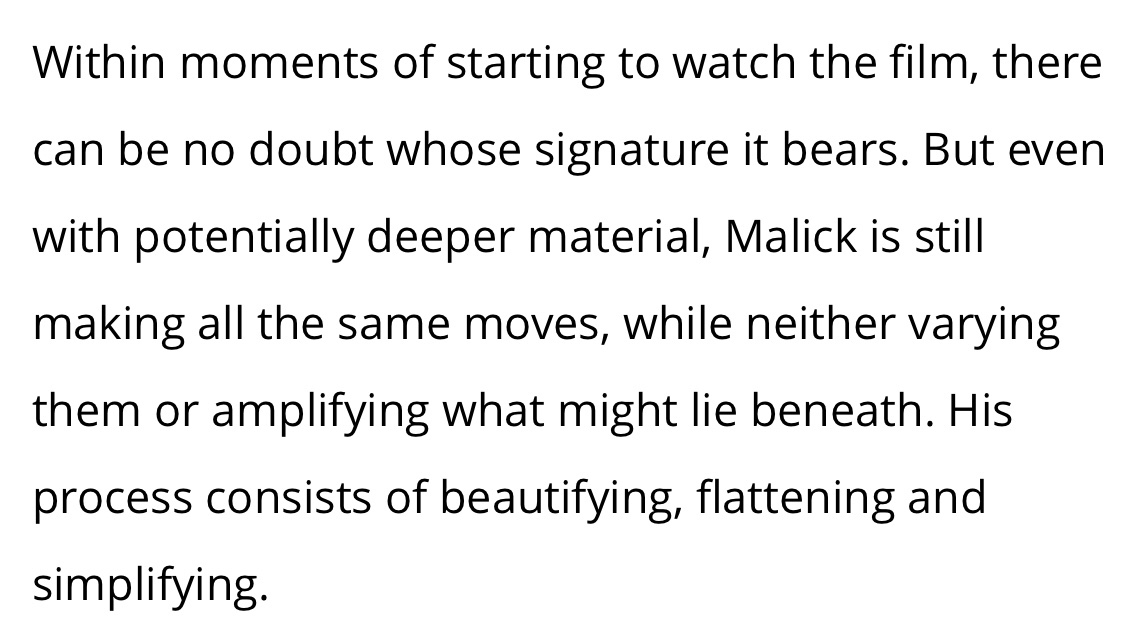
And this description from The Guardian‘s Peter Bradshaw:
“The style that Malick has found for this subject is very much the same as ever: an overpowering sense of being ecstatically, epiphanically in the present moment, an ambient feeling of exaltation created by a montage of camera shots swooning, swooping and looming around the characters who appear often to be lost in thought, to an orchestral or organ accompaniment, and a murmured voiceover narration of the characters’ intimate but distinctly abstract feelings and memories.” In short, another one of Malick’s “signature symphonies.”