
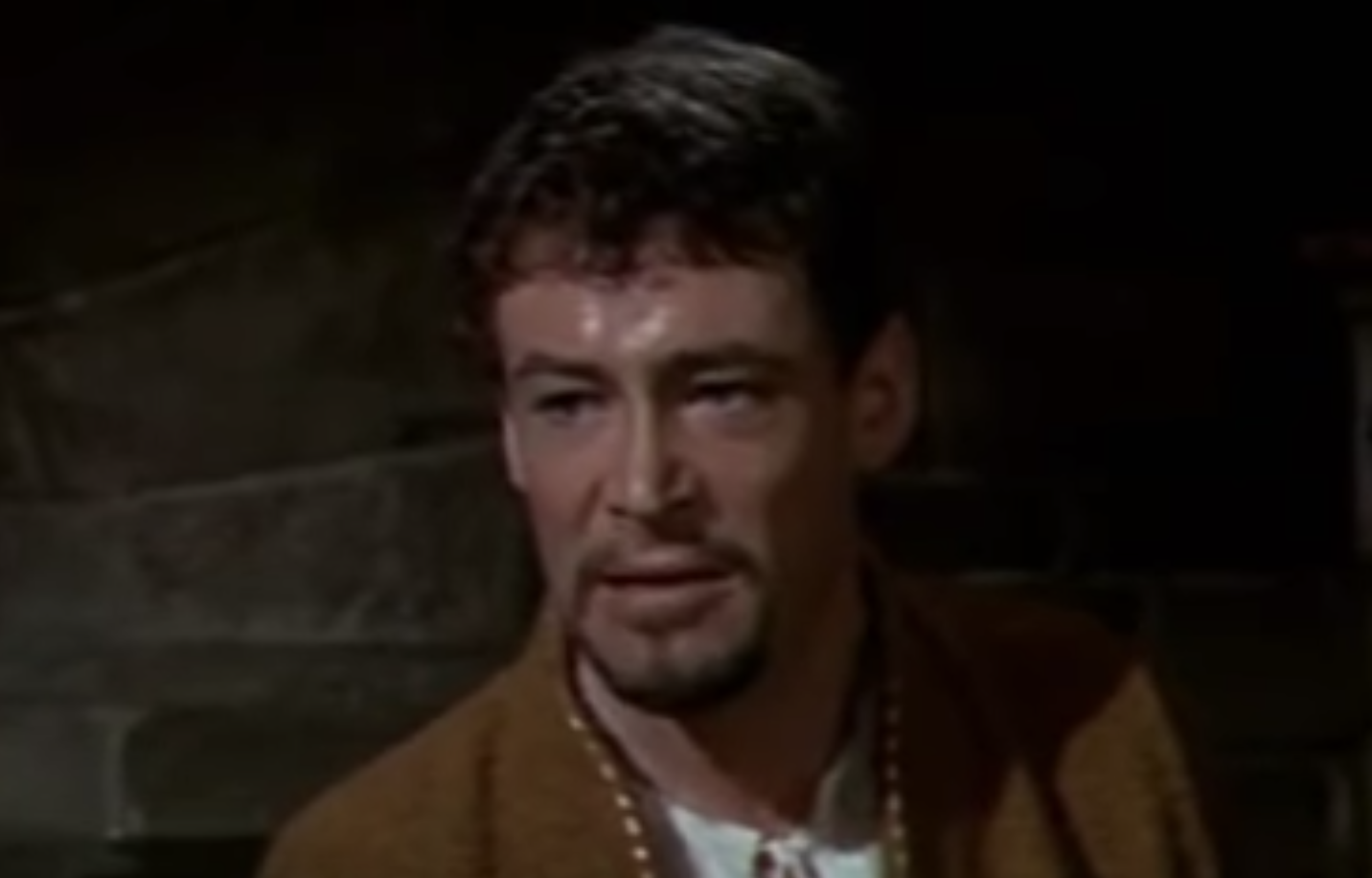
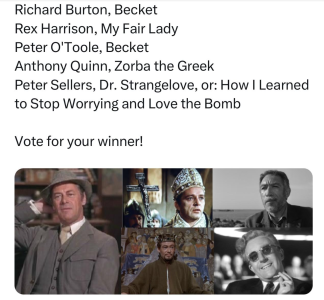
The long-established consensus is that Rex’s Harrison Best Actor Oscar for his My Fair Lady performance was, at the very least, unfortunate, particularly given the calibre of the competition — Peter O’Toole and Richard Burton in Becket, Anthony Quinn in Zorba the Greek, and Peter Sellers‘ trio of performances in Dr. Strangelove, or: How I Learned to Stop Worrying and Love the Bomb.
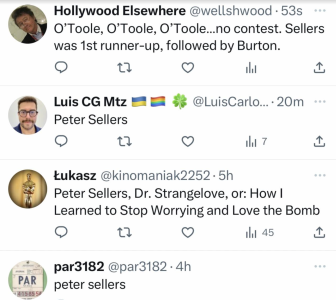
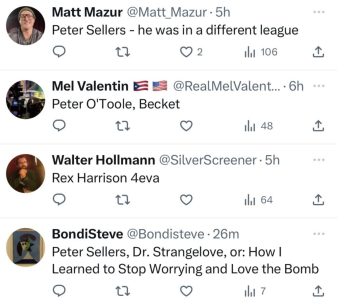
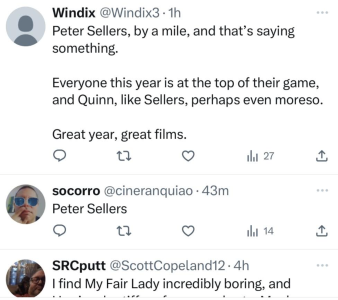
Since Becket hit Bluray in ’08 pretty much everyone began to realize that King Henry II was O’Toole’s peak role and performance, and that he was robbed. Or so it seemed. But according to a Twitter poll I saw this morning, the majority feels it was actually Sellers who was robbed.
My presumption is that everyone has seen Strangelove and relatively few have seen Becket, and there’s not much more to it than that.
Sellers is magnificent in Strangelove, of course, but playing three characters in a single film (if not for an injury he would’ve played four) is essentially a stunt, plus none of his characters really touch bottom, especially given the film’s darkly satiric tone. They were three sketch bits, not full-bodied performances.
And of course, strategy-wise Paramount publicists pushing O’Toole and Burton equally was all but guaranteed to result in a loss for both.
“When Becket Was A Thing,” posted on 12.29.18:
As far as I’m able to tell, Armond White‘s N.Y. Press review of Peter Glenville‘s Becket, which appeared roughly 12 years ago, is no longer retrievable. I posted a condensed version on 1.30.07. It closely echoed a Becket riff I’d posted on 2.3.06. I’m re-posting both here.
White: “Ostensibly the story of King Henry II appointing his confident Thomas a’ Becket to be Archbishop of Canterbury and then reneging on his bequest — a decision that historically split England’s religious affiliation — Becket is mostly fascinating as a love story between two men.
“Jean Anoulih‘s stage play is strengthened by the conflict of worldly affection and spiritual devotion when Becket’s born-again allegiance to God takes precedent over his fealty to Henry. This movie version is deeper than anything the makers of Brokeback Mountain could ever conceive — or admit to.
“Re-seeing Becket in light of the recent so-called breakthrough for gay film subjects makes one realize how advanced mainstream filmmaking used to be. Peter O’Toole‘s Henry and Richard Burton‘s Becket profess their regard for each other with bold openness and extravagant anguish. Precisely because this affection remains Becket’s subtext, it is never treated as a self-congratulatory end in itself. O’Toole and Burton are artistically free to fully vent their characters’ emotions.”
Director Peter Glenville “subtly encodes this historical epic with sexual intimations: Henry and Becket’s tandem escapades, phallic candles, bareback horseriding, etc. But he takes a dry approach to the complications of lost-love and how these legendary leaders deprived themselves — Becket through an excess of religious fervor, opposing the King’s edict out of personal arrogance; Henry through unchecked emotionalism and personal vengeance.
“This psychological depth gives Becket an edge over the other ’60s dramas about the Plantagenet rulers (A Man for All Seasons, The Lion in Winter, Anne of the Thousand Days) and puts it close to the sophistication of Lawrence of Arabia and, yes, My Own Private Idaho.”
One year earlier…