Nothing quite gets me off visually like a rich, luscious, black-and-white ’60s film. Particularly those wonderfully detailed flicks shot between the early to mid ’60s, when the competition from color TV was starting to breathe down everyone’s neck, which prompted certain dps to try harder or push it on some level. This Sporting Life, Sons and Lovers, Seven Days in May, The Train, The Spy Who Came In From The Cold, A Hard Day’s Night, etc.
But for some curious reason, Kenneth Higgins‘ monochrome capturing of John Schlesinger‘s Darling (’65) has never quite done it for me. Appreciation sans levitation.
The lighting in some portions seems unexceptional, the details and textures don’t quite pop, here and there it almost flirts with humdrum. It’s a wee bit underwhelming.
But next week I’ll be giving Darling another chance at Manhattan’s Film Forum, which is showing a newish 4K restoration.
Julie Christie is incandescent, of course (Darling launched her into the stratosphere), despite the fact that she’s playing a shallow, opportunistic, fairly loathsome person. Dirk Bogarde is wonderful, as usual.
Wiki excerpt: “In 1971, New York magazine wrote of mod fashion and its wearers: ‘This new, déclassé English girl was epitomized by Julie Christie in Darling — amoral, rootless, emotionally immature, and apparently irresistible.”
…I could say with absolute authority that it smells or, you know, blows the proverbial big one. But I’ve refused to see it. Has anyone submitted? If so, may I ask why?
It was startling enough when the universally loved and seriously admired Robert Redford suddenly slipped beneath the waves on Tuesday, 9.16. But within a mere twinkling of time….three and a half weeks or 25 days later…the cosmic trap door suddenly gave way underneath Diane Keaton also and she, too, was gone like that.
A half-century ago Redford and Keaton, who probably met a few times but never worked together…in the mid ’70s they were as magnetic and glistening and era-defining as it got…both commandingly charismatic and wrapped up in the social-political-cultural current like few other Hollywood hyhenates.
Even the HE readers who hate my “hot peak period” obits have to admit Redford and Keaton were seriously peaking in ’75. Okay, Keaton’s Everest moment didn’t happen until Annie Hall popped on 4.20.77 but still…
Redford (born on 8.18.36) and Keaton (1.5.46) will receive extended tributes at the end of the Oscar death reel on Sunday, 3.15.26, but who will be given the very last spot?
“A slave stood behind the conqueror holding a golden crown, and whispering in his ear a warning: that all glory is fleeting.” — Francis Coppola by way of George C. Scott by way of George S. Patton.
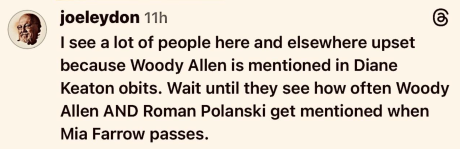
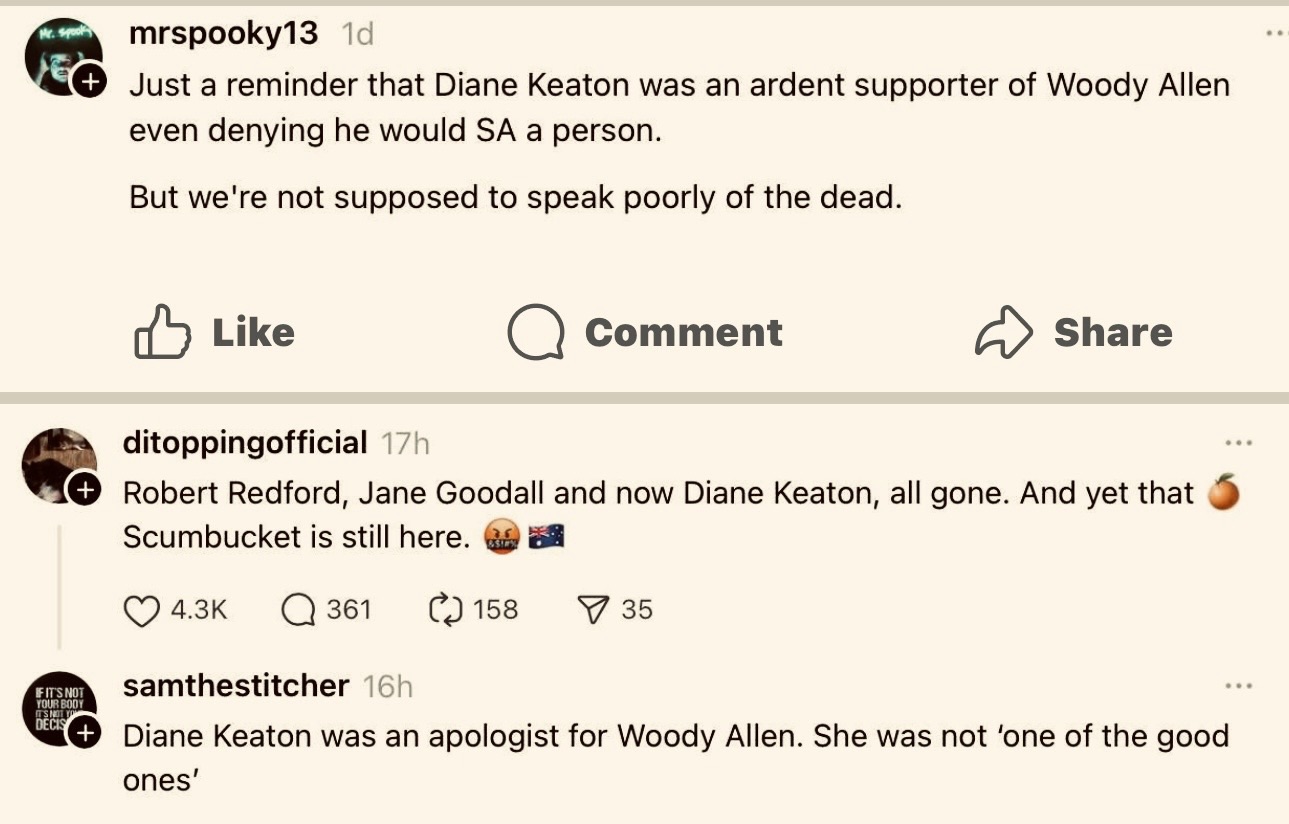
Joe Leydon is completely correct. When Mia Farrow passes, the expansively written obits and summing-up essays will have no choice but to conclude that, like all successful actresses, she was a very shrewd and calculating careerist who boosted her profile and cultural standing big-time by connecting with Woody Allen in the ’80s. And that she turned feral and ferocious in August ’92 over you-know-what and that Moses Farrow knows a thing or two about that (as do many others), and that she’s long praised and stood solidly behind her genius-level Rosemary’s Baby director, Roman Polanski, and admirably so.
“I’ve been poor my whole life. So were my parents, and their parents before them. It’s like a disease, passing from generation to generation [and] becomes a sickness. That’s what it is.”
I’ve been coping all my life with astrology bigots who’ve been describing me and my flock (Scorpios) as scalpel-tongued, stingingly judgmental, mysterious, secretive and overbearing, not to mention ravenous sex serpents.
To which I’ve been saying for decades, “Okay, sure, here and there… HE would be nothing if not for my surgical precision with words and a natural tendency to cut through the bullshit, but otherwise take your toxic character assassination tropes and shove them up your ass, and sideways at that.”
This is the basis for my empathy with POCs who’ve been fending off crude cultural stereotype descriptions all their lives.
The idea that everyone born each year between October 24th and November 22 shares many of these basic traits is, of course, absurd. Plus whatever I may have been (or have been like) in my youth and early middle age…all that hormonally intense crap sailed a long time ago.
According to The Astrology Bible, Scorpio’s colors are deep red, maroon, black, and brown. Bullshit — all my life I’ve been drawn to deep blues, blacks and grays. I own one deep red garment — a 1950s James Dean Rebel Without A Cause jacket — but I always feel uncomfortable wearing it. Plus I hate maroon, burgundy, or ox-blood colors.
And if, therefore, Ridley Scott‘s 1979 original had never been made, you know who would make a really great Ripley? If Scott was casting Alien right now, I mean? Chase Infiniti. She’d be perfect.
Ben Foster‘s beefy, balding Tanner Howard knows he’s finished, of course, but in his final moments he feels triumphant all the same. Elated even.
Tanner is brought down by Jeff Bridges‘ Marcus Hamilton, a sweaty, drawlin’, pot-bellied Texas Ranger who’s determined to get revenge for the death of his partner, Gil Birmingham‘s Alberto Parker. And it’s almost as if Tanner is ready for the coup de grace.
“To live outside the law you must be honest” — a line from Bob Dylan‘s “Absolutely Sweet Marie“.
Derek Cianfrance‘s Roofman (Paramount/Miramax, 10.10), which I saw late last night, is much, much better than I expected. It hums with serious heart, tension, anxiety, inner conflict. And if you ask me, Kirsten Dunst is a shoo-in for a Best Actress nomination.
As we speak the woke-theology fanatics critics aren’t being effusive enough about Roofman — it’s only merited an 82% from Rotten Tomatoes and currently has a droopy 64% score from Metacritic. And that’s really wrong…it’s really fucked up to dismiss or semi-dismiss a film as good as this. Fucking assholes.
Roofman might nonetheless qualify as a Best Picture contender once the word gets around; ditto Cianfrance for Best Director. Tatum is pretty damn impressive also. It’s that fucking good…seriously.
The first trailer sold a semi-comical, character-driven, fact-flirting caperflick about a lighthearted, small-time thief (Channing Tatum) falling in love with a nice, decent woman (Kirsten Dunst) who eventually finds out, etc.
A more recent trailer [below] was a bit more candid about what kind of film Roofman is, but it still lied because it emphasized the “antsy, anxiety-besieged thief having to lie and pretend and skulk around in order to survive” aspect.
What Roofman is, in fact, is an oddly fascinating and curiously touching love story…actually a kind of suburban schizophrenic love story because Tatum’s Jeffrey Manchester is torn between living the sketchy, dodgy, blade-runner life of a thief while falling into the vibe of being a nice, nurturing, church-attending guy who loves Dunst’s Leigh Wainscott, a mother of two teenage girls who works at a Toys R’ Us in Charlotte, North Carolina.
The film is basically about Tatum’s inability to to be loyal to one or the other and trying to split the difference, and eventually succumbing to the yield of his own indecision.
Pic is generally based on a five-year period in Manchester’s felonious life, which began in ’98 and ended in early ’05 (i.e., between his late 20s and early 30s). But it’s more particularly about the Wainscott period (June ’04 to early ’05).
Roofman isn’t guided as much as punctuated (not defined or propelled but punctuated like a dash or an ellipses or a semi-colon) by Manchester’s thievery, which basically amounted to roof-drilling into a series of McDonalds outlets and grabbing the cash as well as living inside a Toys ‘R’ Us and subsisting on baby food and M&Ms peanut candies.
Manchester’s relationship with Wainscott and her daughters is the heart of the film, as well as the primary, paradoxical reason why he gets popped at the end. (The 54-year-old Manchester is currently in the slam and not due for release until 2036.)
And I’m telling you that Dunst’s performance really brings the honesty, the feeling, the hurt and the do-re-mi. I know what an Oscar-level performance looks, feels and sounds like, and Dunst really brings it.
But you still have to be able to roll with the mystery of Jeffrey Manchester, whom Tatum portrays as a real humdinger of a puzzle…an amiable but hidden, strangely conflicted dude….decent but conniving and gently felonious…unconcerned with the usual social commandments but desiring family ties.
It’s actually not so much the Blonde on Blonde poetry of Dylan as the core philosophy of Neil McCauley that Manchester fails to heed.
McCauley’s view is that living outside the law requires a coldly calculating form of discipline when it comes to significant others, to wit: “Don’t let yourself get attached to anything you are not willing to walk out on in 30 seconds flat if you feel the heat around the corner.”
Alas, Tatum/Manchester isn’t cold or tough enough to adopt the McCauley ethos, and it is this failure from which Roofman‘s story tension and emotionality flows. This is what makes Roofman curiously fascinating. Manchester is obviously some kind of fleet-fingered sociopath, but one who paradoxically manages to con himself into believing that he can find comfort and respite in the straight, conventional, church-adjacent life of Wainscott and her two teenage daughters.
The whole time you’re muttering to yourself, “Listen, asshole…I feel the rapport with Dunst and her daughters like you, and I understand why you want to live in that world while taking part in their churchgoing life and all that, but you fucking can’t becauseyou’re chosen the life of a thief. Haven’t you seen fucking Heat? If you don’t want to get sent back to jail you have to maintain that McCauley discipline, and if you fail to do that you’re toast. Do you get it? Wake up, man!”
If a reporter or editor puts quote marks around a term, it means that he/she regards the term as exotic and to some degree suspect. Especially if they qualify it by adding “so-called”.
“[Weiss] achieved [her CBS News hiring] without climbing the typical journalistic career ladder, and with no experience directing television coverage. She is richer in social clout than in Emmys or Pulitzers. And she is known more for wanting to rid the world of so-called wokeness than for promoting journalistic traditions.”
Testa and her editors are obviously casting doubt upon the validity of the “w” term. It follows that they wouldn’t dare use “so-called” as an adjective when mentioning certain sacred-cow terms.
If, say, a reporter or editor were to put quotes around “systemic racism” with a “so-called” qualifier, they would be instantly suspected of being Republicans if not white supremacists and probably fired and ex-communicated on the spot. Same result if they were to post an article that used the term “so-called ‘sexual harassment'”. Ditto if a reporter or editor were to publish an article that included “so-called ‘climate change'” — only a rightwing denialist would use such terminology.
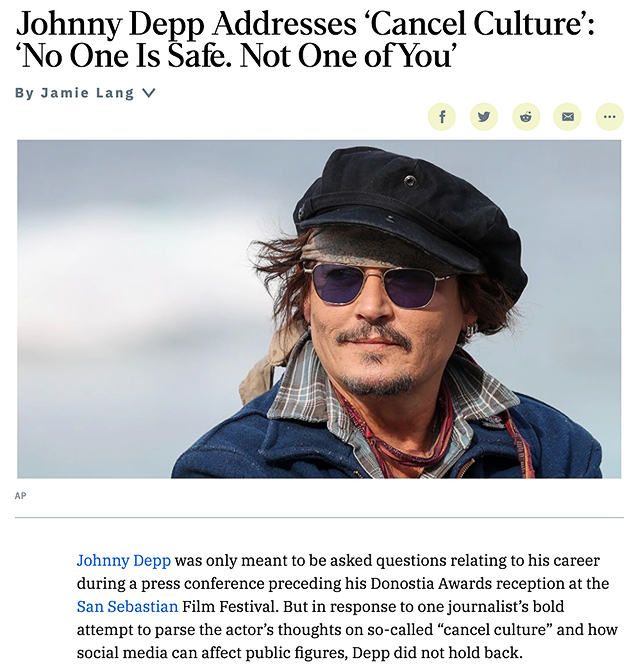
“‘Johnny Depp was only meant to be asked questions relating to his career during a press conference preceding his Donostia Awards reception at the San Sebastian Film Festival. But in response to one journalist’s bold attempt to parse the actor’s thoughts on so-called ‘cancel culture’ and how social media can affect public figures, Depp did not hold back.'”
JFK spots Abraham Zapruder, etc. The JFK voice (created or branded by “Inspector Theory” or Sora or whomever) isn’t an imitation…it’s him! Same vocal chords! The most accurate-sounding artificial JFK simulation I’ve ever heard. Presumably AI-generated.
Why didn’t the creator get the proper seating, the angle and the Dealey Plaza atmosphere right? How hard could that have been? And why does Jackie look like Lois Chiles in The Way We Were?
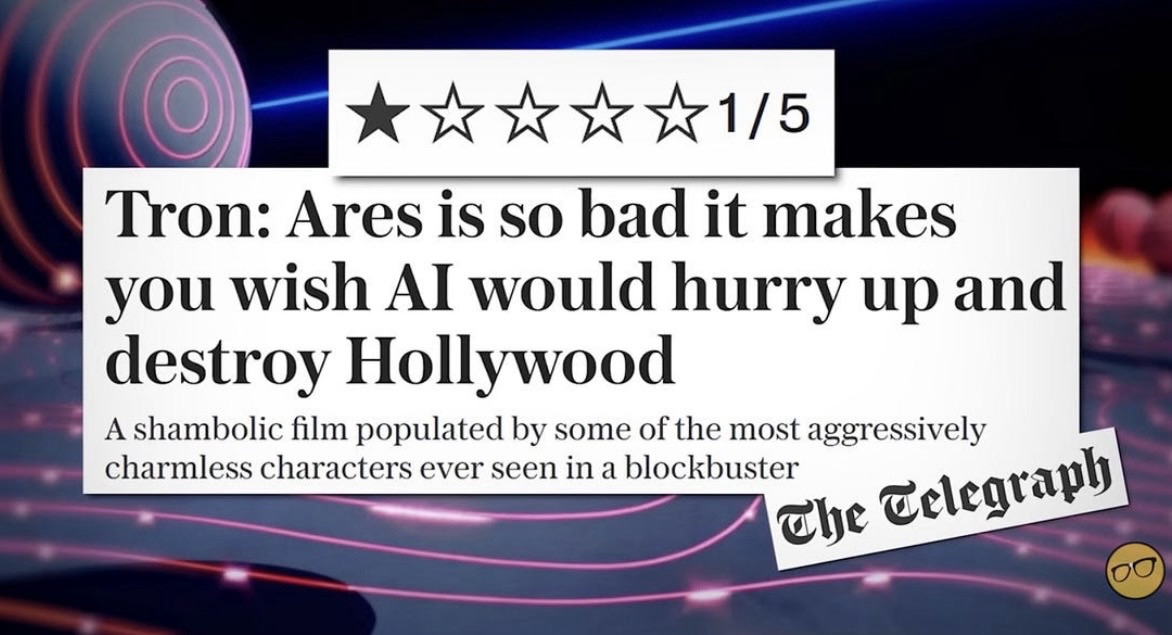
As we all stand together before the gaping, fang-toothed jaws of AI engulfment, I’ve never felt more of an intense longing to see films that operate on the simplest renderings of dramatic or comedic or fantasy-seeking basics — movies that hopefully arouse the mind, trigger the heart and generally go deep.
Translation: AI is fine, but it has to be invisible.