
Eureka! Late last night I watched the first three episodes of Rebecca Miller’s Mr. Scorsese, and I felt so roused and super-engaged I didn’t even notice that episode #3 (which ends with the rightwing hate that greeted The Last Temptation of Christ in ‘88) ended just after 2 am.
We’re all fully familiar with the frenzied, 60-year, up-and-down-but-mostly-up saga of the career of Martin Scorsese, of course, but there’s something primal and alive and almost cleansing in the fissures and textures of Miller’s five-hour doc.
Why did it hold me so? Because it didn’t just feel like Scorsese’s story but my own. At every juncture I was “there” in real time, communing with each and every film — emotionally, instinctually, aesthetically — and I mean going all the way back to Boxcar Bertha, which wasn’t much (after seeing it John Cassavetes gave Scorsese a fatherly hug and said “you’ve just spent a year of your life making a piece of shit”) but at least had one good sex scene.
In a phrase Mr. Scorsese is really great stuff. First-rate, up close and searingly personal. It reminds you that Scorsese led a very anxious and shadowed and haunted life for at least his first half-century on the planet. No bowl of cherries, no walk in the park.
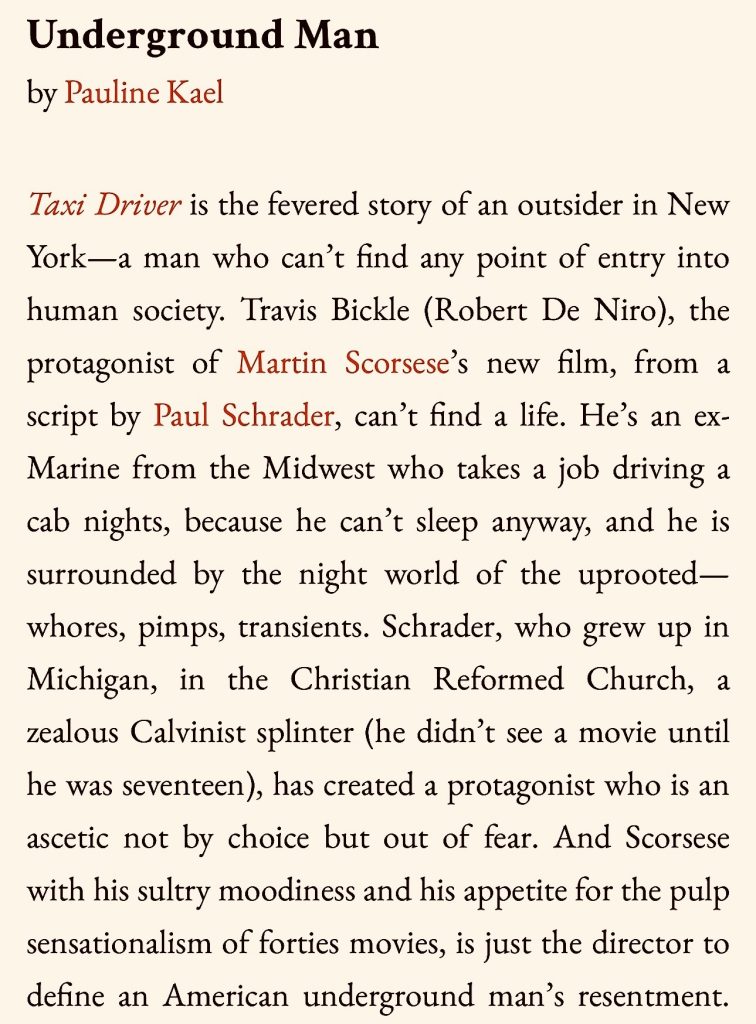
I’m thinking now of an on–camera Paul Schrader quote about how Travis Bickle, the proverbial Underground Man, was speaking to “no one” in the early ‘70s…the isolation was all but total back then. Now almost the same kind of guy is online, and he is legion…the solo Underground Man thing has become an online community…the “Internet Man”.
Please re-read Pauline Kael’s 2.9.76 New Yorker review of Taxi Driver.
Friendo: “The persistent sneers of dismissal that now frequently greet Pauline’s name are one more sign that 2025 film culture has lost its marbles.”