
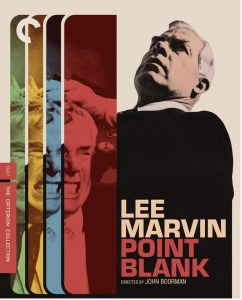
Criterion’s 4K Bluray of John Boorman‘s Point Blank (’67) pops on 4.21.26. I love the extras (which include commentary from Boorman and Steven Soderbergh, an interview with critic Mark Harris, and a “New Reflections on Point Blank” essay by Jim Jarmusch), but I despise Jay Shaw‘s jacket art.
Point Blank‘s color scheme is sublimated to an affected, phoney-baloney artist’s impression of old-school cinema. Or a vague impression of Point Blank by someone who’s never seen it.
A “painted” black-and-white image of Marvin sits on the right (the flesh tone simulates the painted monochrome look of yesteryear theatre lobby stills), and — this is the chief offense — four color-saturated, vertically-cropped images of a stressed and wincing Marvin are on the left.
If you know anything about Marvin’s “Walker” character, you know he’s totally stone-faced…perhaps the least emotionally expressive tough hombre in film history.
Except for a brief flashback showing Walker grinning while flirting with his future wife, Sharon Acker‘s Lynne Walker, Marvin never gives up his feelings…even when fighting or dodging bullets he’s all robotic frost and veneer…no apparent stress or uncertainty or struggle of any kind.
Shaw’s decision to use a still of Marvin getting feral and gritting his teeth in some kind of violent altercation is therefore a total misrepresentation…a fucking lie.
AI sez: “People who hate Los Angeles love Point Blank” is a well-known observation made by film critic and scholar Thom Andersen in his influential 2003 documentary essay, Los Angeles Plays Itself.
Insidious and Grotesque: Point Blank presents Los Angeles as a sterile, alienating, and sinister place through both its exterior urban locations and its interior, garish decor, which Andersen notes makes the city feel both “bland and insidious”.
Alienating Architecture: The movie often utilizes modernist, cold architecture (like John Lautner’s designs) as the backdrop for its villainous characters, reinforcing a sense of soullessness.
A “Low Tourist” View: Andersen classifies directors who treat LA with this kind of critical, bleak eye as ‘low tourists’…foreigners or outsiders who view the city as a dystopian, superficial, or nihilistic landscape rather than a place with its own lived history.
A Purgatory Setting: Point Blank is often cited as a prime example of a film that frames Los Angeles as a purgatory for hollow or lost souls, fitting within a specific, cynical genre of filmmaking that aligns with a dislike of the city.
HE to Thom Andersen: “A place with its own lived history”? Los Angeles is in fact a sprawling, disconnected “city of the fallen angels”…a superficial, dystopian, traffic-choked landscape of bland-ugly apartment buildings and malls both super- and mini-…leaving aside the wealthy, hilly westside and beachside communities (canyons, Brentwood, Bel Air, Pacific Palisades, Mulholland Drive, west of 405) and the Silver Lake district, it has pretty much eradicated all traces of history (Spanish architecture, the old Victorian homes that were everywhere in the early 20th Century). It’s truly a gloomy sprawl during daylight — it only comes alive between 9 pm and dawn. Oh, and the only tolerable way to get around is by motorcycle / rumblehog.