Borat’s sluggish sell

The general awareness and definite interest levels about the hottest, funniest, most out-there comedy of the year — that would be Borat: Cultural Learnings of America for Make Benefit Glorious Nation of Kazakhstan (20th Century Fox, 11.3) — are kind of “meh” so far. With Average Joes, I mean. The people who only focus on movies coming out this weekend (as opposed to two or three weekends from now), the ones who went to see Texas Chainsaw Massacare: The Beginning instead of The Departed two weekends ago…that crowd.
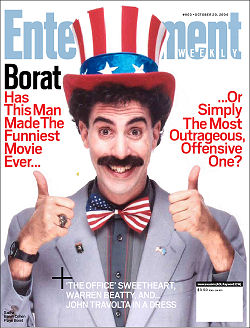

The current EW cover: an obvious boost

It goes without saying that awareness and interest levels are through the roof with media, industry, ubers and early-adopter types — Borat has been heavily buzzed and written about since breaking out at the Toronto Film Festival — but otherwise it’s looking like it may be a little too hip for the room,”the room” being pretty much everyone else.
Maybe Sacha Baron Cohen‘s goofy-dry put-on humor only travels with a certain clientele. Maybe people are starting to hear that Borat is basically about Cohen’s Kazakhstan culture reporter goofing on Middle Americans and maybe that’s not going down so well with some. Or maybe they just haven’t tuned in yet.
I’m not saying Borat is cruising for a buising. I’m saying as of right now that a not-big-enough group is saying, “Oh, yeah, I know that film….looks good!…I’ll be in line!” It’s not doing terribly and awareness and interest levels will certainly climb between now and 11.3, but right now it’s not doing all that great. And it opens only two weeks from this Friday. And it’s rated R.
The good news is that Borat‘s only 11.3 competitors are two family-trade films — Disney’s Santa Claus 3: The Escape Clause (almost guaranteed to be the #1 film that weekend) and DreamWorks’ Flushed Away. Pedro Almodovar’s Volver, one of the year’s great films, is only opening in New York and L.A.
The fact that Borat is unusual means “it’s not falling into any kind of model,” a senior Fox publicist told me earlier today. “Among the intelligentsia, media, industry…everybody’s buzzing about it. And in terms of word-of-mouth screenings, [the numbers] have grown and grown, and they’re continuing to grow. Lately we’ve had turnaways at screenings. Thing is, this is about all real people” — Borat interviewing regular folks who aren’t in on the joke — ” but it’s not a documentary.”
And so some people aren’t sure what it is (yet) and are going “hmmmm.” But that can change. The usual TV ads, trailers in theatres, more magazine and web articles, more word-of-mouth screenings, etc.
Nikki Finke ran a piece about the Borat deal a little earlier than me, but I didn’t catch it until after I wrote my own so there you are.

Marty’s “Silence”

I meant to say this last week, but Martin Scorsese wanting to work in a lower-budget realm is good news because it means more freeedom and creativity and no more Aviators. But his wanting to direct a small-scale adaptation of the Shusaku Endo novel “Silence“, about two 17th century Portugese missionaries, sounds like it may result in a somewhat lethargic viewing experience. Movies about missionaries are generally unwelcome, and the spiritual connotations of that title are very unsettling. Just when I thought the Marty problem was solved by his having rediscovered and accepted his knack with urban crime stories in The Departed, he’s seemingly about to wade into something vaguely Kundun-ish — an east-west spiritual culture-clash thing with shades of The Mission, Hawaii and The Last Samurai. Yipes!

Pitt is Supporting

Brad Pitt gives his best performance ever in Babel, but it’s nothing close to a lead — Babel is an ensemble piece — and so talk of a Best Actor nomination, no offense, is without foundation. (Tom O’Neil is saying Pitt has “declared himself in the supporting race” — has he said this in so many words?) It’s a Best Supporting Actor situation or nothing. The crying-on-the-phone- with-his-son sells the performance, but the one that seeps in even more is the peeing scene with Cate Blanchett, who plays Pitt’s wife.

Van Galder’s cat hat

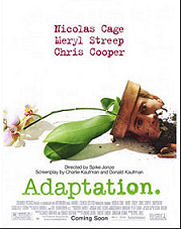
The Hollywood Reporter ran Nicole Sperling‘s nicely sculpted profile of Columbia TriStar marketing group president Valerie Van Galder yesterday…fine. I’ve always respected Van Galder’s aesthetic sense. I really admired that flower-pot concept in the Adaptation one-sheet that she worked on. I remember wanting to do an article on the various Adaptation poster concepts that she’d considered — she loved the film and was very enthused about getting the art just right — but the piece gradually died for some reason. Half me, half her.

I also remember Van Galder wearing one of those cat-in-the-hat hats in front of Park City’s Egyptian theatre in ’96 as I waited to scrounge a ticket for a public showing of Looking for Richard. Van Galder was a Fox Searchlight publicist and, let’s be honest, not exactly a friend. It was my choice to wait and hope — Valerie made no promises — but I stood in increasingly frigid cold for 45 minutes only to be told no-dice. It was nothing in the grand scheme and I naturally moved on, but on some residual level whenever I think of the talented and much-admired Val I think of the total absence of sensation in my toes that night, and the way snow was coming down so heavy and pretty, and how big Sundance kahuna Robert Redford and director-star Al Pacino drove up and jumped out of an SUV about ten minutes after the show was supposed to begin.

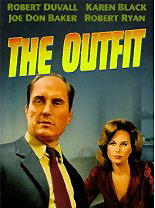
“The Outfit”

I was looking at this boring IMDB poll of popular ’70s movies (you’ll never guess which film came out on top), and out of my temporary non-interest in the same old pantheon of classic ’70s films I was suddenly thinking again of John Flynn‘s The Outfit (1973), and wondering why it hasn’t been issued on DVD.

The Outfit isn’t one of those AFI best-of-the’70s movies by any means, but except for a flabby ending it’s a crackling little genre film that’s done almost perfectly. It stars Robert Duvall as an ex-con named Macklin out for revenge against some cold-blooded mob types. Karen Black, Joe Don Baker, Robert Ryan, Richard Jaeckel, Joanna Cassidy and Sheree North costar. Call it a lean, hardboiled, low-key crime drama in the same realm as Charley Varrick. Not as sombre or big-city noirish as The Friends of Eddie Coyle, but a very fine and flavorful film of its type.
The Outfit is based on Richard Stark‘s (i.e., Donald Westlake‘s) 1963 book of the same name, which was apparently part of his “Parker” series. (“Parker”, I gather, is more or less the same guy as “Walker” in the Stark book that became John Boorman‘s Point Blank.)
I mentioned The Outfit as a DVD candidate a little over two years ago…flatline. It’s only viewable on VHS, and has apparently been screened from time to time on Turner Classic Movies. It was originally an MGM release; Warner Home Video now has the rights. WHV honcho Ned Price seems to be napping on this one. Here’s hoping he wakes up and approves a DVD that will include a retrospective docu- mentary and audio commentaries from at least some of the creative principals. Before they’re all dead.

Better the next morning

I was searching for an item about The Outfit that I wrote in September of ’04, and I came upon my original Sideways review. And reading the following graph almost choked me up because of how infrequently this kind of specialness seems to manifest: “The worst thing a film can do (apart from being awful or boring you to tears) is to deliver this or that cheap high when you’re watching it but then fall apart on the way home. Sideways does the precise opposite. It’s okay at first, and then better, and then deeper and then really funny, and finally very touching. Then it seems to get even better the next morning, and better still a couple of days later.”

Poor Edward Bass

Poor Edward Bass, the Bobby producer who’s sounds to me like he’s just another obstinate and egoistic self-promoter and con artist, which puts him in the same general polluted tank that a lot of other producers in this town are swimming in. L.A. Times writer Robert Welkos has run a profile piece with a headline that describes Bass as an “ex-con,” which he is…but if you read the article a second time, he only sounds moderately flawed. Not that much worse, I’m saying, than a lot of other smiling flim-flammers I’ve run into over the years.
I’m not saying Bass is the most respected or creative-minded producer to have worked on a mainstream film in this town. Is he a dick? Bobby director-writer Emilio Estevez has evidently been of that opinion. He warred tooth-and-nail with Bass over the shape of the script, and as John Ridley‘s seminal Esquire piece recounts, it was Bass whom Esetevez was addressing when he uttered the immortal line, “Checkmate, asshole!
Bass did time in the early ’80s for mail fraud and that’s no joke, but if you look closely at the particulars — he and another guy were charged with falsifying information to obtain a higher credit rating that allowed their company to purchase equipment at cheaper prices — Bass was involved in the same realm of financial fakery that Jack Lemmon‘s Harry Stoner character was guilty of in John Avild- sen‘s Save The Tiger (’73), and he was presented as a flawed but sympathetic man. A lot of people cut corners and put on false fronts. I’m not saying it’s okay, but Hollywood has never been a sanctuary of ethical behavior.
Bass changed his first name from Michael to Edward so people wouldn’t associate him with his younger jailbird incarnation and so he could start anew, in a sense. Is there anyone who hasn’t wanted to keep certain aspects of their past hidden? It’s not exactly touching when Bass says to Welkos, “Why can’t we just let Michael Bass die and let Edward Bass live? He’s my evil twin“…but you can half-feel for the guy.

Laughlin Eastwood Obama

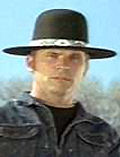
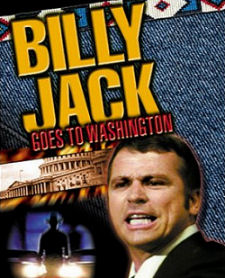
Tom Laughlin and Dolores Taylor‘s website contains a pitch for Billy Jack’s Moral Revolution, a “new 2007 film” that’s not a movie but a plan. The pitch is breathlessly over-written — a super-loaded political-cultural mouthful about a film that would trigger an earthquake of change — a political, sexual, spiritual and psychological revolution that includes ejecting the Bushies and turning away from the Bush Doctrine and managing an end to the Iraq War.


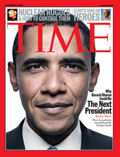
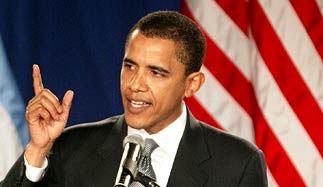
Tom Laughlin, Barack Obama, Clint Eastwood

The idea of Billy Jack’s Moral Revolution doesn’t seem to have been received with sufficient enthusiasm by Laughlin’s network of would-be, small-time financiers. The same ideas and goals were expressed by Laughlin in 6.20.05 article by N.Y. Times reporter Sharon Waxman, and it makes you wonder if he’ll be proposing the same package — he’s trying to raise $12 million — 18 or 36 or 72 months hence.
Laughlin is the original tough-minded independent, but he sounds like a street- corner nutter when he writes that his film will contain “four exciting, highly-charged love stories, with a unique focus on the difference between sex and eros and violence in human relationships — especially among teenagers, including the problem of abortion. Like the original Billy Jack, it will be an uplifting, ten-handkerchief tearjerker.”
But as undisciplined and wiggy as some of Laughlin’s agenda seems to be, a lot of what he says about why this country is deeply loathed and the effects of the Bush Doctrine makes basic sense. I completely agree with Laughlin 100% that the three greatest evils afflicting this country right now are (a) corporate oligarchs, (b) totalitarian neo-con agendas and (c) false evangelicals .
Laughlin is a a devout believer in the fundamental tenets of freedom and individual rights that this country was…I’m not going to say it was entirely founded upon these beliefs (I’m too much of a James Ellroy fan to swallow that one whole), but Laughlin truly believes in the myth of the once-good-and-noble-U.S.A., and there’s something touching in that.

You know who’s also into the idea of restoring the spiritual American dream? Clint Eastwood.
In his Time magazine interview with Richard Schickel, Eastwood sounds standardly cynical when he says that “everyone is looking for who’s the hero that is going to get us out of what we’re in now. I heard somebody on the radio the other day — one of these talk shows — saying, ‘Oh, where’s the new General Patton? Where’s the guy who says, ‘I don’t give a shit what the politicians want — this is what we should do.’ Well, that era’s gone.”
But later in the piece he’s asked by Schickel if “there’s any conceivable possibility in the modern world for the assertion of conventional heroism,” and Eastwood’s reply shows he very much wants to somehow see things made right.
“I certainly don’t see any politician that’s a hero in any party anywhere,” he begins. “I think John McCain did something that I don’t know if I could do and I don’t think many men can look in the mirror and say they’d do: give up a chance to get out of prison because his dad was an admiral and the Vietnamese were going to let him go. Pat Tillman, giving up his NFL career to fight — and die — for his country is like that for me too.

“But all that said, is there a hunger among Americans for heroic behavior? I think there is a hunger. I think that most people would love to see a heroic figure step forward. I can almost sound like one of those Christian-right guys: Where is the Messiah?”
I’m not saying that 75 year-old Tom Laughlin — part visionary, part wack-doodle, part eminently sensible American who’s not stupid and who genuinely cares — is any kind of marketable Messiah, but there’s a common chord in what he and Eastwood are saying — a common lament and a hope-against-hope that I’ll bet hundreds of thousands of Americans are feeling as well.
Barack Obama is no messiah and no saint and he’s not as tough as he could be on issues like health care, but he’s The Guy right now. He’s got that Bobby Kennedy-in-’68, special-aura thing. People of different political tribes, persuasions and affiliations seem to be hugely taken with the guy. And I just think he really has to go for it in ’08 and not four years later. People know he’s Presidential timber and that it’s all but inevitable he’ll run.
If Obama declares, I have a feeling that Laughlin and Eastwood and many, many people in between will vote for him.

Pope video

Screengrab’s Bilge Ebiri has linked to a Pope’s death on April 2, 2005, as noted by four close friends — John Paul II’s talking diary and talking ink pen (who both have sad emotive eyes) as well as Piccolo and Fiona, the Pope’s “bosom pigeons.” Then there’s a Clutch Cargo-like image of John Paul II waving to his followers as he ascends into the night skies above Rome. If only the Pope had bade a final verbal Clutch Cargo farewell with that weirdly organic wet-mouth and “live” lip-and-tongue effect.