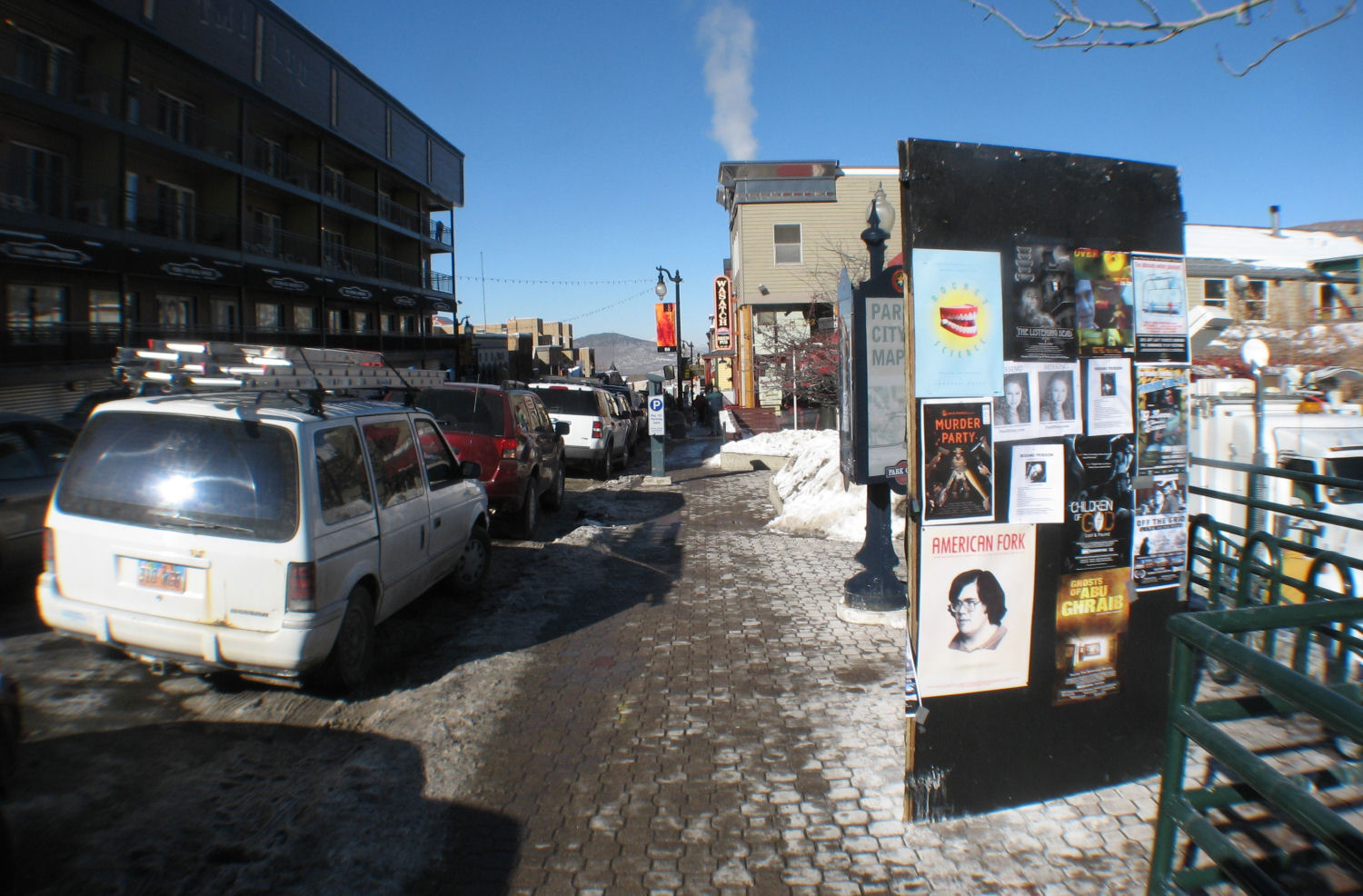
Four Sundance Films

Yesterday was half-consumed by hellish vagabonding; the rental-share I had fell apart and I had to scramble to find a close-to-the-action crash pad with good wifi. Despite this, I’ve managed so far to see Brett Morgen‘s Chicago 10, Tamara JenkinsThe Savages, Mike Cahill‘s The King of California and Jorge Hernandez Aldana‘s The Night Buffalo.
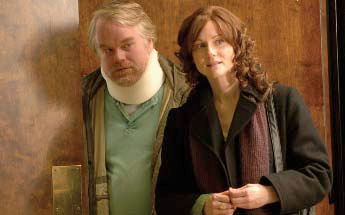
None really did it for me in an emotional world-rocking sense, although Jenkins’ film is by far the best written and acted. It’s a wise/sad/funny downhead drama about a 40ish brother and sister (Philip Seymour Hoffman, Laura Linney) trying to care for their withered, close-to-death dad (Phillip Bosco) and cope with the inevitable.
That’s what we’re all doing, no? (Apart from living our lives, I mean.) Facing the fact that we’re all going to die, and grappling with the fact that every child has to do what he/she can to aid their parents as they gradually submit to the end-game process? Jenkins’ screenplay is certainly a high-end treatment of this. It somehow transforms an innately gloomy situation into something that keeps you interested and, as far as it goes, aroused.
I had to bolt toward the end (my parents are close to this stage — it hit too close to home and I just couldn’t handle it) but The Savages is a totally grade-A indie drama. Except for one aspect, that is — it makes you feel caught in a downward spiral the way life itself can feel that way when death is hovering. Jenkins has my respect for facing this issue squarely and honestly without any Hollywood-style jacking around, but the movie unfolds as a series of vignettes rather than a building/expanding drama with two or three significant turns in the road.
Good God….I just lost over two hours worth of writing — thoughts on Chicago 10, The King of California and The Night Buffalo — by hitting the wrong key or something. It’s all gone and I can’t start over again. I have films to get to, stuff to do, etc. This is infuriating, but I have a radical new idea (for the time being) — what I think about yesterday’s Sundance films doesn’t matter because, The Savages excepted, they all didn’t make it in one way or another.
If you’re not really turned on by a string of films, why get into them? If something really does it for me, I’ll write about it. Otherwise, screw it. I’ll just experience what I can and write what I can manage, and that’ll have to be enough.
Nearly two and half hours worth of work….1200 words, a lot of thought, a single stroke of a key.
“Lucky” bumped again

The release date of Lucky You, the most unloved and unwanted Curtis Hanson gambling movie in U.S. history, has been bumped again — this time to May 4th, Hopefully it’ll snag all the people who aren’t into seeing Spider-Man 3. (Two other films opening that day are Sarah Polley‘s Away From Her and that nicely-pitched anthology flick Paris, Je t’aime.)
By my count, Lucky You, which costars Eric Bana, Drew Barry- more and Robert Duvall, was supposed to come out 9.8.06, then 10.27.06 and then 3.16.07. I can’t understand how a film by Hanson (In Her Shoes, L.A. Confidential) with a script by Eric Roth could turn out this problematically. Whatever’s wrong (or not wrong) with it, the postponements have done wonders for the want-to-see factor.

Sundance pics #4

Blog Whisperers

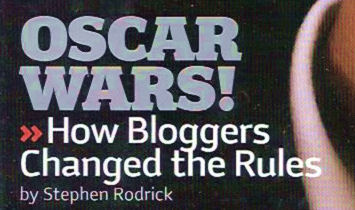
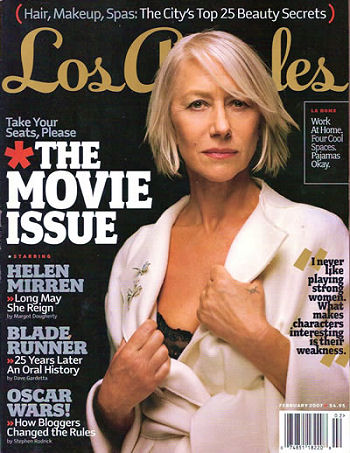
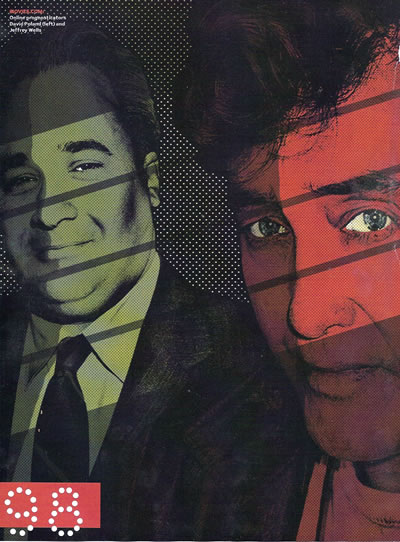
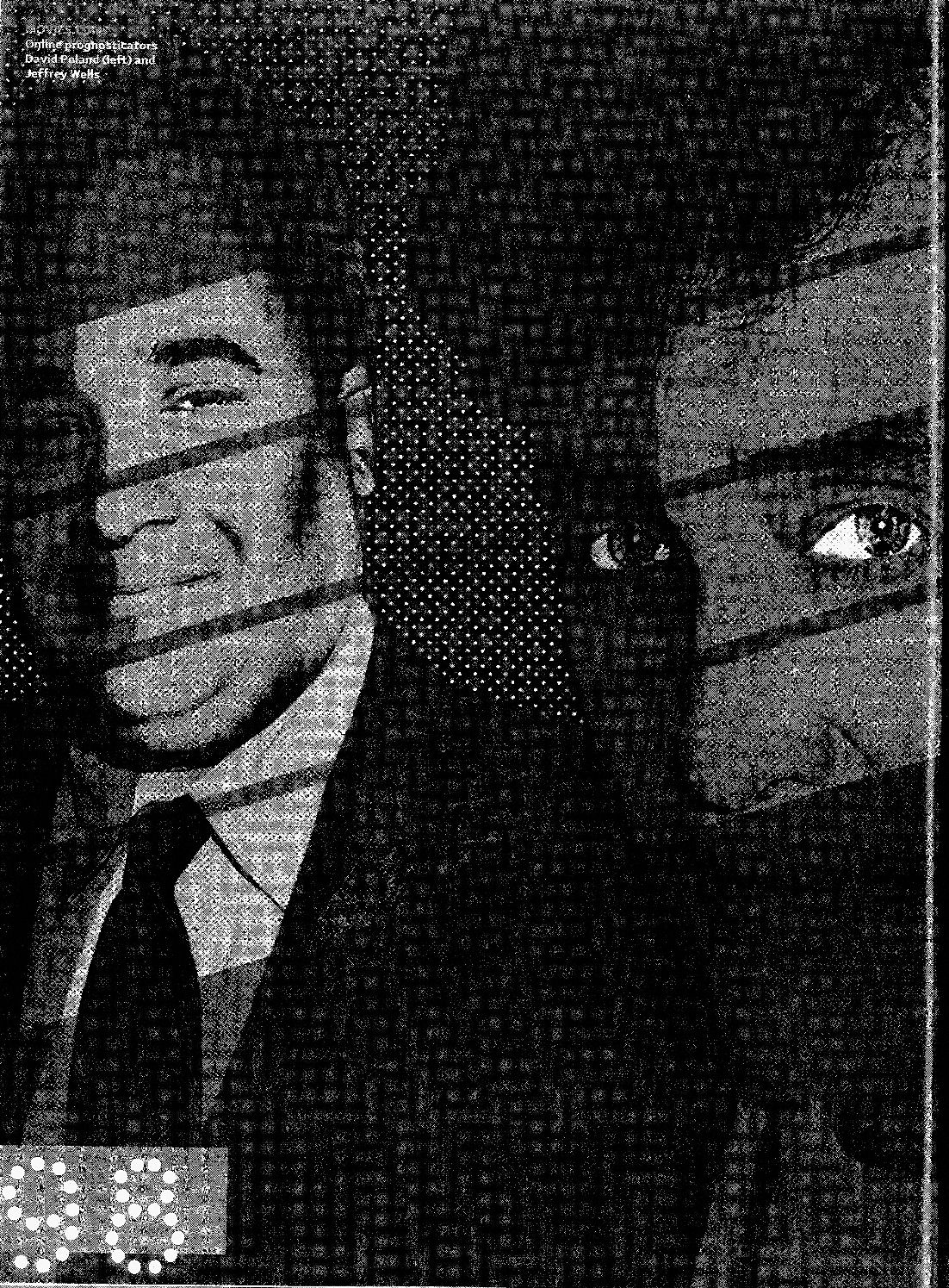
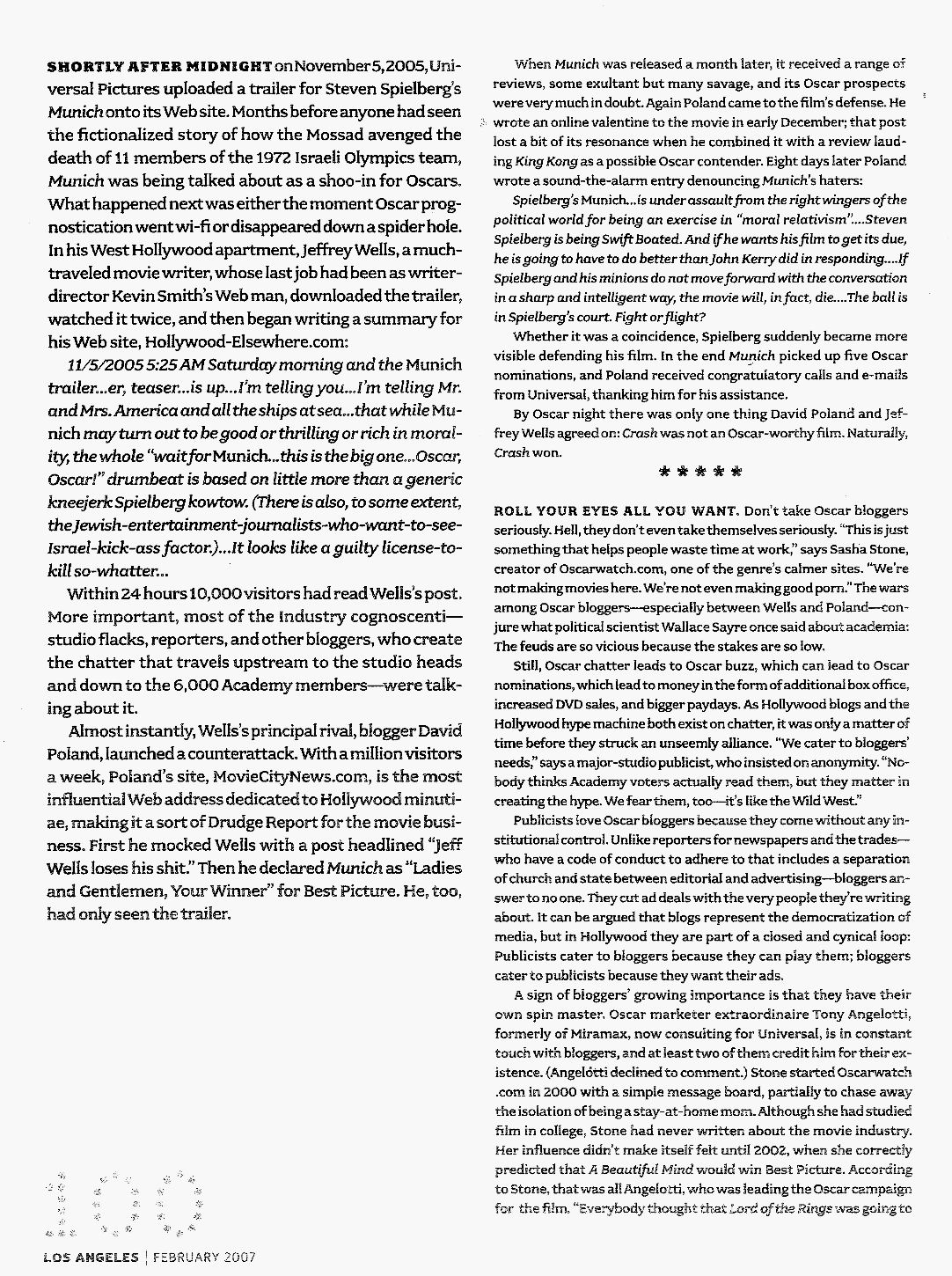
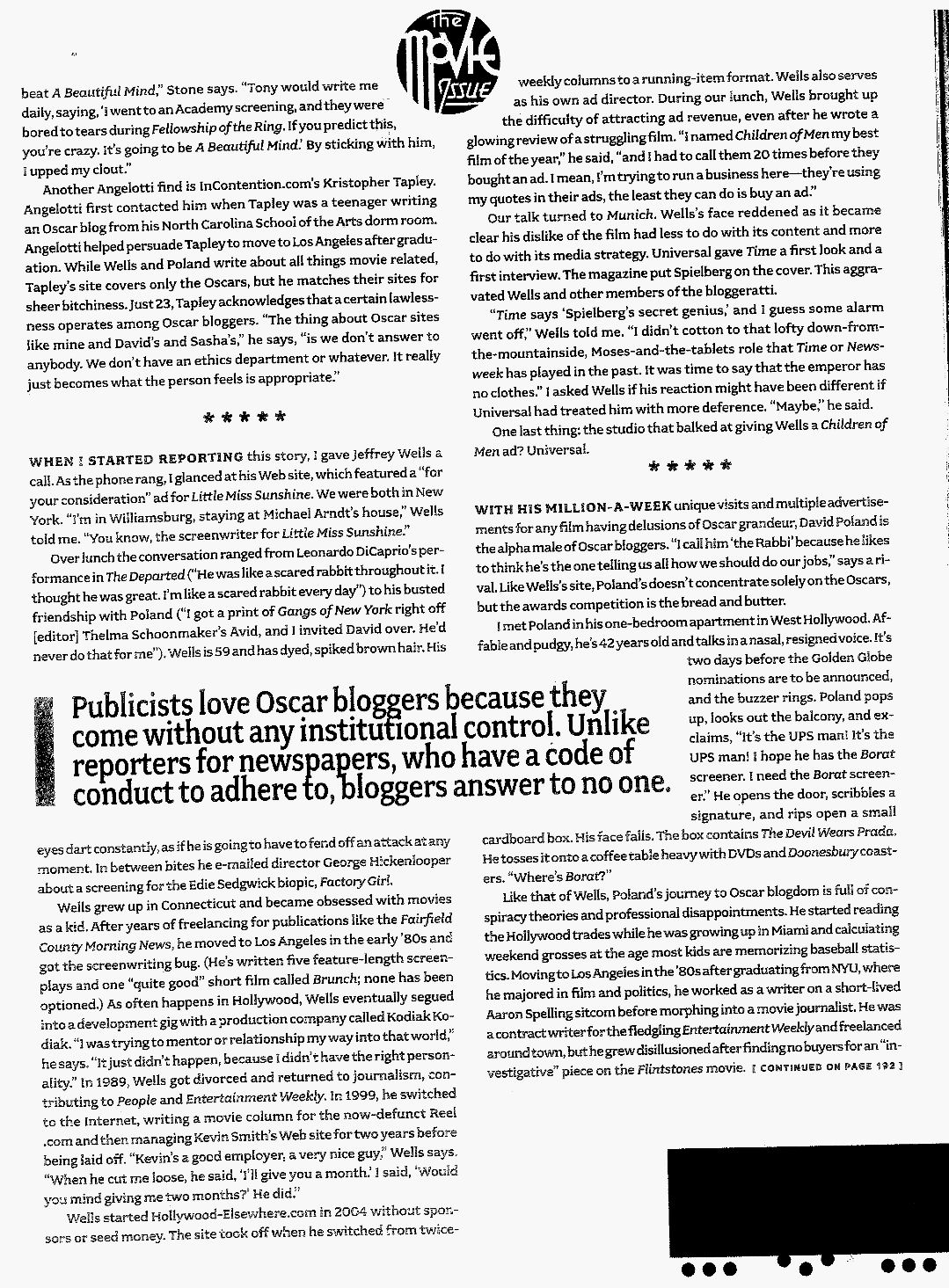
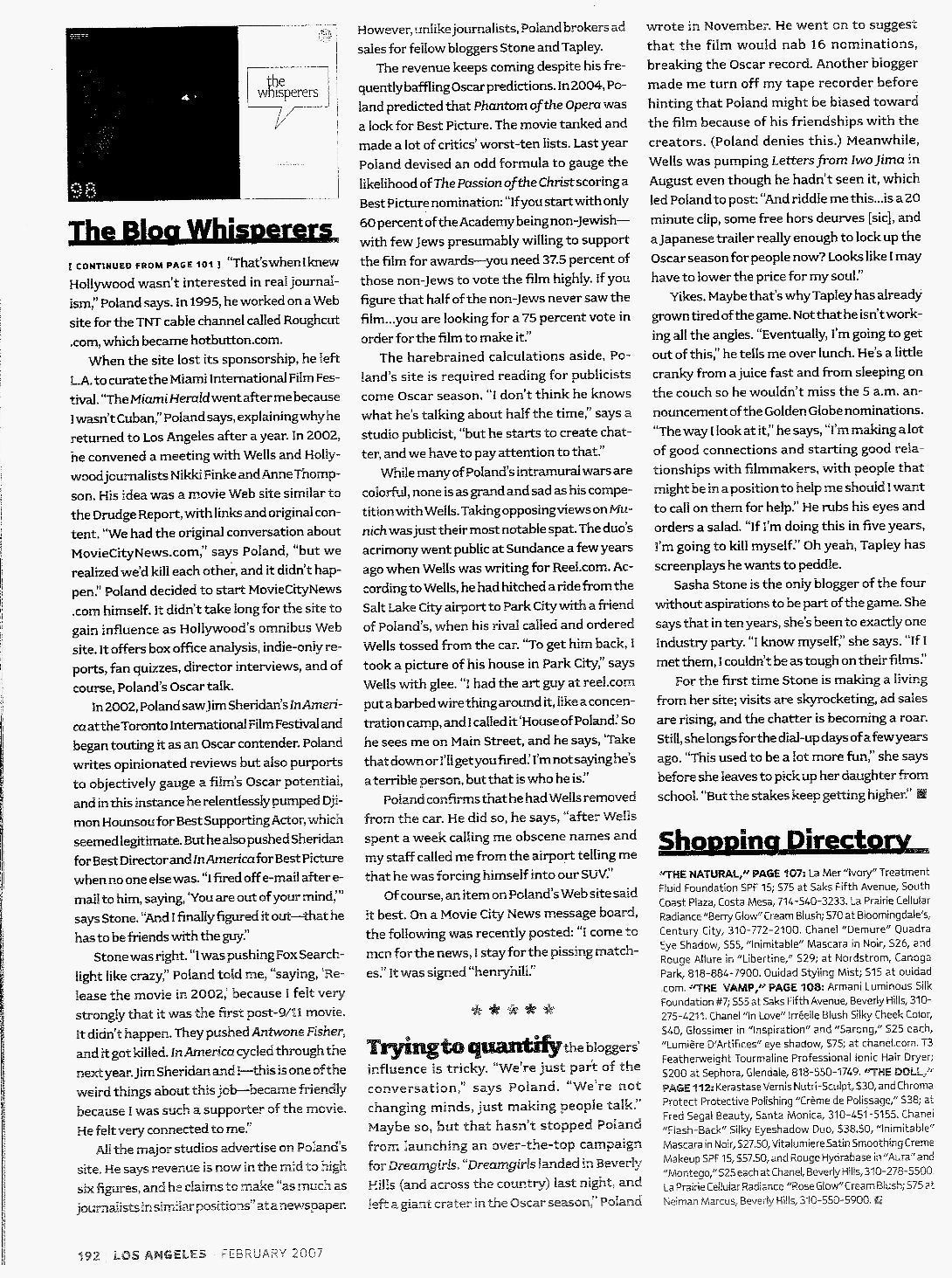
Stephen Rodrick‘s Los Angeles magazine piece about Oscar bloggers (“The Blog Whisperers”) hit the stands yesterday, the main focus being on myself and MCN’s David Poland. I suppose Rodrick or his editor Kit Rachlis thought the Poland vs. Wells bitchfest was the tangiest aspect to run with, but…

The piece is okay but a bit myopic in the sense that no attention is paid to The Envelope‘s Tom O’Neil and Hollywood Wiretap’s Pete Hammond. Poland and I are heavily in the game, of course, but these two guys mainline it. If I’m a “lapsed Catholic” or even an agnostic, O’Neil and Hammond are Elmer Gantry-like evangelicals.

Nonetheless, the subhead of the piece reads, “How two middle-aged, apartment-dwelling, Hollywood-obsessed rivals are quietly — and not so quietly — transforming the Oscar race.”

Rodrick talked, appropriately, to Oscarwatch.com‘s Sasha Stone and In Contention‘s Kris Tapley. They’re both flatteringly portrayed, Sasha especially — she comes off as the most grounded and level-headed of the bunch.

Here’s the cover and here’s the piece in five chunks — the opening visual, the cover page, page 3, page 4 and page 5

I’m running the link-and-look piece in order to argue and correct a few things, to wit:

Correction #1: Rodrick implies unholy collusion by saying that when he called to interview me in Manhattan last month, (a) he noticed a Little Miss Sunshine ad on HE and (b) I told him I was staying in Sunshine screenwriter Michael Arndt‘s place in Brooklyn. I’ve explained this before but let’s do it once again: Arndt and I met on Craig’s List in the spring of ’05 — I was looking for a summer-long apartment swap so I could lie in New York from June to August, and he was looking for a place to stay in Los Angeles while he was working on the Sunshine shoot. He’d read me and all, and yeah, we’ve stayed friendly since, but to imply a quid pro quo in terms of Sunshine ads is bogus and lame.

Correction #2: The production company I wasted 18 months working for in the late ’80s was called Kodiak Films, not “Kodiak Kodiak.”

Correction #3: I got divorced in 1991, not ’89. (A fact-checker called me in early January but she didn’t even ask me to confirm the biographical stuff.)

Correction #4: I didn’t switch to the internet in ’99, but in ’98, when I began my column for Mr. Showbiz. The Reel.com column, which began more or less when my L.A. Times Syndicate deal ended (after five years), launched in August ’99.

Correction #5: Poland has a spacious two-bedroom apartment; Rodrick writes that he lives in a one-bedroom one.

The piece is the piece is the piece — make of it what you will. Rodrick tries one more time to make me look like an ad suck-upper in a discussion of Children of Men and my having had difficulty getting an ad from Universal. My basic policy/ attitude is that I want ads from everybody — like any other web publication, my income is based on ad support. But the appeal of Hollywood Elsewhere is that I tend to write bluntly and candidly about stuff I’ve seen and am hearing from trusted sources and am thinking about. (Within the bounds of political propriety, of course.) Any whiff of editorial ass-kissing would obviously harm my credibility. On the other hand, I do try to make nice and encourage media buyers to look on the bright side and the benefits of advertising with HE.

Overall it’s flattering to be written about and I can roll with most of the snarky stuff that Rodrick and Rachlis are putting out. I mean, it doesn’t bother me hugely.

I was amused by the observation that “my eyes dart constantly, as if he’s going to have to fend off an attack at any moment.” I like that because it makes me sound like Leonardo DiCaprio‘s character in The Departed, whom I relate to. “He’s like a scared rabbit through it,” I said to Rodrick. “I thought he was great. I’m like a scared rabbit every day.”

Shelly’s “Waitress”

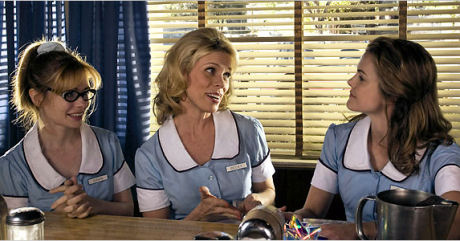
N.Y. Times guy David Carr considers the very sad Sundance legacy of the late Adrienne Shelly, whose last directed film, Waitress, will have its premiere at the festival fairly soon. “Because Shelly had such a clear idea of what she wanted and was not shy about making it happen,” he writes, “her absence [at Sundance] as the film makes the rounds is all the more acute.”


Adrienne Shelly,Cheryl Hines and Keri Russell in Waitress

It became a market…

When did those Sundance-is-losing-its-soul pieces first start to happen? The mid ’90s? A bit later? When did the Sundance-has-been-totally- corrupted-vulgarized-and-putrified stories start happening? Around 2000 or ’01? Question is, as far as Sundance tear-down articles go, where does this John Anderson 1.19 Guardian piece fit in?

Sundance press conference

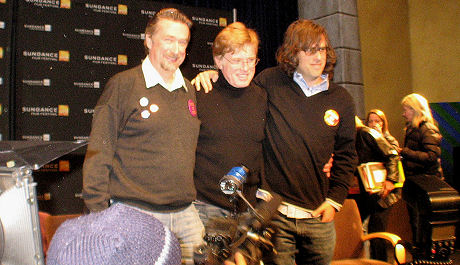
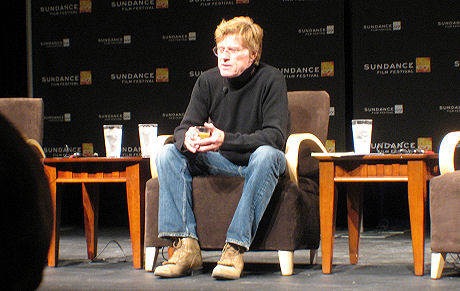
The usual we’re-Sundance-and-we’re-proud-of- what-we-stand for themes were sounded by Robert Redford and festival program director Geoff Gilmore at the opening-day Sundance Film Festival press conference, which ended about 90 minutes ago. I don’t know if anyone was knocked flat by theser statements, but it was good to hear the Sundance fundamentals restated in a clear and concise fashion.


(l. to r.) Sundance program director Geoff Gilmore, Robert Redford, Chicago 10 director Brett Morgen at the close of this afternoon’s 2007 Sundance Film Festival press conference at the Egyptian theatre — Thursday, 1.18.07, 3:20 pm

We’re about movies and not parties or ambush marketing, Redford said. We’re living in a very exciting, expansive and inclusive time, they both said. And I recall one of them saying that the line between narrative features and documentaries is blurring, and that’s good, and the more this happens the better for everyone. (I agree.)
I recorded the whole thing, but I’ll tell you right now that Redford spoke a little too softly and wasn’t adequately miked, so don’t expect much from the first five or six minutes. In fact, the whole recording is on the insufficient side. The clearest thing of all is me asking Redford and Gilmore a question; I was sitting right next to the Olympus recorder so duhhhh.
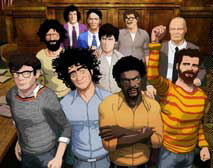
Chicago 10 director Brett Morgen joined them about halfway through the conference to talk about the genesis of his film, why he thinks a revisiting of the Chicago ’68 riots is relevant today, or at least why it should be, and to what extent his film is “political” (scary word, that) and why he decided that the first thing to get right was to make the film entertaining.

Oppressive laughter

I was writing at a table in a sports bar last night, and there was a group of five sitting nearby — four guys and a lady — who couldn’t stop laughing uproariously. Every time they burst out laughing it felt like someone had exploded an aural fart grenade….”hah-hah-hah-hahhhh!” After a while I got out my watch and started timing their frequency — no lie, the boisterous noise happened about once every 75 or 80 seconds.

Everybody explodes in laughter from time to time — it’s wonderful when this happens. But people who do it repeatedly and oppressively in a crowded room are, no offense, animals. They’re the equivalent of a guy who sits down at a communal breakfast table (which I’m sitting at right now at the Star hotel) and loudly slurps down a bowl of Raisin Bran.

Hammond on “Sunshine”

“Many inside and out of the Academy feel Little Miss Sunshine is virtually a lock for a Best Picture nomination come Tuesday,” writes Hollywood Wiretap‘s Pete Hammond. The odds, in other words, are “looking very good right now for LMS to fill the ‘small’ movie slot in Oscar’s top five. [And] people are wondering if there isn’t a sea change in the Academy; a new way of thinking and the possibility that this Little picture, which was the first serious contender out of the gate last summer and the first to send DVD screeners, could just be the last one standing around 9 pm or so on February 25th. In the kind of currently wide-open Oscar landscape we have, this scenario seems as plausible as any.”

Finke nails Grey

Nikki Finke nails Brad Grey for being a credit hog maneuverer at the Golden Globes. To approximately quote Jack Nicholson’s character in The Departed, “Nobody gives you anything — you have to take it.”

“Chicago 10”

An Associated Press story on CNN.com this morning says “it’s rare for the Sundance Film Festival to start with a documentary..and [yet] organizers say this year’s opening night film, Chicago 10, represents just the sort of bold gambit the United States’ top independent-cinema venue likes to see in its movies.” Well, okay…but Brett Morgen‘s film, to go by the various descriptions, isn’t the kind of thing Sundance programmers usually pick for the opening-night attraction. Not to my recollection, at least.

Sundance programmers have always chosen to begin the festival with a film with a thoughtful but moderate pulse — every major film festival (Cannes, Toronto) tends to do this. Totally par for the course. This makes me concerned, of course, that Morgen’s film may be thoughtfully moderate…let’s hope not.
Chicago 10 “is a film that I think at one level is really basically about risk-taking, about people who want to change the world, so in that sense, it’s inspiring,” Sundance director Geoffrey Gilmore told AP. “It speaks to what goes into the struggle for social change, which is not unlike what goes into the personal vision of independent film.”