Gay-friendly “300”

Variety critic Todd McCarthy has suggested that the key target audience for Zack Snyder‘s 300 (Warner Bros., 3.9) may be a bit broader than just your standard comic-book geek-fanboy action crowd. Warner Bros. would do well, he’s essentially saying, to launch a concurrent ad campaign with The Advocate and other gay-friendly publications.
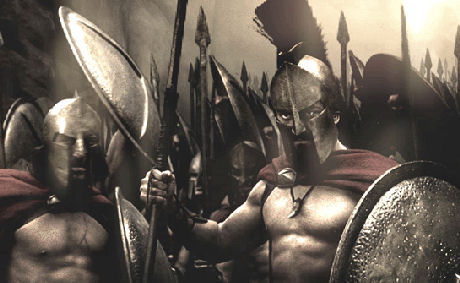
“Possibly nowhere outside of gay porn have so many broad shoulders, bulging biceps and ripped torsos been seen onscreen as in 300,” McCarthy writes, adding that this “will generate a certain bonus audience of its own. It’s not even certain Steve Reeves, the original Hercules, would have made the grade here. But then, this is Sparta, the Greek city-state where boys were separated from their families at age 7 to undergo years of training to forge a population of soldiers unmatched in strength, bravery and bloodlust.”

Right after the words “at age 7” I was expecting to read “and soon after had to be separated from older males with a crowbar” but nope.

The question, of course, is who’s the main closet case among the 300 auteurs? Snyder is the easiest guy to point to, but what about Frank Miller? What other films have been marketed as action-genre films aimed at straight males but in fact had a simultaneous homoerotic appeal to gays? Spartacus was the first sword- and-sandal pic to tap into this (47 years ago!) with the “snails and oysters” scene between Laurence Olivier and Tony Curtis.


Strauss’s “Ghost” review

N.Y. Post critic Lou Lumenick has just posted a link to the first Ghost Rider review, run by the Providence Journal. It’s a somewhat negative take from L.A. Daily News critic Bob Strauss, although he commends Nic Cage for giving “a full-blown oddball performance…more Vampire’s Kiss than National Treasure..a witty/nutso acting experiment from beginning to end.” Strauss’s review apparently wasn’t supposed to surface until 1 a.m, or eight and a half hours from now. Big deal. As if reviews matter.

Dialogue quiz #1

I could get back into running dialogue quizzes with sound files. I quit doing it before because I couldn’t hack transcribing the dialogue and then having to format it. Here’s the first one — I’ve made it deliberately easy. It won’t stay this way.

Cooper in “Breach”

Chris Cooper‘s diseased military dad in American Beauty was acid-intense, his Oscar-winning role in Adaptation was puckish and surly in all kinds of infectious ways, and his Alvin Dewey portrayal in Capote felt completely authentic. But his Breach performance as real-life FBI agent Robert Hanssen, a traitor who sold secrets to the Soviets for more than a dozen years, may be the most fascinating thing he’s ever done.

It sure felt that way to me during Tuesday night’s screening at Mann’s Chinese. Cooper takes a twisted uptight wackjob and turns him into a total “ride.” I was utterly riveted by his rigid, glaring eyes and the way his FBI-man air of impenetrability occasionally dissolves into faint twitchiness.

Cooper “carries himself with a rod-stiff posture and beetlelike precision, his face wrinkled into a permanent scowl and his voice lowered into a disagreeable bark,” writes L.A. Weekly critic Scott Foundas. “A dyed-in-the-wool agency man and devout Opus Dei Catholic, Hanssen devotes himself to work, family and God with the same ascetic rigor, sinning by night and begging forgiveness by day.

“And Cooper is the kind of actor who gets so deeply under the skin of a character that you stop thinking about a performer in a role and instead see only Hanssen and the high drama he was playing out for the better part of his career. Here is one of the best American actors in one of his best parts.”

Eckhardt as Harvey Dent

The news about Aaron Eckhart playing Harvey Dent/Two Face in Chris Nolan‘s The Dark Knight has me hyperventilating. Tommy Lee Jones played the character in the reviled Batman Forever. Pic will see the return of Christian Bale, Morgan Freeman, Michael Caine and Gary Oldman. And of course, Heath Ledger will play the Joker.


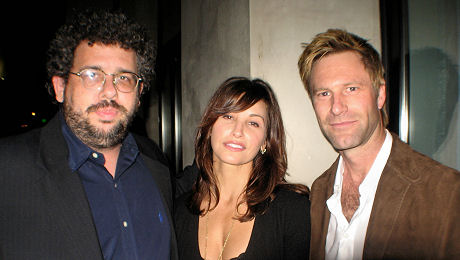
The Harvey Dent casting was probably sealed when Eckhardt (r.) posed with Gina Gershon and director-writer Neil Labute at the relatively recent Three Amigos party.

Assessing Oscar strategists

“Maybe next year only 75% of the contending films will hire the Dart Group, suddenly aware that only Cynthia Swartz‘s favorite (Crash, The Queen) will actually get a Best Picture nod out of the hire. Maybe Tony Angellotti will get a reputation for good-mouthing movies. Perhaps Michele Robertson will have a karma reversal, though I don’t know why she would. Maybe Terry Press will be the hot new consultant in town, a Jet to the Dartees’ Sharks. Could Lisa Taback push Harvey or Sony back into the Oscar winner’s circle? Perhaps Karen Fried will see what it’s like when Focus actually has a movie that could work. Could Murray Weissman, Ronni Chasen and Nadia Bronson do anything but keep delivering for their myriad clients? Will Block-Korenbrot and MPRM and BWR merge to make MMBBRKWRR?” — from David Poland‘s latest Oscar assessment column/chart, Poland’s reiterating his animus toward Tony Angelotti, whom I regard as one of the most reasonable and fair-minded Oscar strategists around (i.e., given what the game is and the way you need to play it), is strange.

“Girls” beats “Music and Lyrics”

Tyler Perry’s Daddy’s Little Girls earned about $4.5 million yesterday, about $400,000 ahead of Music and Lyrics despite the Hugh Grant-Drew Barrymore film being in more theatres. The Perry film averaged about $2150 a print while the per-screen average for Music and Lyrics (which earned $4.1 milion) was about $1405.

Zeidler’s Reuters story on Eddie Muphy

Reuters reporter Sue Zeidler writes that Eddie Murphy “has been loved, hated and ignored but now he is back with Holly- wood heavyweights rallying around him for his career-redefining turn in Dreamgirls, a role that may win him an Oscar.”

In support of this assertion she runs friendly-to-Eddie statements from (a) DreamWorks honcho Jeffrey Katzenberg (an obviously biased source who ironically provided the definitive dynamite-plunger quote about Murphy not being interesting in testing his acting abilities, i.e., “That’s just not who Eddie is“), (b) film critic and historian Leonard Maltin (who merely observes that Murphy has been “laughing all the way to the bank for years” and that “some performers are immune to criticism and [Murphy] may be one of them”), and Dreamgirls director Bill Condon (“I love working with [Murphy] because he’s so terrific”).

Murphy may well win the Oscar for Best Supporting Actor on 2.25.07, but will somebody please tell me how running supportive quotes from the afore-mentioned trio provides convincing proof that “Hollywood heavyweights are rallying around him”?

Katzenberg “dismissed suggestions Murphy was disliked or difficult,” Zeidler reports. “People trash people out of envy and self interest. Eddie Murphy has been in this business for over 25 years. The question is why now are some people anonymously blogging lies about him and trying to hurt him?” Anonymously? Who’s anonymous? And please explain, Jeffrey, what lies have been put forth in my anti-Eddie postings?

It’s not a lie, for instance, that Murphy once saw himself as a half-serious actor who might expand his talents by starring in a film adaptation of August Wilson‘s Fences. He really did do that, and he really did blow the project off when it came time to fish or cut bait. (Perhaps it was poorly written?) A guy who’s never once laid it on the line, arts gratia artis, and who’s opted time and again for the opportunity to earn some low-rent big bucks makes Murphy, in my book, a true Hollywood beelzebub — the ultimate King Turd.

Why O’Toole’s Never Won

Peter O’Toole is a perfect example of the mysterious, almost cruelly diabolical ways in which Oscar works,” writes Hollywood Wiretap‘s Pete Hammond. “A couple of people have asked us recently how it was possible that he has never have won. The answer is that each year he’s been nominated he’s had the dumb luck to be defeated by incredibly formidable, unbeatable performances.

“In 1962 he was up against Gregory Peck‘s Atticus Finch in To Kill A Mockingbird. In ’64, against Rex Harrison‘s Henry Higgins in My Fair Lady. In ’69, he faced John Wayne‘s Rooster Cogburn in True Grit. In ’72 it was Marlon Brando’s Vito Corleone in The Godfather. In ’80 he was up against Robert De Niro‘s Jake LaMotta in Raging Bull. And now he’s facing Forest Whitaker‘s Idi Amin Dada.”

Obama vs. Clinton

A Today show video report on Hollywood’s Obama vs. Clinton competition, linked by the Huffington Report.

The piece is basically saying that Barack Obama has the heat and Senator Clinton is in trouble. That much-repeated David Geffen assessment is used: “[Clinton] can’t win, she’s an incredibly divisive figure, and I think that just ambition isn’t a good enough reason.” Arianna Huffington‘s quote isn’t any kinder, observing that Clinton “is very calculating, always triangulating…you can almost smell the calculation.” And then producer Lawrence Bender completes the thought by saying, “I think people are looking for something genuine.”

That’s it, Clinton has been all but dismissed, the verdict has been rendered. Today‘s complicity in delivering said verdict without a peep or an opposing view tells you that the rank-and-file media elite isn’t very supportive of Clinton either.

Are the Oscars too elitist?

Have the Oscars become too elitist? L.A. Times guy Patrick Goldstein and John Horn get into it, but the answer is pretty clear to me: they aren’t nearly elitist enough. Elitist as in, “Mob tastes be damned.” Screw the current box-office favorites (if necessary) and celebrate the films audiences will respect 10, 20 or 50 years from now. And not the ones the Academy will eventually be ashamed of (Driving Miss Daisy, Around The World in 80 Days, The Greatest Show on Earth, Chicago, etc.).