Vitale is gone

If the guy who hired you goes down, you too will go down. Jungle law says you can’t just kill a lion — you have to also kill all the lionesses and cubs and political allies. And so Ruth Vitale, the former Paramount Classics co-president who was hired 16 or 17 months ago by the recently- whacked Henry Winterstern to run the distribution of First Look Studios, is jobless once again.

Today’s announcement follows Winterstern’s departure by about 12 days. Vitale will stay on as a First Look consultant through the end of the year. I find this stuff upsetting. For me, Hollywood execs being suddenly dropped through trap doors is no less startling or traumatic than than that cell-phone video of Saddam Hussein‘s execution, or the whackings on The Sopranos.

“Billy Budd” arrives

Bought a copy yesterday afternoon of Warner Home Video’s just-released DVD of Peter Ustinov‘s Billy Budd (1962). Black-and-white scope is one of my favorite visual formats, and what an exquisite and luscious silver-toned transfer this is — spotless, velvety smooth, ultra-crisp perfection with each carefully-lit value and tiny detail on view, and assembled exactly right.


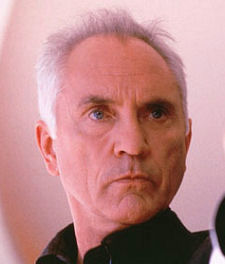
(l.) Terrence Stamp as Billy Budd in ’62; as Wilson in The Limey some 37 years later

The film itself is taut and intelligent and finely sculpted. If you have the character to get into a film that delivers in an exacting, step-by-step way and which uses the technique of just-so dialogue and characters that build and build upon themselves, it will hold you every step of the way. The dialogue is plain and straight in the way that seamen and gentlemen officers once spoke (“I’m sorry for the manner but not the matter”), but heavy with the irony and immense sadness of Herman Melville’s classic tale, which is basically about a meeting of child-like innocence and craggy evil about a British warship in the 1790s.

And the performances! Much better than I remembered them, especially Robert Ryan‘s Claggart , Melvyn Douglas‘s wise old Danish sailor (I forget the character’s name) and Terence Stamp‘s Billy — one of the more striking debut performances ever.

Johansson and Woody

I thought it was generally understood that Scarlett Johansson hurt herself pretty badly by starring in the triple black-spot whammy last year that was Scoop, The Black Dahlia and The Prestige, and that further alliances with Woody Allen feel like thin-ice excursions given the close-to-shocking atrociousness of Scoop. (Didn’t Joe Queenan write a Guardian column last fall about how Johansson is just about over? Scoop was so bad it made me think that perhaps Allen himself had lost it. He could never have made anything that bad in the ’70s or ’80s or ’90s.)

Hence, Johansson’s decision to costar in Allen’s next film, which will mainly shoot in Barcelona this summer, may be something she lives to regret. (Or the opposite. After all, Allen made one of his all-time best, Match Point, only two years ago.) Rebecca Hall, Javier Bardem and Penelope Cruz will also star. The Spain-set film will be Allen’s fourth in a row outside the U.S. The last three were shot in London — Match Point, Scoop and the upcoming Cassandra√ɬ¢√¢‚Äö¬¨√¢‚Äû¬¢s Dream, a dark, Jules and Jim-ish romantic drama that costars Ewan McGregor, Colin Farrell and Hayley Atwell.

And while we’re on the topic of Americans (and American filmmakers) shooting in Spain, remember Whit Stillman‘s Barcelona! A little too dry and reserved here and there, but overall a penetrating, almost haunting work that I only caught up with last year (at the suggestion of Mike Binder, a friend of Stillman’s).

Hitler’s Spartan Supermen

In the 3.19.07 issue of Maclean’s (which I haven’t yet found an online link to), critic Brian D. Johnson‘s lead review starts with a catchy sub-head: “No wonder Hitler loved these guys — Spartan supermen celebrate the joy of war in 300.”

“There’s something brazenly fascistic in how 300 champions muscularity, militarianism and physical purity over ugliness and disease. But then Sparta’s warrior nation was a model for Hitler’s Germany. And with its stunning choreography of shields, swords and spears, 300 plays like the bastard offspring of Braveheart and Triumph of the Will.”

Johnson notes with some fairness that unlike the Nazis, the Spartans were defending their freedom from foreign tyrants and not laying waste to the world.

“But as 300‘s messianic hero happily leads his troops into what is essentially an act of mass suicide,” he goes on, “it’s hard not to think of fascists, suicide bombers and fundamentalists who promote the righteous beauty of marching off to a perfect death.” (Thanks to D. Atkinson of Manitoba for passing this along.)

TMNT

The obvious motive in giving Kevin Munroe‘s new-age digital Teenage Mutant Ninja Turtle flick the title of TMNT (Warner Bros., 3.23) is that it sounds less odorous and sloggy. No ’90s CG technology, no guys in turtle suits, etc. Voice-actors Chris Evans, Sarah Michelle Gellar, Mako, Kevin Smith, Patrick Stewart, Ziyi Zhang and Laurence Fishburne presumably got decent-sized paychecks for their trouble. The closer is that all the press screenings on both coasts are happening at kid-friendly hours.

Denby on “Zodiac”

Zodiac is superbly made,” writes New Yorker critic David Denby, “but it’s also a strange piece of work. As [it] goes on and on, and it becomes clear that no denouement is possible (the crime was never solved), we have to ask what the reason for all this cinematic blind-alleying might be. Any honest neurotic could probably tell you: the emotional payoff of an obsession is not attaining some longed-for goal — it’s the obsession itself, which fulfills certain needs. If it didn’t, it wouldn’t be an obsession.

Jake Gyllenhaal‘s Robert Graysmith, whom no one takes seriously at first, wants to prove himself as a sleuth, perhaps, but his real need is to be absorbed in the search. For Fincher, I would guess, the identity of the killer is less important than the vast effort of almost (but not quite) finding him. He teaches us — and we absorb the lesson uneasily — that truth, like some vision that recedes as we draw near it, will never quite yield to our most ardent pursuit.

“The great film critic Manny Farber once praised what he called ‘termite art,’ by which he meant the kind of small, stubborn movie that chews its way through a narrow piece of turf. David Fincher’s Zodiac is mollusk art: the movie keeps elaborating itself out of its own discharge, hardening its emotions, anxieties, and energies into a shell of obsession.”

Top Spiritual Films

Christian Hamaker of www.artsandfaith.com has sent along a copy of a recent Top 100 List of Spiritually Significant Films. Carl Dreyer‘s Ordet at #1 for the second year in a row, and Pier Paolo Pasolini‘s The Gospel According to St. Matthew, one of my favorites, ranking at #4. Martin Scorcese‘s The Last Temptation fo Christ, which Christian claims to “loathe,” is at # 63. A film called Balthazar is ranked at #11 — I presume they’re referring to Robert Bresson‘s Au Hasard Balthazar, a film about a saintly donkey that’s obviously a Christian-spiritual parable.

“300” despised in Tehran

“All of Tehran was outraged” by 300, writes Time correspondent Azadeh Moaveni. Not just its enormous financial success, she writes, but the fact that it was made at all since it’s being seen by locals as an attempt to drum up resentment and war lust for invading Tehran.

“Everywhere I went yesterday, the talk vibrated with indignation over the film 300 — a movie no one in Iran has seen but everyone seems to know about since it became a major box office surprise in the U.S.,” Moaveni reports. “As I stood in line for a full hour to buy ajeel, a mixture of dried fruits and nuts traditional to the start of Persian new year festivities, I felt the entire queue, composed of housewives with pet dogs, teenagers, and clerks from a nearby ministry, shake with fury [about it].

I hadn’t even heard of the film until that morning when a screed about it came on the radio, so I was able to nod darkly with the rest of the shoppers, savoring a moment of public accord so rare in Tehran. Everywhere else I went, from the dentist to the flower shop, Iranians buzzed with resentment at the film’s depictions of Persians, adamant that the movie was secretly funded by the U.S. government to prepare Americans for going to war against Iran.

“Otherwise why now, if not to turn their people against us?” demanded an elderly lady buying tuberoses. “Yes, truly it is a grave offense,” I said, shaking my own bunch of irises.

“I returned home to discover my family in a similar state of pique. My sister-in-law sat behind her laptop, sending off an e-mail petition against the film to half of Tehran, while my husband leafed through a book on the Achaemenid Empire, noting that Herodotus had estimated the Persian army at 120,000 men, not one million as the film claimed. The morning newspaper lay on the table with the headline “300 AGAINST 70 MILLION!” (the population of the country). It was echoed by the evening news: “Hollywood has opened a new front in the war against Iran.”

“The timing of the computer-generated film, which depicts the ancient confrontation of Sparta and the Persian empire at the Battle of Thermopylae, is certainly inauspicious. It falls on the eve of Norouz, Persian new year, a time when Iranians typically gather in proud celebration, observing rites that date back over 3,000 years, way before Islam, to the age of Zoroastrianism, when their ancient land produced the world’s first monotheistic religion.

“t is not a particularly welcome season to be portrayed as pillaging, deranged savages. Since the entire country will be on two weeks of official holiday, there will be no shortage of time to sit about discussing the slight and what it portends for Iran’s current confrontation with the United States. For a people prone to conspiracy logic, the box-office success of 300, compared with the relative flop of Alexander (another spurious period epic dealing with Persians) is cause for considerable alarm, signaling ominous U.S. intentions.

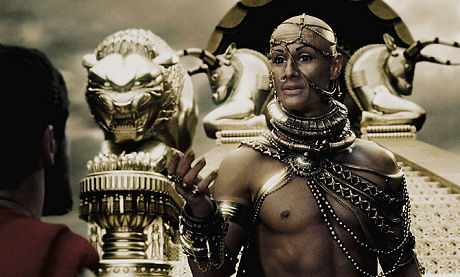
“Top officials and parliament have scorned the film as though it were a matter of state, and for the first time in a long while, taxi drivers are shaking their fists in agreement when the state news comes on. Agreeing that 300 is egregious drivel is fairly easy. I’m relatively mellow as Iranian nationalists go, and even I found myself applauding when the government spokesman described the film as fabrication and insult. Iranians view the Achaemenid empire as a particularly noble page in their history and cannot understand why it has been singled out for such shoddy cinematic treatment, as the populace here perceives it, with the Persians in rags and its Great King practically naked.

“The Achaemenid kings, who built their majestic capital at Persepolis, were exceptionally munificent for their time. They wrote the world’s earliest recorded human rights declaration, and were opposed to slavery. Cuneiform plates show that Persepolis was built by paid staff rather than slaves And any Iranian child who has visited Persepolis can tell you that its preserved reliefs depict court dress of velvet robes, and that if anyone was wearing rags around 500 B.C., it wasn’t the Persians.

“It is going to take an act of foolhardy courage to distribute that film in Iran. It will truly be 70 million against 300.”

Wank CGI Snyder

“My movie is more like an opera than a drama. That’s what I say when people say it’s historically inaccurate. You have to understand the convention I’m working in. Everything is at 11.” — 300 director Zack Snyder speaking to MTV.com’s Josh Horowitz.

HE comment: Exactly! Snyder has brilliantly nailed what’s thick and heavy-smoke oppressive about innumerable graphic-novel type films that are primarily about whoa-cool-dude visuals — they’re cranked up to 11, which delivers a certain spirit-bludgeoning, can’t-miss-it-unless-you-happen- to-be-overdosing-on-heroin awesomeness. But “11” is not what life is like. “11” is the universal wank-crank aesthetic of all CG-for-CG’s-sake movies.

Same goes for “10” or “9,” even. Even on an ancient battlefield and even if you’re a manic depressive, most of life tends to happen at intensity levels of “7” or “8”…maybe. For some it’s down to levels of “5” or “6.” It’ll occasionally surge up to “9” or “10” but only in flashes. (Great hand-of-God sex can put you into a “9” or “10” level experience, but I would imagine most people schtup on a “5” or “6” level, at best — especially if the guy is under 20 and has chugged eight or nine beers.) Being in a head-on car collision is a “10”; ditto creating something really exceptional; ditto being in the midst of a bad drug deal like Mark Wahlberg‘s experience in Boogie Nights.

But in the movie-movie worlds of Zack Snyder and other filmmakers who think and dream like him, “11” is the most desirable place to be — a fantasy realm defined and digitally composed by ejaculatory fakery.

Matters of Faith and Spirit

During my London-fog period of a couple of days ago, Salt Lake City Weekly film critic Scott Renshaw ran a noteworthy piece on Bilge Ebiri‘s Screengrab, voicing a view that “serious-minded filmmakers need to begin tackling issues of spirituality, in order not to leave it to the hacks.”

HE response: The finest all-time films have always been about spiritual connections between wayward mortals and something eternal or transcendent (like Anthony Quinn‘s moment on the beach at the very end of La Strada), but serious filmmakers need to stay away, far away, from films about faith or religion. Leave faith films to the hacks (i.e., the purveyors of the mostly conservative, faith-based market), which is where they belong.

“The reason that Fox Faith and its slate of noxious innocuousness can exist is that there’s a vacuum to be filled,” wries Renshaw, “in case The Passion of the Christ and the success of [the gross and ghastly] Tyler Perry had not made that excruciatingly clear. Mainstream cinema generally seems scared to death of dealing with religion or faith in any way, for fear of giving offense.” Quite so! And for good reason.

“How many fingers does it take,” Renshaw asks, “to count the number of fiction films you’ve seen in the last 15 years, even in art houses, where a character’s religious beliefs played a significant role in the events?”

And how many times has it been repeated that there’s a huge whopping difference between people who feel the only true path to communion with all things Christian and eternal is through “faith” (a word pretty much owned by American heartland types) and through established religions with tax-deductible status, and the free-thinking, stand-alone satori crowd — i.e., the spiritual seekers, mystics and knowers who feel that anyone who uses the word “faith” in the first place is going “baaaah” and doesn’t really get it in the first place?

Apart from being inclined to wear vaguely uncool hair styles and clothing from Target and J.C. Penney-type stores, people who are into “faith” are, I believe, good-hearted souls who, for the best of reasons, are basically into submission and, in a manner of speaking, a kind of spiritual cluelessness.

Faith people are basically saying the same thing in cultures around the globe, which is this: in order to derive a sense of spiritual comfort, I am committed to regularly proclaiming a belief in a wondrous and eternal realm that I can’t see or touch but which I believe lies on the other side of the door. I am but a lamb but proudly so, knowing as I do that God wants me to maintain a certain devotional ignorance. It is not my task to truly know, much less commune with, cosmic wonders and truths.

But a true mystic and spiritualist, someone who feels a greater kinship with (take your pick or make your own list) the writings of Herman Hesse, Aldous Huxley and Alan Watts than, say, the stiff-necked, drop-your-money-in-the-collection- plate creeds of traditional Catholics or Baptists or right-wing evangelists — that liberal-minded person regularly communes with and in fact knows — has savored, tasted, swum in — the spiritual nectar of that realm beyond the door. The interconnected cosmic totality of it all resides within, and both sides of the door are equal parts of the equation. And either you’ve been there and are living there right now, or you haven’t and you’re not.

Faith, in short, is for spiritual pikers — believers in ritual and community and constancy who sense a certain cosmic order and altogetherness but haven’t really formulated it, and in some cases would even prefer not to. There’s nothing wrong in the least with being an adherent of this or that religion — anything the least bit soul-nourishing or soul-sustaining is obviously good to clasp to one’s breast — but faith is for the flock and true mystical God-knowledge is for the shepherd.

The only way I’ll accept a film about a spiritual matter or river of any sort — a depiction, say, of the life of Yeshua of Nazareth, to name but one topic — is if it’s directed by an artist who would rather listen to late ’90s Limp Bizkit or John Coltrane than go to church on Sunday. Pier Palo Pasolini‘s The Gospel According to St. Matthew is my kind of spirit movie. Or Martin Scorsese‘s The Last Temptation of Christ, which the hard-core faith types, fired by their charming righteous certainty, demonstrated against in 1988 outside of movie theatres.

That idiotic response to Scorsese’s film opened my eyes to the essential blindness and bigotry of conservative Christianity, which, as we all know, is a very powerful social force in Salt Lake City. Which is why I (and hundreds of others, I’m fairly sure) quickly discounted Renshaw’s piece when it first appeared on Screengrab. It’s impossible not to suspect that he’s picking up on that SLC vibe and trying to run with it in an erudite film critic-type way. If the piece had been written by, say, a Hassidic Jew from Manhattan’s Lower East Side, I would have seemed a different matter.


Tribeca peeps

If I hadn’t been slogging around in a kind of slow-motion gelatinous London membrane yesterday, I would have posted Stu Van Airsdale‘s early-bird Reeler posting about some of the ’07 Tribeca Film Festival selections. such as: (a) Angelina Jolie‘s A Moment in the World, a documentary that’s most likely about her U.N.-sponsored humanitarian efforts (and is apparently her behind-the-camera debut); (b) Lucky You, the trouble-plagued, endlessly delayed Curtis Hanson gambling movie with Eric Bana, Drew Barrymore and Robert Duvall; (c) Spider-Man 3…please; and (d) the feature directing debut of Limp Bizkit’s Fred Durst of Limp Bizkit, called The Education of Charlie Banks.