Bauer Martinez on the ropes?

“I learned that if you don’t want fleas, you don’t lie down with dogs….but there are only so many distributors out there.” The speaker is producer Aaron Ryder (The Amateurs ), the subject is producer Philippe Martinez, head of the troubled distribution company Bauer Martinez; and the forum is an L.A. Times piece by reporter John Horn.

Some of the same Martinez material was covered in a 10.26.06 Sharon Waxman piece in the N.Y. Times, particularly the fallout from his allegedly not living up to promises he’d made about promoting Harsh Times. Horn also discusses The Flock, a Bauer Martinez movie starring Richard Gere, and another one called I Could Never Be Your Woman starring Michelle Pfeiffer.

Horn also reports that Bauer Martinez has pacted with Die Hard‘s John McTiernan “to direct the $50-million Hayden Christensen action movie Crash Bandits ” and that it “said it would spend $850,000 for the adult film comedy The Amateurs, starring Jeff Bridges.”

Last October, in response to the Waxman piece, I wrote the following about the Martinez syndrome: “Time and again Hollywood types — directors, producers, studios — get into business with oily foreign guys (European or Israeli) who tend to live high and swagger around and smoke cigars. The Hollywooders are always interested because there are always fresh oilies looking to buy their way into the business, and they’ll hook up with almost anyone with a connected rep in order to do so. Elie Samaha, Giancarlo Peretti, Jean-Marie Messier, Bob Yari, Menahem Golan, Yoram Globus, Avi Lerner, etc.

“Yari has been doing pretty well for himself lately (The Illusionist is a hit), but sooner or later the matters of oily men always seem to turn sour or go south. Hollywooders who make movies with them always seem to regret it, sooner or later. ”

And yet I’ve seen The Amateurs, which the IMDB says has been retitled The Moguls, and can sympathize with Martinez not wanting to go the distance for it, despite what Ryder may say. A friend of the film could call it quirky or mildly amusing, but it’s just not very good.

Quentin Grind

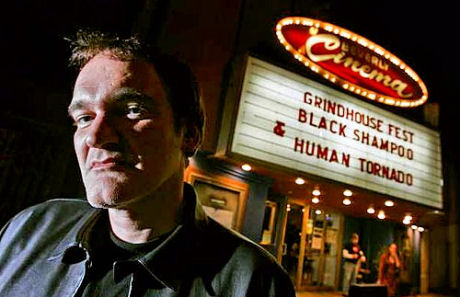
To promote/salute Grindhouse (Weinstein Co., 4.6) in the Los Angeles area, Quentin Tarantino is programming the New Beverly Cinema with so-sleazy-they’re-hip-in-retrospect exploitation films. A double-feature every two or three days, playing now through May 1st — and just about every one a diposable wank except for Roger Vadim‘s Pretty Maids All in a Row (1971), which shows 3.25 through 3.27. (Rock Hudson as a high-school teacher and lecherous poon-hound, plus one or two nude Angie Dickinson scenes….I’m there.)

When and if these films ever get released as a Tarantino-approved DVD box set, I wonder if I’ll care enough to even rent one or two.

Has Tarantino ever sat down and written a definitive manifesto that explains what it is that he finds so wonderful about these films? The thing he worships about them, I think, is their low-rent vitality and lack of pretension, and (I guess) the occasional standout performances. They have all that, yes (if you want to be generous), but they’re not about anything the least bit internal or profound.

Tarantino is a lazy wallower — an attitude huckster, an iconographer, a street- corner smart-ass. Inherent in this is a disinclination to believe in (much less seek out) art or transcendence — in any sort of practice or exercise or canvas-splattering that tries to imagine a world beyond the mundane.

There’s nothing wrong with wallowing in and of itself — I like to go there from time to time, and I’ll probably enjoy Grindhouse when it comes out — but celebrating ’70s grindhouse films as brash and nervy and better than people realized at the time….I don’t know. I think it’s basically horseshit.

Malicious doc

World discourse will never lack for intellectual stimulation as long as there is strong diversity of opinion. It’s a slightly different equation when you’re dealing with documentarians living in states of profound denial, and spreading their disease to millions, like the flu. “Sad” is not a word that comes to mind — “malicious” says it better.

Weekend box-office

Wild Hogs wailed at the box-office this weekend while Zodiac struggled. The consistency in supporting and back-slapping low- brow entertainments straight out of the gate (i.e., as long as they feel familiar and amiable-friendly) is what sets Americans proudly apart from other cultures. (Is there another big-time industrial western society as blue-collar oafish as ours?) A slovenly homophobic movie about four pot-bellied male menopausers on motorcycles handily kicks the ass one of the unquestionably great early films of ’07…as it should be! Yeah!

It was obviously in the cards for Zodiac to come in second — I was just hoping against hope that it would do more like $14 or $15 million. My new dream is that it’ll drop a lot less than Hogs does next weekend.

The yaw-haw Disney flick costarring John Travolta, Tim Allen, Martin Lawrence and William H. Macy played in about 900 more theatres than Zodiac did, and wound up with $38 mil lion, give or take. Zodiac, playing on 2,362 screes, ended up with $13.1 million and a per screen average of $5,546.

Ghost Rider dropped 43% to the #3 position…what, non on DVD yet? Paramount Vantage’s Black Snake Moan, a tasty, morally positive gridhouse drama (liked it quite a bit at Sundance), came in eighth place with just over $4 million on 1252 screens, averaging $3,208 — hey, not as good as Zodiac‘s!

Plotzing Saturday

Apologies to all, but today was one of those vroom-vroom motorcycle Saturdays. I guess I figured after erranding and plotzing and then running around all morning and then hiking in the mid to late afternoon out in Malibu Canyon it’s better to let things lie for a day….just one day…and then jump back in Sunday morning.

Metacritic “Zodiac” plunge

A few Zodiac dissenters — Wall Street Journal‘s Joe Morgenstern, Salon‘s Stephanie Zacharek, Washington Post‘s Stephen Hunter, N.Y. Daily NewsJack Matthews, Chicago Reader‘s Jonathan Rosenbaum, Austin Chronicle‘s Marjorie Baumgarten — have weighed in, and the Metacritic score has resultantly plunged to 77% positive. This calls for some kind of congregational ceremony. How about David Poland‘s on Sunday for beer, hot dogs and potato salad?

Sinno disses Seinfeld

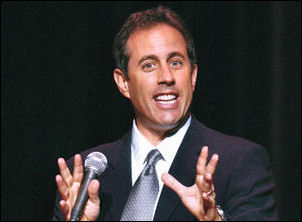
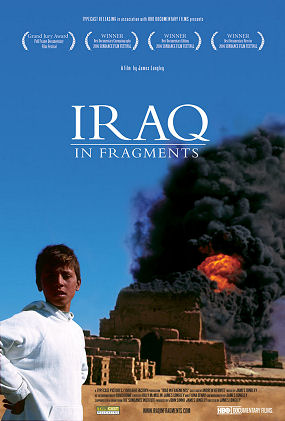
Does this justifiably pissed-off letter from John Sinno, producer of the Oscar-nominated feature-length doc Iraq in Fragments, complaining about Jerry Seinfeld‘s having referred to the five nominated docs on last Sunday’s Oscar telecast as “incredibly depressing,” increase or decrease the possibility that Seinfeld might be hired to host next year’s Oscars? Or does anyone care how ticked off Sinno and other doc makers might be? People laughed at Seinfeld’s joke, after all.

They shouldn’t have, and they damn well should care. Seinfeld not only dissed the docs and their makers — he flat-out lied. The better-made docs don’t depress you — they get the blood going. There’s at least the same amount of narrative punch, thematic weight and genuine emotion in a typical well-made doc as can be found in most mainstream features these days, if not more so. Docs are what you pop into the DVD player when you want to feel something real, when you want to flush the crap out.

“I had the great fortune of attending the 79th Academy Awards following my nomination as producer for a film in the Best Documentary Feature category,” Sinno begins. “At the Awards ceremony, most categories featured an introduction that glorified the filmmakers’ craft and the role it plays for the film audience and industry. But when comedian Jerry Seinfeld introduced the award for Best Documentary Feature, he began by referring to a documentary that features himself as a subject, then proceeded to poke fun at it by saying it won no awards and made no money. He then revealed his love of documentaries, as they have a very “real” quality, while making a comically sour face.

“This less-than-flattering beginning was followed by a lengthy digression that had nothing whatsoever to do with documentary films. The clincher, however, came when he wrapped up his introduction by calling all five nominated films “incredibly depressing!”

“While I appreciate the role of humor in our lives, Jerry Seinfeld’s remarks were made at the expense of thousands of documentary filmmakers and the entire documentary genre. Obviously we make films not for awards or money, although we are glad if we are fortunate enough to receive them. The important thing is to tell stories, whether of people who have been damaged by war, of humankind’s reckless attitude toward nature and the environment, or even of the lives and habits of penguins.

“With his lengthy, dismissive and digressive introduction, Jerry Seinfeld had no time left for any individual description of the five nominated films. And by labeling the documentaries ‘ncredibly depressing,’ he indirectly told millions of viewers not to bother seeing them because they’re nothing but downers. He wasted a wonderful opportunity to excite viewers about the nominated films and about the documentary genre in general.

“To have a presenter introduce a category with such disrespect for the nominees and their work is counter to the principles the Academy was founded upon. To be nominated for an Academy Award is one of the highest honors our peers can give us, and to have the films dismissed in such an offhand fashion was deeply insulting. The Academy owes all documentary filmmakers an apology.

“Seinfeld’s introduction arrived on the heels of an announcement by the Academy that the number of cities where documentary films must screen to qualify for an Academy Award is being increased by 75%. This will make it much more difficult for independent filmmakers’ work to qualify for the Best Documentary Feature Award, while giving an advantage to films distributed by large studios. Fewer controversial films will qualify for Academy consideration, and my film Iraq in Fragments would have been disqualified this year. This announcement came as a great disappointment to me and to other documentary filmmakers. I hope the Academy will reconsider its decision.

“On a final note, I would like to point out that there was no mention of the Iraq War during the Oscar telecast, though it was on the minds of many in the theatre and of millions of viewers. It is wonderful to see the Academy support the protection of the environment. Unfortunately there is more than just one inconvenient truth in this world. Having mention of the Iraq War avoided altogether was a painful reminder for many of us that our country is living in a state of denial. As filmmakers, it is the greatest professional crime we can commit not to speak out with the truth. We owe it to the public.

“I hope what I have said is taken to heart. It comes from my concern for the cinematic art and its crucial role in the times we’re living in.”

Wilson-Plame thriller

That Warner Bros.-funded movie about the political firestorm that happened when Bush White House higher-ups decided in ’03 to get Ambassador Joseph Wilson by outing his wife Valerie Plame as a CIA agent….this could be a seriously gripping All The President’s Men-type thriller. If the screenwriters — Jez and John Butterworth — and the producers — Akiva Goldsman, Jerry and Janet Zucker — decide to portray what really happened and not pussyfoot around.

That means they need to go with good colorful villainy (they obviously have to work Karl Rove in as the opportunistic maestro) and they need a solid hero figure to oppose the Bush baddies. I see Tom Hanks as Wilson, Robin Wright Penn as Plame and Ned Beatty as Cheney. Any suggestions for Scooter, Rove, Bush, etc.?

Variety‘s Michael Fleming is reporting that WB “has secured the life rights of Plame and Wilson. Studio also will use Plame’s memoir, Fair Game, if the CIA permits her to publish it. Plame made a reported publishing deal in the $2.5 million range last year, and Simon & Schuster is expected to publish late this year.

“While it would be ironic for Plame’s story to be illegally leaked by the White House, only to have another government branch deny her the right to tell it herself, the CIA has the latitude to silence Plame.

“She left the agency in late 2005 and she and Wilson have filed a civil lawsuit against Vice President Dick Cheney, Karl Rove and Lewis “Scooter” Libby, the former chief of staff for Cheney who’s currently on trial, defending himself against charges of perjury, obstruction of justice and lying to FBI agents who were investigating the leak of Plame’s identity to journalists.”

“Black Book,” Verhoeven

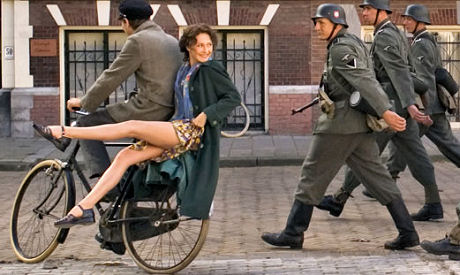
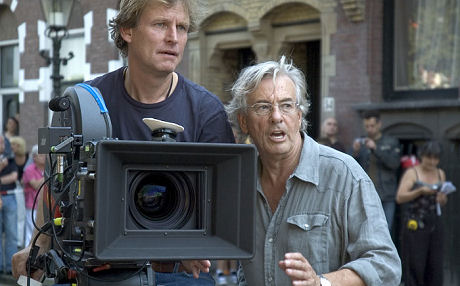
A curious blend of wartime realism, undercover- spy suspense and almost exploitation-level sexuality, Black Book (Sony Pic- tures Classics, 4.4 in NY and LA) is Paul Verhoeven‘s strongest and most fully-felt film since Robocop (’87) and before that Soldier of Orange (’77). This World War II thriller — a surprise — is one of the three genuinely first- rate ’07 films so far, along with Zodiac and The Lives of Others.


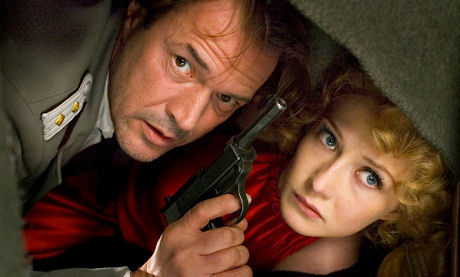
Sebastian Koch, Carice Van Houten in Paul Verhoeven’s Black Book

Set in late 1944, it’s basically a revenge piece — a saucy Dutch lady named Rachel Stein (Carice van Houten) bonds with the Dutch resistance in order to stick it to the Nazis who murdered her parents in cold blood. (For profit, as it turns out.) She goes undercover as a worker at SS headquarters, and eventually as the lover of a local SS commander (Sebastian Koch), which is further complicated when she falls for the guy in earnest.

It was a smart move for Verhoeven to return to the Dutch turf from whence he came. It obviously made sense from a spiritual as well as a “back to roots” perspective. Over the last 20 years he’s been one of the biggest envelope-pushers in the realm of the salaciously sexual (Basic Instinct, Showgirls) and the ultra- violent (Starship Troopers, The Hollow Man), but there’s been a sense for some time that Verhoeven’s well has been running dry. I said to myself a long time ago (somewhere between Showgirls and Starship Troopers) that he’s probably “over” — wrong!

Black Book is a stab in the direction of Roman Polanski‘s The Pianist — a WW II drama partly fuelled by Verhoeven’s own experiences while growing up under the Nazi occupation.

Black Book is tight and well-crafted and finely tuned, but yet it’s clearly a cranked- up thing. It doesn’t strive for the stark realism or solemnity of The Pianist — it’s an entertainment about intrigue, sex, betrayal and the constant possibility of sudden violent death at the hands of the bad guys.

And even that’s not what it seems. There are one or two plot turns that remind us that even in World War II, one of the most clear-cut, good-vs.-evil conflicts of the 20th Century, filthy lucre rules and the defining of good vs. evil will always flow from that.

Verhoeven’s feverish plotting and energetic shooting and cutting keep it all going, and Van Houten’s spunk and sexiness provide much of the flavor and panache, Black Book has a few sex-and-nudity scenes (par for Verhoeven) and that’s always agreeable, although the notion of hot bods and fired-up loins argues strenuously with the horrific realities of Nazi-occupied Holland. In my head, at least.

Koch, the conflicted playwright in The Lives of Others, plays a decent Nazi who’s lost his family and has succumbed to a resigned sadness about the scheme of things, and hence a kind of humanity. (Buy it or don’t.) Halina Reijn, who plays Rachel’s sexually active friend (she’s the lover of a flabby-bellied Nazi pig), holds her end up nicely.

I just wish I could find a website that tells the real story, or the one that inspired Verhoeven and co-writer Gerald Soeteman to write the Black Book screenplay.

Minkler apologizes

A lot of heat has been coming down on sound-mixer Michael Minkle for dissing sound-mixer Kevin O’Connell who’s been Oscar-nominated and lost 19 times, last Sunday night during an Oscar press conference. “I think Kevin should go away with 19 nominations,” he said. “Kevin is an okay mixer, but he should take up another line of work.”

A lot of industry people have voiced anger at Minkle for these words. Editor Walter Murch allegedly sent out an e-mail yesterday condemning Minkle for his words, and now Minke himself has sent out an e-mailed apology (which was sent to be by a big-city reporter who wants anonymity):

“Gentlemen, Friends, and Colleagues,

“A very unfortunate situation has developed because of my stupid answers to some inappropriate questions. I did not seek this spotlight√É‚Äö√Ǭ≠ — the press did, as they have in the past. It was wrong of them to ask the questions, and wrong, wrong, wrong of me to answer them the way that I did.

“I apologize to all of you for creating a messy situation, and exposing the appearance of any dissention among our ranks.

“The press has been asking me questions about Kevin since 2002. They continue to hound me with the same questions again and again, and this time I lost control, using bad choices of words and bitter sarcasm. The award should be about the work—period.

“It is always my concern to preserve the Oscars’ significance to the filmmaking community and its international audience. My thoughts got away from me at an emotional time, and that I regret.

“My response to the last question was off-the-cuff sarcasm meant as humor. However it seems that it has caused even greater reaction…shock. I wanted to end the questioning and those words came out. Not funny. I am very sorry. The time and place was wrong for any of it.

“Adding sentiment to this unfortunate situation has of course been the sorrowful passing of Skippy O’Connell.” (He means Kevin O’Connell’s mom, who died last Sunday night.) ” My sincere condolences go out to the entire O’Connell family.

“I have been in communication with Kevin directly, and I wish the best for him in the future. I am sure that he will receive his due recognition on that same stage very soon, and I will be the first to congratulate him.

“In my career, I’m sure that I have accidentally hurt people, but I’ve never intentionally sought to do harm. I ask forgiveness from them. I have given shots and taken some, but I don’t believe that at any time, true malice was the objective.

“I appreciate you sharing your personal thoughts with me, as I always have. I now thank you for allowing me to share mine with you.

“Respect to all, Michael Minkler