Lurie remaking “Dogs”

Rod Lurie‘s intention to remake Sam Peckinpah‘s 1971 classic Straw Dogs is perhaps the most inspired idea he’s ever had as far as movie-directing material is concerned. Lurie is a bit of a tough guy and a man’s man (as anachronistic as that may sound), and I’m betting that he understands better than most what makes the original Dogs a great (certainly a near-great) work.
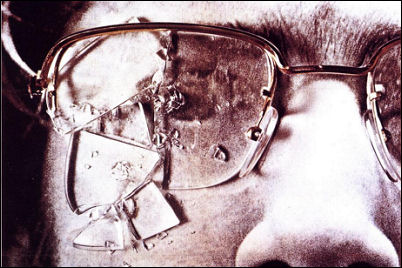
The story, based on a book called “The Siege of Trencher’s Farm,” strikes all kinds of primal macho chords, all of them tethered to the territorial imperative (i.e., the defense of one’s wife and home, and the small-town repelling of exotic invaders). I know that I’ve never felt so aroused and “with” the violence in any film as I have with Peckinpah’s original, which costars Dustin Hoffman and Susan George .

At the very least Lurie’s effort will inspire everyone to re-watch and re-assess the original, which is the second or third-best Peckinpah film ever made (after The Wild Bunch and Ride The High Country). The downside, of course, is that Lurie is asking for trouble. The odds are not overwhelming that he’s going to out-point or out-gun Peckinpah’s version (it being so perfectly cast, so beautifully edited, so full of ominous vibes). Lurie might be able to match the original, but any director would have a difficult time making a better film. But I respect Lurie’s courage in deciding to do it anyway.
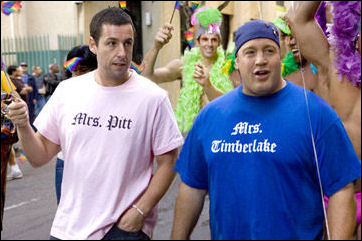
I Now Pronounce You Chuck and Larry

The trailer for I Now Pronounce You Chuck and Larry (Universal, 7.20.07) strongly indicates that the film is another New Homophobia comedy (and therefore a bit of a groaner going in) but also that it might be pretty funny. Or at the very least, a lot funnier than the second and third acts of Evan Almighty.


Adam Sandler, Kevin James

Diller vs. idiot savants

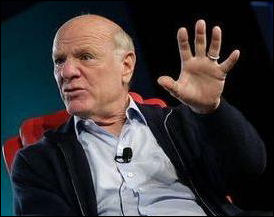
“I’m not damning content by ordinary folk,” says Barry Diller on this Financial Times q & a, as posted by Nikki Finke. “I’m just saying, if you want to reach large audiences then rely on professionals, meaning people who are in the industry and are trained for it, rather than just idiot savants.


Barry Diller

“If you have your little photos of your really darling tiny children, they’re interesting to you and your family and a few others, but not that interesting to that many people. Things that resonate widely — that make successful television shows, successful movies and like that — will be done by people who are really good at it.”

Reaction: This statement is basically true, but it’s also one of the first seriously- behind-the-curve views attributed to Diller that I’ve ever read. The era of the passive viewer doing nothing but soaking up the genius of elite artists is over, and idiot savants — cyber douchebags, jackasses, chatroom big-mouths, YouTube mashers, and various obnoxious mamas and braying babas — are as big as the professionals in our entertainment universe these days.

Sometimes I think that the dribblings and droppings of idiot savants might one day constitute the bulk of the ballgame. I shudder at the thought — who wants to live in a world undefined and unmarked by impassioned artist-confessors and gifted ivory- tower iconoclasts? — but Diller’s statement makes it sound like he’s not seeing what’s really going on these days. We are living right now in an age of file-shar- ing, opinion-sharing democracy like nothing this country has ever seen or dreamt of. Honed creations and practiced performances will always provide the greatest nutritional benefits, but one good result of the general downward swirl of things is that the inmates are running the asylum, and Bedlam Is Us.

Russell’s legacy vs. Doug Wick

David O. Russell will adapt and direct Sammy’s Hill, a film based on Kristin Gore‘s chick-lit, inside-the- Washington-beltway book about a single woman coping with romantic and job-pressure issues, and that’s good news all around. People forget from time to time how good Russell can be, and that real talent mitigates bad behavior. (My view is that loud profane arguments are not a problem if you’re up against Russell — the problem is when the yellers are second- and third-raters.)

But producer Doug Wick struck exactly the wrong chord when he told THR‘s Tatiana Siegel that Sammy’s Hill “will do for Washington, D.C., what Talladega Nights did for race car driving.”

What WIck should have said (and what I hope to God he really meant) is that Sammy’s Hill will do for Washington, D.C. relationships and power games what Russell’s Flirting With Disaster did to illuminate late ’90s relationships and anxieties. You really can’t get farther away from the smart, subversive spirit of David O. Russell than to mention an oafish, blue-collar comedy like Talledega Nights…I mean, c’mon.

“We are going for a bold, subversive comedy,” Wick elaborated, “and David O. Russell is one of the most original voices working in comedy.” Fine and good.

Russell is “working closely” with Kristin Gore (i.e., Al Gore‘s daughter), Dave Jeser and Matt Silverstein on the screenplay, writes Siegel. Wick and Lucy Fisher are producing. Sony suits Matt Tolmach and Rachel O’Connor are overseeing for the studio, and Rachel Shane is “shepherding” the project (i.e., she personally relates to the book, knows Gore, provided the relationship hook-up, urged the optioning/buying of rights) for Wick and Fisher’s Red Wagon.

Tribeca Film Festival costs too much

“The price of a ticket at the emerging Tribeca Film Festival is increasing by 50% this year,” reports Indiewire’s Eugene Hernandez. “While most tickets for last year’s festival were sold for $12, this year tickets for the majority of screenings are priced at $18” — a higher per-ducat price than at any other major American film festival .” The TFF launched on the spirit of downtown recovery from 9.11.01, but now it has a new rep — the nation’s most avaricious and money-grubbing film festival.

“The price of seeing a movie at the Tribeca Film Festival is increasing dramatically in an area of New York City where the cost of daily life seems to be on a continual incline,” Fernandez writes. “The cost is higher than all other festivals in major American urban cities but perhaps not totally surprising to those who face some costly cultural event prices in New York City where a ticket to MoMA infamously hit $20 and the price of a ticket to a Broadway show often exceeds $100.”

It’s not the surprise — it’s the arrogance. Not the $18 tickets in and of themselves (although $18 per ticket definitely sucks) as much as the 50% bump over last year’s prices and the accompanying greed-head vibe overtaking the festival’s founding spirit

More Cannes speculation

The official lineup for the 2007 Cannes Film Festival (5.16 through 5.27) won’t be revealed until 4.19, but Cineuropa is reporting that “according to different sources,” the event will open with Wong Kar Wai‘s My Blueberry Nights and close with David Fincher‘s Zodiac, with Francis Coppola‘s Youth Without Youth expected to join Steven Soderbergh‘s Ocean’s Thirteen as an out-of-competition title.


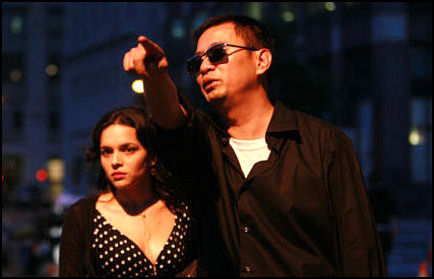
My Blueberry Nights star Norah Jones (l.) with director Wong Kar Wai. The English-language romantic drama costars Jude Law, Natalie Portman, Rachel Weisz, David Strathairn, Tim Roth and Ed Harris.

I ran a Peter Howell-inspired piece a few weeks ago that covered a lot of the same likelies and maybes. The only thing I missed earlier is the relatively fresh news that a longer version of Quentin Tarantino‘s Death Proof will be shown as a stand-alone feaure.

Potential Golden Palm contenders, in the view of Europa’s editor[s], include Denys Arcand‘s Age of Innocence, Todd HaynesI’m Not There, Joel and Ethan Coen‘s No Country for Old Men, Hou Hsiao Hsien’s Ballon rouge, Gus Van Sant‘s Paranoid Park and Emir Kustarica‘s Promise Me This.

Other distinct possibilities include Takeshi Kitano’s Kantoku Banzai, Im Kwon-taek‘s Beyond The Years and Carlos ReygadasSilent Light.

.

The Europa item says that “an air of uncertainty” hangs over Woody Allen‘s Cassandra’s Dreams, Sean Penn‘s Into the Wild, Michael Moore‘s Sicko and Michael Winterbottom‘s A Mighty Heart. Hey, what about Martin Scorsese‘s Rolling Stones documentary?

Papa and the Kraut

“The thing about the Kraut and me is that we have been in love since 1934, when we first met on the Ile de France, but we’ve never been to bed. Amazing but true. Victims of unsynchronized passion.” — Ernest Hemingway to biographer A.E. Hotchner on his never-consummated love affair with Marlene Dietrich, as regurgitated in this N.Y. Times piece by Ashley Parker about some “racy letters” from Hemingway to Dietrich that will soon be unsealed.

Coddling Quentin Tarantino

“Quentin works when he wants to,” Harvey Weinstein says to Anne Thompson in her latest Variety column. “There’s no pressure from us to work at all. It’s better when he’s excited about something. He blends his life and his art. He’s not a journeyman director. He doesn’t have to make a movie every year.”

No pressure? Wanton unstructured types like Tarantino secretly crave it deep down. If Harvey and brother Bob were able to somehow force Tarantino to crank out a movie every eighteen months or two years (instead of one every three or four years, which is his average so far), it would check his natural wank-off tendencies and shape him into being a much more commanding and refined filmmaker. This discipline might even goad him into writing and directing something that’s not a knockoff or a genre riff. (I know, I know — we’re talking about Tarantino here.)

Infantilization of everything

Yesterday’s collapsing-values, fall-of-the- Roman-empire statement came from former DreamWorks marketing ace Terry Press: “Everybody knows that culturally, kids rule the roost. The numbers for kids and the age they adopt things like iPods (and) cell phones…all show that kids are growing up faster. If you make records or something you want consumed in the culture, you have to resonate with kids.” She’s right, of course, but an entertainment culture that caters first and foremost to toddlers, tweeners and young teens has opted for dilution and marginalization and essentially removed itself from the hallowed circle. This is a tired old gripe. I know I need to grow up and embrace the infantilization process. Please forgive the foot-dragging.

“The Silence”

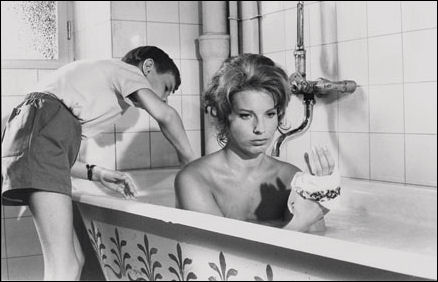
No arguments with the choices of the Nerve.com team for the Most Important (i.e., brazen, influential, talk-stirring) Nude Scenes of all time, but most of us recognize that nude scenes are about “importance” second and erotic intrigues and arousals first. The good ones are, at least. And in this sense Ingmar Bergman‘s The Silence has almost no parallel. Sven Nykvist‘s black-and-white photography of the sultry, vaguely self-disgusted Gunnel Lindblom in various states of undress in that downtown hotel room (and bathroom) is the stuff that lifelong dreams are made of.