Deathly Hallows spoilers

Certain readers have actually said they’re actually going to avoid this site come July 21st because they’re certain I’m going to spoil the ending of J.K. Rowling‘s Harry Potter and the Deathly Hallows, which will go on sale just after midnight. They need to brace themselves for shocking news. The media world en masse is going to spoil the ending. You can disconnect your TV and your computer and wear earmuffs on your way out to your rented cabin in northern Idaho with your car radio shut off, and Harry’s fate will find you out.

As N.Y. Times “Paper Cuts” blogger Dwight Garner wrote this morning, “The journalistic onslaught is…just… beginning.” I especially like this quote from a recent Stephen King column about the book’s final chapter: “The only thing we can be sure of is that `Deathly Hallows’ won’t end in a 10-second blackout.”
The Deathly Hallows Wikipedia page says that hallows “is a word usually used as a verb, meaning ‘to make holy or sacred, to sanctify or consecrate.’ However, in Harry Potter and the Deathly Hallows, the word hallows appears as a noun. Hallows can refer to saints, the relics of saints, the relics of gods, or shrines in which the relics are kept. Since the essence of these saints or gods were often considered present at their shrines and in their relics, hallows came to refer to the saints or gods themselves, rather than just their relics or shrines.”

Another Scrooge

There’ve been four versions of Charles DickensA Christmas Carol (the 1938 Hollywood version, the 1951 British version with Alistair Sim, the George C. Scott version and Scooged! with Bill Murray), and now a fifth is on the way — a digital 3D/performance capture version for the family trade with Jim Carrey as Scrooge, and Robert Zemeckis writing and directing for Disney. If Zemeckis is willing to go dark and spooky (in the vein of the ’51 British version), this could be intriguing with the visual opportunities provided by the three ghosts and the flashbacks and flash-forwards.

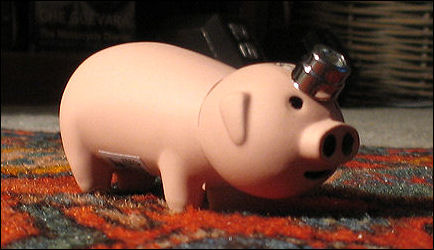
Pig lighter


“Pig lighter” purchased at Ralph’s on Ventura and Coldwater — Sunday, 7.8.07, 2:15 pm. Flames come out of both nostrils.

“Phoenix” fatigue

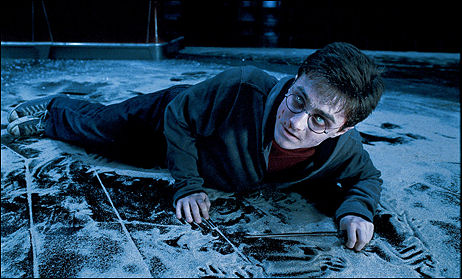
Harry Potter and the Order of the Phoenix (Warner Bros., 7.11), the fifth in the series, is unmistakably darker than the previous four Potters. But for me, there’s nothing so dark and foreboding as the idea of having to sit through two more of these damn things, which is what we’re all looking at.
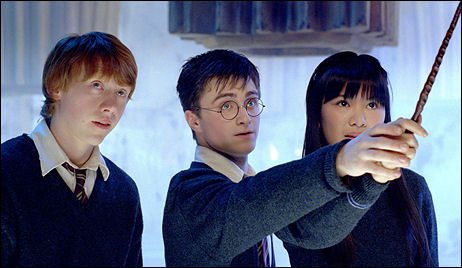
Phoenix slams the teenaged Harry (Daniel Radcliffe) against the wall and makes him glare with rage as he responds to various taunts and assaults and rivers of inner doubt. I didn’t take any of this horseshit seriously, of course, because I regard the Potter movies as corporate CG charades looking to make as much money as they can with zero regard for anything else.
Phoenix is a spooky, shadowy mood piece and far from atrocious, although it’s too damn busy — it tries so hard to be an intense experience that I was wishing it would just shut up and calm down and try some silent passages, like M. Night Shyamalan has done from time to time.
Give Rowling and the filmmakers credit for at least trying to add fresh elements. The nicest alteration is Harry becoming a kind of wizardly arts after-school tutor. (Unofficially. Without the Hogwarts faculty knowing. Don’t ask.) The teaching scenes aren’t about much, but there’s a certain charm and comfort in watching Harry pass along what he knows because he’s gifted at it. But the dominant change in Phoenix is an atmosphere of foreboding like the Potter fans have never seen or felt.
There’s a lot of water-treading in Phoenix, but the central nightmare is about the spirit of the wretched Lord Voldermoort (Ralph Fiennes) somehow infecting or entering poor Harry the way Darth Vader’s heart of darkness threatened to overtake Luke Skywalker. Yes — another summer tentpole movie is dancing the same old tango.
So there’s “darkness” in this film but nothing that truly hurts or terrifies or even gives pause. A good-friend-of-Harry character dies in Act Three but you don’t feel a thing when it happens. I don’t give a hoot about anyone dying in the Potter films, frankly. The whole series could go away tomorrow and my life wouldn’t miss a beat.
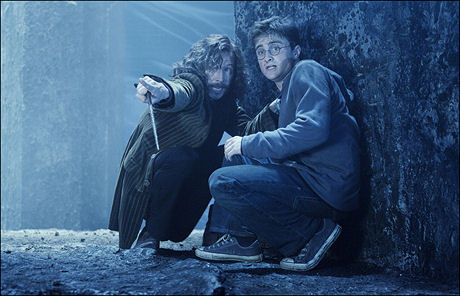
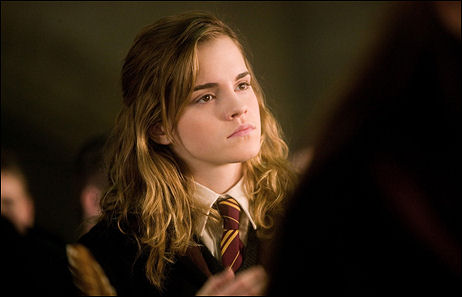
Actually, I take that back as far as Emma Watson‘s Hermione is concerned. She’s not the bossy boots she was in the earlier films — she’s been marginalized — but she’s still my favorite character. Otherwise I feel no affection or investment in Potter Incorporated. The films are something to step around and turn away from.
I saw Radcliffe in a stage play of Equus in London last March. He’s a very focused and intense actor, and he has my respect. But he’s so focused and intense and marble-eyed as Harry Potter that he acts like a kind of narcotic. And I’m getting awfully tired of Harry’s obsession with his the murder of his parents. It was sad, tragic and terrible, but his inability to get over it and live his life isn’t just repetitive and indicative of arrested development — it’s noxious.
There’s a chaste kissing scene in Pheonix between Radcliffe and Katy Leung, an Asian hottie with black bangs and a roundish face and a button nose. The kiss doesn’t lead to anything or affect the story in the slightest way, so I’ve no idea why it’s in the film to begin with. I was asking myself why doesn’t Harry try to do a bit more. He’s 17, for Chrissake. Of course, it’s not Harry kissing her but the director, David Yates, in a sesne. And you can tell he feels deeply uncomfortable about it.
People are free to patronize and enjoy the Potter films. They are not bad people for doing so. They’re easy lays, of course, but easy lays are good for the economy. I’m a little bit sorry there aren’t a few more Potter haters out there, but I can roll with it. I just didn’t grow up with the Potter books and I’m not spiritually invested in the, like my son Jett is. I was marginally into the first two films, but I got off the boat after the Alfonso Cuaron version in ’04.
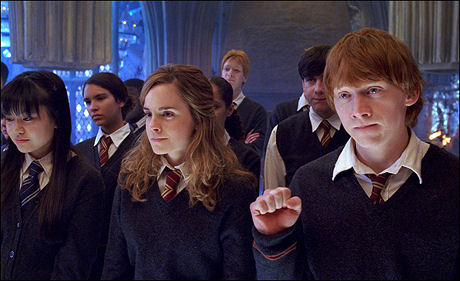
I could maybe tolerate them if the stories and the kids would just get the hell out of Hogwarts and into the real world, but they won’t leave the damn place. Rowling has so decided and that’s that. As far as I’m concerned Hogwarts has become a kind of Devil’s Island. I’m imagining a film poster for Escape From Hogwarts, with a visual of Radcliffe digging his way through a cement-block wall with a kitchen spoon.
There’s no avoiding the tired old thought that the Harry Potter books are being written and the Harry Potter movies are being cranked out for the benefit of the very few. Outside of the reactions of the delighted fan base, the idea isn’t to tell stories that thrill and enthrall and teach lessons. These books and films are saturating our world so that various parties in the publishing, merchandising, movie-making and acting professions can make big bags of money.
Does anyone find this fact the least bit entertaining? There are several first-rate British “name” actors in these films who are pocketing very nice Harry paychecks — good for them. Didn’t I read something about Radcliffe expecting to earn $30 million when all is said and done? But there’s nothing in it for me.
I was in hell the minute I realized from an early Pheonix trailer that Imelda Staunton would be playing a one-note performance from start to finish. Every moment she was on-screen I felt as if I was turning on a spit over the hottest bonfire. What is a character like Staunton’s — a naysaying, control-freak teacher named Dolores Umbridge — doing with power at Hogwarts? It’s nonsensical that a person with her attitude and temperament — a prim, plugged-up “no” person dressed in pink — would be there. The Hogwarts staffers are all eccentric types, some tugged by dark impulses and weird flicks of the brain, but they’re all rather spiritual in this or that way. Staunton’s is anything but.
Why after all these years are the Dursleys (Richard Griffiths, Fiona Shaw and their grotesquely ugly fat son) still openly hostile to Harry and treating him like an unwanted pest? Does that make any sense at all to anyone on the planet? Why with his powers is he even living with these cretins?
The central idea in the Rowling books is that wizard society is secretive, closed-off and very much unto itself. Too much so. Watching a Potter film is like submerg- ing yourself in a kind of isolation tank. No traces or remnants of the day-to-day texture of the year 2007 — a world completely divorced from everything except what Rowling and various directors have imagined. Except the most exciting alternate- world imaginings are always about reflections of the real world.
At the halfway mark I wanted to leave and just walk around the WB lot and get some air. But I stayed and toughed it out. God, that was a long 139 minutes! And all of it endured so we can share in Harry’s big final realization that he has some- thing to fight for, and that he pities Lord Voldemort for having no warmth or love or camaraderie in his life.
I managed to stay in screening room #12 for the whole film by (a) ordering myself to stay and yet (b) allowing my mind to wander and think about other things.
I was thinking about Lord Voldemort wanting to have sex with a Quantas stewardess during a flight, but her turning him down because he has bad stinky breath and no nose.
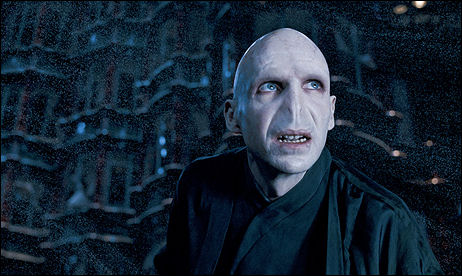
I was thinking about the absolute uniformity of super-villains in super franchises — Lord Voldemort, the Smiths in the Matrix movies, the Green Goblin, Darth Vader, Magneto, Megatron, Emperor Palpatine and all the other big-screen baddies are pretty much the same character. The variations are so slight as to barely register. I know that when a villain make his entrance, I usually mutter “oh, Jesus…here we go.”
Here’s a Wikipedia page analysis of the various kinds of villains — the Dark Lord, the Evil Genius, the Fallen, the Sociopath, the Mercenary, the Minion, the Beast, the Demon and the Trckster. Okay, maybe some differences exist, but from my perspective they’re all jaded, they’re all perverse and they can all go jump in a lava pit.
And I was also thinking about whether Harry will soon come to a literal end. On paper, that is. This got me through some of the slow parts. It’s been widely reported that J.K. Rowling‘s seventh and final installment, Harry Potter and the Deathly Hallows (out 7.21), will deliver two deaths, and the speculation is that Harry’s could be one of them. It doesn’t seem right. Such a young guy with so much to live for and fight against, and with such smarts and passion…and Rowling is thinking about offing him? That’s hard to accept.

“If…” again

In “Fear and Loathing in Las Vegas“, the late Hunter S. Thompson described the 1966 to ’67 era of cultural explosion-revolution as “the kind of peak that never comes again. San Francisco in the middle ’60s was a very special time and place to be a part of. Maybe it meant something, maybe not in the long run . . . but no explanation, no mix of words or music or memories can touch that sense of knowing that you were there and alive in that corner of time and the world.”


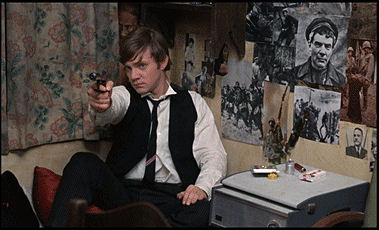
Malcolm McDowell in If…

You can feel a bit of this as you watch Lindsay Anderson‘s If…, which came out on a Criterion Collection DVD a couple of weeks ago. It’s a film that gets eighty or ninety things right (at least), and yet the finest of these is providing a distillation of mid ’60s rightness and holiness and inevitability. Precisely because it’s a metaphor piece and not a recreation of the times (i.e., it uses none of the music).
Except for the long hair and sideburns If… could be happening in the early ’50s or late ’70s or the ’80s, even. It’s about a repressive British school for boys, one that dispenses the old crisp disciplines and stiff-upper-lip values that fortified the British empire for two or three centuries, and about how a lot of this stuff just stopped flying in the early to mid ’60s. And how young people everywhere just knew this.
And yet a strange feeling hit me when I watched it a while back. The final scene depicts a gun battle between the old guard and the new, a small group of rebellious seniors firing machine guns from a rooftop while dozens below take cover and return fire. It’s what was happening back then, exactly like this, and yet it suddenly felt distant. It didn’t deliver the charge that I remembered from way back when.
I wasn’t exactly relating to the harumphy older guys being fired upon. I was still “with” Malcolm McDowell and the gang because I still believed they were coming from a very pure place, and I knew it had to happen. It always does. But I was also half-saying to myself, “Gee, guys shooting at each other…this is too bad. I’m sorry.”

Review rules

I posted a somewhat negative review of Harry Potter and the Order of the Pheonix two days ago, but I took it down 45 minutes later after a Warner Bros. publicist reminded me that an embargo demand (printed on the invitation, she said) stated no reviews until opening day — Wednesday, 7.1. Now I don’t wanna pickle, but I was scratching my head and feeling a little confused as I did the obedient thing.

It had seemed to me that the Potter cat was out of the bag last Friday with reviews already posted from Variety‘s Todd McCarthy, the Hollywood Reporter‘s Kirk Honeycutt, Time‘s Richard Corliss, Rolling Stone‘s Peter Travers, New York‘s David Edelstein and Emmanuel Levy.
And I mean particularly on top of last Tuesday’s David Halbfinger piece in the N.Y. Times that talked about the increasing trend of major publications going earlier and earlier on reviews, in part because of a kind of domino effect created by this site and Movie City News and other online sites going early-ish on reviews of certain films.
Halbfinger began his piece, in fact, by saying that Harry Potter and the Order of the Phoenix “does not open in theaters in the United States and Europe until July 11, but the reviews are already rolling in.” He also stated that “the odds that the New York Post and the N.Y. Daily News will hold their…reviews until the movie hits theaters are, roughly speaking, zero.”
Pheonix reviews aren’t a big deal. The big deal is whether or not J.K. Rowling will kill off Harry in the seventh and final novel, which comes out 7.21. Still, I’m wondering how to play this. I’m thinking if the N.Y. Post or the N.Y. Daily News run their reviews on Monday or Tuesday, then I’ll go that day also.

Edelstein on “Phoenix”

“Having confidently proclaimed that David Chase would learn the lesson of John Updike‘s Rabbit and not kill off Tony Soprano too early (Come on, folks, he’s dead, dead, dead), I’m loath to predict what July 21 — and the final Potter book — will bring. But the film of Harry Potter and the Order of the Phoenix is the best enticement imaginable. It rekindles the dread, the ache in your stomach that says, ‘He can’t die!’ — and at the same time, ‘How can he defeat everything racist, repressive, and murderously Fascistic in the world without making the ultimate sacrifice?'” — from a current review by New York magazine’s David Edelstein.

Taylor on “Factory Girl”

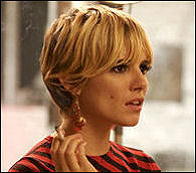
I’ve been dinged here and there for speaking highly of the early, funkier version of George Hickenlooper‘s Factory Girl, and for pushing Sienna Miller for Best Actress. So it’s satisfying to note that contrarian tough guy Charles Taylor has reiterated his support of this embattled film in a well-reported history in today’s N.Y. Times that covers the ride from inception to production to theatrical release.


George HIckelooper, Sienna Miler

“On July 17, thanks to DVD, the public will get to see the fuller version that Hickenlooper, Harvey Weinstein and producer Holly Wiersma were frantically working with last December,” he says. “It’s not the documentary-style cut that Hickenlooper, a documentarian himself whose credits include Hearts of Darkness and Mayor of the Sunset Strip planned when he originally laid out his vision of the film to Wiersma. But it does flesh out the somewhat truncated version that eventually made it into theaters.
“The new version confirms the mixture of empathy (for Sedgwick) and cold-eyed appraisal (of Warhol) evident in the theatrical version. And it confirms the extraordinary power of Miller’s fearless performance, as well as deepens the storytelling.”

Spielerg & Farnsworth

The motive behind Steven Spielberg‘s co-financing and co-producing the forthcoming Broadway presentation of Aaron Sorkin‘s The Farnsworth Invention, about a boy genius named Philo T. Farnsworth who invented television in high school in 1927 only to be ripped off by RCA’s David Sarnoff over the patent, seems obvious. Spielberg is looking to produce and perhaps direct a film version. The golly-gee-gosh American-ness of that name — Philo T. Farnsworth sounds like the cousin of Clem Kadiddlehopper — and the theme of an innocent genius being hoodwinked by big-city tycoons is right up Spielberg’s alley. The question is how different will the movie be (if it gets made) from Francis Coppola‘s Tucker?