“Yuma” boy

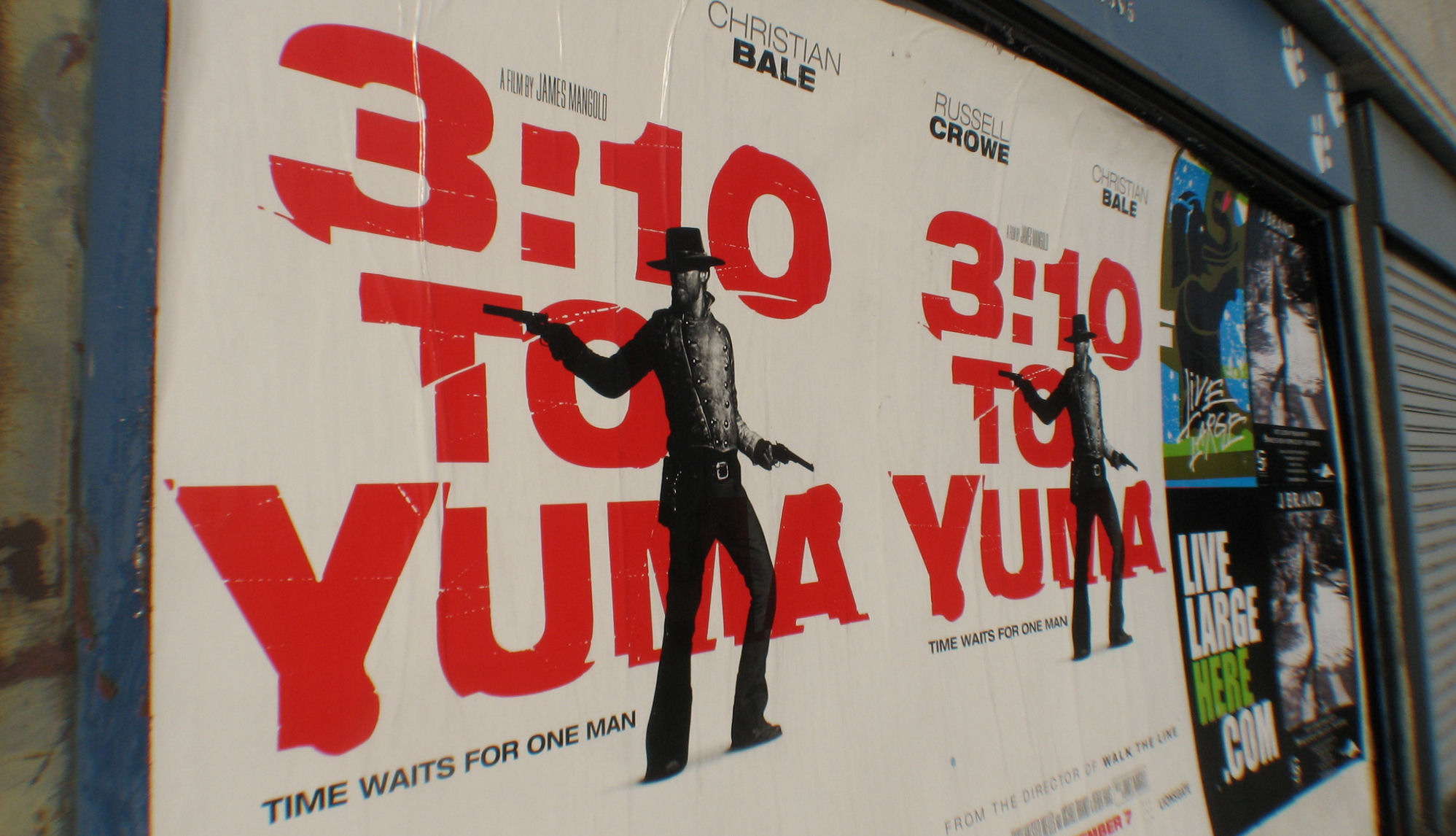
What’s with the slightly bent left leg? Again — the guy looks like a dancer in a rehearsal hall on West 45th Street going over his moves as a hot gunslinger in a B’way musical called Yuma Boy. Seriously… what is it with Lionsgate’s creative ad guys and their gay-appealing (or at the very least flagrantly metrosexual) ad campaign for James Mangold‘s allegedly gritty, unaffected, very down-to-it western?


The only thing missing in this shot is a ballet bar — snapped Sunday, 8.5.07, 5:40 pm near the corner of Cole and Sunset.

One look at the trailer tells you there’s nothing Michael Bennett or Bob Fosse-ish about this film whatsover. Mangold is a gifted craftsman who knows exactly what he’s doing and I’ve heard nothing but very good things about the film, so I’m trying to forget the ads and just wait for the movie, but those Lionsgate marketers keep messing with my head.

Shitty “Bull” sound

Every now and then someone writes a looking-back-on-Raging Bull piece (like this one from the Guardian‘s Ryan Gilbey, a nod to the film’s re-release in England on 8.17). And they all report that Martin Scorsese‘s classic wasn’t tremendously popular critically or commercially when it first opened in November of 1980. But what’ s never mentioned is that moviegoers couldn’t hear many of the quieter dialogue scenes with any real clarity, even in the better big-city theatres. And that this almost surely had an effect upon the general reception.
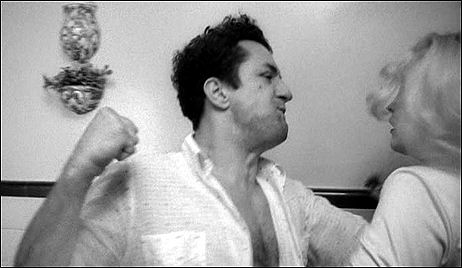
I distinctly remember watching a public screening of Raging Bull in the Sutton Theatre on 57th Street just before Thanksgiving, and leaning forward and cupping my ears and getting angry as I asked myself, “Dammit, why don’t they turn the damn sound up?” I had this reaction every time Robert De Niro, Joe Pesci or Cathy Moriarty were murmuring or muttering their thoughts in their middle-class Bronx apartments, or when “Tommy” the mafia guy was laying things out in his two quiet scenes.

Raging Bull‘s sound was apparently rendered with an intentionally murky-crude quality so it would seem unaffected and working-classy — the idea being that naturalism was equivalent to a kind of aural muck. This almost certainly resulted in tens of thousands of ear-cuppings across the nation given that the sound systems in all but a few big-city theatres back then were atrocious, for the most part. By today’s standards, it was truly the aural Dark Ages.

This sound issue is briefly addressed in the commentary track on the special edition DVD came out in ’05.

I would guess that the murky sound issues probably turned a few people off when it came to recommending Raging Bull to their friends, and that it probably affected the opinions of some critics, if only on a subliminal level. If you can clearly hear what’s being said in a film or a play, you’ll mainly respond to what’s being said — to the content. But if it’s a chore to hear this, then a percentage of critics are going to inwardly say to themselves “fuck this.” And I don’t blame them. So the responsi- bility for Raging Bull‘s underwhelming reception 27 years ago must fall squarely on the shoulders of director Scorsese and editor Thelma Schoonmaker.

I never really heard Raging Bull properly until it came out on laser disc in the early ’90s, and it didn’t sound really great until the special edition DVD hit stores two years ago.

Freaks and Geeks

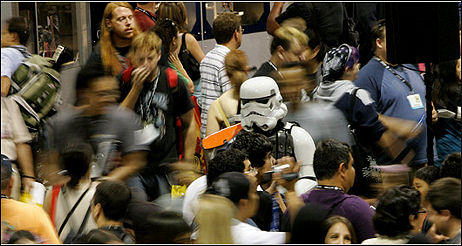
“In the last few decades the emergence of a geek elite has helped legitimize [an] outsider culture and helped bring legions of 97-pound weaklings into the sightlines of the industrial entertainment complex,” writes N.Y. Times critic Manohla Dargis in a late-to-the-table but remarkably perceptive Comic-Con piece that went up on 8.3.

“In some respects America is now a country of freaks and geeks, self- professed outsiders who imagine themselves somehow different from the herd, perhaps because they are Americans — radical individuals who are united if only by their increasingly narrow interests and obsessions.
“This kind of atomization of the culture has its problems, as we know deep in our bones. Yet for all my worries that we are turning into a nation of iPod people, that√ɬ¢√¢‚Äö¬¨√¢‚Äû¬¢s only part of the big, postmodern, late-capitalism picture. Despite all the plastic and dissembling, events like Comic-Con represent something genuine and true and, yes, powerful about how people live in the modern world.
“Every day we wake up to navigate through a faceless, inhuman, Made-in-China existence. Some of us escape through literature, some of us burrow deep into movies. And some of us find sweet relief in what, to the outside world, looks entirely disposable, useless and — here√ɬ¢√¢‚Äö¬¨√¢‚Äû¬¢s that word again — childish.”

Another “Bourne” report

My box-office guy is telling me The Bourne Ultimatum earned $25,437,000 on Saturday. That’s a 3% increase over Friday, which is especially impressive considering that Friday’s total included a number of Thursday midnight shows. Tonight’s final count, I’m told, will be in the vicinity of $70,181,000, or about a million less than Steve Mason‘s prediction of $71,250,000.

Zampano vs. Il Matto

As I was re-watching that beautiful Criterion DVD of Federico Fellini‘s La Strada a couple of weeks ago (for Jett’s benefit, as I felt he was now, at age 19, old enough to get it), I suddenly detected a striking parallel between my soured relationship with MCN’s David Poland and the one between the irreverent, philosophical-minded tightrope walker who is inaccurately called “Il Matto” (Richard Basehart) and the humorless and brutish Zampano (Anthony Quinn). Basehart confesses to Guilietta Massina at one point that he can’t help provoking or making fun of Zampano, even though he knows he may be putting himself in harm’s way by doing so. This exact same observation is made by Martin Scorsese in the video doc that accompanies the film. It’s odd how films, even ones you think you know backwards and forwards, sometimes pass along these little moments of clarity.

Stone pulls out

In an alleged “exclusive interview,” News of the World‘s William Spence reported today that Oliver Stonewon’t be making [his] Afghanistan/Bin Laden film” — commonly known as Jawbreaker — “anytime soon.” Stone is quoted as saying that “the story is changing too fast to properly put to film yet. Perhaps some day. Bush is a fascinating portrait in psychopathy and I think it would make a great film, and Blair would have to play a supporting role.”
So with Stone out of the picture the tally of movies about U.S. soldiers or agents grappling with Middle Eastern terrorists or insurgents is now down to eleven — two Afghanis (Lions for Lambs, Charlie Wilson’s War), seven Iraqs (In The Valley of Elah, Redacted, Stop Loss, The Hurt Locker, Imperial Life in the Emerald City, Grace is Gone and Nick Broomfield‘s Battle for Haditha), plus the Riyahd shoot-em-up thriller that is Peter Berg‘s The Kingdom plus Gavin Hood‘s Rendition (New Line, 10.12.07), which is about U.S. counter-terrorism efforts.
My understanding is that Marc Foster‘s The Kite Runner is more or less on its own nativist Afghani plane and therefore not really part of the club.