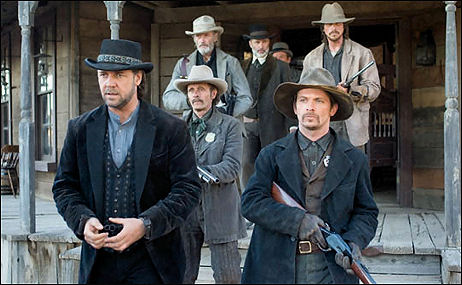
Ben Foster in “Yuma”

It’s too early to get into James Mangold‘s 3:10 to Yuma (Lionsgate, 9.7) which has a lot of good things going for it and will probably, I’m guessing, be widely liked, but if this film was an interactive video game with plastic pistols, I would have spent my whole time firing at Ben Foster‘s nutball bad guy. I wanted him dead — morte — as soon as he came on-screen. I almost mean Foster himself rather than the villain he plays.
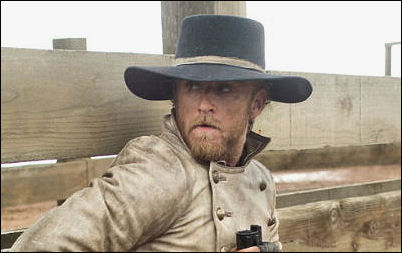
Okay, that’s putting a bit harshly. Foster is “good” as Russell Crowe‘s loyal lieutenant — intense, commanding, colorful — but I hated his performance as much as his $850 Nudies-on-Lankershim leather jacket and all the Hollywood gunk he has caked all over his face at the end. I despised Foster’s performance even more than Joseph Gordon Levitt‘s in The Lookout, and that’s saying something.

Warning: a spoiler than means absolutely nothing follows two graphs from now.

Foster is totally actor-ish and post-modern diseased in ths film. He’s delivering one of those performances that say “look at me, Hollywood — I bring a charismatic evil-ness and a 21st Century loony-tunes intensity to my parts every time.” That is, unless he’s playing Angel in the X-Men movies or doing a quality TV thing in Six Feet Under, in which case he may be into something else. But that won’t happen for a while because Foster has become Hollywood’s go-to guy for parts Michael Madsen was playing ten years ago.

To deliver a classic lunatic performance you have to out-nutbag previous movie wackos, and one way to do this (ask the ghosts of John Ford or Budd Boet- ticher or Howard Hawks for advice) is to burn a guy alive inside a flaming stagecoach. And Foster manages this feat (the performance, not the burning) with just two expressions — his frozen-eyed Alpha Dog wacko look, and a slightly calmer version of same in which he seems to be thinking about turning wacko in about two or three minutes.

An awful lot of people get drilled in 3:10 to Yuma. I’ll bet more people die in this film than all the guys killed in all the dime western novels ever written by Elmore Leonard, Louis L’Amour and Zane Grey combined, and frankly I got a little tired of this after a while. But I kept wishing that Mangold would kill Foster’s psycho. Kill him for those ice-blue eyes, for that hat he wears, for those buttons on the back of his leather coat. Mangold is good at killing other guys you want to see die, but he lets Foster skate and that’s too bad.

If I saw Foster on a Los Angeles street I would smile and shake hands and act like a gentleman, but I’d give him a covert dirty look when his back is turned.

Crime-scene cleaning movies

All we need is one more movie about people who run businesses that specialize in murder-scene cleaning and we’ll have ourselves an Entertainment Weekly News + Notes story. Right now we’ve got only two — Renny Harlin‘s Cleaner (Sony Pictures, opening later this year), a drama about a murder-scene scrubber (Samuel L. Jackson) who unknowingly participates in a cover-up at a job, and Christine Jeffs and Megan Holley‘s Sunshine Cleaners, an apparent dramedy about two sisters (Emily Blunt, Amy Adams) running a biohazard removal/crime scene clean-up service in New Mexico.

How is it that these ideas always pop up at the same time? There have probably been crime-scene cleaners in business for a long while, but for some reason nobody got around to making two movies about this subject until 2007. Within months of each other. I’m rooting for Jeffs’ movie because it’s certain to be more layered and emotional and perhaps even funny. (Alan Arkin is in it.) Harlin hasn’t much of a sense of humor. I remember Sylvester Stallone referring to “that Finnish thing” that he has in his temperament.

In any event, we need one more. How about a crime-scene cleaners TV series that would be half comedy (the up and downs of an eccentric workplace family that cleans up blood and brain matter and caulks up bullet holes) and half C.S.I. because the bickering couple that owns the business wants to be Nick and Nora Charles and are always thinking they’ve this or that hint or lead that will help the cops in their investigation.

Deballed guy characters

Just as there are certain high-powered male directors (Michael Mann, Oliver Stone, Paul Verhoeven) who’ve been accused of not writing fleshed-out female characters — objectifying women by portraying them as sassy hotties, madonna-whores or out-and-out vipers — there are female directors and writers who also prefer opposite-gender fantasy characters, and so they write these sensitive-wimp males for women’s-market movies like The Nanny Diaries, The Jane Austen Book Club, Friends with Money, The Holiday, etc.

I’m saying that “chick-movie guys” are romanticized bullshit projections of men that certain female filmmakers would like to meet and fall in love with in real life. Males who are the polar opposite of Vince Vaughn in The Wedding Crashers or The Break-Up or Thomas Haden Church in Sideways. Tenderness, perceptiveness and sensitivity are admirable traits in any person, but there’s something almost other-wordly about those gentle, supersensitive guys in mature chick flicks. There’s something deballed about them. They’re just not “guys.”

Walker vs. Gigolo

The Toronto Film Festival synopsis of Paul Schrader‘s The Walker (ThinkFilm, 12.7.07) strongly implies that it’s a Washington, D.C. version of Schrader’s American Gigolo. What follows is a beat-by-beat comparison of the Walker synopsis alongside one for Gigolo.

Walker #1: “A contemporary drama set in Washington, D.C., The Walker centers around Carter Page (Woody Harrelson), a well-heeled and popular gay socialite who serves as confidant, companion, and card partner to some of the capitol’s leading ladies.”

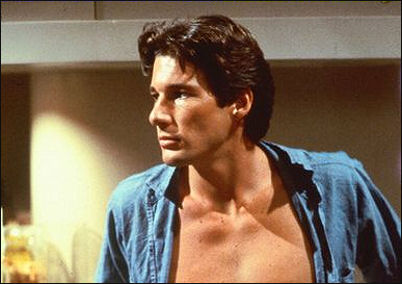
Gigolo #1: “A once-contemporay drama set in Beverly Hills of 1978, American Gigolo centers around Julian Kaye (Richard Gere), a well-dressed and popular boy-toy who makes expert, well-paid love to some of the L.A.’s most well-heeled ladies.”

Walker #2: “Carter’s loyalty [to these women] is tested when his dearest friend (Kristin Scott Thomas) finds herself on the brink of a scandal that could destroy her reputation and her husband’s career. Offering to cover for her, Carter suppresses evidence only to find himself the chief suspect in a criminal investigation. Suddenly this well-connected man-about town is a pariah, hounded by the police and forced to find the true culprit to clear his name. More importantly, he must reexamine whether it is important to be accepted by a society based on betrayal, hypocrisy and corruption.”

Gigolo #2: “Kaye’s attraction for and growing romance with a politician’s wife (Lauren Hutton) is put to the test when he’s initially suspected and then hounded for a murder of a woman he’d serviced in Palm Springs. Suddenly this well-connected gigolo-about town is a pariah, hounded by the police and trying to find the true culprit to clear his name. More importantly, he must reexamine whether it is important to be accepted by a society based on betrayal, hypocrisy and corruption. Sent to jail, he’s ultimately saved by Hutton’s testimony — testimony sure to destroy her reputation and her husband’s career.”

Bullets and Babies

As I am one of those who gets Shoot ‘Em Up for what it is — a comic satire of John Woo-influenced urban action films that doesn’t just send up genre conventions but gleefully urinates on these over-the-top films and their fans — I’m naturally cool with a related website called Bullet-Proof Baby that sells (or pretends to sell) violence-anticipating baby accessories — bullet-proof carriages, shields, helmets and whatnot.

Wait for some priggish parent or ethical stuffed shirt (a person who thinks like Variety‘s Peter Debruge, who called the film “vile” and “shamelessly sordid”) to complain about this.

Bullet-Proof Baby is a site very much in the tradition of the brilliant and legendary 1973 National Lampoon article called “Nazi Regalia for Gracious Living” — written by Bruce McCall, product “manufactured” by Harry Fischman, Alan Rose, Celia Bau and David Kaestle, protographs by Dick Frank and illustrations by Elizabeth Benett. Not just a spread about baby cribs with Nazi flags adorning the four corners, but Nazi decorations for every nok and cranny in the modern home.

“Nazi Regalia fro Gracing Living” wasn’t a drawing board art-design thing. Fischman, Rose, et. al. actually built the Nazi regalia and used it to decorate, and then had it photographed by Frank. Not a single shot from this article is retrievable online. Someone managing the National Lampoon‘s archives and legacy doesn’t understand about internet marketing and value-building.

FInal Toronto List

A final and definitive list of the 349 films showing at this year’s Toronto Film Festival was issued today, and the festival issued a press release highlighting the latest additions. I’ll try and assemble a final list of films I need to see sum-up later today — over 35? 40 or more? — and see how many of these films I’m going to be forced to miss due to time constraints.

Some of today’s new-addition standouts are Michael Moore‘s Captain Mike Across America (more on this later), Jonathan Demme‘s Man From Plains (about Jimmy Carter), Vadim Perlman‘s In Boom (specifics aren’t coming to mid), Jason Reitman‘s Juno, Thomas McCarthy‘s The Visitor and Julian Schnabel‘s recently-shot documentary Lou Reed’s Berlin.

Six new Gala’s were added — Renny Harlin‘s Cleaner with Samuel L. Jackson (about a guy who cleans up the residue of murders), Richard Attenborough‘s Closing the Ring, Robin Swicord‘s The Jane Austen Book Club (which I saw last night), Kenneth Branagh‘s Sleuth and Paul Schrader‘s The Walker.

New documentaries include Paul Crowder and Murray Lerner‘s Amazing Journey: The Story of The Who, Grant Gee‘s Joy Division, and Olga Konskaya and Andrea Nekrasov‘s Rebellion: The Litvinenko Case.

Mangold Just Doing It

As he began to make 3:10 to Yuma, director James Mangold “felt that the western had been hurt by a couple of things,” he tells MTV.com’s Josh Horowitz. “One is the over historical epic-ization of the western. The western was never about historical accuracy or teaching a history lesson, not the great ones anyway. They were about character.

“To my taste, one of the mistakes in westerns I’d seen was this ponderous sweeping Remington painting kind of Western with the big sweeping strings where suddenly I felt it was more about someone getting lost in the idea of making a western than actually making a story about characters living in the west.” Like what? Open Range? The Grey Fox? Wyatt Earp? Unforgiven? Silverado?

“And then there was a post-modern thing where I felt like a lot of westerns had just become tributes to movies. I didn’t arrive on set everyday with a frame blow-up of a Sergio Leone or John Ford movie.

“At a certain point I think it’s incumbent upon you to just let go. Shoot it like George Stevens would shoot it. Shoot it the way John Ford would shoot it which is to say without some kind of compendium of DVDs in your trailer. Just do it. Be in the moment and make the movie. Look at the people and what they’re doing and the sets your friends have built and make the movie. That to me was the critical mental adjustment I wanted to make.”

Blu-ray vs. HD-DVD…again

Nikki Finke reported yesterday that Paramount/DreamWorks’ recent decision to sever ties with Blu-ray and go with HD-DVD for their high-def titles was basically driven by “cash grabs” — $50 million to Paramount and $100 million to DreamWorks for “promotional consideration.”

I thought Blu-ray had basically won the format war, especially with the Playstation 3 advantage it’s had with gamers in recent months. It’s still ahead in terms of either exclusive or bipolar studio support (Disney, Fox, Warner, Sony, Lionsgate and MGM). Now Paramount has joined Universal in being exclusively HD-DVD. And the consumers who half-care about this situation are throwing up their hands. I don’t care at all. Nobody cares deep down. Especially given that neither format is “going to become the next platform,” in the words of DreamWorks honcho Jeffrey Katzenberg.

Foundas on N.Y, Film Festival duties

In a thoughtful, well-composed but slightly obsequious Reeler piece about his recent experience as a N.Y. Film Festival juror, L.A. Weekly critic Scott Foundas quotes Thierry Fremaux, the artistic honcho of the Cannes Film Festival, for a concise explanation of what festival programming is basically about. “The point of this job is not to say ‘I like’ or ‘I don’t like,'” Fremaux says. “My job is to say, ‘Do we have to screen this film or not?’ Maybe I don’t like a film, but I think I have to show it. Maybe I like a film, but I’m not sure that we have to show it.”

Well and good, but how does this square with the Cannes Film Festival having turned down The Lives of Others? By Fremaux’s own words, it is fair to infer that however he and the ’06 Cannes jurors personally felt about Florian Henckel von Donnersmarck‘s deeply moving, stunningly well-directed film — an emotional and political bulls-eye with three world-class performances — they finally decided it wasn’t important or essential enough to show at Cannes.

I don’t know the backstory (was Others given the shaft because it had already shown at the Berlin Film Festival in March of that year?) but if Fremaux & friends turned it down because it wasn’t strong or attention-getting enough, then that decision would fall under the heading of “borderline loony.”

I seriously doubt that “importance” is a universally adhered-to criteria among jurors selecting a film for a festival. The first two reasons are always the quality of the film and the resume of the director (and particularly his/her past history with the festival), and sometimes vice versa. The others are (a) having a film first (i.e, territoriality), (b) a juror hating a particular film with a passion (i.e., a female N.Y. Film Festival juror reputedly hated Amelie when it was screened in ’01), (c) the political needs and forthcoming release strategies of the producers, and (d) other side political issues.

Gambling and Hollywood

Gambling is an addiction — a high-dive fever trip that people with wired, aggressive natures enjoy because (and I’m not trying to be facile or judgmental about this) it offers a brief respite from the dutiful, methodical, nose-to-the-grindstone rigors that are necessary in order to lead a life defined by at least some degree of honor, dignity, consistency, responsibility and consideration for others. Gambling is, I’ve always believed, about tempting disaster and flirting with self-destruction. It can take you down as surely as alcohol or cocaine or debt or anger. But there’s still something about it that I like.

The willingness or at least the readiness to gamble is, of course, a necessary element with any creative person who dreams of making it big, and certainly with any producer or screenwriter or director. It’s been said over and over that the lack of hot gambler nerve is what ails the film business more than anything else these days. You can’t hedge or calculate your way into a hit movie. The biggest Hollywood cliche of all is that movies are a crap shoot, but over the last 25 years or so the purse strings have become increasingly constricted by more and more nervous-nelly corporate types, which has often been a key factor in bad big-studio movies and the much-bemoaned corporate addiction (unfortunately necessary within the realm that big studios are obliged to operate) to franchises.

The vast majority of creative people in this town are not problematic casino gamblers, although a lot of them are in regular poker games with industry friends. I know a few actors and at least two director-writers who enjoy playing the tables in Las Vegas and Atlantic City, but I wonder if anyone has ever written a piece about the overlap between gamblers of whatever delineation and the type of films they tend to dream up or pitch or try to make?

Gambling addicts are people looking to lose, but is there something in the character of people who, under the right circumstances and with the right idea or inspiration, have the brass to throw the dice on a script or a concept that has a tendency to spill over into Vegas-y gambling (or horses or dogs) to some extent? All the legendary producers have been tenacious with thick skins, but don’t you also need a little of that “crazy guy still playing craps downstairs at 4 ayem” spirit?

I’ve never been into gambling of any kind. I’ve played in less than ten serious poker games in my entire life. I hate losing money. But there’s something about that side of my nature that has also led, I suspect, to not having had the brass or the drive to push harder at other ventures like scriptwriting (which I tried and failed at, possibly because I didn’t have the talent but also because I may have lacked the moxie to keep at it and theoretically improve as I went along). I’m very happy with what I do, but deep down I’ve always admired the gamblers, or at least the thing they have that leads them to an occasional belief, as James Caan‘s character puts it in James Toback‘s The Gambler, that “two plus two equals five.”

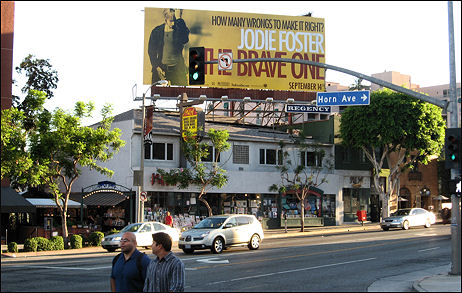
“Brave One” on Sunset


Sunset Blvd. and Horn Ave. — Monday, 8.20.07, 6:45 pm, taken at Coffee Bean, waiting for 3:10 to Yuma screening (my second) at the seriously under-ventilated Sunset Screening Room