“Darjeeling” Selling Issues

I somehow missed Ramin Setoodeh‘s 8.29 Newsweek story about the “awkward situation” faced by Fox Searchlight in the selling of The Darjeeling Limited (opening 9.29) in the wake of last weekend’s suicide attempt by costar Owen Wilson.

“If Wilson skips the normal pre-opening publicity duties, journalists will likely become obsessed with his condition — and virtually ignore the movie itself,” Setoodeh surmises. “If he does submit to interviews, journalists will likely become obsessed with his condition — and virtually ignore the movie itself.”

Correction: this syndrome — ignoring the film, feeding off a near-tragedy — will most likely only kick in among empty, parasitic, rancid-soul slimeball journalists who have possibly themselves flirted with suicide.

Movie Marketing Madness blogger Chris Thilk disagrees. “This is going to have a tremendous impact on the film’s marketing,” he telles Newsweek. “If you take Wilson out of the mix, it’s not just the loss of a leading man, it would severely impact the movie’s brand identity.”

Corliss on “Elah”

“Those of us who weren’t crazy about Crash thought it reduced each of its dozens of characters to one small virtue and big flaw. In In The Valley of Elah, Haggis is more open to his characters’ drives and demons.

“The good guys, the ones so well played by Tommy Lee Jones, Charlize Theron and Susan Sarandon, have nuances worth noting; and even the ones capable of committing the most heinous crimes seem like decent people to whom some awful thing happened. (Special mention to Wes Chatham, who could be Matt Damon‘s younger, cuter brother, as a soldier testifying to Hank about the killing.)

“The combination of dedicated actors and a superior script helps make Elah a far more satisfying film than Crash.” — Time critic Richard Corliss in a 9.1.07 piece, “Iraq War Films Focus on Soldiers,” filed from the Venice Film Festival.

“Blood” will be 160 minutes?

Thompson on Hollywood‘s Peter Debruge has linked to a post on a Paul Thomas Anderson fan site that was written by a projectionist who frequents a forum called film-tech.com, and from this has glommed the technical details from a print of There Will be Blood. The aspect ratio is 2.39:1 (the standard Scope aspect ratio isn’t 2.35 to 1?) and it’s 8 reels long, which indicates a running time in the vicinity of 160 minutes, give or take. The average 2 hour movie is about 6 reels, or 20 minutes a reel.


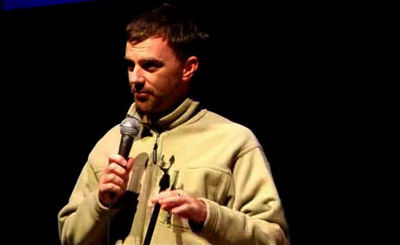
There Will Be Blood director Paul Thomas Anderson prior to Friday night’s Telluride Film Festival showing of 20-minute reel from his forthcoming film. [Photo snagged from Spoutblog‘s Karina Longworth.]

New Best Picture situation

I’ve amended my Best Picture Oscar Balloon list down to eight — American Gangster (Universal Pictures); Atonement (Focus Features); Charlie Wilson’s War (Universal Pictures); Elizabeth: The Golden Age (Universal Pictures); No Country for Old Men (Miramax); Sweeney Todd (Dreamworks SKG) and There Will Be Blood (Paramount Vantage).

It’s no secret that violent movies about angry, vengeful men tend to be dismissed or undervalued by older, stodgier Academy members, so if this prejudice holds the odds (obviously a spitball calculation made from a long distance away) don’t seem to favor American Gangster (although a friend who’s seen it believes it has the makings and the moxie to go all the way), No Country for Old Men, Sweeney Todd and There Will Be Blood. The music of Stephen Sondheim mitigates Sweeney Todd, I realize, but combine those throat sittings with the visual fetish tendencies of Tim Burton and you’re looking at possible recoils.

Barring a surprise electrical jolt from one of the unseen above or some out-of-the- blue Million Dollar Baby-type entry, that leaves three finalists — Atonement, Charlie Wilson’s War and Elizabeth: The Golden Age. A lavish British period romance with strong performances and great tracking shots, a feel-good ’80s political drama of redemption about a small group of wily Americans doing the right thing (also with strong performances), and a period costumer with presumably fine acting, high political intrigue and battle scenes.

I’ve been fighting a feeling about this situation for the last two or three days, which is that I’m not personally happy with it.

I’ve read Charlie Wilson’s War and have been told that its a strong and satisfying piece. We’ll know the truth about Atonement when it plays Toronto next week and some real Americans with no cousins in England have a look at it. And Elizabeth: The Golden Age has had Oscar written all over it for months. And yet once again the softest, safest and most upbeat-sounding contenders are deemed the favorites because the Academy likes soft (but not too soft), safe (as long as there’s a fair portion of smarts and edge) and upbeat (as long as it’s not too gooey or homilistic).

The other two contenders may be American Gangster and…I don’t want to say. If I could wave a magic wand and put No Country for Old Men in as contender #5, I would, but I fear too many people are going to take it as crime movie about a good old cowboy on the run with some ill-gotten drug money and a creep lugging around a device that shoot-slams metal pellets into people’s heads. Some might get what it’s really about — the simple basic decency of the past giving way to an oncoming indecent present — but not enough, I fear.

I hope I’m wrong. Please God…step in and do the right thing. And please don’t give the ’07 Best Picture Oscar to Elizabeth: The Golden Age. Not because it doesn’t deserve the honor (I’ve seen nothing, know nothing) but because of that atrocious coffee-table title. It sounds like a PBS documentary. Ask yourself, readership: if you were directing and feeling wonderful about making a real, full-hearted “movie” that was also a stirring historical drama about Queen Elizabeth (whose reign lasted from 1558 to 1603) with the great Cate Blanchett, would you want it to be called “Name, Colon, Bland Allusion to Rich Cultural Era in 16th Century England”?

Howell’s TIFF Buzz List

Peter Howell‘s annual Toronto Film Festival buzz piece went up yesterday, proving once again that handicappers are always fallible and are sometimes ill-informed.

Example #1: The highest vote-getter — Ang Lee‘s Lust, Caution — has been losing steam since Variety‘s Derek Elley gave it a stiff whack across the chops (“too much caution and too little lust”) at the Venice Film Festival last Thursday. Example #2: Anne Brodie, daily film columnist for MSN/Sympatico, describes The Assassination of Jesse James by the Coward Robert Ford as “testosterone-heavy.” It’s mainly about guys and definitely has a supply of the stuff, but if there was ever a western that isn’t “heavy” with testosterone, it’s this one.

I make at least one embarassing prediction each every year, and it’s starting to sound like this year’s HE wrongo, to judge by reactions from a friend at Telluride as well as MCN’s David Poland), was picking Noah Baumbach‘s Margot at the Wedding.

Villaca returns!

Former HE columnist Pablo Villaca, the Brazil-based editor of Cinema em Cena, told me with a couple of days ago that he “almost died in August” but is now back from the abyss and euphoric for that simple fact.

“After spending almost the whole month in the hospital and going through two major abdominal surgeries, I’m finally home and recuperating. I lost more than one meter of my colon and another 10 centimeters of my intestine, but I’m alive. They suspected I had cancer, but the biopsy showed that was not the case. I had complications from the first surgery and had to go through another one and it was a close call. But thanks to God, the modern medicine and the competence of my doctors, I’m still here.

“And it’s a great feeling. Value your health, my friend. Most of the time, we only remember how important it is when it’s gone.” Cheers to Pablo and the benefits of modern medicine…onward!

Concern over “Lambs”

I need to put this the right way, which is to say not too definitively or emphatically. But over the last two days I’ve heard from two second-hand sources (one of them having direct access to someone close to the action) that there’s concern — a moderate term that doesn’t mean panic or alarm — about the emerging shape of Robert Redford‘s Lions for Lambs (MGM/United Artists, 11.9).

It’s not so much advance-word terms like “dull” and “pedantic” — there are always people with agendas who will tell you this or that film isn’t working, particularly around this time of year — as much as a report that “an editing team has been brought in to fix it.” One of the editors is long-time veteran Paul Hirsch (Ray, Mission: Impossible, The Empire Strikes Back).

Redford is known to be exacting and methodical (polite terms for “slow”) in the cutting room, and he’s been working with highly respected editor Joe Hutshing (who won Best Editing Oscars for Born on the Fourth of July and JFK) so there’s no reason to think anything might be amiss in the skill and vision departments.

If the “fix-it” editing team info is true (I trust the source), the most likely scenario is that Cruise-Wagner and Redford are at odds over certain aspects of the film and that the UA chiefs have pulled rank. Redford is a tough hombre and doesn’t back off (a key ingredient with any strong director), but Lions for Lambs is the first picture out of the gate from United Artists and there’s a lot riding on it, especially with the heat on Cruise (who plays a right-wing Senator in Lambs) having dimin- ished over the last couple of years.

This doesn’t mean, of course, that things won’t pan out in the end. Disagreements about final refinements to a film are part of the natural creative fiction, and there’s no question that Cruise, Wagner and Redford are smart, shrewd players who know from quality.

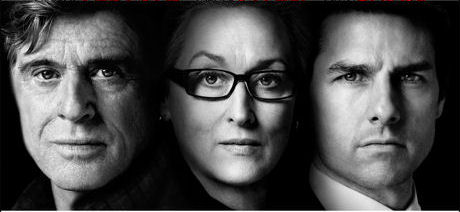
I’ve never read Matthew Michael Carnahan‘s script — an apparently Babel-like piece about a California professor (Redford) and his influence over two students (Derek Luke, Michael Pena) and how their fates (as well as a third Redford student, played by Andrew Garfield) are affected in some way by a “bombshell story” given by a high-powered Senator (Cruise) to a seasoned Washington, D.C., journalist (Meryl Streep) — but it’s hard to imagine it not being an above-average work, given the pedigree of the players.

Lions for Lambs is going to play the AFI Film Festival on 11.1.

Stability over brilliance

N.Y. Times reporter Michael Cieply on studio chiefs like Paramount’s Brad Grey hanging onto their jobs because their bosses have come to value “stability over brilliance” because “the film business [has come to be] less about scoring the odd hit than keeping the pipeline full of something other than losers.” Isn’t that always the way? The dutiful stable dolt always seems to last longer in a given job than the brilliant erratic eccentric, especially in a doltish business environment.

Tutturro’s “Cigarettes”…again

“How could this film not make $3 million back in theaters?” James Gandolfini asks about Romance and Cigarettes, John Turturro‘s much-delayed musical that will open at Film Forum on Friday, in a 9.2 N.Y. Times piece by Franz Lidz . “There’s at least $3 million of weirdos out there who’d go to see it. I probably know half of them.”

Debating “Assassination”

I was going to ignore David Poland‘s vitriolic slam of The Assassination of Jesse James by the Coward Robert Ford out of concern that a tit-for-tat would convey an impression of too much respect, but I’ve been urged to take a poke anyway.

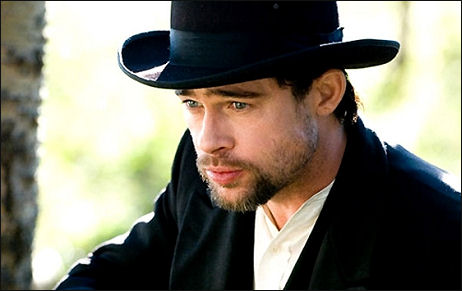
“Like” it or not, Andrew Dominik‘s deeply atmospheric moralistic western about the last days of Jesse James (Brad Pitt) and the tragedy of “groupie” Robert Ford (Casey Affleck) is a time-machine passage to the way life in rural and urban Missouri (and to a lesser extent New York and Colorado) quite possibly felt, tasted, smelled and sounded like some 135 years ago. It feels utterly real, convincing, lived-in…and at the same time is a chocolate sundae of awesome style and immaculate flavor.

And yet Poland has called it “the most pretentious studio release in a decade.” I don’t know where derision of this sort comes from in people. Films of this calibre and pedigree sometimes strike people as poised and overbearing. I remember talking to a bartender at the Spring Street Bar & Grill 29 years ago about how he’d dismissed Days of Heaven as masturbatory, self-important shite. I developed an instant dislike for the guy at that moment, but I also felt twinges of pity. He didn’t have it in him to get it, is all. If you reach high and achieve big, somebody is going to come along and slap you with the “p” word and there’s nothing to be done about it.

Poland accuses Dominik of having ripped off Terrence Malick, Robert Altman‘s McCabe & Mrs. Miller, Michael Cimino‘s Heaven’s Gate, Sam Peckinpah‘s Pat Garrett & Billy The Kid and so on. The natural process of every artist is to take, assimilate and make anew. Dominik’s film certainly has the echoes of ’70s cinema all through it, but anyone who looks at Jesse James without understanding that he’s delivered a very particular feast of his own — similar, yes, but a long way from being shamelessly borrowed — and then calls it “obnoxious” and “taste-free” is coming from a numb and enervated place.

I can only throw up my hands at the taste buds of someone who would use these terms to take down one of the most potent dream trips ever released by a major studio (dreamy in a gently musty, burnished, lace-curtain-y sort of way) while having previously creamed over The Proposition, a movie that was so caked in pretentious grit (with each and every actor covered in makeup-van “chicken grease”) that I went home and took two showers after seeing it.
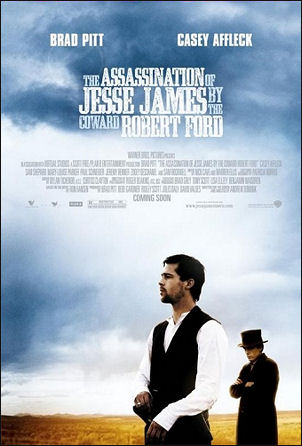
Poland says he feels “bad” for everyone involved including Brad Pitt for having “[worked] his ass off to create an elusive but distinct character.” And yet Pitt truly succeeds — his Jesse James is probably his best performance ever. Empathy is misplaced and unnecessary. Graciously, Poland allows that the supporting cast is “excellent” — true. And that Patricia Norris‘s production design is “first class” — check. And that Roger Deakins‘ cinematography is “stunning” because “you will likely never see light coming from the inside of every character in a movie’s eyeballs like this again.” All true, and let it go at that.

Poland also correctly understands that Warner Bros. reported attempt to cut this 160 minute film down to 110 or 120 minutes was doomed from the start because it’s been shot in a way that necessitates the spending of some time — it’s a movie that has sunk itself right into the pace of life in the 1870s, and any attempt to cut into this would ruin its integrity. I felt the 160-minute length in my butt somewhat, but I never once resented the scope and ambition of this film, and would never in a million years call it an “abusive…self-indulgent mess.”

The Assassination of Jesse James is a curiously sad and haunting slow-train ride that definitely goes to a place that feels whole and complete and resolved. In a way it’s like a theme-park movie, albeit one of the most historically precise and devoted ever made. It isn’t a faux ’70s art film but the real thing, released some 25 or 30 years after the that wondrously fertile decade began to wind down and a bringer of much-needed deliverance. I can’t wait to see it again.

Telluride sum-up

“The 20 minutes — yes, only 20 — of Paul Thomas Anderson‘s There Will Be Blood [that was shown Friday night at Telluride] looked great,” a friend writes. “Unfortunately, I liked those 20 minutes better than any complete film I’ve seen here.

“The only truly awful thing has been Redacted, which is Brian DePalma‘s worst film ever. (And I still have The Black Dahlia fresh in my mind, so that’s saying something.) Beware, beware, beware of anyone who says they liked this picture. If they do you can never trust them on anything ever again.

“Post-screening the audience was shown a live q & a with DePalma via computer, with screenwriter Larry Gross conducting it and worshipping DePalma so sycophantically [that] I had to leave the room. Any respect I had for Gross went out the window. It was embarrassing to see.

“The movie I had the highest hopes for, Noah Baumbach‘s Margot at the Wedding, didn’t quite live up to expectations. (For what it’s worth, David Poland also pissed all over Baumbach’s film yesterday.)

“There are still two days to go, but I’m thinking Into the Wild probably is the best thing here.” Probably?

“This has been my 14th Telluride Film Festival, and it’s probably the first time I haven’t been blown away by something after my first seven or eight films.”

Willman on “I’m Not There”

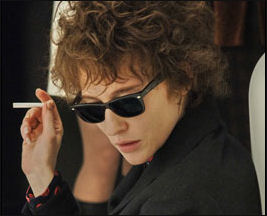
On EW’s Popwatch, Chris Willman responds to last Friday’s Telluride premiere of Todd HaynesI’m Not There and says it’s “every bit as loopy as you’ve imagined, assuming you’re familiar with the conceit — six different actors playing various aspects of Bob Dylan‘s personae with good portions playing as a No Direction Home parody.

“Like a lot of my fellow Dylanologists in the audience, I chuckled at the sections that use dialogue from Dylan’s press conferences and concerts almost verbatim, but for the non-buffs I’ve talked with, it seems to play out pretty much as a 2-hour-and-15-minutes series of in-jokes.

“Most successful at incarnating Dylan, oddly enough, is Cate Blanchett, getting the most screen time and obviously having a ball playing the Blonde on Blonde-era Dylan with a fright wig.

“Visibly suffering onscreen, meanwhile, is poor Richard Gere, who plays Dylan as Billy the Kid — or maybe playing an actor playing Billy the Kid? — and looks even more baffled about what he’s supposed to be doing than we are.

“Somewhere in between are Heath Ledger who plays Dylan as a hot Hollywood actor (although this makes no sense, Ledger’s section dramatizes the protagonist’s divorce from Sara Dylan while heading even further into the realm of fictionalization) and Christian Bale (portraying him in both his folk-singer and born-again phases), and, yes, an African American lad who likes the ride the rails, a la Woody Guthrie (and bringing to mind The Jerk, since apparently Dylan, too, was born as a poor black child).

“At least I’m Not There is more coherent and commercial than Dylan’s own 2003 writing and starring effort, Masked and Anonymous. But maybe not a lot more.”