Domink speaks to Filmmaker

In a just-up posting on the Filmmaker site, Nick Dawson speaks to Andrew Dominik, director of The Assassination of Jesse James by the Coward Robert Ford, which Dominik describes as ” a big beast of a film.” He epxlains that “there’s all kinds of westerns. Revisionist westerns, acid westerns, Nicholas Ray-type neurotic westerns, John Ford westerns, and Pat Garrett and Billy the Kid. We thought of it more like that kind of a movie, like Pat Garrett. [It’s a] western as a Greek curse.”
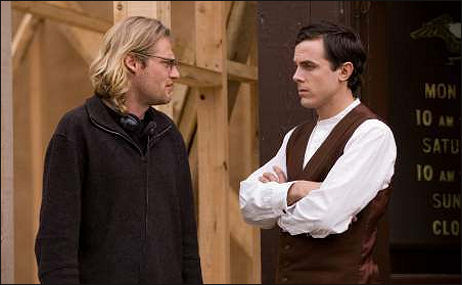
Barry Lyndon was also a big influence, Dominik says.

“It’s been a weird rollercoaster ride because last week we got a batch of reviews that came in,” he comments. “One was Andrew Sarris saying it was a masterpiece, and then we had People magazine saying the same thing. We thought, ‘Fuck, this is going to be great! We’ve got highbrow and lowbrow!’ (Hear that, Leah Rosen? You’re not writing for the intellectual elite.) “And it really looked good. And then the New York Times and L.A. Times came out and just slated it.

“So it’s been really interesting, because I think the critical response to the movie has been really polarized. It’s not universally liked, not by any stretch of the imagination, and those that dislike it really don’t like it! [laughs] So I don’t know if that’s a good sign or a bad sign. I remember when Raging Bull came out, the Variety review was warning exhibitors not to book the picture, so when the Variety review for us came out and it was really good, part of me was like, ‘Fuck, maybe I’ve done something wrong…’

“But when do films really shake out, when do we really know if they’re important or not? It’s probably not in their initial release. But by the same token, the first time I saw Raging Bull, I knew it was one of the great, great films and I felt the same way about Barry Lyndon, which I saw when I was 12. I thought it was really strange and slow and so unusual, but it affected me hugely. But I think the critical weighing in on it has only come together very recently.

“I even went and saw a screening of it at the end of last year at the Academy [of Motion Picture Arts & Sciences] here [in L.A.], and my feeling sitting there in the theater was that most people were sitting there feeling like it was good for them to be there.”
Indy 4 = theme-park ride

For fifteen years and counting, the spiritual dead weight around the neck of the Indiana Jones franchise has been producer George Lucas. The lameness of Lucas’s creative vision was made abundantly clear by the Stars Wars prequels — no argument, a settled issue. It’s also commonly known that Lucas was the principal naysayer in turning down idea after idea and script after script for the fourth Indy film — a process that tore through the entire eight years of the Bill Clinton administration and two-thirds of the reign of George W. Bush.

But it bears repeating once more that the script Lucas finally signed off on, a Steven Spielberg idea crafted and polished by David Koepp called Indiana Jones and the Kingdom of the Crystal Skull, is on some creative-bedrock level based upon a theme park ride. The ride, an attraction at Tokyo’s DisneySea theme park, is called “Indiana Jones: Temple of the Crystal Skull.”

I’m sorry but it just seems diseased — I was going to say “debased” but I held back — that after going through a passel of seasoned writers (Jeffrey Boam, M. Night Shyamalan, Jeff Nathanson, Frank Darabont plus two reported consultations with Tom Stoppard and Stephen Gaghan) for fifteen years, the script they finally decided upon is a conceptual outgrowth of a theme-park ride. A story drawn from the same kind of opportunistic well, in other words, as the Pirates of the Caribbean films. How can any semblance of thunder and wonder come out of something like this?

I’m trying to stifle my crabby attitude about this thing. For years I’ve regarded Koepp as a crafty, above-average writer, and I’m sure he’s given the script hell. I loved the wit-humor in Indiana Jones and the Last Crusade, and Spielberg’s brilliant choreographing of some of the action scenes (the River Pheonix opener on the train, the Venice speedboat sequence, the big Nazi castle, the dirigible scene). But I can’t shake this mantra out of my head: Lucas, theme-park ride…Lucas, theme-park ride….Lucas, theme-park ride.

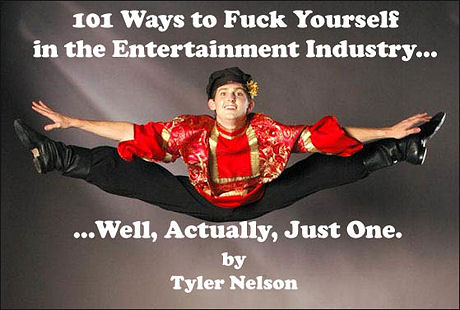
After thinking this through the legend of Tyler Nelson, the hapless jerk who killed his acting career by spilling some Indy 4 plot points to his hometown newspaper in Oklahoma, the Edmond Sun, seems a tad less shameful.

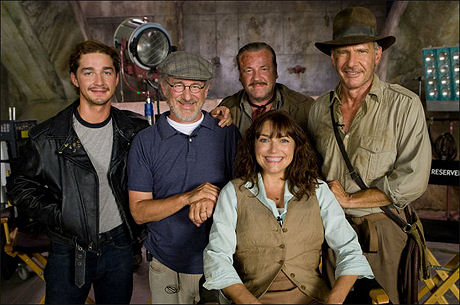
Indiana Jones and the Kingdom of the Crystal Skull, currently filming under Lucas and director Steven Spielberg and starring Harrison Ford, Shia Lebouf, Cate Blanchett, Ray Winstone, John Hurt, Jim Broadbent and Karen Allen, will open on 5.22.08.

Laughing quietly to myself

The best line I heard all day was from comedian Demetri Martin, who was being interviewed early this evening on NPR: “I never write LOL in e-mails. I write LQTM — laughing quietly to myself. It’s more honest.” I would say my own personal LQTM to LOL ratio, over the span of my entire life, has been about 10,000 to 1.

Roth vs. Schwartzbaum

Another industrious Finke link: Hostel director Eli Roth ripped into Entertainment Weekly critic Lisa Schwartzbaum last Thursday (9.20) for views posted two months earlier (7.19) saying that she hates torture-porn and that she refuses to see films of this type. Roth replied that Schwartzbaum’s “smug, holier-than-thou attitude” makes him sick because “there’s no such thing as ‘torture porn‘” and that “it’s time for her to hang up her critic’s pen.”

I think we’re all tired of hearing this stuff debated. I’ve felt repelled, naturally, by any and all torture killings in any films, and I don’t look forward to seeing anything else in this vein (the torture-porn vogue is over anyway), but Roth is not without talent. He has sharp instincts and some first-rate chops and knows his filmology, so I wish he’d hunker down and apply himself in other directions. That said…

“Never saw Saw or its sequels, never will,” Schwartzbaum wrote. “I’m not impressed with the ‘quality’ of the gore or the ‘wit’ of the filmmaking. I’m not enjoyably scared; I’m horrified, and not in the way horror fans get off on, groaning and screaming with pack-mentality excitement. Instead, my horror is one of disturbance and anger: Who makes this vile crap?”

“I hate to break it to you Lisa, but there is no such thing as ‘torture porn,'” Roth answered. “It’s a made-up term, made up by people who don’t understand these movies, who are afraid to even watch them, and who feel some bizarre sense of moral obligation to warn the public about them, despite the fact they don’t watch them and never would.

“Would you not watch Three Kings because there’s torture in it?” Roth questioned. “What about Marathon Man? And are you implying that the millions and millions of people who do watch these films actually endorse torture themselves? It’s too bad [Schwartzbaum] doesn’t know what she’s missing. Which is why I’m thankful they have Owen Glieberman over there, who’s someone who clearly gets it.”

McTiernan going to jail

Holy moley — Nikki Finke is reporting that action director John McTiernan (The Hunt for Red October, Die Hard, Last Action Hero, The Thomas Crown Affair) is going to the slammer for four months for lying to a federal agent over an aspect of the Anthony Pellicano wiretapping prosecution. The fib was that “he had no knowledge of alleged wiretapping” involving Pellicano, Finke reports. The rap carried a maximum penalty of five years.

“Band’s” Oscar eligibility

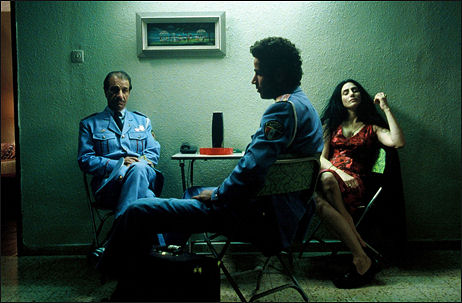
Israeli film columnist Yair Raveh usually writes me directly about stuff, but this time he spoke to Nikki Finke about the Best Foreign Language Fiilm Oscar qualification issue that may be affecting Eran Kolirin‘s The Band’s Visit. But I did some calling around and found out a couple of things.


The Band’s Visit

The plot of the Israeli-French production deals with an Egyptian brass band visiting Israel for a performance, only to become stranded there…fish out of water. The issue is whether the dialogue in the Sony Classics release (which won’t open commercially until February ’08) is primarily Arabic and Hebrew (i.e. more than 50%) or, as “rivals” are contending (according to Finke), primarily English. If it’s the former it’ll qualify as a possible Oscar contender, and if it’s the latter it won’t.

Raveh told Finke the film’s dialogue is less than 50% English. A publicist who’s seen the film (and who isn’t working for Sony Classics) says that the characters speak Arabic and Hebrew, and sometimes resort to English when the need to communicate is urgent, but that the language thing “never seemed like an issue” — i.e., that it seemed to her a foreign-language film for the most part.

The publicist said that the Motion Picture Academy makes the calls about language content, and that “they tend to be lenient” on such matters.

Torene Svitl, the Motion Picture Academy’s foreign film liason/adminstrator, says she’s “been in contact with the Israeli people [on this] and we’ll be getting into it” sometime after October 1st. The foreign-film screenings always start in October so a decision will probably come down sooner rather than later.

“As someone who’s been following Israeli cinema for the past 15 years,” Raveh told Finke, “I’ve yet to see a local film getting such glowing international reviews.” If it makes the grade as an Oscar finalist, The Band’s Visit will be the first Israeli film to be so honored since Beyond the Walls (’84). Six Israeli films have been Oscar nominated, but none have won.

America’s top pundits

Going by data compiled by market research group E-Poll on the country’s leading pundits, Forbes staffer Tom Van Riper has listed the top dogs — Roger Ebert, Bill Maher, Bill O’Reilly, Al Franken, etc. Leonard Maltin was ranked seventh. This is obviously based on visibility through television. Has anyone ever done a pundit/columnist popularity poll restricted to movie opinion? When I think of my favorite opinion-givers it’s not how important they are or how much they’ve influenced my thinking (whatever that means), but how much I enjoy reading or hearing them.

Edelstein on “Old Men”

The lamenting in Joel and Ethan Coen‘s No Country for Old Men — those perfect, world-weary ruminations spoken by Tommy Lee Jones‘ lawman character about dissipation and ghosts and the fate that you can’t see coming, much less stop — are what the film (slavishly faithful to Cormac McCarthy‘s novel) is all about. It’s the damn raison d’etre. Take it or leave it but the tune is the tune.


Joel and Ethan Coen

The Coens ladle it out in even portions all through. It’s stated plain as day in Jones’ opening narration, in those chats he has with those two old coots (played by Barry Corbin and Rodger Boyce), and in that last description of a dream he’s had about his long-gone father. You can whinny and rear up and say “hold up there, that’s not the resolution I’m looking for” but hell, that’s just spittin’ in the wind.

In his New York magazine essay on the Coens and Old Men, critic David Edelstein says what I’m sure 95% of the paying moviegoers will be muttering about as they exit the theatre. I’m no one to talk — I complain about films not doing what I want them to do all the time — but it’s a little dispiriting to read an exceptionally smart and perceptive guy siding with the brutes on this one.

“In the film,” he writes, “you wait to see the sheriff, the venerable rock of decency, confront the newfangled evil in a showdown as cathartic as Carl Franklin‘s B-movie classic One False Move. But the Coens are true to their source, if not their strengths. I’m told that McCarthy liked the last part of the picture best, and he would.”

The final No Country scene is what I like best also. What Jones says (and the way he looks as he says it, and that five or six-second delay before the cut to black) sums it all up and takes it home. The question should be “does No Country for Old Men stick to its guns and achieve its goals in a way that works according to its own motto and terms?” Damn straight it does. That’s why it’s a great film — the finest the Coens have ever made. The probability of some people saying “what the hell?” at the end is, for me, in a roundabout way, one reason why it sits tall in the saddle.

Field or Harden as Mary Todd Lincoln?

In the third graph of a 9.19 Newsweek story by Karen Springen about Mary Todd Lincoln, it is offhandedly stated that Sally Field will play the emotionally troubled wife of Liam Neeson‘s Abraham Lincoln in Steven Spielberg‘s forthcoming Lincoln biopic. This is a done deal, or is this being floated to see what the reaction might be? I’m asking in part because the IMDB is reporting that Marcia Gay Harden has the role, and because she’d nail Mrs. Lincoln cold.


Sally Field, Mary Todd Lincoln, Marcia Gay Harden

I’ve no doubt that Field can turn on the juice and make this work to some degree, but it might be a stretch. I’ve had this image all my life of Mary Todd Lincoln being a scrapper with a cast-iron backbone, and there’s something about Field’s squeeky heartland voice and fretful manner that seems to channel victims and underdogs (Norma Rae, Places in the Heart). Harden has been superb time and again with that heart-of-darkness battle-axe thing (Pollock, Mystic River, The Dead Girl). And she resembles Mrs. Lincoln a bit more (or certainly could be made to resemble her). This would make her a perfect match alongside Neeson, who’s obviously a close biological cousin of the nation’s 16th president.

Due respect but isn’t Spielberg obliged to at least listen to public opinion on this matter? It’s his movie but the legend of Abraham Lincoln belongs to all of us. David O’Selznick understood this concept when he was casting Gone With the Wind. Not that he would have cast Fred MacMurray as Rhett Butler if the public had called for this (which they didn’t — everybody knew it had to be Clark Gable), but he knew the public was heavily invested in Margaret Mitchell‘s novel and at least made a show of listening to their casting preferences.

Wes Anderson observed

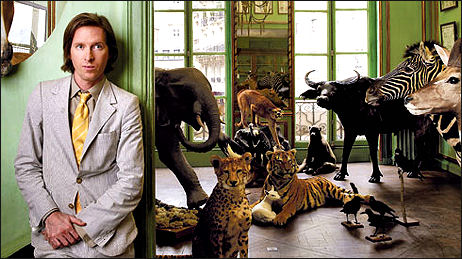
Curiously, almost bizarrely, Darjeeling Limited director Wes Anderson has given his critics all the ammo they need and then some by freely discussing his whimsical, mercurial, Wes-world lifestyle (thus spurring thoughts about how this may have affected the style and content of his films) in a New York interview by David Amsden called “The Life Obsessive.”

Anderson, says Amsden, is “someone who has constructed a life almost preposterously conducive to the pursuit of fantastical whims. [And yet] one gets the impression that even Anderson, these days, can find living in Wes’s world a bit claustrophobic.

At one point Amsden mentions a recent Atlantic Monthly essay by Michael Hirschorn which “argued that, as a culture, we are ‘drowning in quirk,’ an aesthetic he defines as the ’embrace of the odd against the blandly mainstream.’ Citing Anderson’s movies as a prime example, Hirschorn claims that the problem with quirk is that it ‘can quickly go from an effective narrative tool to an end in itself.’

“You need only watch a few frames of one of his movies to spot it as an Anderson production,” Amsden goes on to say. “Though he is originally from Texas, there is something distinctively European in his obsession with aesthetics: a belief that the way something looks is what dictates how it will make you feel. His impeccably composed wide-angle shots have the feeling of a childhood fantasy: wistful, more than a bit ridiculous, with a darkness creeping in at the edges.

“Pepper in some resurrected classic-rock songs; deadpan dialogue; themes of failure, nostalgia, and fractured families; and the result, at its best, is a world unto itself.”

I’m not heartened by Amsden’s observations at all. Anderson is obviously one of the most distinctive signature filmmakers working today, and he used to be one of our finest. He can solve his problem by simply crawling out of his own rarifed ass and exposing himself to some form of raw, unruly, Hemingway-esque experience — a life without stuffed African animals or spur-of-the-moment train trips to Rome or specially tailored seersucker suits.

Career-saving suggestions for Anderson to consider: (a) do a T.E. Lawrence and join the Army or Marines as a raw recruit with a fake name, and serve in Iraq for a year; (b) get a job in Iraq as an ambulance driver, and have an affair with a nurse if he gets sent to the hospital if and when he gets maimed by an I.E. D.; (c) do a T.E. Lawrence and take a low-level job in some blue-collar industry in Missouri or Mississippi for a year, again under a fake name; (d) do a John Pierson and run a repertory movie theatre in some far-off territory for a year — soak up the exotic atmosphere, get to know the locals, etc.