Strike situation boiled down, part 1

There are 39 paragraphs in Dave McNary and Josef Adalian‘s well-reported, well-composed Variety story that went up yesterday about the increasingly likelihood of a WGA strike happening on 11.1 (or perhaps in January) rather than next June, but you can boil it all down to four:

Graph #1: “Many believe a November walkout could be particularly crippling since it could affect both the current TV season and the next one. By Nov. 1, the nets will have enough episodes of current shows in the can to get them through mid-January. But the February sweeps would be decimated, and new shows would halt production well before they’d filled their initial 13 episode orders.”

Graph #2: “There are some observers, however, who think a January strike might make more strategic sense. The TV season would still be hurt, with original episodes of shows running out by late February. Pilot season would still be affected, since nets might be reluctant to lense $4 million pilot segs without scribes available to do rewrites — especially for comedies.”

Graph #3: “If scribes wait until January, they can also claim to have gone the extra mile on negotiations by working without a deal for two months. On the other hand, almost all nets have made early pilot commitments to at least two or three projects, some of which are expected to lense in December.”

Graph #4: “One industry insider believes writers will wait to see if any progress is being made before deciding to walk out. ‘If there’s absolutely no progress being made, they’ll go out,’ the insider said. ‘If there is some movement, they might give it a few more weeks.'”

Suspected militant WGA sentiment: “Make it hurt. Hit ’em hard. They talk tough, but deep down the suits are a bunch of candy-asses. As Terry Malloy said to Johnny Friendly, “Ya know, ya take them heaters away from ya and you’re nothin!’ They’re blustery and unreasonable and trying to break the union. And you can’t deal with unreasonable people.”
AFI Fest highlights

The full slate for L.A.’s AFI Fest (Thursday, 11.1. to Sunday, 11.11) was announced today, and as usual the films with genuine intrigue are few and far between. Two of the three big galas — Robert Redford‘s Lions for Lambs and Mike Newell‘s Love in the Time of Cholera — are thought to be half-and-halfers, leaving Jason Reitman‘s Juno as the only solid. The biggest eyecatcher is Gregg Araki‘s Smiley Face, enjoying another festival viewing on its way to the home video bin (which some feel is an unjust fate, especially those who saw at Sundance ’07).

The World Cinema section will show Cristian Mungiu‘s 4 Months, 3 Weeks and 2 Days and Eran Kolirin‘s The Band’s Visit — two likely Oscar nominees for Best Foreign Language Film. Two docs are said to be worth a looksee — Doug Pray‘s Big Rig and Kent JonesThe Man In The Shadows: Val Lewton. And a Latino Showcase feature called Manuela y Manuel, directed by Raul Marchand, is said to be a standout.

Indiana Jones story (to be cont’d)

After the dust finally settles on last week’s Indiana Jones photo-theft caper, it’ll be fascinating to read a detailed account about the web journalist who made the call to Paramount Studios that led to the “sting” arrest of Roderick Davis, the 37 year-old Cerritos resident who tried to sell hundreds of stolen photos from the shoot of Indiana Jones and the Kingdom of the Crystal Skull for $2000 bucks. I don’t know when the details will finally surface, but it’ll make a fascinating story.


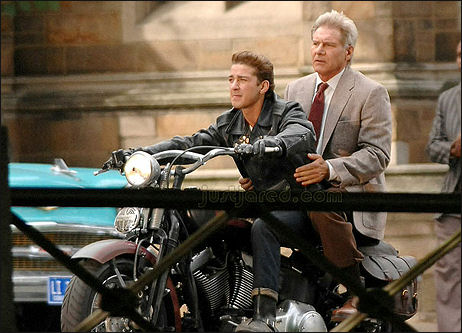
Shia Lebouf, Harrison Ford in an action still from Steven Spielberg’s Indiana Jones and the Kingdom of the Crystal Skull, obtained from a Czech website.

Anton Corbijn phoner

I did a phone interview last week with Control director Anton Corbijn. I’m not going to describe our chat except to call it easy from start to finish. Nothing remarkable in that, but pleasant all the same.


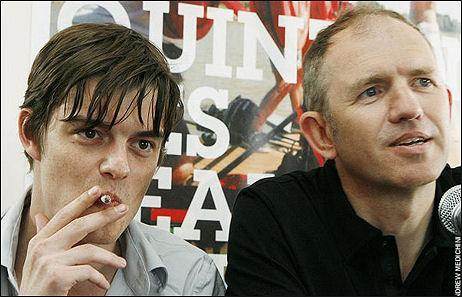
Control star Sam Riley, director Anton Corbijn at the film’s very first press conference in Cannes last May

I didn’t mention a nagging thought to Corbijn, which is that a film as fine and top-notch as Control — the toast of ’07 Cannes Film Festival, one of the finest rock-music dramas ever made, easily one of the most beautiful black-and-white films of the last 40-plus years — is somehow diminished by opening in a couple of piddly-ass theatres in New York and Los Angeles. This is a film that demands crowds, noise, kleig lights, after-parties.

I’m especialy deflated that it’s debuting here at the Nuart, a place that always manage to diminish the impact of a film due to its small screen and cavern-like shape. Perhaps it’ll be shifted to the Landmark megaplex after the first week.

A naitve of Strijen, a town in southern Holland, Corbijn’s primary rep is that of a rock band photographer. He began his photography career in the mid ’70s before gradually moving into music videos in the early ’90s and then, two years ago, feature directing with Control, which I’ve now seen three times and which seems to improve with each viewing.

Corbijn’s visual style is defined on his Wikipedia page as follows: “Corbijn tends to favor a rawer look, often in black-and-white. His subjects appear to be calm and far removed from everyday life. His photographs show raw emotion. His influential style of black-and-white imagery with stark contrasts on grainy film (sometimes referred to as ‘overcooked’) has been imitated and copied in such extent that it has become a rock cliché and a vital part of the visual language in the 1990s.” This, visually, is pretty much what you get when you watch Control.

I began by asking Corbijn whether any color shots had been taken during the shooting of Control, and he said nope. The monochromatic palette of the film is so dominating that I found myself wanting, perversely, a kind of aesthetic counterbalance to wade into.

Here’s the British website for Control (it’s stunning how the Weinstein Co. refuses to create websites for its releases) and the mp3 of our discussion. Watch the trailer if you haven’t seen it. Corbijn says he definitely intends to make another film, which of course is good news.

Bad Tits

This “Fifty Best Breasts in Film History” piece (dated 10.9, which is tomorrow) on the Film Threat site is a bore and a time-waster. The YouTube clips stink, for one thing. It’s the kind of online wank that makes you hate yourself for dancing through it even for four or five minutes.

In a suburb of Toronto…

“I’m trying to satisfy your need to probe into my private life and thoughts, but uh….I’m not going to give you any revelations. Just not going to happen.” You should to try and guess who said this to a would-be interviewer inside a trailer parked in a Toronto suburb in 1986. If it takes you more than five or ten seconds to identify the person, then you probably need to see a certain film by Todd Haynes, and I don’t mean Velvet Goldmine.

Flat “Kite Runner” review

I’ve twice read Alissa Simon‘s Variety review of Marc Forster‘s The Kite Runner (posted last Thursday after a Chicago Film Festival screening), and it feels so dry and dispassionate that a computer program could have written it. Trade reviews are supposed to assess the merits and demerits of a film (including how commercial it may turn out to be), but you can feel the presence of perspective, personality and even emotion in the Variety reviews by Todd McCarthy, Robert Koehler and Derek Elley. Simon seems to be saying that it’s a modest achievement, but offers no real hints about how she really and truly felt deep down.

Stuart’s second NYFF45 video

Jamie Stuart‘s 2nd New York Film Festival short is a lot trippier and more engaging than the first, which I posted on 10.2.07.

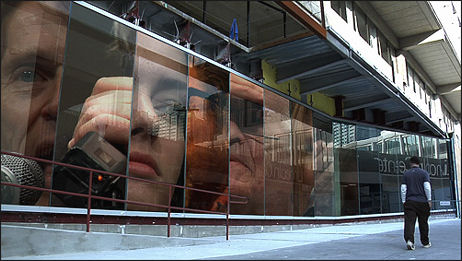
He’s still using that Forbidden Planet music on the soundtrack to suggest a feeling of being disengaged as this or that filmmaker answers a question, but the overall cutting is sublime and the first 40%, in which images and dialogue from various post-screening press conferences are digitally projected upon (and made to fit within) various Manhattan ad spaces, is flat-out brilliant.

The first portion of this section shows Stuart emerging from the Columbus Ave. subway station, hearing the voice of Before The Devil Knows You’re Dead director Sidney Lumet behind him, and then turning around and seeing a video of Lumet’s press conference playing on a plasma screen mounted just above the subway stairs. He stands there transfixed as Lumet prattles on about…well, not much.

We later see a clip from Willem Dafoe‘s press conference projected on a Times Square billboard, another clip shown within a car’s side rear-view mirror, and an assortment of clips pasted upon a group of outdoor display posters.

I asked Stuart to send me a frame capture of of this last scene. Maybe he’ll respond later today.

Terry George on strike situation

Yesterday Wilson Morales of blackfilm.com posted a chat with WGA negotiator Terry George (culled from an interview George gave to promote his latest directing effort, Reservation Road) about the state of discussions between producers and the Writers Guild regarding a possible strike. DGA and SAG have related issues, says George, but right now the suits and the writers are miles apart.


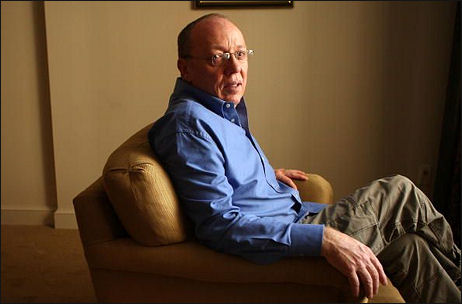
Terry George

The studios, George said, are saying “this an antiquated system [we’re living under] and we want to revisit the residual situation. The residual is what most actors and writers live off. It’s that little bit of money you get back when a film shows. They say they want to go back to a profit-based distribution thing.”

And the hell with that because the studios are world-famous for using an account- ing system that, George says, “is beyond mafia bookkeeping.” That David Mamet/Speed-The-Plow line, “There is no net,” is part of the lore and legend of this town. And WGA negotiators understandably feel that allowing their incomes to be governed by studio accounting notions of what is and isn’t profitable is, to put it mildly, bordering on comical.

“I still get statements on Hotel Rwanda which basically say we are $20 million dollars in the red and [ones that say] In The Name of the Father is $16 million dollars in the red, so the notion that writers and actors work until they declare a profit is ridiculous. It’s a smoke screen to get away from what this all about, which is that the whole industry is moving over to the internet and the new media.

“All we are saying is to give us a little piece of that and we would be very happy with it. I don’t know if they think they can bust the WGA or the whole industry or make a change here, but we’re not going for it. We’re not asking for a lot. We’re asking for a portion of this; and they have been trying over the last few years with reality TV shows and non-union writers just to chip away at that.

“My mood and the mood of some of the Guild is `Let’s not wait til June 30th’. They all think we are going to wait [until] June 30th and wait for the actors to come out and by that time they would have stockpiled 200 films and it will be a de facto strike anyway. I’m all for going as soon as we can. Let’s get it out there and see. Given the level of profit that’s been made now and the ‘Frank Purdue-ization’ of the whole product, to turn around and say the writers and eventually the actors shouldn’t have a piece of that is ludicrous.

“We’re not stupid enough to call a [strike] date” — October 30th or November 1st have been mentioned — “that everyone else decides for us. We are going to look at the most strategic time if they are not willing to negotiate and then make that move then or go the membership and say, ‘Look, this is basically is an attempt to destroy this union, which I think it is or to weaken everyone to the point of where, the future of the whole industry, being a virgin again or something.'”

After “Control”


Santa Monica’s Aero theatre as a mostly-younger crowd filed out of a special showing of Anton Corbijn‘s Control, which opens 10.10 in NYC and on 10.19 in Los Angeles — Sunday, 10.7.07, 9:38 pm.

Robinov’s sweeping statement

According to a story posted two days ago, three different producers have told Deadline Hollywood Daily‘s Nikki Finke that Warner Bros president prexy Jeff Robinov has declared that “we are no longer doing movies with women in the lead.”

Finke concludes that Robinov’s “Neanderthal thinking” is a kneejerk reaction to the tanking of two WB female actioners — The Brave One, a Jodie Foster urban revenger, and the Nicole Kidman pod-people thriller The Invasion.

She fails to mention that still another Warner Bros. femme-topped thriller — Hilary Swank‘s The Reaping — tanked last April, and that four years ago Halle Berry‘s Gothika, another WB action flick, also performed unremarkably.

Finke is missing a key distinction, of course. Would Robinov be saying “no more movies with women in the lead” if WB had recently made a film as good and successful as The Silence of the Lambs, Aliens, Crouching Tiger, Hidden Dragon or Kill Bill? Not likely. If a sweeping statement is required, Robinov should actually be saying that Warner Bros. “is no longer doing female-starring thrillers and actioners produced by Joel Silver.” Silver, after all, produced The Brave One, The Invasion, Gothika and The Reaping.

I’m not saying that that sweeping statements of any kind are wise (they usually make the speaker sound stupid or short-sighted), and I’m also guessing that Finke’s interpretation of what Robinov actually said (or may have said) misses certain shadings and qualifications. Finke can be very strident and simplistic when it comes to female-power issues in the industry.

But if Robinov has in fact said to producers what Finke has reported, my suggested sweeping statement — ixnay on the Silver action chick flicks — is obviously more logical than the one has Robinov allegedly voiced.

Jim Carrey’s tears for Burma

Nobel Peace Prize winner Aung San Suu Kyi, the Burmese humanitarian and politician who’s been held under house arrest by military thugs since winning 82% of the Parliamentary seats in her country 17 years ago — that’s not funny. But Moving Picture Blog’s Joe Leydon has noticed something overly sincere about Jim Carrey‘s delivery of his video message about her situation, so he runs a post that snickers at Carrey’s maudlin emoting. (“But seriously folks!”) Doesn’t the reality of the Burma thing balance out the Carrey factor?