Annakin owns half the city

Right off the top, within the first ten seconds of the trailer for Awake (Weinstein Co., 11.30), Terrence Howard (a doctor) is standing next to Hayden Christensen (a rich guy) and saying to him as they look out at New York harbor, “You’re saving jobs, you’re creating companies …you own half of this city.” Anakin Skywalker (“I need haahlllp!”) owns half of Manhattan? At age 26?

That’s it — I’m out the door. I don’t support movies that depend upon exposition dialogue that’s written as crudely as this. If Howard had said Christensen owns 20% of the city, fine. If he’d said Christensen would own half the city by the time he’s 40, fine. (A stretch, but I’d buy it.) But no — the film has to go for the brass ring with that “own half of this city” line. And because director-writer Joby Harold was foolish and intemperate, he must pay the price.

“Beowulf”‘s Day of Judgment

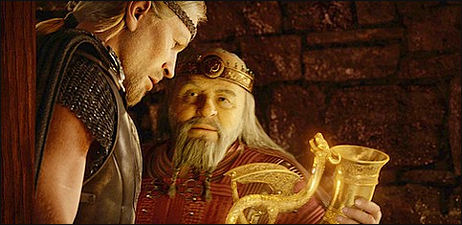
Awards Daily has taken note of trade ads pushing Robert ZemeckisBeowulf (Paramount, 11.16) for Best Picture as a safety measure should the Academy decide to rule that Beowulf doesn’t qualify for the Best Animated Feature Oscar. I won’t see the completed film until Friday, but I’ve seen a reel and as far as I’m concerned Beowulf not only qualifies as an animated film, but it deserves an industry-wide salute for expanding the definition of “animated” in a truly brilliant and innovative fashion.

The short list of eligible animated films will be announced on Monday, 11.5, so we’ll know soon enough if the Academy reactionaries and fuddy-duds have succeeded in keep in Beowulf out of this category.

Image technologies have been blurring the line between live-action and animation more and more in recent years. Technically, Beowulf is digitally enhanced live-action film, but it’s so richly and imaginatively composed that it seems absurd not to call it animated. Animation tools are obviously computerized today — the industry has come a long, long way from the days of Disney animators painting cells for Bambi — and it seems that the liberal view would have to be that Beowulf is not live action — it’s been “painted” on a bit-by-bit, frame-by-frame basis.

The foundation of the objection to Beowulf‘s being considered for the Best Animated Feature Oscar has been the Academy’s “Rule Seven” which states that (a) “movement and characters’ performances [in an animated film] must be created using a frame-by-frame technique,” and (b) that “a significant number of the major characters must be animated, and animation must figure in no less than 75 percent of the pictures running time.”

Don’t kid yourself: Rule Seven is a blocking move by old-line Academy types in order to protect the entrenched old-fogey animators from encroachment by the digital crowd.

A senior Paramount marketer told me three days ago that Pixar chief John Lasseter “is firmly against motion-capture being eligible for the animation”, and yet John Bloom, the head of the Academy’s animation committee, which numbers about 100 people, “fully supports Beowulf and live action.

“Remember when old-line animators complained that Toy Story wasn’t real animation?,” the Paramount guy reminded. “Remember that kerfuffle? People at AMPAS who are not animation specialists are confused that the characters look like the actors playing them, but that doesn’t have anything to do with anything. The Beowulf character doesn’t look like Ray Winstone, although he’s got Ray’s voice and acting style.”

In any enterprise of any kind, be it business or creative, the old-schoolers will always try to protect their turf by blocking the innovators. Everyone knows that trying to hold back the tide is futile, except for those who try to do it anyway.

Clairification and apology re “Band’s Visit” story

Angered by the Academy’s disqualification of The Band’s Visit, a much-praised Israeli film, because it had, in their judgment, over 50% English and less than 50% Hebrew or Egyptian in the dialogue, and having heard from Band’s Visit‘s producer Ehud Bleiberg that allies of Beaufort, another Israeli-produced contender, had lobbied against The Band’s Visit on this issue, I wrote a paragraph the other day that voiced my feelings but which also contained a small but crucial error.

I wrote that “if I were king I would scratch Israel’s Beaufort” from consideration for Best Foreign Language Film Oscar [as] There doesn’t appear to be any question that Beaufort‘s producers lobbied the Academy’s foreign film committee on the 50%foreign-language issue that wound up disqualifying The Band’s Visit. Punish the Beaufort team for playing dirty, discourage this kind of thing, etc.”

Wrong. What happened is that Beaufort allies addressed the issue in some fashion with Israel’s motion picture academy, not the Beverly Hills AMPAS, and somehow I switched the two in my head. I hereby apologize to the Beaufort producers for blurring this and confusing the facts.

The principal ranter against the Beaufort team has been Bleiberg, producer of The Band’s Visit and producer / CEO of Bleiberg Entertainment. When I spoke to Bleiberg on or about Tuesday, 10.16, about the unfortunate 10.11 (or 10.12) AMPAS decision against The Band’s Visit for eligibility for Best Foreign Language Feature, he was emphatic in saying that certain parties allied with Beaufort had lobbied and/or strategized in some fashion to push the language-qualification issue.

Bleiberg was adamant about this, and asked me to quote him as having said this. He said that even the Beaufort people hadn’t made a secret of their agenda in this matter.

I had suspected that someone’s agenda was being served in the disqualification, and as Beaufort obviously benefitted from the AMPAS decision logic suggested they had a rooting interest in the matter.

Part of my determinations came from a 9.25 story about this matter by Deadline Hollywood Daily‘s Nikki Finke. Having spoken to Israeli film critic Yair Raveh, she reported that “rivals are claiming that the political movie…has more than 50% English dialogue and therefore must be ruled ineligible for the nomination. Raveh…reports that The Band’s Visit producers, backed by Sony Pictures Classics, insist the English dialogue is less than 50%. The Israeli motion picture academy says it’s the producers’ call, not theirs. That has infuriated rivals who are calling on the local academy to check into the matter before the film is officially submitted.”

Raveh explained to me today that “days before [Israel’s] Ophir awards I heard that Beaufort‘s producers sent the Israeli Academy a letter from their international sales agent Bavaria Films, saying they counted the words in The Band’s Visit, it has 60 percent English and therefore will be probably be disqualified. Beaufort‘s team wanted the Israeli academy to find out only one thing: whether they will have the chance to send the runner up after dead-line if the film is disqualified? This is the only lobby I heard of from Beaufort’s producers, and it was aimed at the local academy.”

Two days after an announcement of the AMPAS decision to disqualify — on Sunday, 10.14 — IndieWire‘s Anthony Kaufman wrote that The Band’s Visit had been disinvited from the Abu Dhabi Film Festival for cloudy reasons. The festival’s director Jon Fitzgerald told Kaufman “it’s not the cleanest situation” and then Kaufman quoted you as saying that the film was turned down for “political reasons.”

Here we go again, I said to myself. The Band’s Visit once again getting elbowed out of the room due to political agendas and back-room maneuvering.

Raveh’s final word on the situation is that Bleiberg’s claims were inaccurate — he and others allied with The Band’s Visit knew the English language content was more than 50% all along, Raveh says — and overheated. “No one ratted anyone out. Not that I know of. As I see it, it’s all about a producer lying — as producers often do, and maybe should in order to protect his movie — and when Bleiberg’s bluff was called he said ‘someone snitched’ instead of bowing out with grace.”

Telegraph on Andrew Garfield

This Telegraph profile of Lions for Lambs costar Andrew Garfield is about as clueless as it gets. Writer Isabel Albiston presumes that Garfield acting in a film directed by Robert Redford will act as a launching pad for his career, when the backstage rumble says otherwise. Supporting actors never get the blame when a film bombs with the critics and/or the pubic, but they never benefit from this. Lambs certainly won’t catapult Garfield to stardom.

Odds are he’ll get a much bigger bump d’estime out of John Crowley‘s Boy A, which I saw at the Toronto Film Festival. The Weinstein Co. has acquired it. Harvey, don’t shelve this one!

Scott on Iraq evasions

Another article about the public’s unwillingness to see Iraq War movies….it won’t stop. The only reason I’m linking to A.O. Scott‘s N.Y. Times piece is to suggest that Brian Stauffer‘s art — a U.S. solder-in-Iraq action figure with a celluloid magazine feeding out from his rifle — works better with the solder lying on his side.

Criterion “Heaven” DVD

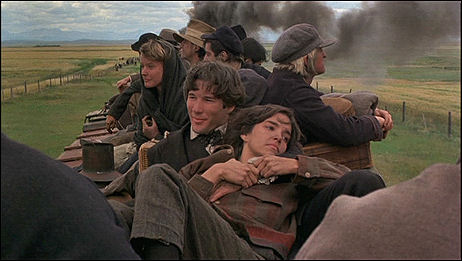
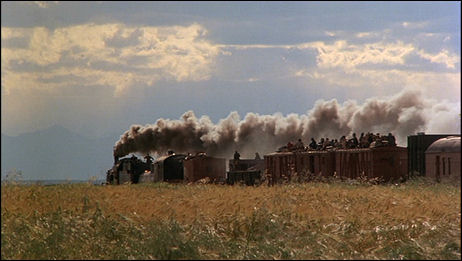
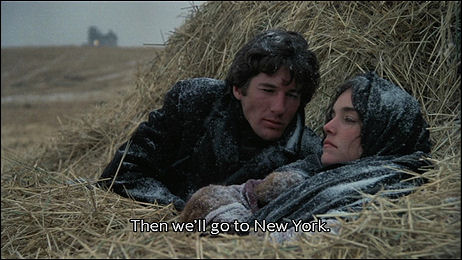
Having now seen the wonderfully vivid and deeply affecting Criterion Collection DVD of Terrence Malick‘s Days of Heaven, it needs to be said that Criterion producer Lee Kline misrepesented the truth of what this DVD contains in a ridiculously over-amped piece that he posted on the Criterion website on 8.16.

With Malick himself presiding over the final tuning, Kline said the DVD images have been “deliberately unsweetened and “very different” from the previous version because Malick “wanted it to look as natural as possible.” Kline explained that Malick didn’t want the film to look ” too postcard-like” so the watchword during the color correction session was “not too pretty.”

With the “gold and the warmth” taken out, the transfer went “to a really different place” than previous versions,” Kline wrote, and the version that finally emerged was something “beautiful but boy, was it different! I told Terry people were really going to be pretty surprised by this new transfer, since it was such a radical departure from before.”

I saw Days of Heaven in 70 mm on the day it opened — 9.13.78 — at the Cinema 1 on Third Avenue, and the Criterion DVD took me right back to that transporting experience. This is how it looked back then, and should have always looked. And what a sound mix! The rumble of thunder and steam engines is just as strong, but the dialogue is easier to hear than it was way back when. (High-end, multi-channel sound systems in the ’70s were more about delivering “oomph” sounds.)

Maybe the version on 1999 Paramount Home Video DVD was a little warmer or richer, fine, but the defining difference between that eight-year-old disc and the Criterion version is clarity, sharpness and a more delicate rendering of the almost eerie natural beauty of Nestor Almendros and Haskell Wexler‘s photography — a feeling of Andrew Wyeth-y purity made all the more breathtaking by the careful application of God’s natural light. Criterion absolutely needs to produce a high-def version.

Kline, no offense, is an idiot for thinking that fans of the film would be “surprised” by this transfer — it’s a God-send — and a serious boob for having written all that hooey on the Criterion blog, which he knew damn well would stir things up. Kline was trying to sell DVDs in the manner of a flim-flam man hawking stuff from the back of a horse-drawn wagon. I will never take anything he writes about a Criterion DVD seriously again.

Go to this DVD Beaver page to see a couple of decent frame-capture comparisons between the old Paramount DVD and the Criterion. Gary Tooze, the site’s hard- to-please critic, calls the Criterion “close to a must-own for film fans. The ground-breaking ‘magic time’ visuals are discussed in detail in the supplements and this adds to the package’s authoritative pluses. Tremendous DVD!”

Welkos, Thilk on red-band trailers

The best quote in L.A. Times reporter Robert Welkos10.26 piece about red-band trailers comes from Chicago-based marketing blogger Chris Thilk. Each red-band trailer, Thilk has written, becomes the “equivalent of sneaking a Playboy into junior high homeroom.” And the opposite effect kicks in when you try to shoehorn the essential appeal of an R-rated film into a “green” PG-13 trailer. “If you’ve got an R-rated movie and you’re creating a PG-rated trailer,” he tells Welkos, “I’m not going to say you’re misrepresenting the film, but you’re certainly watering it down.”

Universal guy fires back

Referring to that 12:18 pm item about the New York “Vulture” guys having removed Charlie Wilson’s War from the Best Picture hot-to-trot list due to rumors about extra shooting, a Universal publicity guy got in touch and set things straight.

“I wish you’d check in before perpetuating rumors. This isn’t studio spin: there were no recent or costly reshoots on Charlie Wilson’s War. Just didn’t happen. There were a couple of days reshot many weeks ago because of a weather impact in Morocco. And that was nearly fully covered by insurance. That’s it. Nothing more.

“This is some sort of manufactured thing that gets passed along as true. It ain’t.

“But even if it were true…good. Good for any director who is willing to keep working on a film and finding its best version. Better that than the filmmaker who thinks the first cut is a perfect and precious thing that shouldn’t be altered in any way. Shouldn’t a filmmaker use the time given to keep working, even if that means adding a couple of different scenes or takes? I don’t understand this rush to judgment about what reshoots mean.

“In any event — the Charlie thing is a myth…didn’t happen.”

For what it’s worth, I completely agree that having the option to augment or re-do with extra shooting is a very good thing that always results in improvement. (Unless it happens under the gun with no time to reassemble and refine, like with Factory Girl.) I always augment and rewrite my column stuff so I don’t see the big deal.

Poland vs. McLintock?

It’s now incumbent upon David Poland to scold and swat down Variety‘s Pamela McLintock for writing an assessment article about the tanking or underperforming of all those serious early fall dramas that’s more or less coming from the same place as that Rachel Abramowitz L.A. Times piece from two days ago.

Time, in other words, to explain once again that it’s all “a bunch of hysteria over a few films that didn’t catch in limited releases” and that “there’s no real story here” and “it’s business as usual when you take a real look at it.”

Yellowing with antiquity

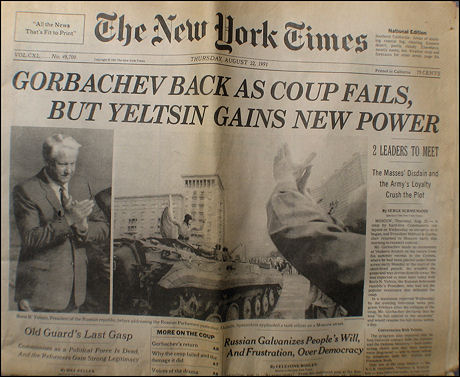
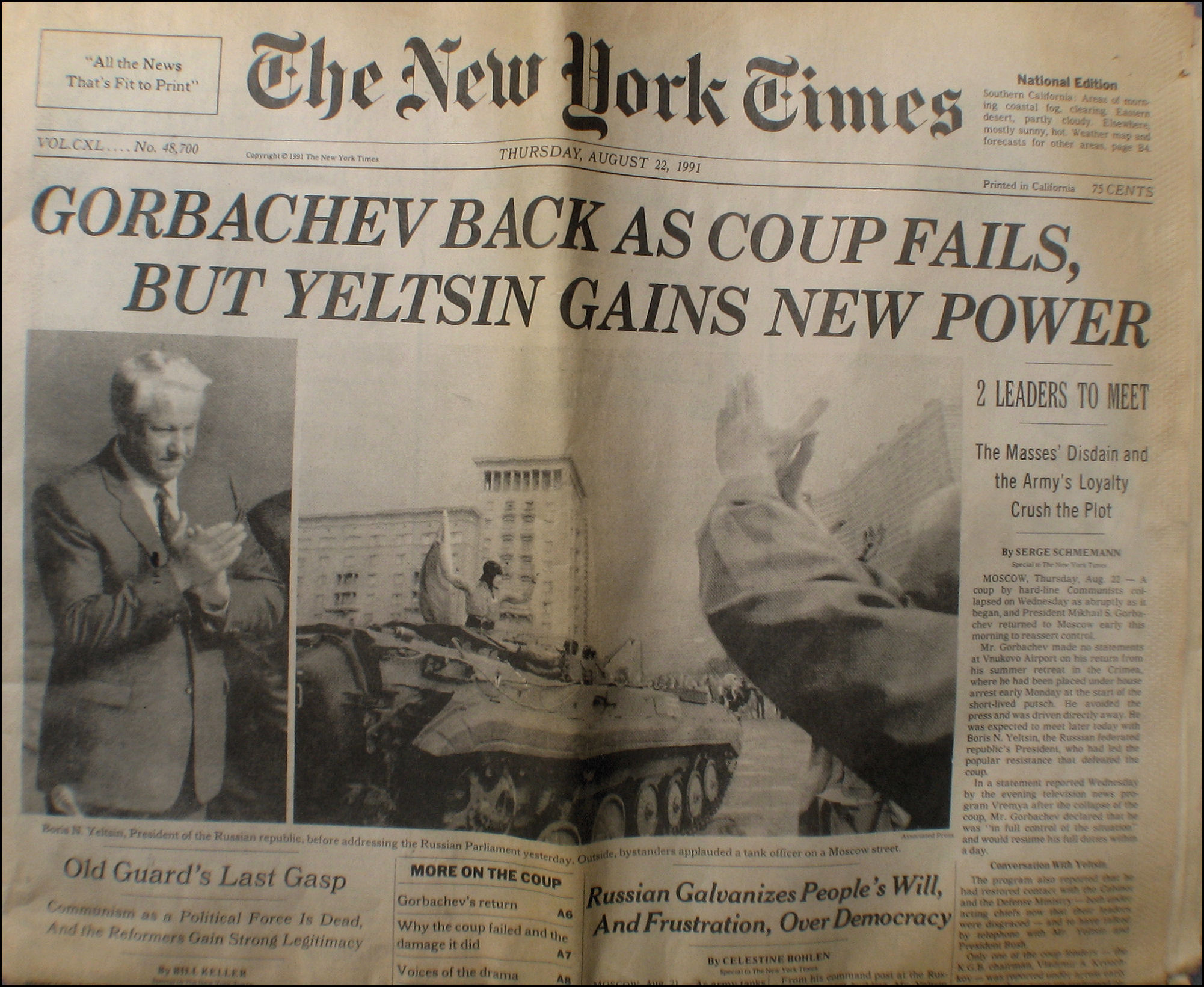
I’ve saved copies of newspapers reporting historic events for years, and I’m therefore accustomed to the tattered and sepia-toned effect that kicks in after a couple of decades. I was nonetheless a bit surprised this morning when I came upon this copy of the 8.22.91 issue of the New York Times — the failure of the old-guard communist coup, the triumph of Boris Yeltsin — and saw that it looks fairly yellowed and decrepit.


The bottom line is that I’m not quite ready for 1991 to be regarded as a long time ago

Gee…was 1991 that long ago? I guess sixteen years isn’t all that different from twenty, right? Odd little realizations like this kick in every so often and give you a sense of the clock ticking faster and faster along with an onrushing fate.

New York’s “War” cross-off

Yesterday New York‘s “Vulture” column did an odd thing with its Best Picture predictions list: it put a cross-out line through Charlie Wilson’s War because of the reports/rumors about extra shooting. A publicist friend told me last Wednesday that these supposed extra scenes (reports of which have been denied by Universal publicists) have cost many millions besides.

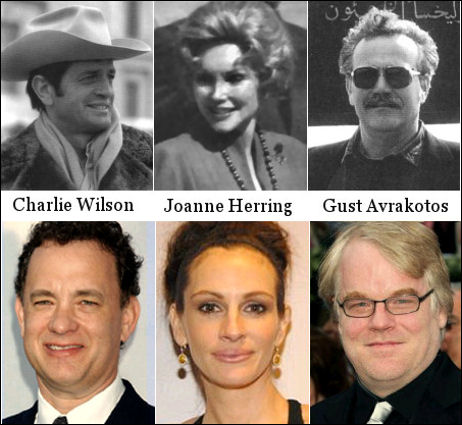
Last week I expressed a concern about the trailer making War seem a little too jaunty and glib — I’ve read the script and know that it plays differently. New York‘s cross-out makes it clear, however, that others have been unsheathing their knives and looking for ways to hurt this Mike Nichols film on general principle. Somehow, some way, a vague wolf-pack mentality has developed. I don’t understand why, exactly. The star-quality aura of Tom Hanks-Julia Roberts-Phillip Seymour Hoffman casting probably seems irksome to some. Let’s take down the big names, rub their faces in it, etc.

The other New York contenders are American Gangster, Atonement, Juno, Michael Clayton and No Country for Old Men. With all due respect and affection for Juno, I don’t think it’s quite as eloquent or touching or humanistic as Little Miss Sunshine. It’s a snappy and soulful film, but it’s a big reach to call it a likely Best Picture contender.

And I think that the New York guys are totally dreaming about Michael Clayton being a comer in this circle. Tony Gilroy‘s film is a very satisfying corporate thriller with a moralistic undertow, but it doesn’t have an across-the board resonance for you, me and your mother’s uncle. As some guy said to Kim Masters recently, it’s not “about” anything. By which they meant it doesn’t really deliver a theme. Or at least, not one that sticks to your ribs. If I’m wrong, please explain.

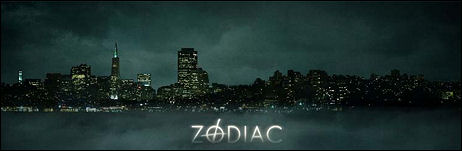
Two extra “Zodiac” scene

I tried to time the new Zodiac Directors’ Cut screener that I was sent a couple of days ago, and I failed. What happens is that you get so caught up in watching it that you forget about the damn running time. An extra five or six or seven minutes…what does it matter? I know that the extras don’t seem to stand out in a “whoa!…look at this!” sort of way. They just seem to belong, like they should have been there from the start.

That said, I have two favorites: (a) a new scene in which the San Francisco detectives on the Zodiac case (Mark Ruffalo, Anthony Edwards) orally explain all the incriminating evidence and indications against Arthur Leigh Allen to a superior officer over a voicebox, and (b) the five-year passage-of-time sequence in which various TV news reports and songs of the era are heard over a black screen.

Here’s an mp3 of the evidence recitation scene.

I love these sequences — they definitely add significantly to the whole — and they don’t take up very much time so why the hell weren’t they included in the original theatrical cut? It makes no sense to have cut them out…none.