Counter-buzz kibboshings

The Envelope‘s Mark Olsen has thrown together a mildly amusing riff on how an award-quality performance can be countered-buzzed or kibboshed by another high-profile performance given by the same actor or actress in the same year that isn’t as widely admired.


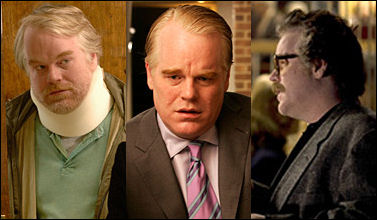
Philip Seymour Hoffman’s performances in The Savages, Before The Devil Knows You’re Dead and Charlie Wilson’s War overlap to some degree, but they don’t (or won’t) tarnish each other in the slightest.

The best-known example of this syndrome, he notes, is the case of those Norbit billboards having killed Eddie Murphy‘s shot at winning the Best Supporting Actor Oscar for his Dreamgirls performance.

Olsen lists 14 possible scenarios that might result in another Murphy-like tumble, but no one in the running for any acting award has a low-rent stinker like Norbit in the wings. Olsen has mainly listed actors and actresses who’ve given two or three strong or distinctive performances in ’07, which may have voters dithering over which was was superior, and in what category the best one belongs. Nice try, but the analogies don’t fly.

Why people cry

All film journalists and critics are obliged to write at least one essay about why people cry at movies. Today, Washington Post critic Desson Thomson wrote his. He doesn’t expose his personal soft underbelly, though, and that’s what you’re supposed to do when you write these things. Unload, let it out, confess.

For me, unleashed emotion in the womb of a movie theatre is about as primal as it gets. I’ve had many, many more emotional floodgate moments in a theatre seat than I’ve allowed myself in real life. (Most guys tend to keep things in check when someone’s watching, even trusted friends or family members.) As Thomson says, “Guys will cry only if someone squirts Mace directly at their eyeballs.” In public, he means.

Thomson’s best quote is from Mary Beth Oliver, a Penn State University communications professor and researcher of the effect of media on humanoids. Films that make us cry, she says, “cause us to contemplate what it is about human life that’s important and meaningful. Those thoughts are associated with a mixture of emotions that can be joyful but also nostalgic and wistful, tender and poignant. Tears aren’t just tears of sadness, they’re tears of searching for the meaning of our fleeting existence.”

In my most recent movie-crying piece (which ran in ’02 or ’03), I said that most guys “choke up over loss. Stuff you once had in your life (a girlfriend or wife, a beloved dog, naivete) that’s now gone and irretrievable.” (This thought actually came from Owen Wilson, who was picking up the phone back then.)

My biggest proverbial meltdown is still watching the ghost of Gordon MacRae singing his apologies to the live Shirley Jones in Carousel (1955). Talk about loss. His Billy Bigelow character blew it when alive and now he’s stuck in a kind of 20th Century Fox sound-stage purgatory, and to make matters worse his genetic code and lingering reputation are helping to screw things up for his teenage daughter….whew.

I also tear up at my idea of happy endings. Old Rose returning to her youthful form as she returns (possibly at the instant of her death) to the Titanic’s grand staircase to say hello to all the people who went down with the ship.

Or when Willem Dafoe‘s Nazarene realizes he hasn’t betrayed his destiny and is suddenly back on the cross in Martin Scorsese‘s The Last Temptation of Christ, and rejoicing over this. That moment when he slips away we hear that cosmic sound of Arab women doing that high-pitched yodeling thing as the image recedes into blinding white, like the film is running off the reel and going into the leader…man, I just fold.

I just remembered something a friend said to me when in my 20s. It has nothing to do with movies, but I’ve never shared it before. The friend was telling me about his very first time in bed with his girlfriend, whom he was totally in love with at the time. He said, “The sex was so good, I cried.” I’ve never heard that line since — not from anyone I’ve known or spoken to, and not in any movie, book, play, poem, song lyric or nightclub act. I didn’t believe him, of course — he was trying to amuse — but I felt the residue of it. If you don’t know what he meant you haven’t lived.

Avary discusses “Beowulf”

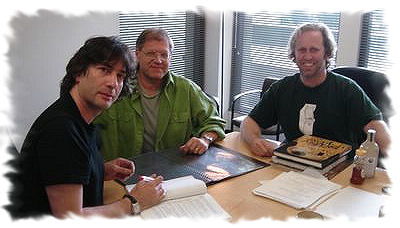
Beowulf producer and co-write Roger Avary, just back from the film’s London premiere and international press junket, called to debate the ongoing Beowulf animation issue as I was editing the Paul Thomas Anderson interview earlier this afternoon.


(l. to r.) Gaim, Beowulf director Bob Zemeckis, Avary

I brought up the fact that basing animated human images upon live-action footage — a Beowulf speed-bump issue for some — is a technique that goes all the way back to Disney’s Snow White and the Seven Dwarfs. As I understand it, Disney animators used a primitive form of rotoscoping to make the body language and some of the features of Snow White, the evil queen and the handsome prince seem more life-like.

I said towards the end of our chat that a critic friend who hasn’t seen Beowulf confided he wasn’t looking forward to the 3D headache syndrome, which Beowulf‘s IMAX 3D process is absolutely free of. Avary agreed that previous 3D films (the 3D Spy Kids, for one) have definitely been a little rough in this respect. I suggested that the Beowulf newspapers ads should promise a relief from this in so many words — “No headaches!”

Anderson interview

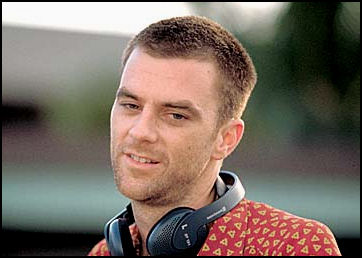
There Will Be Blood director-writer Paul Thomas Anderson called a couple of hours ago to chat about the film. We spoke for about 25 minutes. I threw out some half-decent questions and did what I could to keep my obsequious impulses in check. Anderson has a shy, circumspect way of putting things. It’s axiomatic that most first-rate directors will shy away from “selling” their film or trying to explain it in any kind of relentless detail. But it was exciting to get a word in and run it all down as much as possible.

Anderson and Blood stars Daniel Day Lewis and Paul Dano will discuss the film and their work following a special WGA theatre screening this evening. A reception will follow.

Ryland on “There Will be Blood”

“The horror that is Paul Thomas Anderson‘s fifth feature, There Will Be Blood, is not simply an amplified feeling of distress but distress itself: a seething perpetual pressure, unremitting, brutal, always on the brink of eruption,” writes House Next Door contributor Ryland Walker Knight (excellent name!).

“Yet the threat (or the promise) of the film’s title is a mere hint of the lurking, bubbling terror within. More pointedly, the title — written in a skuzzy, white, printing press Old English across the width of the film’s opening black screen — is the film’s first trigger pulled to wring its audience anxious and uneasy for a terse, dire, cunning two hours and forty minutes.

“Flipping Punch-Drunk Love on its ear, There Will Be Blood‘s operatic score (composed, by Radiohead’s Jonny Greenwood, of dissonant string arrangements and odd percussive rhythms aping Kubrick’s favored Penderecki and Ligeti) amplifies the tension of the film not for a flow of delirious hilarity but for a knotting of orchestrated discomfort. This film denies the release laughter allows. This film will beat you down, bury you under its weight. But your beating will be beautiful.

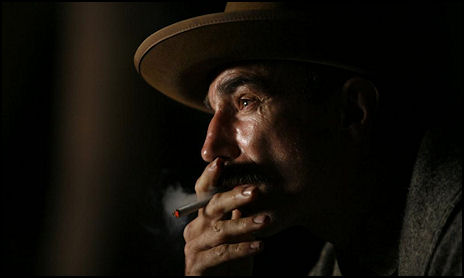
There Will Be Blood “bears Anderson’s signature throughout. There’s the father-son melodrama, the stately and gliding camerawork, the fear of people, and even a few discomfiting wink-jokes at the audience. Most of all, though, there’s Daniel Day-Lewis, covered in crude oil, raising his arms like a conductor to signal the explosion to begin. It’s terrifying, invigorating, phenomenal. I fear I’ve said too much already.”

Knight ran his review after catching last Monday night’s benefit screening of There Will Be Blood at San Francisco’s Castro theatre.

Lowdown on “Magorium” blockage

Two days ago at the Denver Film Festival a trade critic called to say he’d been told by a Fox rep he would be physically blocked from a public festival showing of Mr. Magorium’s Wonder Emporium (Fox Walden, 11.16). I ran an item about this late Saturday afternoon I was told this morning by Fox Walden spokesperson Jeffrey Godsick that the incident was some kind of misunderstanding, that an “overzealous” festival rep had conveyed the physical blocking threat (“a weird little thing“) and not a local Fox rep, that the film has in fact been screened for certain critics including Richard Roeper and Michael Wilmington, and that the film was screened for junket press last weekend so no one’s hiding anything.

Denver Film Festival media relations chief Britta Erickson also called to explain that “neither the festival staffers nor Fox reps would have physically blocked any critic from seeing the film” and that Saturday’s festival screening was “a great event for families and children, as it was a benefit for Toys for Tots.”

Godsick said there had been an expectation that trade reviews would be held until the day before the 11.16 opening, and that yesterday’s review by Variety‘s Brian Lowry was posted because Variety took the appearance of Magorium quotes in Sunday newspaper ads as a green light to run their own review.

Lowry called Magorium a “genial and G-rated fantasy from screenwriter/first-time director Zach Helm (Stranger Than Fiction) that sprinkles in charming moments but ultimately doesn’t evoke enough wonderment to overcome its tongue-twisting title and completely win over adults along with kids. Given the dearth of quality family fare, Fox and Walden might drum up nice business, but holiday shoppers at this emporium should be advised that the merchandise is limited in scope and ambition and thus more suited to the specialty realm than franchise-oriented spectacle.”