Coen Brothers gag reel

Time magazine is running an article that summarizes the ten best moments from various Coen Bros.films over the last 22 years. It’s a decent appreciation, but as I happened to notice the piece on Sasha Stone‘s Awards Daily earlier today, I couldn’t help but notice Greg Gingold‘s Coen Brothers gag reel video that Stone included as visual filler.

Gingold’s reel is a typically shallow thing — rapid-fire clips aimed at snagging the attention of infants and cultural primitives. The Coens have always had a distinctive visual sense, of course, but to me the words “a Coen Brothers film” has always meant extremely well-crafted dialogue and sardonic hipster humor that’s vaguely misanthropic. They’ve often gone for madcap cleverness, but they’re extremely careful photographer-editors who are just as much about balance and formal framings — a kind of John Ford-Sergei Eisenstein composition sense.

No awards-show writers?

Susan King posted an interesting Envelope piece yesterday (11.10) about the impact of the writer’s strike upon the various awards show, if and when it continues into January and February — the Oscars, Golden Globes, DGA and WGA awards and Film Independent Spirit Awards. The patter on some of these shows is bad enough as it is (the Globes especially) but can you imagine how grotesque these shows will seem without guild writers chipping in at least an occasional decent joke? This more than anything other presentation issue should force a settlement before New Year’s Day or soon after.

Tom Cruise’s big boast

“I wear jeans, socks and a shirt — all totally normal,” Tom Cruise has allegedly told the Post-Dispatch. “I get my hair cut on set. I have no iPhone, no mobile, no email address, no watch, no jewelry, no wallet.”

I believe 80% of that statement. The “no wallet” and “no mobile” is bullshit. Everybody carries a driver’s license and a couple of cards around — you have to. (I’ve seen photos of Cruise driving a motorcycle down Robertson Blvd.) And Cruise expects people to believe that if he’s with his daughter and God forbid an emergency were to happen, he’s not going to have a cell in his pocket so he can call an ambulance or the police?

Any guy saying “I carry nothing in my pockets” is actually boasting that he’s got so many security guys and kiss-ass assistants watching his every move that he doesn’t need to do anything except “be.”

Forget Ben Foster

Someone take Salt Lake Tribune critic Sean Means aside and quietly explain that Ben Foster is an almost certain no-go for a Best Supporting Actor nomination for his psycho-wacko bad guy in 3:10 to Yuma. There are three reasons why, and if you can’t remember them just have Means read this item.

One, Foster has built his relatively young career out of playing nutters with glaring eyes and arterial neck veins pumping furious red plasma, so it’s not a big deal that he’s done it again in a gunslinger vein.

Two, Foster let his makeup person gunk his face with too much soot and ash for the final shootout scene — he should have said, “C’mon, man…you’re making me look like I’m an actor wearing grungeball makeup just to make the point that I’m the kind of gunslinger who bathes only once a month instead of…you know, a real gunfighter! It’s arch and distracting.”

And three, Javier Bardem‘s No Country for Old Men Anton Chigurh is way scarier and creepier than Foster’s bad guy, and I really can’t imagine people saying, “Well, Foster’s nutter wasn’t as good as Bardem ‘s but he does the boiling-rage, thyroid-condition thing pretty well so what the hell…let’s nominate him.”

Reilly gives the finger

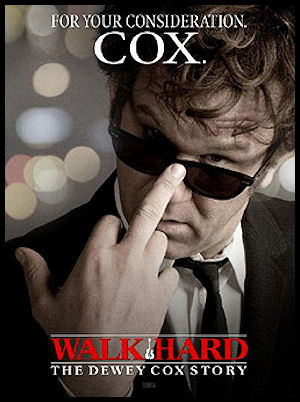
Saw this on Kris Tapley‘s Red Carpet District, snickered, wondered what it actually meant, smiled, thought it over, reminded myself that John C. Reilly‘s character didn’t seem all that rude or insolent in the product reel I saw, decided it’s a good sell-job regardless, etc.

Baumbach and “Margot”

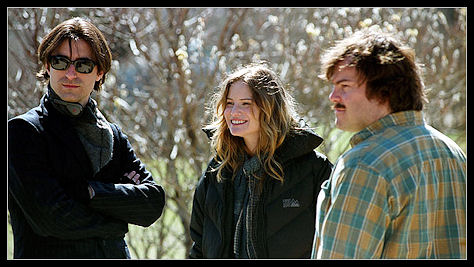
In his N.Y. Times profile of Margot at the Wedding director-writer Noah Baumbach, Dennis Lim notes that Baumbach has always “specialized in characters whose verbal acuity outstrips their emotional maturity. In Margot at the Wedding, family members use information as a weapon, disguise cruel judgment as insightful concern and extend or withhold intimacy as part of a power game.

“It’s a family where if you show your belly, people are going to pounce,” Baumbach tells Lim. And, Lim says, no one pounces as often or as recklessly as Nicole Kidman‘s Margot, a seething bundle of anger and self-loathing who swings unpredictably between aggressive and passive-aggressive attacks.

“Margot is me at my worst, probably,” Baumbach says. “I try not to analyze the characters when I’m writing, but I’m very analytical in my life.”

But perhaps too analytical as a dramatist. At least as far as a clan of serious Deliverance-style creeps living next to Margot’s family of malcontents (Kidman, Jennifer Jason Leigh, Jack Black, et. al.) is concerned.

Make no mistake — Baumbach has created a family of foul people who treat their kids harshly, slaughter pigs in their front yard, dump garbage on their neighbors’ lawn and demand that a beautiful tree near their property be cut down. Worst of all, they have a teenage son (maybe 14 years old) who attacks Kidman’s young son and by all appearances is a malicious hillbilly monster. There’s no way to avoid despising these people and not wanting the good guys to stick it to them in some way, and yet Baumbach never writes a confrontation or payback scene of any kind. He presents us with malignant fiends and yet he lets them skate. This is deeply unsatisfying.

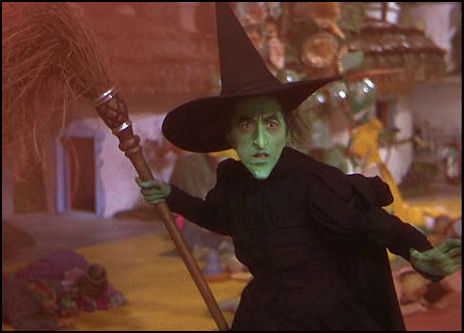
Imagine The Wizard of Oz in which Margaret Hamilton‘s Wicked Witch of the West (i.e., Miss Gulch) isn’t melted to death when Dorothy douses her with water. And yet this is what Baumbach gives us in Margot at the Wedding.

“No Country” prospects

The Envelope‘s Tom O’Neil is wondering if No Country for Old Men is as much of a lock for Best Picture nominee status as it seems to be this weekend, with the 95% and 94% positive ratings on Rotten Tomatoes and Metacritic, respectively, and its impressive $41,000 screen average in 289 situations. O’Neil figures it may be a “testosterone rush” critics’ favorite, by which he means…what?…it’s not emotional or “musical” enough, and because some are flummoxed by the ending?

It’s not really a testosterone movie at all, Tom. Testosterone movies can be stupid or smart (The Bourne Ultimatum), but NCFOM has a refinement that sets it apart. It’s a master-class exercise is delivering an art film disguised as a chase thriller. Simians looking for hormonal-surge excitement can do much better elsewhere. It’s very rare for a film to be as calm and unhurried as this one is — that’s the key element, I think. No Country delivers high-level existential dread and Hitchcock-level suspense, but it doesn’t seem the least bit hurried or anxious about whether it’s doing it “right” or if the apes are getting twitchy during the meditative moments.

The more times I watched the finale of No Country for Old Men, the more I see something exquisite and deeply profound. Tommy Lee Jones has been a Greek chorus lawman all through it, observing rather than affecting the course of events, and the whole central theme is about longing for the old days…the days of decency and trust and old-timers doing the right or caring or considerate thing with friends and strangers alike. “The old days were better” is a romantic pipe dream, of course, but that’s the central current in this film. What has happened to this country? What is this malignant scourge as represented by Anton Chigurh?

Jones passing alone the particulars of a dream he had the night before about he and his dad being on horseback in some cold and barren area, and how he always knew his dad would doi what he could to protect and care for him. “And then I woke up.” I love, love, love that the Coens hold on Jones’ face after he says this, and then cut to Tess Harper staring at Jones across the kitchen table, and then back to Jones before cutting to black. Jesus Christ, what a dead-perfect moment that is.

In a way this finale is a kind of spiritual companion to the very last scene in the Oscar-winning To Kill a Mockingbird, particularly Scout’s final line of narration: “He would be in Jem’s room all night, and he would be there when Jem woke up in the morning.”

Sunday box-office

With Saturday’s figures now in, one will argue with the concept of Fred Claus being a major flop, especially in relation to cost. The total weekend projection for the Warner Bros. release has been lowered to $17,781,000, or about $2 million less than Friday’s projection. A popular family film usually gets a bump of about 50% on Saturday, but Claus only went up about 20%. It’ll be a push to make $50 million on this thing, which won’t begin to match the combined production and marketing costs. Plus it stannds a good chance of suffering a drop of over 50% next weekend (11.16) with Mr. Magorium’s Magic Emporium expected to snag a large piece of the family trade.

The problem is Claus star Vince Vaughn, whom the family audience apparently sees as an R-rated motor-mouth (the Wedding Crashers persona) and therefore not kid-friendly, even if he’s portrayed as a grinning 8 year-old riding around on a kid’s tricycle in the one-sheet. WB marketers tried but couldn’t sell Claus to big enough portion of the family audience. A guy told me he went to see it yesterday and saw a few parents and kids but mostly twentysomethings. Yesterday’s haul was $7,600,000, which was up about 20% from Friday.

Oh, and the per-screen average for No Country for Old Men is $41,000, which translates to a total weekend tally of $1,151,000. A sensational opening, to say the least. Of course, the Coen Brothers film is playing to hip urban audiences. No one knows what will happen when it starts playing for the dumb-asses in Redville on 11.21.

Dead Claus Postcript: Variety‘s box-office story projects an estimated $19.2 million — very optimistic! (“Christmas movies are a marathon, not a sprint.”) MCN’s Len Klady has estimated $18.5 million. A friend who knows this game pretty well is predicting the low 18 range.

Daniel Day Lewis by Lynn Hirschberg

“While Daniel Day-Lewis may appear a bit rough, his demeanor is courtly,” writes N.Y. Times profiler Lynn Hirschberg. “You have to possess something utterly to push it away, and whether it’s his extreme good looks, which he obscures beneath the trappings of a bohemian pirate, or his cultured background, which he disparages, Day-Lewis has an intense attraction to the opposite of whatever he came by easily.

“He is particularly compelled by the idea of spontaneity, but there is nothing sloppy or haphazard about him, and that lends Day-Lewis, despite his careworn clothes, a quality of grace. He is most voluble and passionate on the subject of film. He loves even bad movies and likes to analyze the work of actors past and present. Day-Lewis reveres the greats — Brando, DeNiro — but he is intrigued by all kinds of performances. He dislikes John Wayne, loves Gary Cooper, prefers the Jimmy Stewart of Capra’s classic pictures to the Stewart of Anthony Mann‘s westerns and is fascinated by Clint Eastwood.

“‘I used to go to all-night screenings of his movies,’ Day-Lewis recalls. ‘I’d stagger out at 5 in the morning, trying to be loose-limbed and mean and taciturn.’ He paused. ‘My love for American movies was like a secret that I carried around with me. I always knew I could straddle different worlds. I’d grown up in two different worlds and if you can grow up in two different worlds, you can occupy four. Or six. Why put a limit on it?’

Bardem and the stun-gun syndrome

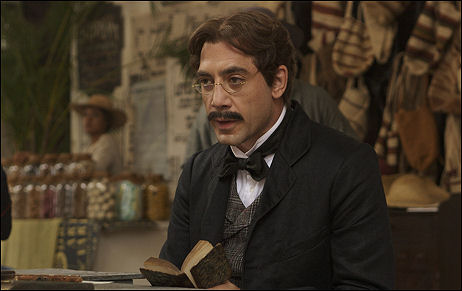
A critic friend who recently saw Mike Newell‘s Love in the Time of Cholera (New Line, 11.16) said that in the wake of No Country for Old Men that it was difficult to fully accept Javier Bardem as Florentino Ariza, a romantic-minded guy who’s conflicted but more or less normal. The critic said he had a hard time blocking memories of Anton Chigurh. Ariza is about sadness and unrequited love, but the critic couldn’t stop thinking about that gas-powered stun-gun.

I’m sure this is temporary, but what other actors have been so indelible in a certain role that critics and audiences have had trouble buying them as anyone else?

I’ve been hoping to avoid seeing Love in the Time of Cholera. A little voice has been telling me I’m going to hate it. (The critic didn’t care for it much.) But it’s the closing-night screening at the AFI Film Fest tomorrow night. It’ll be derelict of me not to see it. I need to grim up and get it done.

Read more

Strongarm “Magorium” tactics

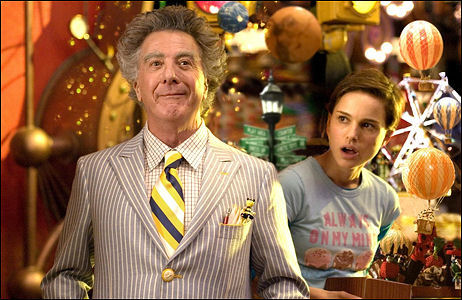
Mr. Magorium’s Wonder Emporium (20th Century Fox, 11.16), directed and written by the once-hot Zach Helm and costarring Dustin Hoffman and Natalie Portman, is a family film that most likely blows on some level. But I wasn’t sure how bad it was until I heard today that Fox publicists made it clear to critics (or at least one unnamed critic I spoke to) that they would physically block them from attending today’s 2 pm Denver Film Festival showing at the Ellie Caulkins Opera House.

The ticket-buying public was free to attend the showing. There was an ad promoting it in a local Denver paper. But when this critic asked about attending the show, he was told “forget it” by the local Fox rep. But it’s a film festival open to the general public, he argued. Anything that shows at a film festival is fair game for critics — those are the rules. The Fox rep was adamant — no entry for critics. “Does that mean you’re actually going to physically block me for going in if I have a ticket?” the critic asked. Yes, the Fox rep said. We will physically block you.

When was it exactly that 20th Century Fox — big Fox, not Fox Searchlight — became a goon studio? It’s SOP for studios to blow off press screenings of mediocre movies before the opening, but strong-arm tactics are something new. What if the unnamed critic had worn a wig and a beard and slipped through and then was recognized by the Fox goons? Would they tackle him? Would they use tasers? “Noooo….don’t taser me! No…aaaahhhh!”

The critic told me that the Denver Film Festival reps “are nice people…they’re caught in the middle of this.” Maybe, but they’re not very responsive. I e-mailed Britta Erickson, the festival’s media & industry relations director, three or four hours ago and no reply.