Synecdoche, Baby

There’s no way around saying that Charlie Kaufman, the director-writer of Synecdoche, New York, is a gloom-head. A brilliant and, in his past screenplays, hilarious one (by the standards of dryly perverse humor), but a gloom-head all the same. Who, for now, has put aside his sense of humor. The problem with his film, which I loved in portions, understood the point of and was intrigued and somewhat amused by in the early rounds, is the damn moroseness of it.
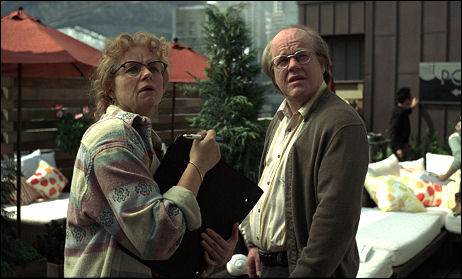
And the title is impossible. I would actually say commercially suicidal. I finally learned how to pronounce the damn thing — Syn-ECK-duh-kee — but if the folks who wind up distributing believe that average moviegoers are going to do anything but run in the opposite direction when this puppy opens, they’d best think again. Titles should always convey something that your average dumbass can understand — this one doesn’t. And they sure as shit can’t be tongue-twisters on top of this.

I nonetheless said to myself during the first 50 minutes or so, “This is my kind of deal.” Okay, maybe into the first hour. Smart-guy material, wise and witty, at times almost elevating, at times surreal, performances that strike the chords just so.
But it began to wear me down. I could feel my interest ebbing. This had something (okay, a lot) to do with the archness and obsessiveness of the characters caught up in various fickle head trips and never saying “uncle.” I didn’t hate what was going on — it’s an imaginative Alice in Wonderland-type thing — but I found myself wishing nonetheless that all these dithering neurotics (Caden especially) would get over themselves and…I don’t know, go rob a bank or move to rural China or something. The story tension in Synecdoche, New York is zilch.

And later with the shots of pink urine and bloody stools sitting in the toilet. I don’t care how lame this makes me sound, but I’ll put up with no more than one human waste shot in a film. Here there are three.
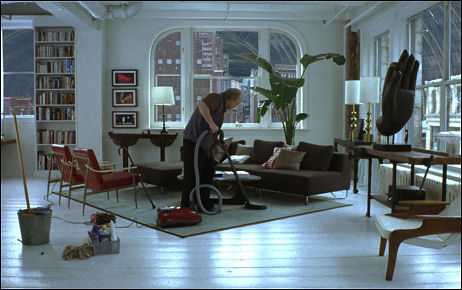
Kaufman doesn’t do “comedies,” per se, but he should have (and could have, if he were so inclined) made it all funnier. And a bit shorter. In the realm of, say, 110 minutes rather than the 124-minute version shown in Cannes.

This might sound like a thoughtless suggestion for a film that follows its characters for a good 30 or more years, staying with them into old age and serious decreptitude. I only know that for all the rich ideas and fully worked-out totality of it, for me it started to drag big-time.

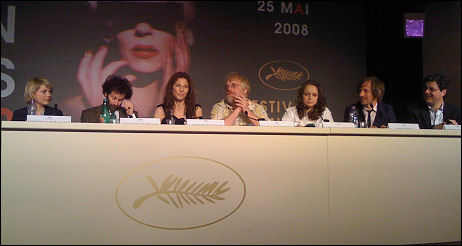
Kaufman said at the post-screening press conference that he began writing it in response to feelings of oncoming decay and death. That’s what 49 year-old gloom-heads do, I guess. They’re most likely looking at another 35 to 40 years of life, if not more, but they feel threatened about the depletion of the organism and the curtain coming down.
The shorthand buzz before Friday’s screening was “quality material, tough sit.” I was intrigued and semi-into what it was doing, but I didn’t and couldn’t submit like Kaufman wanted me to. That said, it’s certainly worth a tumble. Only two hours and four minutes of your time, and a promise of at least some satisfaction.

I was especially wowed by a sermon scene that happens sometime in the last third. It’s just some young bearded clerical letting go with the gospel according to Kaufman (we live in a gloomy, fearful universe), but the way it was written and performed made me feel alive and re-engaged.

After the press conference I asked Kaufman and producer Anthony Bregman if I could be sent a copy of this speech to give HE readers a taste of what’s really good and special about the film. Kaufman passed me along to Bregman, who said, “Do you have a card?” No, I’m cardless, I said, but you can easily send me the dialogue through the website. I knew then and there I’d never hear from him. If anyone has a copy of the script, please get in touch.
Caden (Phillip Seymour Hoffman) is a 40ish upstate New York theatre director who’s married to Adele (Catherine Keener), a successful miniaturist painter. They have a very cute little daughter (Sadie Goldstein) named Olive, who doesn’t slightly resemble either of them. Naturally.

As the story begins, Caden is becoming more and more alarmed at signs that serious diseases (or intimations of same) may be shortening his life. His marriage seems like a typical union — relatively stable, shuffling along, both parties depressed, he with a girlfriend (Samantha Morton‘s Hazel) on the side. But Adele can’t hack his gloominess. She flies Olive to a Berlin gallery showing with her friend Maria (Jennifer Jason Leigh) and never returns.

Caden soon after is handed a genius grant, and decides to stage a massive atmospheric theatre piece inside a super-hanger-sized structure that houses a scaled-down replica of Manhattan. The subject is Caden’s own life. He casts actors to play himself and all the people closest to him. So by the halfway mark there’s a duplicate Caden (played by Tommy Noonan), a duplicate Hazel (Emily Morton), a duplicate Lucy (an actress character initially played by Michelle Williams) and so on.

Caden rehearses and rewrites for years on end, but the piece is never performed for the public. They wouldn’t get what’s going on anyway, right? Keep things hermetic. Process is all. But there I was watching it, realizing after a time that there was no escape from the hangar, and wishing more and more that something else would happen. A visitor who isn’t in the play upsetting the apple cart, say. Or a 747 crashing into the hangar and blowing it all to hell.
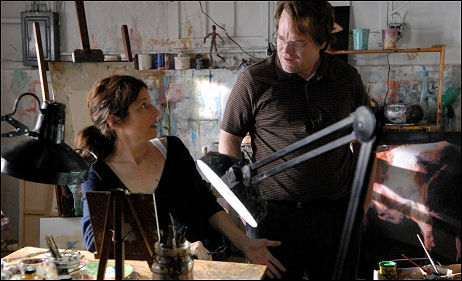
And yet I was never exactly bored. In a way it’s a riff on Federico Fellini‘s 8 and 1/2. It’s been 45 years since that landmark film. Isn’t it good for our collective moviegoing soul to wade through such films now and then? Then why am I mostly pissing on a film made by a guy whom I’ve enjoyed and admired for many years? Because I’ve always gotten a sardonic kick from Kaufman’s screenplays, and this one took me into the Realm of the Bright but Dispiriting Bummer.

In his Synecdoche, New York review, Cinematical’s James Rocchi wrote that “there are some dreams where we awake perfectly clear as to how the pieces and parts of our nighttime vision matches up to our waking life, and there are other dreams where we simply blink, and dismiss them as nothing but crazy talk; Synecdoche, New York is more like the latter kind of dream, and that hurts the film. Its ideas are so fecund and fertile and promiscuously perverse that we’re often left with a movie too slippery to grasp with the mind and too clever to claim with the heart.”

That says it pretty well, I think.

I asked a few journalists at last Friday’s Sony Pictures Classics luncheon which film they’d rather distribute if they had to choose one or the other — Synecdoche, New York or Steven Soderbergh‘s 260-minute Che. The latter, they all said. That’s saying something.
Spread It Around

Steven Soderbergh‘s Che, my choice for the most exciting and far-reaching film of the Cannes Film Festival, didn’t win the Palme d’Or this evening. Lamentable, dispiriting news. Instead the jury gave the coveted top prize to Laurent Cantet‘s justly admired Entre Les Murs. I was wandering around Montmartre when the news broke, and when I heard it I just swore to myself and put it out of my mind and kept waking. I didn’t have my computer with me and I didn’t care.
At least the gifted Benicio del Toro won the Best Actor prize for his portrayal of Che Guevara in the twin Soderbergh films.
Cantet has everyone’s respect, but to me his films have always seemed more quietly admirable than arousing. I’ve never gotten a lightning-bolt charge from anything he’s done. I just feel let down about this, knowing what a Palme d’Or win might have done to at least partly help Che‘s chances in finding the right U.S. distribution deal. I’m obviously thinking politically, and this just doesn’t feel right. Sean Penn and the jury members went with their idea of the best film of the festival, and that’s cool. Entre Les Murs will play at elite art theatres when it opens in the U.S. for two or three or four weeks. Connoisseurs of first-rate French cinema will pay to see it. Terrific.
Congrats to Matteo Garrone‘s Gamorra, which everyone liked for the most part, for winning the Grand Prix. And double congrats to Three MonkeysNuri Bilge Ceylan for winning the Best Director prize. A Jury Prize went to Paolo Sorrentino‘s Il Divo. Sandra Corveloni won Best Actress for her work in Walter SallesLinha de Passe, and the Best Screenplay award went to Jean-Pierre and Luc Dardenne‘s Lorna’s Silence. (Sorry, but I don’t agree with that one at all — the Lorna story did not end on a satisfying note.) The Cameras d’Or prize went to Steve McQueen‘s Hunger.
The jury obviously wanted to be magnanimous by giving a little something to everyone. They succeeded.

Showgirls Lives

In an interview with Margy Rochlin in the N.Y. Times, Elizabeth Berkley — now the host of Bravo’s new competition series Step It Up & Dance (Thursdays at 10 pm) — is again given the old Showgirls grilling. Naturally.
Rochlin notes that Berkley “has watched Showgirls go from a movie synonymous with Hollywood tastelessness to what some — most notably the French New Wave filmmaker Jacques Rivette — argue is a misunderstood art film about surviving in a coarse, venal world. ‘For something that was supposed to die on the video shelf, it certainly has had legs,’ Berkley said.”
Rivette’s Showgirls praise, found in this March ’98 Senses of Cinema interview with Jacques Bonnaud, are as follows:
“I prefer Showgirls (1995), one of the great American films of the last few years. It’s Verhoeven’s best American film and his most personal. In Starship Troopers, he uses various effects to help everything go down smoothly, but he’s totally exposed in Showgirls. It’s the American film that’s closest to his Dutch work. It has great sincerity, and the script is very honest, guileless. It’s so obvious that it was written by Verhoeven himself rather than [Joe] Eszterhas, who is nothing. And that actress is amazing!
“Like every Verhoeven film, it’s very unpleasant: it’s about surviving in a world populated by assholes, and that’s his philosophy. Of all the recent American films that were set in Las Vegas, Showgirls was the only one that was real — take my word for it. I who have never set foot in the place!”

Calamity Continues

Either David O’ Russell‘s currently-rolling Nailed “is horribly cursed, or Capitol Films is completedly busted, or both,” writes Deadline Hollywood Daily‘s Nikki Finke. “I’m told that IATSE today ordered its members off the political comedy because the crew haven’t been paid. There are no plans to resume filming until next Thursday at the earliest. This is the 2nd time IATSE has moved to protect its union members, but only after the Screen Actors Guild first sounded the alarm bell over Capitol Films’ cash crunch and instructed its actors to leave the set earlier this month.”

Ticked-Off Russkis

The actions of Cate Blanchett‘s Irina Spalko and her Russian henchman in Indiana Jones and the Kingdom of the Crystal Skull are, of course, “rubbish,” as St. Petersburg Communist Party chief Sergei Malinkovich has said. Are the film’s Russian dissers really this incapable of getting the pop-humor context? More likely they simply saw an opportunity for some press and ran with the indignation. Commies aren’t quoted that often these days.
√ɬ¢√¢‚Äö¬¨√Ö‚ÄúOur moviegoers are teenagers who are unaware of what happened in 1957 will go to the cinema and will be sure that in 1957 we made trouble for the United States and almost started a nuclear war…it√ɬ¢√¢‚Äö¬¨√¢‚Äû¬¢s rubbish,” Malinkovich has reportedly said.
Andrei Gindos, another party member, has called Blanchett and Harrison Ford “second-rate actors” who are “serving as the running dogs of the CIA. We need to deprive these people of the right to enter the country.”
I’ve always loved the imagery of the term “running dogs” but to this day I don’t really get it. How is the nature of a CIA lackey or stooge analagous to a dog in motion? Something lost in the translation.

Mad Bono

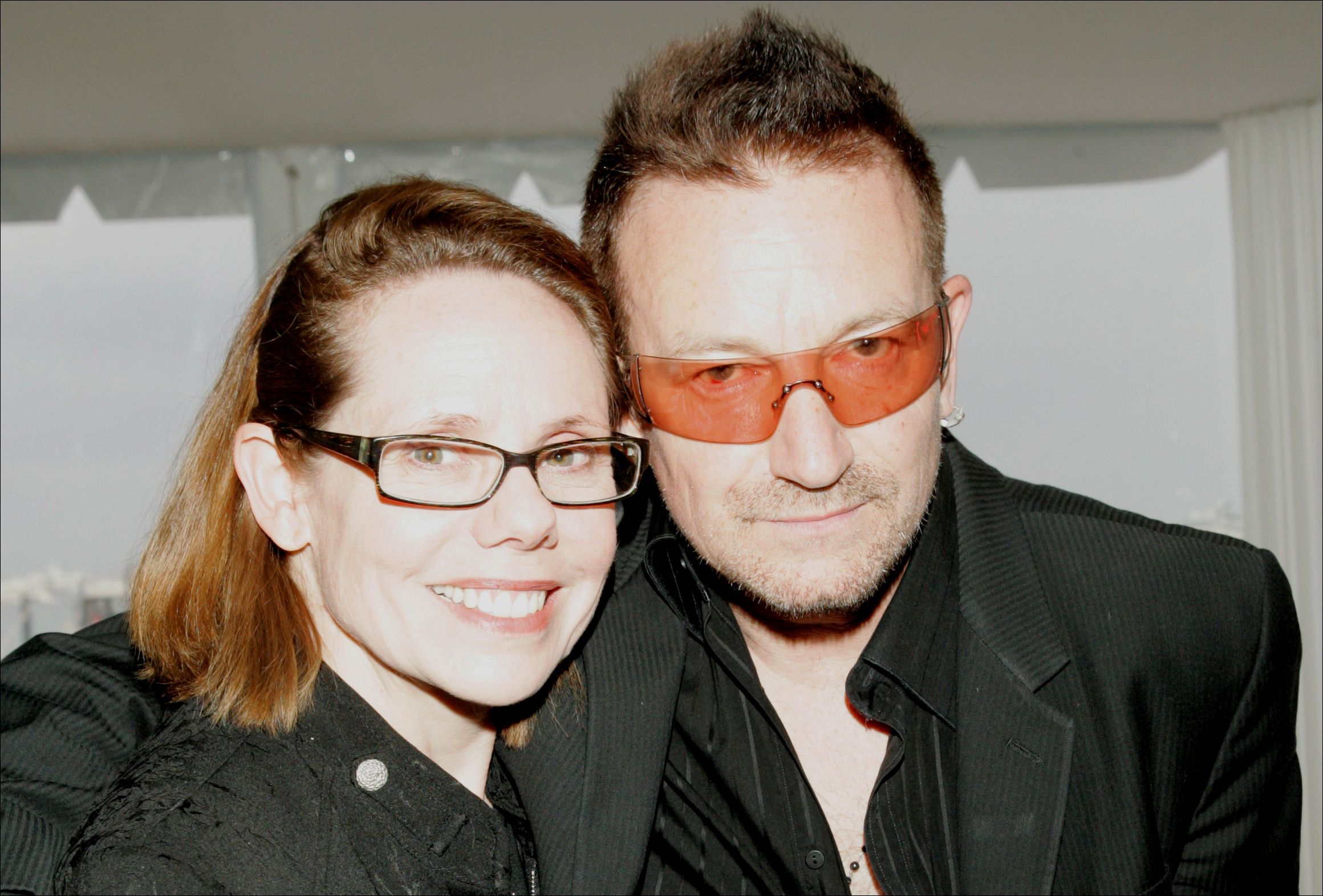
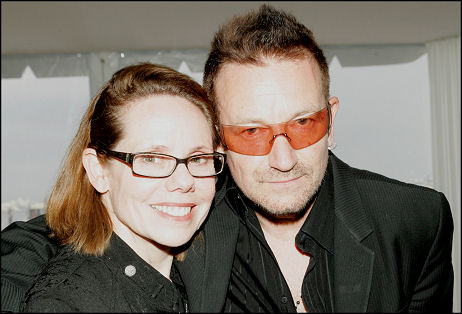
Variety‘s marketing chief Madelyn Hammond showed kindness to me during my lost baggage limbo during the Cannes Film Festival. I especially appreciated her giving me a couple of Variety T-shirts to wear plus a Variety umbrella. So here’s to a good friend — Madeline and Bono at the Creative Coalition party in Cannes that Variety sponsored last week.

Breathe In

After 10 or 11 straight days of whirlwind, 6:30 am-to-midnight Cannes Film Festival hammering, I had my first taste of relative calm and quiet today. The end of every big-time film festival demands at least a day of chill-down or else. All to explain that while I posted some stuff today, I couldn’t bring myself to write about Charlie Kaufman‘s Synecdoche, New York. Tomorrow maybe.


Saturday, 5.24, 2:35 pm.

Gospel of Il Divo

“Never overdramatize things. Everything can be fixed. Keep a certain detachment from everything. The important things in life are very few.” — former Italian Prime Minister Giulio Andreotti, whose political career, particularly the events that led to revelations about his ties to the Italian mafia and reported complicity in the murder of a journalist, is dramatized in Paolo Sorrentino‘s Il Divo.


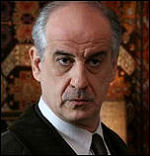
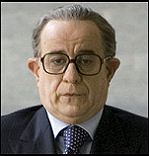
(l. to r.) Seven-times-elected Italian Prime Minister Giulio Andreotti; actor Toni Servillo; Servillo as Andreotti in Paolo Sorrentino’s Il Divo.

Wisdom, or a semblance of same, sometimes comes from very odd places. There’s nothing very admirable about the Andreotti portrayed in Il Divo — an uptight, coldly calculating Machievellian politician of the highest (or lowest, as the case may be) order. But since hearing the above lines during Thursday night’s screening, I haven’t been able to shake them. It’s almost become a kind of mantra to me. A way of fending off life’s unruliness that I’ve considered and agreed with in discussions from time to time, but hearing the above spoken by actor Toni Servillo (whose performance as Andreotti is somewhere between a marvel and a hoot) led to some kind of “aha!” moment.
Since Thursday night I have become, as far as this approach to life is concerned, an Andreotti convert of sorts. As far as dealing with life’s hassles is concerned. Be cool, don’t get all cranked up, there’s always a way through it. Call me Darth Implacable.
I seem to recall Oliver Stone saying something to the effect that the experience of making Nixon led him to admire or at least appreciate some of the virtues of Richard Nixon. The big-time politicians with the darkest souls have frequently passed along some very choice pearls, it seems. The wit and wisdom of Ferdinand Marcos, Josef Stalin, Pol Pot, etc.
Il Divo hasn’t a prayer of betting distributed in the States. As Variety‘s Jay Weissberg noted in his 5.23 review, the film’s “sole drawback is that non-locals will feel inundated by names, most of which are familiar only to Italo auds…this is a brave, bold film whose chances of international success are relatively small, but whose ramifications are huge.”
He called Il Divo “a masterpiece for Sorrentino…an intensely political film so wildly inventive and witty that it will become a touchstone for years to come. Pic features an astonishing degree of craftsmanship and a towering performance by Servillo.”
I knew I was seeing something intensely audacious and stylistically exciting, but the political arena it depicts is so dry and complex and wholly-unto-itself that gradually the film makes you feel as if you’re lying in an isolation tank. Most of the journos I spoke to after the screening expressed admiration for it, but at the same time confessed they weren’t all that drawn in, a result of the syndrome Weissberg described.

Che Needs It

The Village Voice‘s Jim Hoberman has called Steven Soderbergh‘s Che a “single-minded meditation on the practice of guerrilla warfare, the creation of militant superstardom, and the nature of objective camera work[that] is at once visceral and intellectual, sumptuous and painful, boldly simplified and massively detailed.
“Despite this, as well as a commendable performance by Benicio Del Toro, Che may require its own miracle — or at least a few angels — to reach an audience in the form Soderbergh intended. While the first half could certainly be tightened, the movie demands to take its time and be taken in at a single sitting. One can only hope that the world beyond Cannes will get the opportunity to do so at something approaching the original running time.”
One thing discussed yesterday about Che‘s chance of winning the Palme d’Or (but which I didn’t mention in my same-day riff about same) is that everyone on the jury knows that Che, in part because certain humbuggers are saying it’s not releasable in the U.S. in its current form, really needs the Palme d’Or to give it a psychological leg up. Which is why I suspect they’ll act accordingly.